Doing the same…

Recently I’ve been really digging into Project-Based Learning. My last three posts have all revolved around this. Often when I talk with people about a shift to more learning that is project-based, inquiry-driven, choice-based, and experiential, I get pushback asking for the research that backs it up. The truth is, there is a lot of support for this type of learning. If you want to do a deep dive into that research, check out this great post from A.J. Juliani on The Research Behind PBL, Genius Hour, and Choice in the Classroom.

If you take the time to read through that post from Juliani, you’ll find research on engagement and achievement, success stories from fellow teachers, ways that PBL is connected to standards, and some related reading. I’m thinking about this question of research because two authors that I follow both recently shared posts that questioned why we continue to do some of the same things in education. We’re so driven to think about what the research says about new practices, that sometimes we don’t look at what the research shares about the stuff we’re already doing.

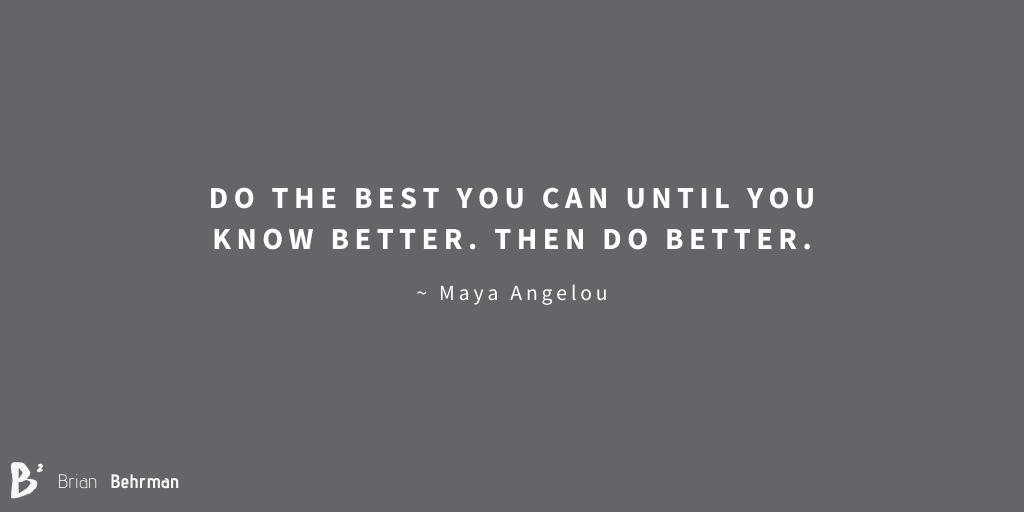
Before I get into that too far, here’s what I have learned. Research changes over time. Methods and strategies change over time. Things that were considered “Best Practice” in the past may not be true best practice anymore. And there are times we find that things that we thought were not a best practice have become one after further study. The other thing I’d say about best practice is that sometimes there are practices that we utilize that are pretty good, but when we learn that there are better practices, it might be time to make a shift. What is it that Maya Angelou says?
A recent post from Scott McLeod (here), and then a related post from AJ Juliani (here) both shared a link to this post from The Hechinger Report. As we spend time talking about transformative learning opportunities in our schools, I think the data that The Hechinger Report is sharing should drive us to think more deeply about why we do the things we currently do in education. Let me share some of the key points that stood out to me from this post.

As we all know, the No Child Left Behind Act of 2001 mandated that every student in the 3rd through 8th grade need to take an annual test to see who was performing at grade level.

In the years after the law went into effect, the testing and data industries flourished, selling school districts interim assessments to track student progress throughout the year along with flashy data dashboards that translated student achievement into colored circles and red warning flags. Policymakers and advocates said that teachers should study this data to understand how to help students who weren’t doing well. 

Anyone who’s in education probably has spent significant amounts of time in the past 20-ish years analyzing student performance on tests. Here in Indiana that might include the IREAD-3 or ILEARN tests. It might also include time spent poring over data from NWEA, or other formative assessment data within your district. So, here’s the question. If these tests are supposed to help us identify the students who need the most support, and help teachers adjust to meet the needs of those students, why do we continue to see the same learning gaps from many of the same demographic groups?

According to Heather Hill, a professor at the Harvard Graduate School of Education, “Studying student data seems to not at all improve student outcomes in most evaluations I’ve seen.” A review of research by Hill (found here) finds that in terms of student outcome, most of the 23 identified outcomes were unaffected, and of those that were affected, only 2 had positive impacts, and in one case the result was negative.

So, if the time analyzing student data (something that seems like it would be beneficial and impactful for students) isn’t having a positive outcome for students, we must ask the question, why?

According to these studies, teachers are using various assessments to identify content that they need to return to. Often, they then make plans to revisit those concepts using a combination of whole-group and small-group instruction. But we need to go a step further. We must take that data that’s been collected, along with what we know about kids, to deepen our understanding of how kids learn, identify the reasons behind misconceptions, and then adjust our instructional strategies.

If our strategy to support students on concepts that they are not currently grasping is to re-teach the topic the way we did the first time, hand the student a worksheet, or put the student on a technology-based program to practice, we’re not going to impact student learning. We can’t do the same thing again for a student who is struggling.

That is part of why I am on this path of pushing others to think about doing school differently. More inquiry, PBL, or design thinking will put our students in learning situations that are different. It forces students to move out of their comfort zone and to the growing edge. And that’s the reality – we all need to be a little bit outside of our comfort zone to grow. Trying new instructional strategies are going to force you out of your own comfort zone.

And I don’t want a takeaway from this post to be that we have been wasting our time with data-driven instruction, PLCs, RTI, etc. That work is valuable, but if that work doesn’t also change teacher instruction, the learning gaps are going to remain.

As McLeod closed his post, so will I: It is time we make schools different.

Developing a PBL Unit

Last week I was having a conversation with a teacher about planning for some Project-Based Learning (PBL) in her classroom. She said something to me that I think a lot of teachers might think when they hear the phrase “Project-Based Learning.” She shared that she wasn’t sure that she had the time to devote to project work in her classroom. And I think that’s what can be tough about moving towards project work. We hear stories about these amazing projects that spanned weeks or months, like the time some 6th graders at my previous school worked to bring ice cream to our school cafeteria (see a post about that here), or the long term project by a 3rd-grade class who noticed a big blank wall and felt like they could make something much more beautiful.

The reality is though, you don’t always have to have huge projects like this. Sometimes project-based learning may only take a day or two and be really focused on a specific skill. This post is going to dive into some ways you might think about the planning side of PBL. In my current school, our leadership team is working closely with a pilot team that will be launching a mini-PBL unit in their classroom in the coming weeks, and the process is related to what I’ll be sharing here.

So, let’s start with how you might kick off the planning process. The way I see it, there are a few different ways that you might begin on the path to PBL work. Here’s a list of a few:

  • Academic Standard or Unit of Study: You might be looking at a list of standards that are coming up, or a Unit that you have used in the past, and that may spark an idea for a project. In last week’s post (see it here), I shared a social studies project that started in just this way.
  • The End in Mind: As I’m writing this, President’s Day has just passed. What if we looked at our school calendar and said, “I want my students to be able to share something about…”? This could potentially work for any holiday (US or elsewhere), or for other things that come up on the calendar. You have a clear end in mind, and you backwards plan.
  • A Way of Thinking: Imagine that you want your students to learn more about something like mindfulness, or restorative practices. Or maybe you want something that ties more directly to a standard, so you want them to learn more about the scientific method or engineering process standards.
  • Something Awesome: Maybe there is something that you recognize your students being really excited about (this is how the mural above got started). It’s taking that excitement in the moment and running with it!
  • Student Ideas: You might recognize that your students are really interested in Minecraft, or a video game, or animals. Take that idea that they are interested in and help guide them!

Now, some of you might be saying something like, “But what about my standards!?!?” And I get it, ultimately, we are all beholden to our standards, but I guarantee you that with any of the ideas I listed above, we can find a few standards that we can tie in. If nothing else, you’ve got standards related to reading, writing, and research that can be connected to just about any project. That said, if you can integrate multiple subject areas, you have hit the pay dirt! I also often found that as we worked our way through a project, there would be things that came up that I needed to create a mini-lesson on. When I was teaching sixth grade, I had to create a mini-lesson on plagiarism after seeing kids cut a paste from some of their resources. In another project, we folded in a grammar boot camp to help with some of the grammar issues that were coming up. These were teaching moves that I made in the middle of a project as I recognized a need.

Once we have our starting point on the path to PBL selected, we next need to think about how we’re going to get to the endpoint. You might have students work towards a product – something that could be shared on a specific day, or at a specific event. Every student will create some type of product, but choices are made in how they get from the start to that product. Another option might be to start with a problem – maybe leading up to President’s Day you have a bunch of students asking why there isn’t school on that day. This could be our problem that we’re going to solve – we need to find out why President’s Day is a holiday, and then we could share our findings with our school community. Finally, you might decide to make the endpoint more open-ended. You might have your starting point, share with your students what it is that you want them to learn about or take away, and then allow them to pick a product that suits their needs.

I don’t necessarily believe that any one of these three methods is the best. I would say that it might be challenging for students to jump into an open-ended pathway if they have had limited project experience in their school careers. As with any creative task, our students will need some guardrails to help guide them. When those guardrails are too wide-open, some students struggle to even get started.

So, at this point, we have an initial idea, and hopefully a pathway we will be following. Now we need to select a few standards that may serve as the basis for your project, as well as some standards that may support the learning. In my past, when I was planning a PBL unit, I’d pull my upcoming standards and look for standards that are seeking a deeper level of understanding (words like apply, understand, or explain are good key terms to watch for). And again, it’s a great idea to try to find standards from multiple subject areas to be the key ideas. These standards can be the driving force of PBL. One thing to keep in mind though – if you try to pack too much into a single project, you begin to lose focus on the main point. While there may be several skills that you are able to touch on throughout the work, you should have one or two standards that are the primary focus of the project.

Once we have a couple of standards identified, we want to think about what we want our students to learn or be able to do because of this project. These are the takeaways we want to highlight. When I did project work with my students, I would share the takeaways with them at the beginning of a unit and would reiterate them throughout the unit. I always tried to make sure that this was in “kid-friendly” language that they could understand and describe to others. I would often also use these takeaways to create what I liked to call our guiding question. This question would boil all our projects down into one question. A couple of examples from past projects I carried out in my classroom include:

  • What are the planets and objects that make up our solar system?
  • What are some of the cultural achievements of Ancient Rome?

OK, so I know this is a lot, but here’s what we’ve got so far:

  • Starting point
  • Project pathway
  • Standards
  • Takeaways
  • Guiding question

One of the things I have noticed about PBL is that there are lots of different protocols out there. You can choose to pick one to guide your planning, you can decide to create your own hybrid of the ones that exist, or you could create something all your own. But to me, the items that are listed above are keys to the planning phase, no matter what you call them. Even with the work we’ve done so far, we aren’t ready to dive into the project yet. We must always plan for the end in mind. So next week, we’ll talk about the importance of assessment. When thinking about backward design, we need to plan our assessment before we begin teaching our unit. We’ll talk briefly about pre-assessment, formative assessments along the way, and some potential options for post-assessment.

So, what have I missed? Is there anything that you are still wondering about with the planning process? Let me know your thoughts in the comments below!

Doing a project, or project-based learning

I’ve been reading a book called Project-Based Learning: Real Questions. Real Answers. How to Unpack PBL and Inquiry by Ross Cooper and Erin Murphy, and I find myself reflecting on my past as an educator. As a science teacher for most of my career, I had a lot of opportunities for project work to happen in my classroom. But here’s the thing, I’m not sure that I was always achieving the full potential impact of project work. And I think the difference lies in whether we are “Doing a project” or if we are engaged in “Project-based learning.” I’d love to dig into those ideas a little bit more.

Doing a project

When I taught sixth-grade science, a section of the standards we covered each year was related to space science. One standard was something about gaining an understanding of the planets and objects in our solar system. It seemed like a great opportunity for a project. So, I opened a word document to start writing some directions. I pulled together resources (checked out books from the library, found some websites to share, and collected some videos on our solar system). I decided that the best format would be a poster. When I finished my directions, it was about a page long. The only choice that a student got to make in the project was what planet/object they wanted to learn about.

While we were working on the project, I provided class in time to do research. I provided supplies for students to make their posters. I met with students regularly on their projects to make sure that they were on the right track (most of these meetings were about whether or not they were following the directions). At the end of the project, I collected the posters, and as I went through them, I noticed a few things.

Every one had the name of their planet/object centered at the top of the poster. Everyone had one of the same two dozen pictures that I had printed out for them to use. Everyone had the same types of facts (size, mass, distance from the sun, length of the day, length of a year, etc.).

Now, there is nothing wrong with this project. Students learned about their planet/object. Students created something that they were proud of. Students were excited to have them displayed around the classroom as well as in the hallway outside of our classroom.

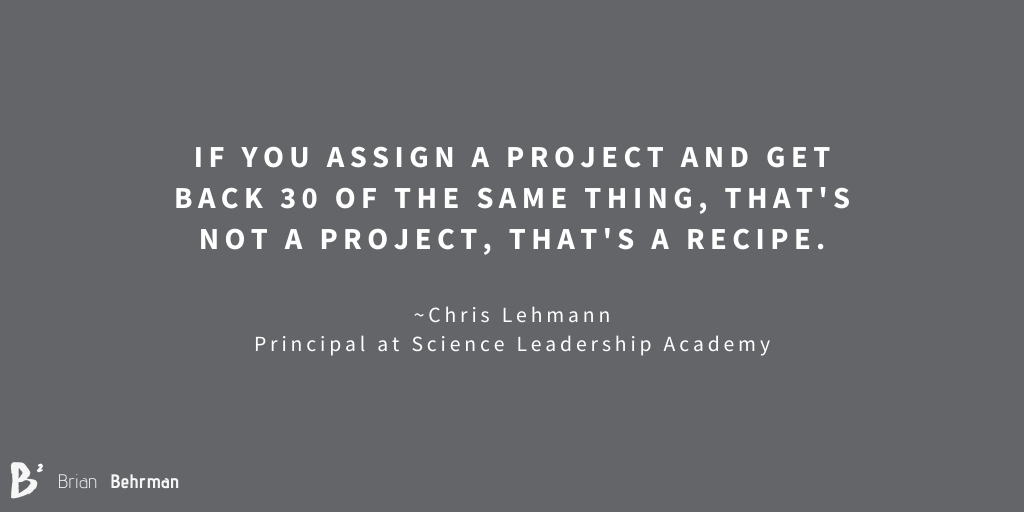
But what they did, I don’t know that I can call it true project learning. I had the privilege of meeting Chris Lehmann when I was at the ISTE Conference in Philadelphia. Something that I’ve heard him say is:

Think about it. Websites like Serious Eats or Bon Appétit post some amazing recipes. Many of those recipes have been developed by professional chefs working in professional kitchens, and then they are tested by others in their home kitchens so that the recipe can be adapted so that I, as a home cook, can make J. Kenji López-Alt’s All American Meatloaf recipe in my house and end up with a result that looks (and hopefully tastes) like the version that Kenji made himself (by the way, this is seriously one of my family’s favorite recipes that I make, and is worth every second of the time it takes to make).

So, what’s the point? What does recipe testing have to do with project work? Well, recipes are developed so that anyone who makes them can make a version that they can be proud of. But if you are great at following recipes, I’m not sure that you can call yourself a chef (yet). Similarly, doing a project is more likely about following directions, especially if a category of your rubric is based on following directions! Often, doing a project has more to do with following directions than learning.

Project-Based Learning

So, let’s think about how Project-Based Learning might be a little different than simply doing a project. Here’s an example from when I was teaching social studies.

One year I was part of a team of sixth-grade teachers. Within that team of teachers, my role was to teach all our students in science while the other teachers would teach our students other subjects. Then each one of us would teach social studies to our homeroom class. One of the years I was teaching social studies, my students got into doing “extra” research on the topics we were learning about. As we were approaching our unit on the Roman Empire, I wanted to lean into that interest that they had. Instead of teaching that unit in the typical format that was suggested by our curriculum guide or our scope and sequence, I decided to create a project. But this was when I was several years deeper into my teaching career. I had learned from some of the issues of “doing a project” that I had learned as described above.

For this project, instead of creating a word document that was full of directions, pulling together a bunch of resources, and then expecting a similar outcome, I decided to go very much minimal. I wanted to see what my kids would come up with. I decided that I was going to create the conditions for students to dig into the things they were most interested in about the Roman Empire. And my students did not disappoint! So, here’s what we did:

At the time, there was a single standard that said something along the lines of “understand the rise, fall, and cultural achievements of ancient civilizations in Europe and Mesoamerica.” Then it listed several examples including the Roman Empire.

On the day we started the project, I had no directions sheet. I had not pulled together any resources. I put the standard on the board, and as a class, we dissected what it meant. We talked about what it meant for an Empire to rise and fall. I had students share what they thought the phrase cultural achievements meant. I let them make conjectures based on current cultural achievements. Students brought up music, art, clothing, design, architecture, and so much more.

Next, we talked about resources we might be able to use to learn about some of these things. Students brought up our textbook, the library, digital encyclopedias, and the web, among other options.

The next day, I gave students time in class to learn. I had gone to the library and checked out everything I could on Ancient Rome. I checked out the iPad cart (does anybody else remember those) and put a handful of quality resources on my class website (this was before having an LMS like Canvas for a middle school class). But I also told them that if they had other ideas of places they might look for information, they certainly could use it. I told them that by the end of our third day, they needed to select a topic they wanted to learn more about and share with the class.

The next few days in class were a blur of research and work time. When students were struggling to find what they needed, I would sit down with them, but they also worked collaboratively at times. My role was that of a guide, not the all-knowing sage. They became aware of others learning about similar topics and they shared resources. On Monday of our second week of the project, we came back together for a brief share of what they found most interesting about our topic, and then we started talking about ways they could share what they knew. Some students wanted to make a poster, a few wanted to create a PowerPoint, one student who was studying architecture wanted to build a model, yet another student said she was going to design and sew a Roman outfit. We set a target due date of Friday for students to share what they had learned.

That week, our classroom converted to a working space every day in social studies. We had kids designing, building, sewing, and more! They spent time developing and then practicing their presentation. The learning was electric! A couple of times I needed to pull the class together to go over a few important details where I noticed some misconceptions. When Friday came, it was sharing day. The kids were so excited to share what they had learned. We invited our principal and assistant principal, our librarian, and anyone else who wanted to come for a visit that day. We had food, we had a fashion show of Roman clothing, we had a student who built a miniature working Roman aqueduct. This is a project that will stick with me forever!

Pulling it together

What I want to point out about the difference between the Space Science project on planets, and the Ancient Rome project was in how the learning happened. In the space science unit, learning happened prior to the project. We tacked a couple of days onto the end of the unit for students to put together a poster of things they had already learned. All the resources and materials were provided by me, and the results were identical. But in our Ancient Rome project, the work we did for the project was where our learning occurred.

One of the things that I figured out by the time I led my students through our Roman project is that some of the best learning experiences take place in integrated learning experiences that are fun and authentic! And even more important than that, I’d argue that the overall learning that happened for students during this project went far deeper than what the standard asked for.

Next week, I plan to look at how we might go about planning a great PBL experience for your class. I also hope to share some of the mistakes that I think I made in some of my earlier PBL experiences (hint: assessment! It can be hard in PBL settings!)

I’d love to know more about your thoughts. Have you ever noticed a difference between doing a project and engaging in project-based learning? Is there something that you’re still wondering about? Let me know! This is a topic I’m going to be digging into in the coming weeks, and your questions may help guide my direction.

Moving from why to how

In the last post, I shared the importance of meaning and purpose in learning. As Grant Lichtman has pointed out, “…there is substantial evidence that having purpose, more so than strong test scores, leads to outcomes of success and happiness that most of us want for our students and ourselves.”

I’d like to think that we all agree, in some form, on the importance of purpose in learning. And that is true whether we’re talking about our own learning or the learning of our students. For most educators, we got into this profession because we want to help our students to learn and grow. For most of us, helping our students to learn is a big part of our why. But I’d also say that embedded in that desire to help our students learn is the continuing desire for all of us to keep learning too!

I’ve referenced Simon Sinek before on the blog. His TED Talk about the Golden Circle helped me to shift my thinking, realizing that the real driver of transformational education is that we have to start with the why rather than focusing first on the what (you can see that TED Talk here). If you don’t have time to watch the TED Talk, the basic gist of the Golden Circle is that the most inspiring leaders, brands, and ideas don’t start with a question of what, instead they start at the core of understanding their why, then moving outward on the circle to the how and what.

Last week’s post really dug into my thinking about why learning should bring meaning and purpose for our students, but it didn’t get so much into how we might do that. As I was thinking about how to bring more learning and purpose into our schools, I remembered a book I read a few years ago by Katie Martin titled Learner-Centered Innovation. The basic premise of the book is that we live in a world that requires people to think creatively and work collaboratively. Our traditional learning experiences in schools are driven by a curriculum and by teacher decisions that do not allow our students to think creatively or work collaboratively.

I’m reminded of my experience as a sixth-grade science teacher. One of our units was on space science. If you’ve ever taught any form of science, you know that it is ripe with opportunities for students to ask questions and get creative. We could spend an entire class period talking about the “what-if” questions that my students had. Unfortunately, as a teacher, I didn’t always see this as a good thing. I mean, I had my scope and sequence that I needed to try to stick to if I wanted to “cover” all the material. I literally remember saying “We don’t have time for your questions.” Insert face-palm emoji here! Also, if any of my former students are reading this, I’m sorry I discounted your curiosity. It’s one of the things that I find myself reflecting on as I learn more.

In retrospect, that unit was an ideal opportunity to create a project-based learning experience. I could identify the standards, create learning targets for my students, and then help them develop their own project that would allow them to meet the learning targets while also allowing each student to scratch the itch of curiosity! They could have helped create a plan for how they would show what they know in relation to those standards!

Now, I admit that not every unit we teach will have this level of curiosity naturally embedded in space science. But I do have some ideas of little tweaks that we might be able to make to take something traditional and turn it into something more meaningful.

Imagine if you would a unit on literary devices. Maybe you have a standard that says that your students need to understand simile and metaphor, or maybe they should understand imagery and symbolism. Or you might have a series of standards related to the point of view in a story. In a traditional format of teaching, you might work on defining the terms, you might have students read a passage and identify an example of a specific literary device. Maybe the student would be asked to read a sentence and then answer a multiple-choice question identifying the literary device. Maybe then there would be a test or a quiz, and we can check off that standard and move on. (And just to be clear – I AM NOT saying that there is anything wrong with a unit design of this nature!)

Here’s what I’d challenge you to think about though. Our standards are meant to be a guide, not a checklist. And when we think about learning, does being able to regurgitate some information in a moment on a worksheet, or in a packet, or on a quiz/test mean that I have learned that information? I would argue that true learning doesn’t happen until we are asked to do something with the knowledge we have gained.

So how might we take that Literary Devices activity up a notch? Again, I’m not saying there is anything wrong with any of the steps we have taken thus far. Part of the learning process requires that we as teachers share information in some way, part of it requires students to practice a skill, but the true magic happens in the doing. You see, learning definitions, identifying examples in a passage, answering questions, are all relatively passive parts of the process. Thomas Jefferson said, “What we learn to do, we learn by doing.” What if after the introduction of skills, we asked students to create a piece of writing that includes the literary devices that are included in your standards? We could have them write a short story and label where they used simile and metaphor, identify the point of view, or highlight an example of imagery or symbolism. Now, we’re taking a Depth of Knowledge level one or two activity and turning it into a DOK level 3 or 4. It’s more challenging for students, but that challenge helps develop stronger synapses in the brain.

This is just one example of how we might be able to take a more typical learning experience and make it more transformative without having to completely rewrite the way we do things. Here are a few more things that you might consider that would help students better see meaning a purpose:

  • You could start a classroom blog – not for you to write, but for your students to write. They could share what they are learning about. They could share how it impacts them and their world. They could choose to include pictures or videos. As students share their learning, they will see that they have an audience that wants to know about what’s happening. If a whole blog post seems overwhelming, maybe you could start a classroom Twitter or Instagram page where students craft the message that will be shared, and then (pending your approval) they post the update. Many of us utilize classroom jobs – this could be one of the jobs in your classroom. Students could have a specific time each day or week to update the world on what’s happening.
  • Help your students find ways to use their learning to create action – at a previous school, a group of students noticed that many of their items from the lunch tray should be recyclable, but it all went in the trash. This happened to tie to a standard on sustainability. They worked with their classroom teacher, did some research, and eventually were able to get a representative from a local recycling company to visit their class. They were able to present to the representative, and our school was then provided with a recycling dumpster. The students then took on the challenge of teaching other students what should go in the recycling and what should go in the trash. They created PSA videos, put posters up around the school, and even created smaller fliers to go on the lunch table. The ownership of all parts of this project was taken on by the students in this classroom, and the learning was able to spread throughout the building. For something like this to happen in your classroom, you just have to pay attention to what your students seem interested in and are talking about. That teacher recognized early on that her class was full of “social-justice warriors” and she found ways to let them use that drive in their learning. You might notice other things about your class and find ways to integrate your standards into their interests and desires!

It’s important that we all remember, as Katie Martin says, that “Learning is a process, not an event.” The more chances for students to do something with their learning, the more likely it is that the learning sticks. When we help our students to explore what they are learning, we help inspire students to solve problems and innovate!

Talent is jagged

I was recently scrolling Twitter (as I often do). I often think that Twitter is one of the best free and on-demand professional development resources out there. The number of new ideas I’ve gotten from it is too great to count, not to mention the friends and connections that I have made because of my activity in that space. I know not everyone loves social media, and I really do understand why, but I think it is one of the greatest ways to share the story of your classroom or school and connect with others with who you might never normally be able to connect.

While scrolling last week, I came across an amazing infographic on Universal Design for Learning:

This graphic on UDL comes from Katie Novak. I’ve mentioned her on the blog a couple of times before. You can see those posts here and here. What really jumped out at me about this infographic is the section about the variability of “Average” Student A and “Average” Student B. The graphic immediately made me think of the book The End of Average by Todd Rose.

In that book, Rose tells a story about the history of the Air Force. When designing the planes in the 1940s, a lot of pilots were having issues in flight. This was happening as the planes were transitioning from propeller-driven planes to jet propelled (that made them much faster!). Initially, designers struggled to figure out why those issues were coming about. The earliest opinions issued were that the issues came from “pilot error.” Pilots were convinced that the issue could not be them, so they blamed mechanical issues. But study after study showed no sign of mechanical issues.

Over time, the focus began to be on the design of the cockpit itself. After some research, it became clear that the cockpit was designed based on the average measurements of hundreds of pilots in 1926. The dimensions of the cockpit were standardized based on these measurements so that all planes had the same measurements within the cockpit. The Air Force was concerned that maybe the average size of pilots had changed a bit over the years.

Now, let’s pause for a moment there. If you have a vehicle, think about what it would mean to have a car that was designed for the average-sized person. Imagine not being able to make adjustments to the driver’s seat in your car, the height of the steering wheel, or even the mirrors!

So, going back to the story, beginning in 1950, a new study was started. Over 4,000 pilots were measured on a wide variety of variables, and then averages were found on each dimension. The initial belief was that this new study would lead to a better-fitting cockpit. But one member of the team had some doubts. Lieutenant Gilbert Daniels decided to compare the individual measurements of all the pilots in the study with the average for 10 of the physical dimensions. What he found surprised even him. Not one pilot fell within the normal range on all 10 dimensions. There was no such thing as “an average-sized pilot.” Instead, the Air Force recognized that with each person there came some variability.

After learning this, the Air Force went back to the drawing board and made the decision to create environments that fit the pilot, rather than expecting pilots to fit the environment. This meant that new planes had to have adjustable seats, foot pedals, helmet straps, and flight suits. When these changes in design went into place, performance among pilots improved significantly. And as a side bonus, the lessons learned in this research were able to help make automobiles adjustable too!

So when we think about UDL, we have to think about our students. Like the pilots who had different measurements, no two students will have all the same strengths and weaknesses. Take a moment to scroll back to the infographic at the top. Those zig-zag lines that represent student A and student B remind us that every child has variability (In his book The End of Average, Rose refers to this variability as a jagged profile). No two students are the same! Talent is always jagged. When we better utilize UDL strategies, we help adapt the learning environment to the needs of students, as opposed to expecting students to adapt to the learning environment.

I could go on to make suggestions for how you might implement more UDL practices into your classroom, but I really doubt I can do any better than what Katie Novak did in the infographic above. If you’re interested in trying out some of these tips, I’d suggest choosing one or two, and trying it out for a while. Once those tips become routine, then add in another. As you increase your utilization of UDL strategies, you will be better at adapting your environment to meet the individual needs of each student in your class.

If you want to dig into more of Katie’s work, check out her website here. On the site, you will find options for PD, Online Courses, other Resources, and Katie’s blog. While there are other resources out there for UDL, this is one that I know that I would trust!

If you decide to implement some of these strategies, I’d love to hear more about them! Be sure to come back and share on the blog, or let me know in some other way!

Are we a teaching organization, or a learning organization?

Recently I’ve been thinking about a statement I heard once – I honestly can’t remember who I heard it from first, but I think I recall versions of the quote from Dave Burgess, another version from Matt Miller, and yet another version from George Couros (all are some of my favorite authors in the educational space). The quote basically says that teachers who have a 25-year career need to avoid teaching 1 year 25 times.

Let’s unpack that a bit – the gist of what they are saying here is that as teachers, our students change from year to year. Their needs change from year to year. The world changes from year to year. A teacher who teaches 1 year 25 times is someone who has their “January” binder or folder that they pull out every year and it has all the activities for the month of January pre-created. In environments like this, the focus is on the teaching – often it’s about “what is easier for the adults in the building?” The problem is that it may not be what’s best for our students.

Instead, what these authors say we should strive for is to teach each year one time. We adapt our lessons and curriculum to meet the needs of our students, to meet the needs of our community, and to meet the needs of what’s happening in the world right now. And to me, that’s the beauty of the Professional Learning Community! Your PLC team is there to support one another in identifying needs, doing some research on how to meet those needs, and then testing it out.

As I think I have shared before, I’ve been reading the book Professional Learning at Work this school year. I finished it over winter break, and it has me thinking about what it takes to be a school that is focused on learning rather than just on teaching.

Let’s take a moment to define the differences – in a teaching organization, we might have our list of standards and skills or lessons from the textbook, and we say “I have to get through all of this!” It’s almost like we create a checklist for learning. Once I get through item number 1, I move on to number 2, and so on down the list. Can you see a problem with this? I don’t think students can be thought of like items we’re producing. A checklist will not meet the need of every learner in a classroom. Learning is not about developing a lesson design, implementing the steps, and ending at a finished product. I think we all know that students don’t work that way. Learning rarely happens as a straight line – instead, it’s often made up of a bunch of squiggly twists and turns.

On the other hand, a learning organization is all about looking at learning as a process of perpetual renewal – for us as teachers and faculty, for our students, for our community. We get there by focusing on the emotions that have brought us to the career path of teaching, and the emotions that keep us coming back each day (no matter how good or bad yesterday may have been). Ultimately a learning organization is a place where the community is passionate, driven, and in a continuous process of growth.

In a previous blog post, I wrote all about “My Why” – the things that motivate me to do what I do (You can see that post here: Starting with why). I encourage all of us to do a little self-assessment – where are you now? Do you trend towards the teaching mindset? Or do you trend towards the learning mindset? Are you comfortable with where you are? Is what you are doing helping your students to learn and grow?

If you feel completely comfortable with your answers, good for you (To be honest, I’m not sure I can say that I am 100% comfortable with my answers). But if your reflection leads you to feel like you have some growing to do, then go with that. Reassess what you can do to improve. My goal is to help lead a school that is a true learning organization. I see our process as one of continual growth and renewal, and I’m always thinking about how I can help in that process. We will never get to a point where everything is perfect! Even when we meet our initial goals, that creates a place where we can set a new goal. 

What are you working on? What growth do you seek? Share with us in the comments below!

Back to normal?

Back to normal?

Recently I’ve been having a LOT of conversations with a wide variety of people about what the future holds for us next school year. Parents of incoming kindergarteners want to know what their child’s kindergarten year will be like. Teachers want to plan for what the learning environment will look like. Neighbors have even stopped me while I’m out walking the dog to ask questions about what’s going to happen. The question I’ve been hearing the most is, “When will we be able to get back to normal?”

I understand the concept of the question. Part of our human condition is to be averse to change. Change creates dissonance, and dissonance makes us uncomfortable. But… I think it’s also worth pointing out that dissonance is where learning and growth happens. If we don’t feel a little bit uncomfortable in our learning, we aren’t stretching ourselves.

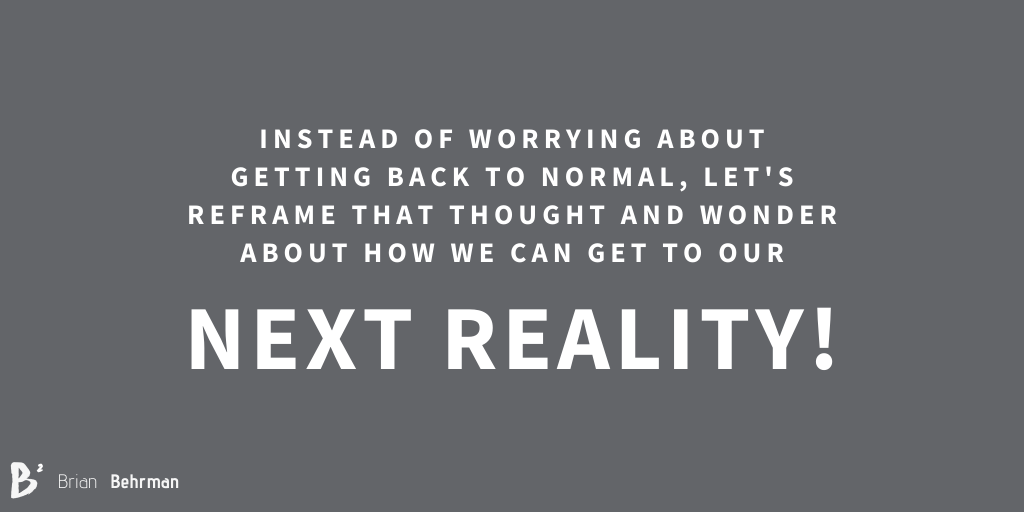
Earlier this week though, I saw this quote pop up in my Twitter feed:

I think sometimes we must take a moment to reframe the things that people are asking us. Instead of a focus on what we want to get back to, let’s take a moment to reflect on the learning and growth that has happened in this past school year. What are the things that we want to carry on? Here are a few that stand out to me:

1 – The power of the video chat. As we’ve shifted through various modes of learning here in my district, one of the things that has been a constant is the utilization of Zoom in our classrooms for both student learning events and professional learning. Think about what this technology does for us! We can reach out to anyone in the world and bring them into our classroom. Want to talk to the author of your current read-aloud? Reach out and see if you can set up a zoom. What about an astronaut while you’re studying space science? Or maybe you could hold a virtual celebration of learning where students can share their recent writing piece in the classroom while parents can watch it live from home or their work, or later on a recorded version! There are so many possibilities here!

2 – Options for flipped learning. I’ve had conversations with a couple of teachers who have leveraged the use of recorded lessons that students can watch and return to anytime to do the teaching of the minilesson, which frees up additional time in the classroom for conferring or for individual or small group support. An added benefit? Depending on how your students process information best, a live minilesson might be a challenge for some kids. They need to hear things multiple times; they need to stop and think or jot some notes. Having a video allows them to do all of this without a teacher needing to repeat themselves. Also, those videos can be used by students as a review tool later. Worried about the time it takes to record in advance? Record your minilesson live and then post to your learning management system. The benefits of going back to a recording still exist for your students!

3 – The ease of setting up parent meetings. Think back to pre-Covid times. How hard was it to set up a parent meeting? We’d have to email everyone involved to find a time that would work. Parents needed to be able to leave work or home in time to drive to school which probably added at least a half-hour of time on either side of the meeting for parents. Childcare for siblings could be an issue at times, and that would limit options for meeting times. On the other hand, with Zoom (or similar technology), I have set up meetings on the same day, or sometimes even within just a few minutes later to hold the meeting. Parents can hop on zoom from just about wherever they are.

4 – Relationships. Coming into this past school year, one of the things we were most nervous about was how to build relationships in this new environment. Our school district began the year in a virtual learning setting, and we didn’t know if it would be possible to really get to know our kids when they weren’t here at school. To help with this, we took our first two scheduled student days and set up individual zoom calls between the teacher and student. Parents were invited as well. By about lunch time on the first day, I had teacher sharing with me how powerful this was. Think about the beginning of the typical school year. When would you be able to have a 15 minute, uninterrupted conversation with any of your new students? What we have found in teaching this year is that many teachers feel that they have stronger relationships with this year’s class than any other class before. Considering that we had significant chunks of the year where all or some of our students were learning from home, this is amazing! We plan to create opportunities to build those early relationships with students again next school year even though we will hopefully be starting the year in an in-person learning model.

I am sure that other things come to mind for all of you who are reading this now. Instead of wondering so much about getting back to normal, let’s shift that thought and wonder about how we can get to our next reality!

Share with us in the comments below if you have things that you are planning to do differently moving forward. We’d love to hear your thoughts!

Clean slate

How many times have you messed up? Forgotten something at home? Been a couple minutes late to a meeting? Have you ever paid a bill late? Or have you ever done something that hurt a close friend? If you’re anything like me, you can probably identify some examples of times that you have messed up, both professionally and personally. Now pause and think – as an adult, what has been the reaction of other adults? I find that more often than not, the adults we are around are quick to accept our apologies and move on (although we might have to pay a late fee on that bill!)

I know that there are times that as a classroom teacher, there were students who would manage to make my life difficult. Maybe they came to class unprepared. Maybe they spent too much time chatting with their neighbors. Other times the behavior was a lot more serious – acting out in major ways, knocking over a chair, throwing a desk, etc. I know that I sometimes took that behavior personally.

As teachers, sometimes it is hard for us to show the same level of grace to our student’s tough behaviors that we might show to an adult who makes mistakes (I know, the behaviors are different, but the emotional and cognitive coping skills of an adult are way different than a kid in our classroom).

Here’s the reality that I think we can all agree on – teaching is an emotional gig! You get invested in your students. You hope for the best from them. You pour your time and energy into them. You celebrate the smallest of victories. And yet, at times, the response we get just doesn’t quite live up to our expectations. Sometimes we feel disappointed, upset, or even hurt by how kids act in our classroom.

So, when a student become dysregulated, it can be frustrating for us as the adult in the room. Real quickly, in case dysregulation is a new term for you, let me define it for you:

Dysregulation: An emotional response that does not fall within the conventionally accepted range of emotive responses. These emotions can be internalized by our students, which causes them to appear withdrawn, shut down, or non-engaged. For other students dysregulation will manifest as externalized behaviors such as acting out, being emotional, and trouble calming down. Some students may show a combination of internalized and externalized behaviors.

A couple years ago, I wrote a post on adult responses to dysregulation. You can see that post here. In this post, there is a link to a document that can serve as a really solid reminder of how to respond when students are dysregulated.

It can be so tempting at times to take a student’s dysregulation personally. But we have to remember the acronym Q-TIP – Quit Taking It Personally! When our students are flipping their lid, we might wonder “Why are they doing this to me?” The fact is, most of the time, this behavior has nothing to do with us. It could be that they are hungry, or tired, or thirsty. Maybe they had an argument with mom right before getting on the bus. Maybe someone hurt them.

I believe that part of working with kids is being able to give a kid a clean slate every day. Each morning, you and that student need to start refreshed and ready for the day. And here’s the thing, kids can sense it in your para-verbal and non-verbal cues. The tone of your voice during your first interaction, the body language when the student enters the room, both can impact how the day is going to go with that student. And as a former colleague of mine pointed out to me earlier this week, sometimes that reset to a clean slate might need to be more often than just the beginning of the day. Sometimes the clean slate comes into play after returning from lunch for the second half of the day. Sometimes it might even be after every transition!

Students who have been through trauma are often the ones that are most likely to carry out those difficult behaviors. They are also the ones who are most sensitive to what the adult who’s “in charge” is doing, because that’s how they have learned to keep themselves safe. It’s their survival mode. The single most important way to help our students who have been in trauma? The love and support of a caring and trusted adult.

Think about the students in your class? Who are the ones that most need that clean slate? Once you have those students in mind, challenge yourself to become that caring and trusted adult for them. Be that person they know they can turn to and confide in. Be that person who will be there even when they act like they don’t want you to. That’s what our kids with challenging behaviors need most!

Planting trees

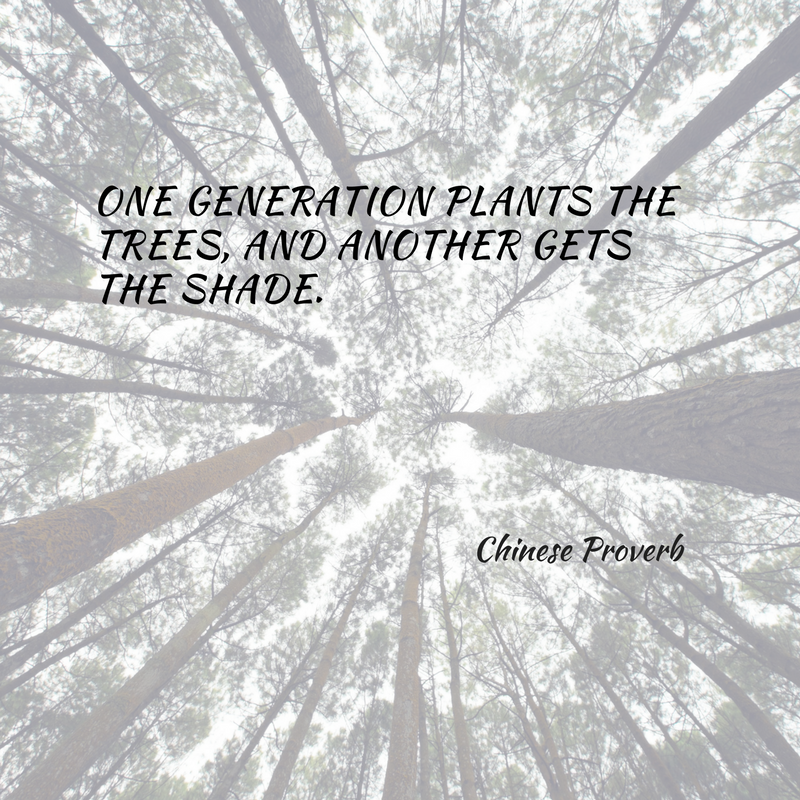
8 years ago when my daughter was born, we planted a tree in our backyard. It was a Japanese Maple, and at the time of planting it only came up to about my waist. Unfortunately, we no longer live in that same house, so I am not quite sure exactly how tall that tree is now, but based on what I know about the growth rate of trees like the one we planted, it’s probably no taller than me. Given that amount of growth, I’m sure it only provides shade for a small section of the lawn. As any of you know, planting trees for your own benefit is a long-term project. The Chinese have a proverb that I believe says it best:

Chinese Proverb

Education can be a lot like planting trees. When our kids first come to kindergarten, they are a like a seed, and before long they begin to sprout. The amount of change that takes place in that kindergarten year can be truly impressive. Throughout elementary school, students develop much like that sprout, and by the time they hit the intermediate grades, they are a bit like a sapling. Those saplings are more developed, and beginning to look a little like a tree, but saplings still have a lot of development to do in order to provide meaningful shade.

One of our roles in education is to be like the gardener, and help each of our seeds grow into a mature tree over the life of their education career. There is an important thing to remember though – trees don’t completely mature in just a year. It takes time and effort to get them to grow.

In the house we live in now, there are 3 maple trees in the backyard. Two of them were already there when we moved in, and a third was added last summer. The tallest of the three is not even as tall as our house, and I didn’t even have to rake the leaves that were produced this year, I just ran over them with a mower. They don’t give off a ton of shade yet. At times that can be frustrating – especially on a hot summer day. Each year I have to trim back a little on the branches, but I know that trimming them back is sometimes the key to new growth.

I know that in time, those trees will grow and provide our backyard with plenty of shade. Two of them are close enough together that I may even be able to hang a hammock between them for some relaxation.

Just like those trees, our students don’t always come along quite like we would hope. Some of them are challenging, and we need to do work to help them to learn and grow as we would want them to. Some of them don’t seem to grow as quickly as we’d like them to. It’s easy to become frustrated when our students don’t get to where we “think” they should be, but we have to remember that the education of each of our students didn’t start with us, and it won’t finish with us. We get the opportunity to do the best we can with each of our students, help them to learn and grow the best that we can, and have the confidence that through our best efforts, they will continue to develop into the mature tree that we want them to be.

As I know I’ve shared before, I believe that every one of our students has a path to success inside of them. Sometimes it isn’t easy to see that path, but it is there. All we can do is to guide them along their path of development.

The value of communication and collaboration

Lombardi - Work Together

About a month ago, one of my posts (What are you learning?) made reference to the National Association of Colleges and Employers Job Outlook report.  I want to come back to that report today and look at the top 6 items on the report.  As I look over the list it keeps bringing me back to one of my favorite questions when thinking about learning in our classrooms: What do our kids need in order to be successful in the future?  This list can help serve as a guide.

NACE Attributes Employers Seek

Think about some of the most successful companies in our world today.  Whatever the company is, if they are trying to be innovative in their field, they are focused on creating the best products possible for their customers.  What does work look like for those innovative companies?  I’m guessing that they are concerned about their teams of employees working together to create innovation.

Think for a second about your best lessons.  How many of you can claim that every aspect of your best lesson for your students was imagined, planned, created, and developed completely by you?  I know when I was still in the classroom, I was constantly collaborating with other teachers to improve my lessons, to add cool new ideas, or to make the learning experience even better for the learners in my classroom.  I’m guessing that most (if not all) of you will say the same thing.

If we know that innovative companies seek communication and collaboration, and we know that we achieve our own best work through communication and collaboration, and the data from the most recent NACE Jobs Outlook report shows that employers value communication and collaboration, what are we doing in our classroom to explicitly teach our students how to communicate and collaborate?  Paul Solarz, the author of Learn Like a Pirate has an entire chapter on peer collaboration.  He shared lots of great ideas of how he creates a collaborative environment for his students.

Early in the chapter he talks about the importance of establishing classroom expectations and norms as a group, where all members of the class have their input in those norms.  As you build in and truly teach collaboration skills, students will take ownership of those skills and will help one another to be better collaborators, letting each other know what they need from one another so that all can be successful.

Even with the opportunity to teach collaboration, the only way students will be able to learn and grow in this skill is through the opportunity to practice.  Be looking for as many ways as possible to integrate collaboration and communication into your lessons.

And something has to be said about the classroom environment in order to create an environment that is conducive to communication and collaboration.  Think about when you are working with colleagues, how do you choose to sit?  Based on my informal observations visiting team PLC time in our building, generally we sit in a group in such a way that everyone can see everyone else.  Students need to be able to do the same when they have time to collaborate.  Rows aren’t conducive to communication and collaboration.  Seats where students are far away from their nearest neighbor don’t facilitate collaboration either.

Many of the classrooms in our school have created opportunities and spaces for students to be able to sit together and collaborate, whether it’s a small spot on the floor, a rug area, creative seating options, a couch, or high tables and chairs, there are places where students can sit together and collaborate in the classroom.  To take it a step further, how many of you have considered not having a seating chart in your classroom?  A true flexible seating environment can be created where there are norms about students choosing the space that they are able to do their best space.  And as a safety net for you, you can always set the norm that poor choices by students may result in the teacher asking the student to make a different choice.  Think about the way you would empower the learners in your room to be able to select their own seat each and every day in order to meet their learning needs!

I want to conclude this post sharing some pictures from offices for Google and Apple, two of the most innovative companies around today, as well as one of my favorite shared working space, Starbucks.  I’m not saying that our classrooms need to necessarily look like these (they’re a bit extreme), but we might want to think about how spaces like this create environments where employees are able to put out amazing and innovative products.  We also should realize that some of the students will be doing work in environments like this in their future.  What can we do in our classrooms today to help them be successful in their future?

This slideshow requires JavaScript.

So what are your thoughts?  Have you had success teaching students communication and collaboration explicitly?  What has worked for you?  What concerns do you have about integrating more collaboration and communication into your classroom?  Share your thoughts in the comments below!