
One of the things you should know about me is that I love to solve problems. To the point that sometimes, when I need to listen, my mind goes to suggestions for how to fix the issue. Often, those suggestions are specific to the exact need but don’t necessarily help with general needs in solving all types of problems.
As a classroom teacher, this was sometimes my focus as well. In the first few years of teaching, I often did a “Problem of the Week,” where students worked in a small group to solve a deep-thinking problem that was somehow tied to the curriculum. As a class, we would go over the problems. But when we went over them, we’d focus on how to solve that specific problem. In my mind, I assumed the skills would translate. Sometimes they would, but not always.
Over time, I have learned more, and one thing that I have considered is that schools need to be learning environments and that students need to develop deep thinking skills. These deep-thinking skills don’t happen when our teaching is based on how to solve a problem. While on a bike ride recently, I listened to an episode of the Tim Ferris Show podcast, and he interviewed Edward O. Thorp. He’s known for many things, but I was thinking about him from his perspective as a math professor. During the podcast, he was talking about teaching a class about investing. In the episode, he said the following:
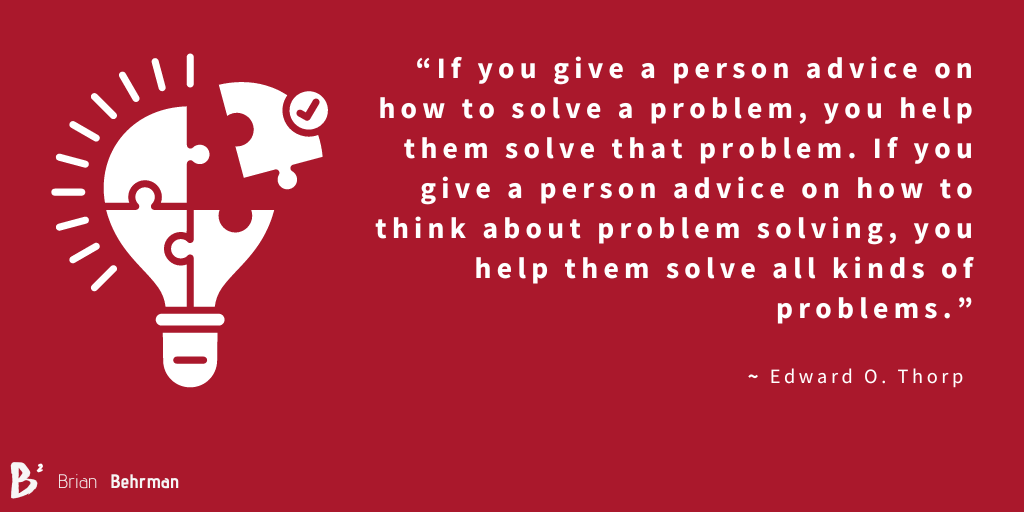
Ultimately, the goal is to help teach students how to be lifelong problem solvers—whether we’re talking about math or any other skill, thinking is the key to our students’ success! That’s part of what I love about a book we’re reading, Building Thinking Classrooms by Peter Liljedahl. While the book focuses on ways to develop thinking skills in mathematics, we are looking at it from the perspective of how we bring similar shifts to learning in all subject areas.
If you’ve never read this great book from Liljedahl, you should know that it’s based on research he carried out in many classrooms and grade levels. The book’s core concept is that 14 practices, when implemented, will lead to greater student success based on learning measures. While the book is designed so that you can implement different practices as you see fit, Liljedahl suggests implementing the first 3 practices together. Those tasks include:
- What types of tasks – the tasks should be highly engaging. When starting this process, you might begin with non-curricular tasks, but the goal is to get to tasks developed around the curriculum. These tasks will exist at a higher depth of knowledge, say DOK 3 or 4. For example, in a language arts class, you might have students creating a word web for various vocabulary words – connecting one word to another helps make the learning stickier. In social studies, you might have a task that involves a quick reenactment of an event from history that you’re studying. In science, you might have students exploring a hands-on, engaging lab task before explaining why something works so that they can make connections to what is happening in the real world.
- How we form groups – According to Liljedahl’s research, the best groups are randomly formed in a way that students know is random (if they are preselected, students may not trust that they are truly random). In primary grades, you might want groups of 2, but from grades 3 and up, it’s best to have groups of 3 or fewer.
- Where students work – The best place for a group of students is at what’s called “Vertical Non-Permanent Spaces.” These might be whiteboards around the room or something like a Wipebook (some creative teachers even use pieces of white shower board (they can be cut and then mounted to the wall like a whiteboard). Verticality is important because it allows for a flow of knowledge throughout the room. If a group gets stuck, they can see what others are doing. That’s not cheating. That’s using resources! And non permanent is important because it leads to lower stakes. Students are willing to take risks because they know they can erase something that doesn’t work.
When we create a learning environment that encourages thinking, has tasks at a higher DOK, and puts students into groups to collaborate, we encourage 21st-century thinking skills that will help our students know how to solve this problem and, more importantly, how to solve any problem.
What are your thoughts? How do you ensure that students in your classroom are learning to think about how to solve all kinds of problems? Share with us in the comments below!
 The View from 518