
Anyone who has read my posts knows I listen to many podcasts. That’s where I get many of my ideas for posts. Earlier in the spring, I was listening to one of the many podcasts I like, and one of the people was talking about the importance of student engagement.
We all know that student engagement is vital to creating a productive and supportive educational environment. High levels of engagement foster academic growth and play a crucial role in shaping our students’ personal development. By maintaining high levels of engagement, we can help our students unlock their full potential and equip them to tackle future challenges.
One of the comments that struck me was when the host pointed out the difference between behavioral engagement and cognitive engagement. It makes sense if you stop to think about it, but I had never thought of engagement as having different types. But then, I started thinking about those students who visibly would not appear engaged in the lesson. Then, it would be time to answer a question or provide a thought, and their hand would shoot up, and they’d give the most insightful and informative addition to the lesson. I was always so surprised!
Reflecting on the podcast, it became clear that behavioral and cognitive engagement are integral to effective learning. Each type represents a unique way students interact with the learning process, and both are equally important for student success.
Let’s talk for just a moment about each one.
Behavioral engagement involves the observable actions and behaviors of students in the classroom. A few of those actions and behaviors include:
- Active participation in class activities, discussions, or collaborative work
- Paying attention during lessons and maintaining focus on tasks
- Putting effort into completing assignments and learning activities
- Regular attendance and punctuality
- Following classroom rules and expectations, showing on-task behavior, and minimizing disruptive behaviors
Conversely, cognitive engagement refers to students’ mental processes and strategies to understand and learn the material. A few of these processes and strategies include:
- Seeking to understand the material at a deeper level rather than just memorizing facts
- Analyzing, evaluating, and synthesizing information
- Setting goals, monitoring progress, and reflecting on learning
- Being aware of one’s thinking processes and strategies for learning (metacognition)
- Having a genuine interest in learning and finding personal meaning in the material
The exciting thing for us to think about, though, is the role that the teacher plays in this engagement piece. Teachers sometimes believe that it is the student’s job to engage in the learning once a student shows up. There’s that old saying, “You can lead a horse to water, but you can’t make it drink,” and I’ll agree that students have a role in their engagement. But if we leave it up to a second grader to decide whether they will engage in the lesson, we are doing a disservice to their learning. We expect them to raise their hand to use the restroom. We expect them to walk in lines in the hallway. But will we let them decide whether they should engage in a lesson? I think not.
As educators, we have a role in helping students engage more effectively. When we create a structured and supportive environment, we can enhance behavioral engagement. Some of these steps could include:
- Clear classroom rules/expectations—These expectations should be enforced consistently, and students should agree.
- Routines—Predictable daily activities and transition routines will help students know what to expect and reduce disruptions.
- Build positive relationships—Students want the people they spend time with to show interest in their lives, listen to their concerns, and respect their opinions. Students who have developed relationships and trust with their teachers are likelier to engage in the lesson.
- Inclusive environment—Students want to feel valued and included. Creating a classroom culture where everyone is seen and heard is important.
- Use positive reinforcement—This is two-pronged: First, recognize and reward positive behaviors and achievements through praise, tokens, or other small rewards to motivate students. Second, provide timely and specific feedback that helps students understand what they did well and how they can improve.
- Implement effective classroom management techniques—First, try to be proactive and anticipate potential disruptions before they occur so that you can address them. When things go wrong (and they will), apply fair and consistent consequences and ensure that students understand their role in those consequences.
When we work to design challenging and meaningful learning tasks, we’re able to enhance cognitive engagement. Some of the ways we can do this could include:
- Create a curriculum relevant to the students—Include student interests and real-life experiences whenever possible. Use interactive teaching methods like group work, discussion, and hands-on activities to keep students involved in their learning.
- Provide varied instructional strategies—Differentiate learning to meet your students’ needs and provide scaffolds to help students learn new concepts, gradually reducing assistance as they become more proficient.
- Foster student autonomy—Whenever possible, provide students with choice. How can they show what they know? Ask them how they want to show you! You could also offer opportunities for students to take on leadership roles in the class or school.
- Encourage collaboration and social interaction—Time and again, reports say that one of the most critical skills for our children to learn for success in future workplaces is effective communication and problem-solving skills. To build these skills, incorporate group work or collaborative projects that require students to support one another. Be mindful of what’s going well and what isn’t. Be ready to step in when a group hits a bump in the road (it will happen). At the same time, foster a classroom culture where everyone can be the teacher and learner.
- Promote self-regulation and responsibility—Have students set personal and academic goals, then teach them to monitor their progress and reflect on their learning. Students also need to be taught and modeled practical time management skills.
Earlier in the post, I discussed how behavioral and cognitive engagement are related. However, there are also some key differences to consider. Behavioral engagement is ultimately about what students do, while cognitive engagement is how students think and process information. Behavioral engagement can often be observed and measured directly (participation, attention). In contrast, cognitive engagement is more internal and assessed through indirect measures (self-reports, formative or summative assessments, problem-solving tasks).
However, the most important difference is the impact of these two types of engagement. Behavioral engagement is essential for maintaining a conducive learning environment and ensuring participation in classroom lessons and activities. On the other hand, cognitive engagement is particularly crucial for deep and meaningful learning. When both behavioral and cognitive engagement are in place, we can help our students reach what Mihaly Csikszentmihalyi, a Hungarian-American psychologist, refers to as a flow state. “Flow” is a highly focused mental state conducive to productivity and learning.
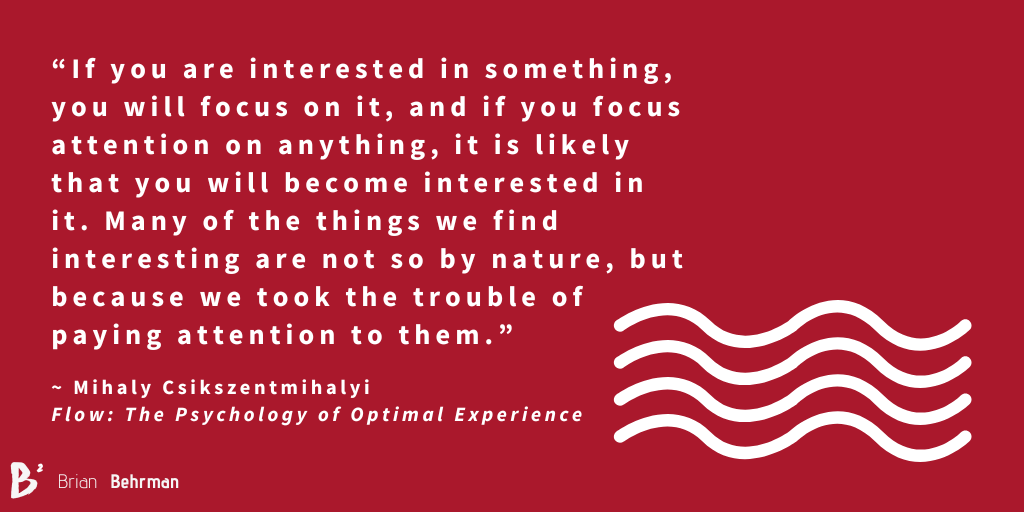
This quote has me thinking that engagement strategies can help students develop an interest in something. As teachers, we help develop that interest by using our engagement skills to help students pay attention to that thing.
Let’s consider what these types of engagement cause on a classroom level.
Without apparent behavioral or cognitive engagement, a classroom will be chaotic, and little learning will occur. You would likely see a lot of referrals, and end-of-year academic data shows little growth for students.
A classroom with strong behavioral engagement but not a lot of cognitive engagement would have an orderly classroom environment, have very positive teacher-student relationships, and students would typically participate, but the drawback would be that there was only shallow learning, limited critical thinking, and a lack of motivation or interest for students. This would show in assessments – students would do well on basic fact recall but struggle with tasks requiring more knowledge.
In a classroom with strong cognitive engagement but weak behavioral engagement, you would expect higher-order thinking skills, high levels of intrinsic motivation, innovative ideas, and a natural curiosity. Still, this would come at the cost of a disruptive classroom environment, teacher and peer frustration, incomplete task completion, and high levels of stress and anxiety for all in the atmosphere. These classrooms also tend to struggle greatly when the classroom teacher is not in the room and has to have a substitute teacher.
When a classroom has both types of engagement, we expect it to run like a well-oiled machine. Students would be orderly and respectful, have positive peer interactions, be highly motivated, and actively engage in learning activities. We would also expect enhanced learning and achievement and students who develop lifelong learning skills. This is the environment where most students are most successful and teachers are most happy.
When you reflect on your classroom, where do you think you are strong in creating an engaging environment? What are some areas of continued growth for you? What are some ideas you have that might help others grow in the areas you are strongest? Share with us in the comments below!
 The View from 518
One thought on “Behavioral engagement vs. Cognitive engagement”