
As a classroom teacher, I remember spending chunks of time with my students. We’d read, sometimes me to them, sometimes them to me, sometimes to each other, and sometimes on their own. Then, I would do some comprehension activity—maybe some questions to answer, a written response, or something similar. This is how I was trained then, so it’s what I did. I thought I was doing good work.
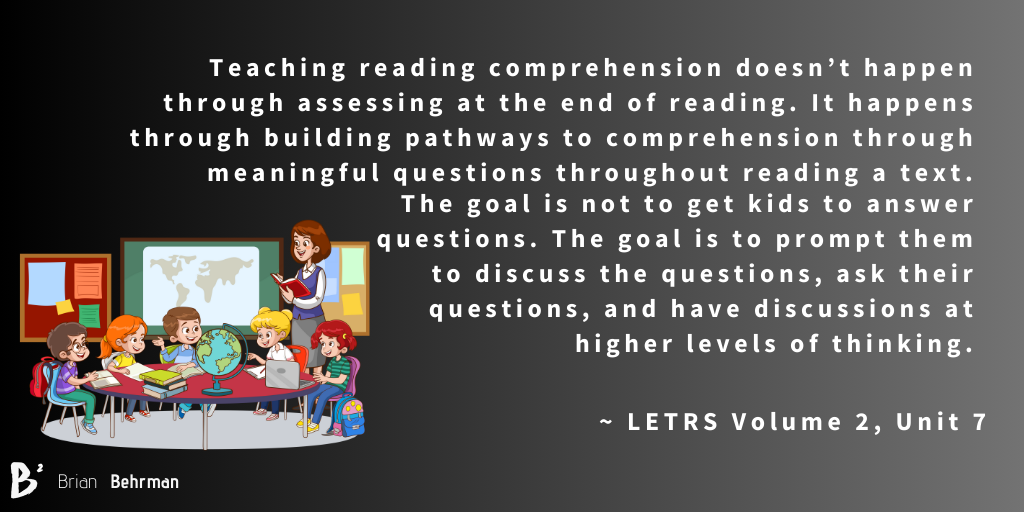
However, in the past couple of training sessions with LETRS, my thinking has been challenged to move students to true comprehension. There was so much more that I could have been doing throughout the reading process to help build higher thinking skills for my students. So let’s dig into some of the things we can do Before, During, and After reading to support building reading comprehension (you can reference the planning checklist below).

Before:
First, we need to establish a purpose for reading—why have we selected this text? What should our students take away? Is there a lesson to be learned? This helps us define the why behind the reading for our students.
Identify text structure – Is this an informational piece? A narrative? What do your students need to know about the text structure to be able to attack it?
Prepare background knowledge – As you look at your text, what do you think your students need to know to comprehend this text? Is there information they may not have already been exposed to?
Select vocabulary – As you preread the text, consider what words your students need to know to comprehend the text. Focus on the Tier 2 words.
Finally, Identify Challenging Language – What language might be challenging for students when pre-reading the text? Are there phrases that could be difficult to understand? Are words used in unusual ways? Mark those spots during your pre-read to be prepared to discuss them during the read-aloud.
During:
We should be sure to Plan Questions & Anticipate Student Questions intentionally – As you pre-read your read-aloud text, have a stack of sticky notes nearby. Mark spots in the text where you will pause to check for understanding. Are there parts that might be tricky to understand? Language that you might want to highlight? And be ready to address spots where students might ask you questions – maybe a place where something confusing happens. By taking the time to prepare, you can ensure that the questions you ask during the reading are more than surface-level questions but comprehension questions that push your students to higher levels of thinking.
Next, Use text structure to organize thinking – graphic organizers like a story framework, a web diagram, a cause/effect map, or a Venn diagram are just a few examples of the types of graphic organizers that can help students track the plot of a narrative story, or organize the information in an informational text.
After:
Once you finish the reading, some things to consider with students include: Was the purpose met & did the students’ thinking change? These questions can help you evaluate students’ understanding of the text. Do you need to reread portions of the story? Is there something unclear? This might help illuminate a need to go back into the text.
Finally, Assessment: Can students express takeaways? Use text evidence? This is where we can evaluate the big ideas and long-term understanding that students take from a text. Did they get the lesson we wanted them to learn when we established the purpose? Can they point to evidence in the text to support their thinking? These are key signs of true comprehension.
If you are like me, you probably wonder when I have time to do that. I read aloud every day! Sometimes, multiple times a day. You’re right! Trying to do this with every text would be very difficult. But that is where the power of teams comes in. When you work as a team and plan units together, you can select common read-alouds. If you have the same 8-10 read-alouds (maybe more, maybe less) in a week across your team, each person can prep 2-3 of these a week, and you can share. Think of the read-aloud library you could build as a team during a school year.
You might choose to do this with the actual books with markings in the book, or if you are a more digital native, you could create shared folders, and your read-aloud notes and outlines could live there. And what if you expanded the creation of the read-aloud library across the school? In a school of 20 teachers, doing two books weekly, that’s 40 books per week, and over 1,400 books in a school year that could be shared for read-aloud purposes. Work smarter – not harder.
So let me leave you with this – remember that building reading comprehension is more than asking questions when you finish the reading. It’s a constant process. If you use your read-aloud as I did, without any prep and mainly as a throwaway time, learn from me and do better. Those 10-15 minutes a day can be such rich opportunities for teaching, but it takes planning and prep to make it so. Please work with your team, or we can work across the school to build a shared read-aloud library that we can all access to benefit our students!
 The View from 518