
As I’ve shared before, I am absolutely fascinated by learning about how the brain works and how people learn. Recently, I participated in a micro-credentialing course on cognitive science. During this course, I found myself nodding along with much of what I learned because it aligned with what I had seen from students in our classrooms about how they learn. And yet, there are moments when what the research says is good practice is not aligned with the teaching methods being implemented.
And as I spend time in classrooms, I see moments where we live in two different versions of teaching. One is the idea of explicit instruction, and the other is a model called constructive. Let’s make sure we have a clear definition of both before we go further:
Explicit Instruction: A structured, teacher-led approach in which skills and concepts are taught clearly, directly, and systematically. It’s closely related to the work of Barak Rosenshine and his “Principles of Instruction.” Key features include strong modeling and explanation by the teacher, guided practice with frequent checks for understanding, immediate feedback and correction, and, finally, a gradual release of independent responsibility.
Constructive Instruction: An approach where students build (construct) their own understanding through exploration, discussion, and problem-solving. Constructivist learning theory is often supported by researchers such as Paul A. Kirschner. Key features would include student-centered learning, open-ended tasks, collaboration and discussion, and teacher as facilitator.
What I find myself reflecting on is that neither method is always the right one. There are times when students are better served by an explicit approach, and others when constructive methods work best. In fact, I’ve written a little about this line of thinking in a previous post, drawing on ideas from the book Just Tell Them by Zach Groshell. He calls it the Novice-to-Expert Continuum, and I wrote about it in this post.
So how does this relate to what I see in practice? When visiting classrooms, I often see strong explicit instruction during the literacy block. It regularly appears when we’re teaching phonics or introducing writing structure. But what I notice is that, whether the material is new to students or a review of prior learning, I see teachers almost immediately adopting constructivist practices in math. Questions like “What do you think we should do here?” or “How would you solve this?” during the introduction to a lesson might be signs of a constructivist model of instruction.
In a recent post from Barbara Oakley, a professor at Oakland University and co-creator of an online course titled “Learning How to Learn,” the thinking she shared really struck me (you can read the post here). She talked about the idea of what she refers to as “Cognitive realism.” Here’s how she defines that: “…there are facts about how brains encode, consolidate, and retrieve information, that these facts constrain what instructional approaches can succeed, and that our theories about those facts must remain open to revision when evidence says so.”
She goes on to say that cognitive realists understand there is a time and a place for inquiry, but that explicit instruction is needed to build background knowledge and make inquiry possible later. It also means that different approaches might suit different subjects and different levels of understanding. As with any pyramid, you need a solid base before you can place a stone at the top.
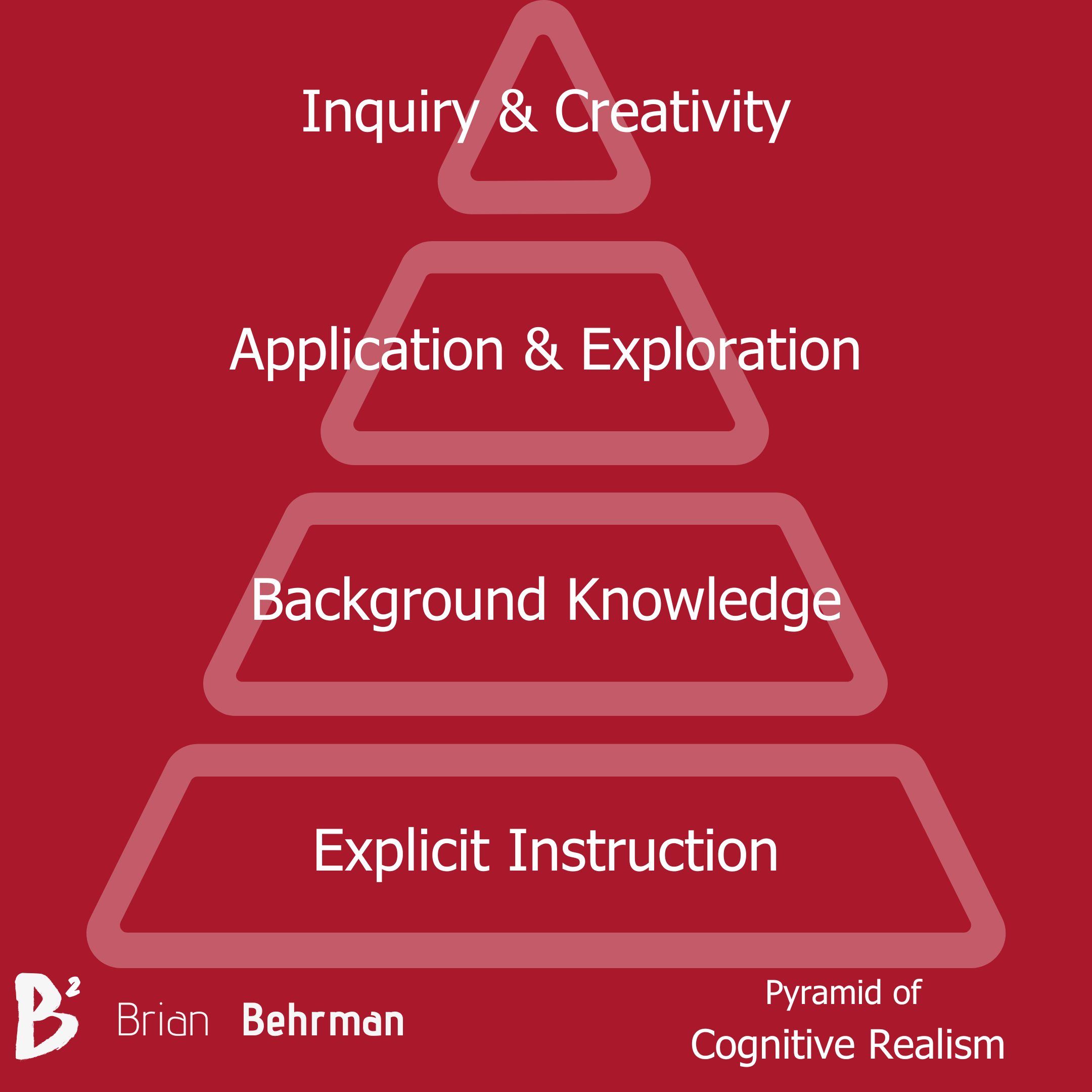
In an elementary classroom, an effective practice might look like this: First, teach sentence structure explicitly; then have students create sentences while providing clear feedback and corrections; and finally, have students experiment with writing styles during the independent practice portion of writing.
So, as a bottom line, let’s think about when one strategy might be better suited than another. The chart below lists some examples of when we might use each instructional model
| Explicit | Constructive |
| Teaching something new (or reviewing something from a previous grade) | Promoting deeper thinking |
| Fixing gaps | Encouraging creativity |
| Building fluency | Applying learning |
The reality is that in the most effective classrooms, you get a mixture of both. The teacher will cycle between modeling and guided practice until students show mastery about 80% of the time (this is the explicit instruction), then we might shift to some exploration and application (this is the constructive instruction). Across research, we see that explicit instruction is most effective for initial learning, and then constructive approaches work best after students have a strong foundation.
What would you add to the list above? Are there explicit practices you’d add? What might be a more constructive approach? Does this prompt you to reflect on your own practices? Share your thoughts in the comments below.
 The View from 518
[like] Michelle Bunnell reacted to your message: ________________________________
LikeLike