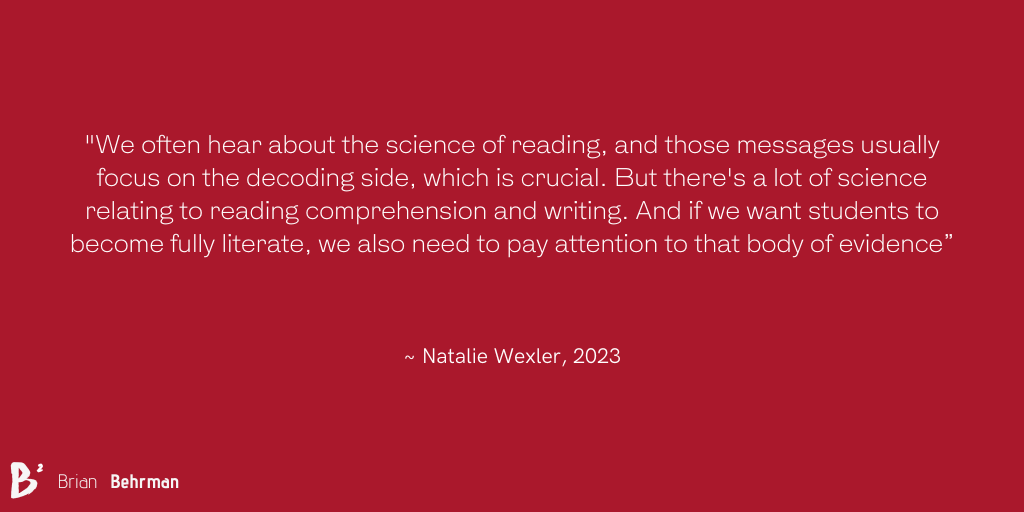
In last week’s post, I began to really dig into the concept of the purpose of reading. With our work around Science of Reading, we have really spent a lot of time, especially in our early grades, focused on structured literacy and skills like phonemic awareness, phonics, and decoding, but as Natalie Wexler reminds us:
What I was focused on in my last post (which you can see here) is digging into the idea that the ultimate purpose of reading is to comprehend the words that are on the page. At a conference I recently attended, Anita Archer shared the four things that all students must be able to do in order to comprehend:
Read the words accurately and fluently.
Understand the meaning of the words.
Have adequate background knowledge.
Focus attention on critical content.
Last week, I focused on the idea of accuracy and fluency. Today I’ll be digging into the idea of understanding words. In future posts, we’ll dig into building background knowledge and focusing on critical content.
As you know, I always love to understand the why behind what we do, so what does the research say about understanding the meaning of the words in relation to comprehension? I think we can all agree that vocabulary is related to reading comprehension. In fact:
“…one of the most eduring findings in reading research is the extent to which students’ vocabulary knowledge relates to their reading comprehension.”
~Osborn & Hiebert, 2004
I think we’d all agree that for our students to be able to read fluently, they need to know the words that they are reading. When our students don’t know the meaning of a word they are decoding during text reading, they must use context to figure out what the words mean. This added cognitive load takes away from fluency – one of the things that must be in place for solid reading comprehension.
There are several ways we can make sure that our students have that strong foundation in their vocabulary. Anita Archer suggests the following checklist to help build vocabulary:
Use high-quality classroom language.
Consistently use academic language.
Read narrative and informative read-alouds in primary grades.
Promote wide independent reading.
Teach word learning strategies (context clues, morphemes, and resources like dictionaries, thesauruses, etc.).
Explicitly teach critical vocabulary terms.
Over the years, I’ve spent time sharing about the work of John Hattie. His research says that vocabulary programs have an effect size of 0.67 (that’s pretty high, and definitely above the “hinge” point). In fact, Bob Marzano says:
“Direct vocabulary instruction has an impressive track record of improving students’ background knowledge and comprehension of academic content.”
So, what might a vocabulary instructional routine look like? This is the format that Archer suggests – just like with any other part of the five pillars of reading, it should be systematic and explicit. To do that, we should introduce the word, introduce the word’s meaning, illustrate the word with an example (and non-examples when it’s helpful), and then check for understanding. Let me take you through those steps a little more in-depth:
Step 1: Introduce the pronunciation of the word: You should display the word in some way, maybe on the screen, written on the board, or on chart paper. Then, read the word to the students and have students repeat it. With multi-syllabic words or more difficult words, repeat it several times. You might also have students read the word by parts, tap the word, etc.
Step 2: Present a student-friendly explanation: Tell the students an explanation, or have the students read an explanation with you. This might include using the word in a sentence, providing synonyms or antonyms, etc.
Step 3: Illustrate the word with examples: You might use concrete examples like having an object or acting the word out. You might use a visual example like an image or picture. Or you might use a verbal example to explain the word.
Step 4: Check students’ understanding: You might choose to do this in a few ways. You could ask deep processing questions, give the students think time, and then ask partner A to tell partner B. You might have students discern between examples and non-examples, so you might share a sentence and then ask students to say whether it is an example of the word or not. A third way you might check for understanding is to have students compare the vocabulary term with another term. You might have partner A share examples of ways the words are similar, and partner B share examples of ways the words are different.
Linnea Ehri tells us that if words have been read before and stored in memory, prediction strategies are not required for a reader to decode. When we can introduce difficult vocabulary words to our students in an explicit way before teaching, then our readers are better able to focus on their primary task in reading, comprehension.
What strategies have you tried in building vocabulary with your students? What has worked well? What hasn’t? Let us know your thoughts in the comments below!
In the past few months, I have been deeply engaged in learning a lot about reading. What it takes to support our students in their reading growth, how do we create a foundation for learning to read, how do we assess where our students are as readers, and what do we do when a student is struggling. But even with all that learning, I don’t think I’ve taken a lot of time to reflect on the true purpose of reading. What would you say if you were asked? Pause and reflect on that for a second…
There are several things you might say. Some of the ideas that pop into my head have to do with gaining information about a topic, connecting information in the text to knowledge the reader already has or for the purpose of entertainment. Personally, I love to sit down with a good book and get lost in the words on the page, although I know this is not the case for everyone. But I think we can all agree that whether or not a reader sees reading as a joyful task, it is definitely a necessary task. Ultimately though, whatever the purpose of reading may be, it’s meaningless without comprehension of the words on the page.
In a recent post, I shared a little of what I had learned from Pamela Snow during my time at The Reading League’s Annual Conference (you can see that post on the connection between oral language and literacy here). But her presentation went even deeper than that connection, it also dug into the importance of comprehension in reading. She shared the following about reading comprehension:
Comprehension will suffer if a word has been incorrectly recognized, if the text includes words that are not in the reader’s oral vocabulary, if the linguistic structure of the text is overly complex, or if the topic of the reading material is so unfamiliar that the reader cannot make inferences (“read between the lines”) that are necessary to understanding the text. (Emphasis added by Snow)
Snow, Scarborough, & Burns (1999). What speech-language pathologists need to know about early reading. Topics in Language Disorders, (20)1, 48-58. (p.51)
While I agreed with the concepts of this statement and much of what Snow shared during her presentation, I was left hoping for a bit more on the how. I get the why of reading comprehension, but what can we do in practice to support readers in this area? That’s why I appreciated the afternoon session I attended that same day with Anita Archer. Her session that afternoon was titled Comprehension is an Outcome, not a Strategy. I’ll be honest, I wasn’t immediately familiar with Anita Archer’s name, however, I was mesmerized by her presentation. First, any presenter who can keep a room full of adults fully engaged for an entire one-hour presentation has my utmost respect. Most of the time I’m at a conference, I find myself tweeting out (X-ing out now… that just doesn’t have the same ring!) highlights of almost any session I’m in. I didn’t tweet once during this session. Not because there was nothing worthy of sharing, but because I was so engaged I didn’t want to look away. If you ever have the opportunity to hear Archer in person, you should absolutely take it!
Archer’s simple definition of comprehension is the act of understanding what you have read. But as educators, what do we need to do to make sure this happens? In Archer’s opinion, there are 4 things that all students must be able to do. The student:
Reads the words accurately and fluently
Understands the meaning of the words
Has adequate background knowledge
Focuses attention on critical content
What I loved about the presentation was that for each of these sections, she gave a little information on the research of why that skill is important, a checklist of things that we as educators should do to make sure that our readers are able to carry out these skills, and then a way you might go about teaching at least a piece of that skill. Today’s post is going to dig into the way we make sure that our students can read the words accurately and fluently.
First, though, why is this important? Here are a few pieces of research that help explain why our students need to read accurately and fluently:
Cognitive science has shown beyond a doubt that fluent, accurate word recognition is a hallmark of skilled reading with comprehension.
Adams, 1990; Rayner et al., 2001
…poor readers are almost always limited by their ability to use letter-sound skills (e.g., phonics skills) to identify unfamiliar words.
Ehri, 1998; Rack, Snowling, & Olson, 1992
Based on this research, it is imperative that ALL students get to the point of reading fluently and accurately. And it’s also important to remember that reading fluency is about more than just the rate of reading. There are actually three key aspects of reading fluency: Accuracy (decoding and recognizing words correctly), Rate (the pace of reading), and Prosody (use of intonation, stress, and phrasing). But how do we help all our students read fluently? Archer put together a checklist of what we should think about in order to be sure that our students have these skills (and it’s important to remember that these skills apply to all grade levels). If we are committed to making sure that all our students can read accurately and fluently, here are the things that Archer suggests we must do at our school:
Teach foundation skills to ALL students to mastery (print skills, phonemic awareness, letter-sound associations, decoding, fluency)
Teach advanced decoding of multi-syllabic words
Provide systematic interventions on foundational skills for struggling readers
Preteach the pronunciation of unfamiliar words before passage reading
A huge part of fluency instruction revolves around modeling, practice, and feedback. Strategies that can support fluency in reading might include scaffolded repeated reading, choral reading (teacher and class read together), echo reading (teacher or partner reads a sentence, and then students read the same sentence), recorded reading (have students record themselves reading a passage, then listen and self-reflect), read-alouds, and performance reading (like a reader’s theater).
When choosing to use a passage for repeated reading or any fluency work, previewing the text as the teacher is important. Are there print structures that might be difficult for students? Are there multi-syllabic words that students need support in decoding? Are there words that students might need to have pronunciation modeled? Once you identify those challenges, take a moment to pre-teach those structures or words. For pronunciation practice, you might read the word, show it to students, and have the class echo it back to you.
When we take the time to practice fluency routines, we set students up for success. When students are more successful in their fluency, they are able to better comprehend their reading. As you begin working toward that purpose of helping your students read more fluently and accurately, you are bound to notice higher levels of comprehension.
What are some of the specific things that you have found support the fluency work in your classroom? Do you have favorite tools or activities? Share with us in the comments below!
At the beginning of the month, I had the privilege to attend The Reading League’s 7th Annual National Conference in Syracuse, NY. I went with several others from our district. The goal of the conference is to develop a deeper understanding of the science of reading and learn about the implications for teaching and learning. In the coming weeks/months, I look forward to sharing with you some of my key takeaways from this conference. There were several amazing presenters!
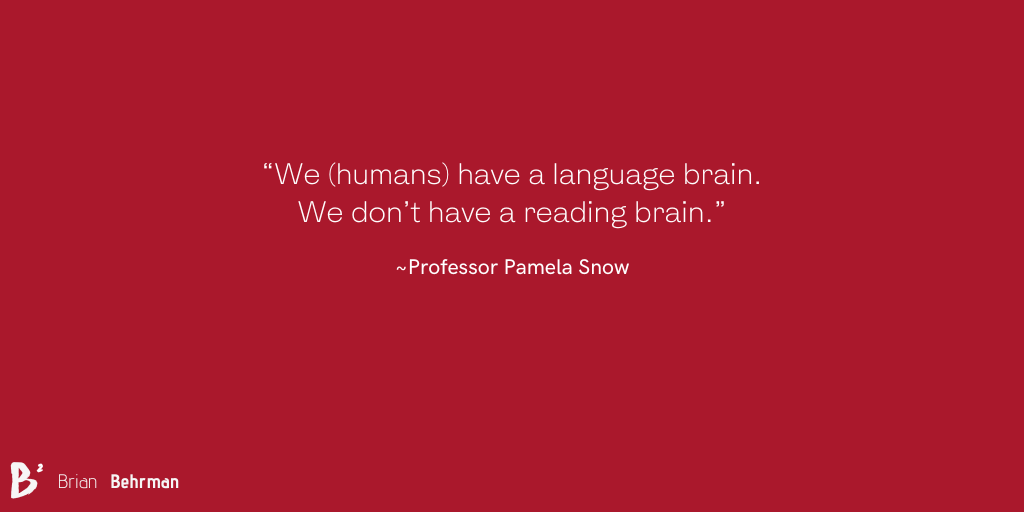
One of the first sessions I attended was led by Pamela Snow. She is a Professor of Cognitive Psychology Much of her work is centered around the early transition from language to literacy and the ways this transition is supported in the classroom. In that session, she reminded me of something that I shared in our recent PD on the Science of Reading – Human brains weren’t originally meant to be a reading brain.
The chart below was one she shared during her presentation and served as a good reminder that less than 3% of human existence includes the use of written language.
What’s important for us to keep in mind given this information is the reminder that Language is a paradox (this theory comes directly from Pamela Snow) – “Humans have evolved a special facility for oral language, such that it is innate (biologically primary). We have a “language instinct.” However, it is highly vulnerable to a range of developmental conditions (e.g. hearing impairment, intellectual disability, autism spectrum disorder, brain injury, or developmental language disorder). For humans, language is highly sensitive to environmental exposure.”
At times, when a reader is struggling with transitioning from an oral language structure to learning to read a written language structure, or as a student expands their reading skills beyond the oral language skills they have been exposed to, students may struggle with their reading. Literacy (reading and writing), builds upon oral language skills (vocab, speaking/conversation skills, syntax, phonological/phonemic awareness). When students lack language comprehension (remember the reading rope?), they will struggle to read fluently, which will impact their reading comprehension.
Readers with strong oral language abilities are more likely to develop strong reading abilities. Those strong reading abilities in turn will increase a reader’s vocabulary and background knowledge, which will further strengthen their reading abilities.
So what does this mean in practice? It means that our classrooms need to not only be a literacy-rich environment (lots of reading and writing), it also needs to be an oral language-rich environment (listening and speaking). Whenever possible, for all levels of readers, we can strengthen oral language skills by building opportunities for conversation, narrative discourse (think storytelling), procedural discourse (explaining a procedure), and expository discourse (informative or persuasive). Ultimately we can think of the oral language as the engine of literacy skills, while high-quality instruction in language development and reading is the fuel for success.
What are some of the ways you support oral language in your classroom? Share your thoughts and ideas in the comments below!
For as long as I can recall, I’ve heard people talk about how kids these days are just different. I’m sure people said it about my generation when I was a kid, and now we’re adults saying it about the students that we serve. But when you stop to think about how the world is an ever-changing place, how technology leads to innovation, and how knowledge is so much easier to access, it’s not surprising to me that kids these days would be different.
This year, our school district is engaged in phase two of the Ford NGL (Next Generation Learning) Roadmap. This roadmap is all about developing a district-wide vision to help the graduates of our district be ready for college, careers, and life beyond high school. For a long time, I’ve been talking about this idea of helping to prepare our current students for their future reality, not our current reality. When we think about learning, this roadmap will help us to engage community stakeholders to plan for the future of our community.
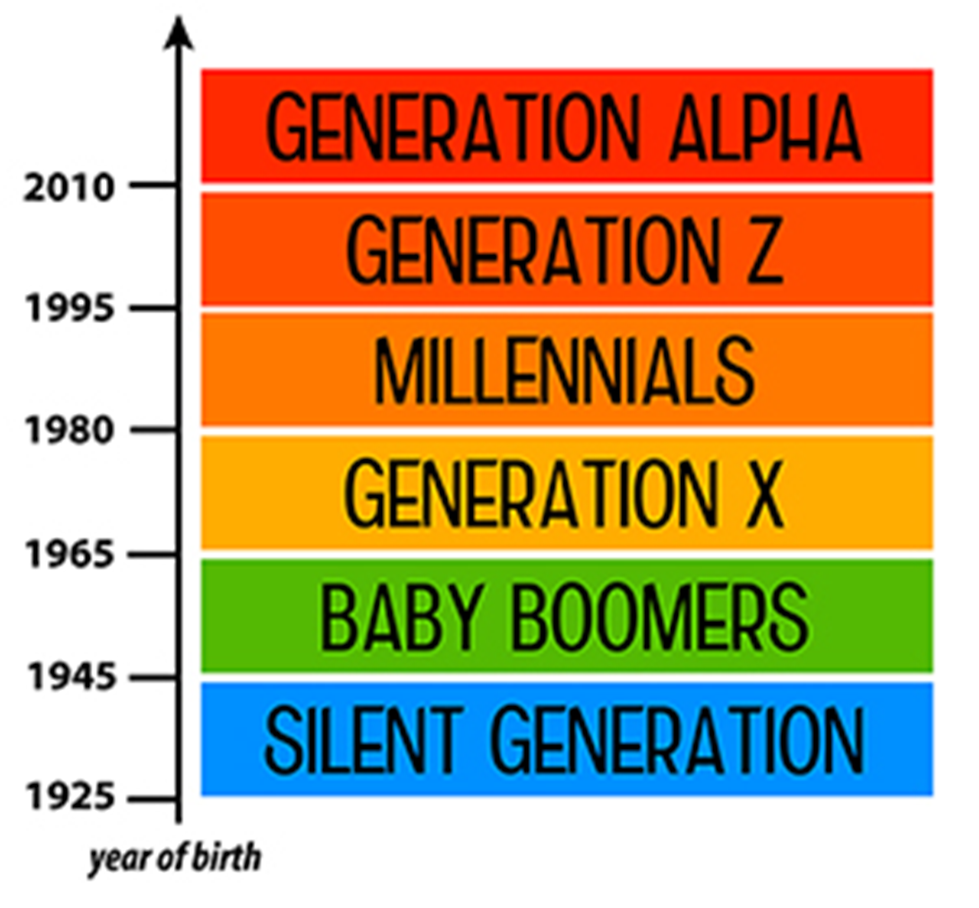
Recently, all the K-8 administrators in our district attended a two-day conference to learn more about the work we are engaged in as we begin this second phase. One of the pieces that was most fascinating to me was some discussion about generations. Personally, I am a member of Generation X. The experiences of my childhood, the time period that I grew up in, and the technologies I experienced all helped to form me into the person that I am today. What generation are you a part of?
One of the things that was shared with us was that there are certain characteristics that are generally true of most people from any given generation. Take a moment to think about how the generation you were born in might have helped to shape who you are today. Then, take a look at this graphic that will compare a bit about the different generations and the characteristics that helped form them:
As you think about your own generation, what do you notice from this chart that strikes you? I definitely noticed the Rubix cube and the Walkman, two key parts of my own childhood. The day I upgraded to the “Sports Walkman” with the yellow body and matching yellow headphones, whoa! Although I also recall the excitement of the upgrade from the Walkman to the Discman!
Now, here’s the thing, let’s think about the students that you work with most directly. If you work in an elementary setting like me, all the students you interact with on a daily basis are part of Generation Alpha. So let’s think a little bit about who they are, and then what that means for them as learners.
First, a few facts about Generation Alpha (based on the research of McCrindle and found here):
This is the first generation born entirely in the 21st century
Their lives have been shaped by:
A climate crisis
A pandemic
A mental health epidemic
Seeing their parents and relatives working remotely
Witness the introduction of Artificial Intelligence
Access to digital devices and screens their entire life
If current trends continue, Generation Alpha will be the most racially and ethnically diverse generation
If current trends continue, they will be more likely to be surrounded by college-educated adults than prior generations
They will be more likely to interact with peers online and through social media, which could result in shorter attention spans and impact their social formation
To go a little bit deeper, take a look at this graphic about Generation Alpha:
So let’s bring it back to learning. Now that we understand a bit about who Generation Alpha is, and what how they have been impacted by the environment, what does that mean for them as learners? According to “Understanding Generation Alpha” from McCrindle:
A shift in educational engagement is occurring for Gen Alpha, with schools switching from structural and auditory learning to engaging, visual, multimodal, and hands-on methods of educating this emerging generation.
Because their parents will indulge them in more formal education and at an earlier age, Generation Alpha will have access to more information than any other generation.
If we take all that we know about Generation Alpha, we must recognize that teaching students in the ways that may have worked for those of us in other generations will not work for today’s students. So what will education look like for Gen Alphas?
Skills over degrees – Just mastering a standard is not enough for Gen Alpha. They are seeking learning that feels relevant. They want skills that they know they will be able to use in their future.
Real-world simulations – How can we connect our learning within the four walls of the classroom to things that exist in the real world? Our students want to know that the things they are learning connect to life beyond school.
On-the-job training – As our students grow older, we want to seek ways to provide them learning opportunities while in the job setting.
Personalized learning – Choice for students will be so important! UDL helps to get us there. We want to provide choice and scaffolds in how to learn material, and then choice in how to show what they know.
Shared learning – Our world is relying on collaboration more and more. Shared learning opportunities will help our students be better able to collaborate.
Will learn at faster pace due to smart & voice tools, AI, and machine learning – As digital natives, our students understand how technology makes life and learning easier. Knowing that they have access to Google and AI tools, DOK 1 and 2 thinking will not push our students to the levels of thinking they will need for their future. We must work towards higher level thinking skills that technology hasn’t yet caught up with.
As I said earlier, our goal in education is to help prepare our students for their future. With that in mind, the most in-demand skills of the future work force include:
Communication – The ability to use both spoken and written communication to work with others.
Collaboration – The ability to develop constructive and cooperative working relationships with others.
Customer Focus – Actively look for ways to assist customers and clients.
Personal Learning and Mastery – The ability to acquire knowledge or skills through one’s study or experience.
Cultural and Social Intelligence – Have awareness and understanding of other’s reactions.
My hope is that you can take this post and use it as a reflection for how to shift learning in a way that better meets the characteristics of our learners. What I believe you’ll find is that as you integrate teaching methods that meet the needs of today’s generation, you will see higher levels of engagement and greater learning for our students! What ideas do you have from this post? Does the information about Gen Alpha resonate with your experiences with students? Share your thoughts in the comments below!
Let me get this out of the way up front, this one is personal and longer than most of my posts. Most of the time, the posts I make to my blog are focused on education, my learning, the work we’re engaged in at my school, and ways to support learning. Today probably isn’t going to hit on that too hard. If any of you follow me on social media, or you look at my Twitter feed, you’ll see a good number of posts in my past about things related to my fitness. I love to be outdoors, to hike, to run, and when I can’t do those things, I love to workout in my basement. But by far, the thing that has been an almost lifelong love, and the thing I find myself coming back to again and again is my bicycle.
I learned to ride when I was in elementary school, and remember that as a child of the eighties, the addition of a bike expanded the horizons of where I could go and what I could do. First, it was up and down the street, then to other parts of our neighborhood, and eventually riding down to the Village Pantry (sorry Mom, we probably didn’t ask!).
I still remember the old chrome Schwinn with the white wheels that I learned to ride on, then the Specialized Rockhopper that was my ride through most of high school and into college. I also remember an old road bike that my aunt left at our house after college – I tried fixing it up, but quickly realized I was too big for it.
In high school, a friend’s parents convinced me to do a big group ride – called The Hope Ride in southern Indiana. I don’t remember what distance we chose to ride that year but do remember riding all those miles on a mountain bike, there were great snacks at each of the sag stops, and an amazing lunch when we got back to the start-finish line. I was hooked.
In college, I bought my first legit bike. A red Specialized Sirrus road bike with 21 speeds, perfect for getting up and down the hills around Bloomington, Indiana. I rode with friends some in college, but also with my sister, who was probably a stronger rider than me at the time. I still remember a ride we went on one summer day where I thought I was riding better than her, then we turned down a road near the lake with some huge hills. Before long, she’d left me in the dust. I didn’t see her again until I got home. She gave me a hard time that day and for a few days after.
Eventually, I upgraded my bike to the Trek that I still have today. While I have a mountain bike for trails and a hybrid to tool around the neighborhood, the road bike is my go-to daily driver type bike. Most weekends I get up and go for rides, starting at my house and choosing a direction based on the weather and how I’m feeling. And when the weather won’t allow it, I probably have that same bike on the trainer in the basement connected to my Zwift account.
So, on the morning of July 22nd, when I got up to get ready to go for a ride, it was a routine I had gone through literally thousands of times. It was a beautiful July morning, if anything just a little cool when I started my ride. The sun was shining, the birds were chirping, and I was planning to ride about 35 miles. At my halfway point, there’s a Speedway gas station I love to stop at. I grabbed a coffee and a pop-tart (my favorite mid-ride fuel!) and took a quick break to top off a water bottle. Then, I hit the road for the last section of the ride home. I was feeling pretty good, so when I came to that spot where I normally turn right, I decided I’d go straight instead to tack on about 5 more miles, and a couple of additional hills to climb. In retrospect, that was a bad decision.
On the last big road before I turn into the back of the neighborhood, just a couple of miles from home, I noticed a white car coming from the opposite way. It had its left turn signal on and was slowing. I had the right of way, and everything looked normal at the time. It seemed that the car was going to stop and wait for me to go by.
The next thing I knew that white car had turned right into my path. In an instant, I tried to react, but I was on a slight downhill and was probably going a little more than 20 miles an hour. I hit my brake and swerved, but my bike hit the side of the car. I went over my handlebars and the trunk of the car, landing in the middle of the road just beyond the car. The first part of me to hit was my shoulder, then probably my head (encased in my trusty Giro Helmet), and then the rest of me. Immediately, I knew a lot was wrong. I had pain in my shoulder, my arm, my hand, my wrist, my chest, and my back. I also knew I was lying in the middle of a road, not a very safe place to be. I was able to roll my way over to the grass on the side of the road, but I knew that getting up was not an option.
Luckily there was a witness who saw the whole thing. She stopped, came to check on me, and then called 911. She waited by my side until help could arrive. She placed her hand on my chest and helped me to stay calm as we waited for EMTs. After what felt like forever (although probably only a little more than 5 minutes), local fire department EMTs were on the scene to treat me.
After an ambulance ride, too many X-rays to count, a CT scan, and the help of lots of different doctors and nurses, I learned that I had broken my clavicle, my scapula, my pinkie on my right hand, and 5 of my ribs. Luckily, there was no other internal damage – no signs of a concussion, no damage to any organs, and no injury to my spine or neck. I spent almost all the next 30ish hours laying on my back in a hospital bed. Finally, I was released to come home. When I got home, I quickly realized that simply moving was going to be a challenge for a while. Standing up hurt, sitting down hurt, getting into bed hurt, getting out of bed hurt. Picking something up off the floor was impossible.
All of this happened on a Saturday. Over the weekend, I had so many people check in on me. Texts, emails, phone calls, messages on social media, and more – I can’t tell you how good it felt to know that there were so many who cared.
Now this is the part of the story where I must pause to think about the importance of self-care. And let me preface this next section very clearly – as a leader, I understand every part of the why behind the decisions that were made. Anyone who is an administrator in a school in America knows that the last couple of weeks of July is a crazy time. There are hiring decisions to make, placement decisions, new enrollments, early enrollment assessments, and so much more. Not to mention, over the summer, I had a complete turnover of my leadership team – a new assistant principal, a new counselor, a new Teacher Development Specialist (instructional coach), and a new literacy coach. With all those things in mind, my school needed a leader, and my injuries were likely to prevent me from being able to do that job. My doctors shared with me that I might feel okay in a week, or I might be struggling for 6-8 weeks. Everyone heals a little differently.
On Monday afternoon, a little more than 48 hours after the accident, I received a phone call from my district’s superintendent. She called to check in on me, make sure I was doing all right, and ask a little about what happened. But she also, as a leader, had to have a conversation that was admittedly difficult for me. As we talked about my recovery, and what the doctors shared, she let me know that she was going to be speaking with our school board president about bringing on an interim principal to help lead our school so that I could focus on my recovery.
As a leader, I completely understood why we needed to have that conversation. And a part of me was relieved to know that I could simply focus on recovery. At the same time, I was devastated. I love my job, I love my students, and being at school is among one of my favorite places to be – especially during the hustle and bustle of the beginning of the school year.
But that phone call reminded me of a difficult reality:
You see, what this experience has reminded me of, is that no matter how much I love my job, it is just that, a job. Some people love to talk about how education is a calling – if you feel that way, more power to you. I love my job and I think I’m pretty good at it most of the time. I’m also deeply committed to helping my school be the best it can be to serve our students and community. But that job will never be as important as the other parts of me that exist. I am a:
Husband
Father
Son
Friend
And in my mind, all those roles are a higher priority than my role as a school principal. Now, do I make sacrifices in those areas at times because of the job I have? Sure. We all probably do.
But I know that I can never be replaced in any of those roles. I can be replaced in my job. The experiences of this summer showed me how quickly that can happen.
For a long time, I have shared with my staff that we will never be able to be our best as educators if we don’t take care of ourselves outside of school as well. As the saying goes, you can’t pour from an empty cup.
Those four roles listed above fill my cup to the max, and while there are a lot of times that my job helps keep my cup full, there are also times that it drains the cup.
My hope is that none of you ever must go through an experience like this. But it’s also my hope that you can take a little bit of wisdom from me – Make sure that you find the balance between the things that are most important to you and your job. My experiences have certainly done that for me!
Remember that while some call teaching a calling, it is just a job. And if/when something happens, we can all be replaced.
This work can be never-ending. I know that I always have something else I could do. But at some point, I must weigh my time spent trying to be the best administrator against the time spent being a person. So next weekend, when you feel yourself being pulled in multiple directions, make sure you do the thing that helps you to feel whole. Because you can never be there as an educator if you aren’t able to be there as a person first.
I wanted to add a brief post-script about my recovery in case you are wondering.
I am almost 6 weeks out from the injuries sustained in my crash. I would say that my finger is completely healed. Most of the time, my ribs feel pretty good, but I still feel a bit of pain if I take an awkward step or a deep breath. There’s also occasional pain when I get into or out of bed – you use your core a lot for those things, and it pulls on the ribs. At my last ortho appointment, my doctor said he was pleased with the progress my shoulder is making. The clavicle is looking pretty good, but the scapula wasn’t quite as far along as he would have hoped. I have follow-ups scheduled soon to find out more.
I missed 2 weeks of work and was then feeling pretty good. I was able to get back to school in time for the first teacher workday, which felt wonderful. I will say that I am still moving more slowly and cautiously. I find that I have to sit down to relax my arm and shoulder. As someone who almost never sits during a typical school day, that’s a challenge!
I still can’t run, hike, jump, or bike outside. But I have been going for long walks around the neighborhood to rebuild my stamina. I’ve also been cleared to ride my bike while it’s attached to the trainer in the basement – there’s less risk of falling! I’m getting reacquainted with my Zwift account and feel good on the bike most days.
There have been a couple times with minor setbacks, but overall, I can feel myself trending back to a healthy place. While I’m not 100% yet, when I compare how I feel now to how I felt right after the crash, it’s hard to even compare!
In December 2009, I decided to sign up for a Twitter account. Some of my friends were talking about it, and at that time I was noticing more places would share their Twitter handle on advertisements. Like most people, after signing up, I started following people or accounts I was interested in. On that list, I added friends, some favorite athletes, a few news sources, and people from pop culture. In the beginning, I was mostly a “lurker.” I followed conversations, but never posted or replied. I would log in from time to time, but it wasn’t something that I utilized on a regular basis.
About three years later, I was driving to school when I heard an interview that gave me a fresh perspective on the potential uses of social media as an educator. On Morning Edition on NPR, I heard Scott Rocco talking about this weekly Twitter chat called #satchat. Scott and Brad Currie, another superintendent in New Jersey, co-founded #satchat as a chance to have a discussion on important topics in education through social media channels so that more people could be involved. At the time of the interview, there were about 200 people that participated in this weekly chat.
It was the fall of 2012. I was a classroom teacher at the time. In addition to my teaching responsibilities, I was coaching junior high football and basketball and had 2 young children at home. I was busy! I knew that I wanted to continue to grow as an educator, but I didn’t necessarily have the time for book studies and conferences. I needed something that could be a little more on my own schedule. Hearing about #satchat let me know that maybe there was another way for me to learn that could be on my own time. That radio program taught me that an app on my phone could connect me with educators and emerging leaders in education from all over the world.
Soon after I participated in my first ever #satchat. I don’t recall the specific topic, but I did start following several of the other educators that were active in the chat. Since then, I have looked at Twitter as my own Personal Learning Network. While I still use social media for a variety of purposes (I still follow athletes and pop culture icons, and it’s often the first place I look for news on just about any topic), it is also my go-to resource for growing as an educator and leader.
This belief about social media was only reaffirmed as I listened to Matt Miller at Ditch that Convention in 2017. I don’t want to steal his story, and some of you may be aware of who Matt is. During the keynote, he said:
Matt was the lone Spanish teacher at a small rural school in western Indiana. As the only teacher of his subject in his school, he felt that he struggled to create meaningful learning opportunities for his students. Eventually, he found a Professional Learning Network through Twitter and realized there were many more possibilities for his students. His learning through Twitter led him to begin presenting to countless educators, writing multiple books, hosting podcasts, and more. Without those connections created through Twitter, he felt he might have burnt out, and eventually left education.
So, here’s my suggestion to all of you reading this – If you aren’t on social media to learn as an educator, start making use. Twitter is still my go-to source for learning from others and sharing about amazing things happening in my own school and world, although others prefer to use Instagram, Facebook, or even TikTok. If you follow me, you’ll see posts about things happening in my school and district, but I also share pieces of my personal life as well. I like to be able to be my full self.
If you are new to using social media as an educator, seek out people in positions like you. When I moved into my current role, I began following as many elementary principals as I could. Next, learn to use hashtags! Some of the ones I check in on regularly still include #satchat on Saturday mornings, but I also like to look at #echat, #edleadership, #PLCatWork, and #TLAP. As you check out those hashtags, start following anyone that is posting things you are interested in, or would like to learn more from.
As an educator, I believe strongly in the importance of lifelong learning. While there are lots of different ways that we can learn, one of the greatest sources for me in the past 10 years has been through social media. The portability of my phone allows me access to the world no matter where I am or what I’m doing. If you’re new to the world or social media in education, feel free to seek me out. I’m @brian_behrman on both Twitter and Instagram.
Now, go on and build your own Personal Learning Network!
During the first semester, I wrote a post based on a tweet from Brad Weinstein. That tweet included this graphic:
The post was titled “The reason behind the behavior” and really focused on the fact that so much that happens to the children who walk into our school each day is well beyond their own control. As adults, it’s important that no matter the why behind a student’s behavior, if we can create a warm and caring environment, students will want to be here and do their best (If you’d like, you can see that post here). The graphic above and the post brought up some of the traumas that impact our kids and their ability to be ready to learn.
After sharing that post, I got a response from one of the teachers at our school. This is what she said:
I enjoyed reading this blog and agree with how students can show up with so many unknown traumas. My number one strategy is just to be kind.
Another thought that I had is that there are staff members that show up with unknown trauma, and because we teach all day, we feel like we need to be “on” all the time. This can be really hard to do when you are the one in front of the class teaching all day and some days feeling like you don’t have time to just sit and decompress.
I guess I just wanted to respond because I just think it’s important to always keep in mind that both kids and adults can carry unknown trauma. (Although adults know how to deal with it better.)
Even though this response came from a teacher almost 6 months ago, I’ve been thinking about it a lot. That idea of being “on” all the time is something that I’m quite sure we all feel. Teachers are great at showing up and putting a smile on their faces to create positive learning spaces for their students, no matter what might be going on in their heads. Sometimes we face trauma of our own in our lives. Other times, we take on secondary trauma when students share their own trauma with us.
But the reality is that if we can’t take care of ourselves, if we can’t take care of our family, how can we ever be expected to take care of the children that walk into our classrooms each day?
So here are some thoughts on how we might help take on the trauma that the adults in schools have to take on:
Have a person – In every school that I’ve worked in, I’ve found the ability to have at least one “buddy” that I feel like I could share anything with. I’ve talked to colleagues about stress, loss, sadness, and about celebrations. Knowing you have someone you can turn to (and maybe more than one person) can be such an important part of keeping ourselves balanced. If you don’t yet have that person, what can you do to create that type of relationship? And if you notice someone who appears to be off their game, you could check in. Sometimes just knowing someone noticed is more than enough for me!
Use your prep time – I feel confident in saying that I am not the only person who went back to my classroom during prep time, closed the door, and took a moment for quiet, or maybe even for a quick cry. Sometimes when we’re going through our own trauma, we just need some solitude. I’ve mentioned mindfulness in some of my past posts, and when I’m having a really rough day, I pull up the Headspace app (free to K-12 educators – click here for more info) and select a session that fits my needs – there are different topics and genres or you can just select the next one cued up in your list. Taking a few moments to yourself can allow you to get recentered in a moment when you don’t have to be “on.”
Take care of yourself outside of school – For those of you that know me well, you know that I’m big on getting my exercise. It’s part of what helps keep me balanced. I get up and get my movement in before the day even really starts. This morning when the alarm went off, I didn’t really want to get up, but I knew that I had a lot on my to-do list at school, and then after school, there is family stuff too. Occasionally I will allow myself to sleep in a bit and then do something after school. Because of my schedule today, I knew that wasn’t an option, so I went ahead and got up. Once I was up and moving, I felt so glad that I made the choice I did. Now, I’m not saying you must do what I do – exercise might not be the thing you need to keep yourself balanced, but hopefully, you have some hobby that helps you unwind and relax. Finding a way to disconnect maintains that healthy balance and boundaries between your professional and personal self.
Do things to minimize decision-making – Think about how many decisions we make as educators each day. I’ve seen blog posts that suggest that during a typical school day, educators make 1,500 or more educational decisions. I can’t find any data to back that up, but the number seems almost low. Teachers are managers of their classrooms, content holders, master communicators, and support systems for our students. Decisions fatigue is a legitimate thing! The more decisions we make in a day, the harder it is for our brains to make more (that’s why the brownie sitting on the counter after dinner turns into the evening snack instead of the grapes in the fridge – we all know what’s the healthy decision, but our brains are fried!). To avoid having to make additional decisions, there are some things I do every evening to remove some of those morning barriers. I set up my coffee and breakfast things, I make sure my school bag is packed, I set out my workout gear prior to going to bed, and I pick out my clothes for the next day. The more choices I make in the evening, the less I have to worry about in my day, which allows me to spend my morning preparing for my day. Be thinking about how you can remove some of the decisions from your day.
It’s so true, as a colleague suggested, that the adults at school have trauma too. We are human. But if we take steps to help ourselves stay balanced, we’re better able to create the kind, caring, and supportive environment that our students require to find their own success. And know that the people around you are masters at helping people (typically their students) handle their traumas. Turning to those you are closest to can help with your own care.
What are some of the things that you do to maintain that balance? What could you try that you haven’t previously used when you are having a day that you don’t quite feel like you can be “on?” Share your thoughts in the comments below!
Recently, I attended my annual recertification in Mandt. For those of you not familiar, Mandt defines itself as “a comprehensive, integrated approach to preventing, de-escalating, and if necessary, intervening when the behavior of an individual poses a threat of harm to themselves or others.” For me, the most important, and most utilized aspects of this training are the concepts of relational interactions and de-escalation. But while I have participated in this training many times, this time something new struck me – the importance of teamwork.
I have long thought of the people I work with as my team. We are all engaged in work with a similar purpose – to have a positive impact on our students in terms of learning and personal growth. When we’re going through the training in Mandt, we are taught about how powerful teamwork can be in the process of de-escalation and/or intervention. But, teamwork applies to so much more of the work we do in schools too!
Recently, I have had a few posts related to the importance of the work we do within our PLC team. If you want to look back at them, you can find “Habits and teaching” here, and “Thoughtful in what we do” here. As stated before, a team is defined as a group of people who are working together toward the same goal and results. My hope is that does, or will, define the PLC team that you are a part of. If you don’t know that you can currently define your team in that way, my hope is that this post will help you to build a truly collaborative team that has common goals and results they are seeking. Even if you can define your team in that way, hopefully you’ll have some things to reflect on to strengthen your team even more!
In 2013, Steve Kozlowski and Bradford Bell released a review of a great deal of research on teams titled “Work Groups and Teams in Organizations” (you can access the full piece here). Two key points garnered from this work are:
Psychological safety on the team contributes to team success.
When we believe our work is interdependent there is higher information sharing, team learning, and team effectiveness.
This reminds me of something else that I’ve written an awful lot about – Collective Teacher Efficacy. As a reminder, that concept says that there is a shared belief that through their collective action, educators can influence the outcomes and increase achievement for all students.
Now, here’s the reality that I know we sometimes don’t talk about openly enough – not all teacher teams are holding themselves accountable to these beliefs. Sometimes, a PLC team goes through the motions of doing the work of the PLC but doesn’t see the influence on student outcomes and increased student achievement that we might hope for. I have a couple different theories for why this might happen, but today’s will primarily focus on the work of the team.
A few years ago, John Spencer wrote an excellent blog post that ties into this concept of teamwork. That post was titled “The Difference Between Cooperation and Collaboration.” You can see that post here, or watch a short YouTube video from John here. He argues that for healthy teamwork to exist, you have to have both cooperation and collaboration, so really they are not versus, rather they work in tandem with one another to strengthen teamwork.
This graphic shows a bit about what John sees as the difference between cooperation and collaboration:
Think for a moment about teams that you have been on. What do you recall about the teams that felt the most successful? What about the teams that felt the least successful? I’m guessing that for most of us, the teams we remember as being the most successful probably had a high culture of collaboration. But one of the things that John points out is that in a collaborative team, we sometimes grow stagnant.
So, for our teams to be successful, we need to be both cooperative and collaborative. How do we get there? Kenneth William, a former teacher and administrator shares that the key to making sure that our teams operate in a state that leads to efficacy we need to not only have norms for the way we do work, we must also have accountability protocols (You can see his article on this topic here). In my school, at each team meeting, we start by doing a brief review of the team norms. This is also a time for discussion about whether we need to add or change a norm.
But something that we have not yet implemented is an accountability protocol. I’ll be honest, it’s not something that I’ve thought about a lot because once we set norms, we all generally have this optimistic belief that no one will violate the norms. But setting an accountability protocol is the way we answer the question “What is our process for holding each other accountable in a respectful and dignified manner?” Maybe your team has a norm around not allowing any one person to dominate the space, and yet there is a member who continually does dominate the conversations. What do you do? If you don’t talk about an accountability protocol when setting your norms, it may feel too uncomfortable to let that person know that they are dominating the space. One thing I know about most of us as educators (I’m raising my hand here) is that we don’t ever like to come across as rude!
Here’s what Williams says are potential scenarios if we don’t address accountability protocols:
The norm violation is not addressed, and as a result, unspoken tension and frustration grow within the collaborative team.
The norm violation is addressed, but inappropriately. With no established protocol, the reaction to the confrontation becomes defensive.
Too early in the process, the team takes the issue to the principal for him or her to handle.
Going back to the graphic from John Spencer, what happens to the collaborative culture if one of these scenarios happens to our team? What will that do to our collective teacher efficacy? I’d argue that not having accountability protocols will prevent your team from reaching its potential. As educators, that should be very concerning. So while some of us might struggle with how to hold others accountable, a failure to do so is a failure of our team to do the work.
So pause for a moment to think about the team that you are a part of now. Is there a healthy collaborative culture? Are your students learning and growing at the rate you’d hope? Does the culture of your team feel good to all the members? Then you probably are in a place where you have been holding one another accountable as a collaborative team, but also as a team that is excelling in the work. If the answer to any of these questions is no, I’d suggest that you need to go back first to your norms to make sure you have a shared understanding of what those norms mean. No matter whether your team is high-functioning or not, you need to then do the work of setting some accountability protocols in case something doesn’t go well.
I’d love you to share your thoughts. Does your team have accountability protocols? If yes, what does that look like for your team? Sharing some ideas might spark a system for others who don’t. And if you don’t have accountability protocols, what steps can you take now to help set something up? Or what ideas do you have for ways you might hold one another accountable? Let us all know in the comments below!
In last week’s post, I was talking about the way the human brain processes language (you can see that post here). Those processes include the phonological processing system, the meaning processing system, and the context processing system. These systems help the human brain listen to what others say, respond with words and sounds, and understand what those words mean within the context of what’s being said. As homo sapiens, this brain has adapted over the past 200,000 years to process language that is spoken and heard.
As I shared last week, for most of human history, words only existed in verbal form, so the brain was ready to process that information. With the development of a written language, a new process had to be developed within the brain.
Now, I’ve got to pause here for just a moment to share just how fascinating the human brain is! It constantly is redeveloping itself, adapting one portion of the brain for new uses, and learning from past experiences. From some past learning, I know that a portion of what now makes up the orthographic processing system in our brain used to be used by the same part of the brain that helps us to recognize faces. When someone looks familiar to you, your brain is using similar areas of the brain as when you look at the letters on the device you are reading from right now. Think about how the human brain has had to adapt in the last 20ish years of the digital age. But the difference is that skills like reading must be learned by the brain. On the other hand, the language processing system is online for each human even before birth.
So here is how the brain had to change. With the development of written language, a new processing system had to be developed in the brain. We call this the orthographic processing system. This system is able to learn to recognize letters, and then eventually letter strings. In time, those recognitions come to feel almost immediate. To a proficient reader, most words seem to become sight words.
So what does this mean for us instructionally? It means that once our students have a strong foundation of language comprehension, the next step is to support them in phonemic awareness. This means that students need support in first noticing, articulating, and manipulating the smallest sounds in words. Eventually, after they have strong phonemic awareness, then we move into phonics where we begin connecting the sounds we hear in spoken language to the letters that make up those sounds.
In Shifting the Balance, there are a few shifts in instructional practices that Burkins and Yates suggest. Here are just a few things you might consider:
High-leverage instructional routines – We might start with skills like noticing how sounds are made, then progress into putting sounds together to make words, then take words apart, then listen for similar sounds, then taking sounds off a word, and finally changing one sound to make a new word. These phonological awareness skills help build the sound knowledge that students need prior to bringing the orthographic processing system online.
Word lists – There are several different resources that I have seen that could be used at various grade levels to assess students understanding of the various skills. In the district where I work, we could utilize the differentiated spelling lists that go with HMH/Into Reading, or we have access to the digital teacher’s version of Words Their Way. If you’re looking for another source, there are some excellent decodable word lists sorted by skill that were put together by Burkins and Yates as part of their work on Shifting the Balance. You can find those lists on their website here.
Multisensory scaffolds – Utilizing tools such as Elkonin boxes with chips or counters, then progressing into letter tiles or magnets. Burkins and Yate point out that these multisensory tools might be especially important when a task is new or students are struggling.
Assessment plan – As with any other skill that we want our students to know, formative assessment should serve as our guide along the way. Are there phonemic awareness skills that some or most students still need to develop? Do we need to create or utilize a more formal assessment to check your student’s phonemic awareness? This information will help us to know when it’s time to make the jump from focusing on the sounds in phonemic awareness to the point where we add in the work of connecting letters to sounds in phonics.
Just as with most other forms of learning, there is a progression that most students follow, first learning the skills of recognizing words in a sentence, then breaking words into syllables, then noticing beginning or ending sounds, and eventually identifying all the sounds of the word. When students miss steps along this progression, they might struggle further down the line. What I’m recognizing now is that many of the students who came to my classroom as a 5th or 6th grader who struggled with reading skills were probably missing some of those early phonemic awareness or phonics skills. Backing up and supporting some of the early language fluency skills might have helped them develop the skills they needed to be more successful readers. Hopefully for those of you who are teaching students who have reached the stage that we expect them to be “reading to learn,” there are some steps here that you might be able to integrate into instruction for your students.
What are your takeaways from this? What will you commit to trying based on this new learning? Share your thoughts with us in the comments below!
Not that long ago, I wrote a post called Science or craft (you can see that post here). One of the things I talked about in that post was the fact that I felt as an educator, being involved in a series of “Reading Wars” was not beneficial to the concept of learning and growth. In my view, one of our goals as an educator should be to learn as broadly as we can on the topics that matter to us. As an educator who has an impact on some of the earliest learners, literacy must be a big part of my focus, and therefore it must be an area I am seeking continual growth. That has in turn led me to ongoing learning about the Science of Reading.
In the post referenced above, I shared that it felt as though there are some who view the teaching of reading as having two sides, and neither one saw value in the other. It made me a bit uncomfortable because I had taught in a Balanced Literacy Classroom for years of my career as an educator, and while that format had worked for me as a learner, and felt comfortable to me as a teacher, I could also see that there were kids who were not learning to read at the level they needed to. You see, I spent all my teaching career as a fifth or sixth-grade teacher. Once students reach that level, for the most part, they are no longer learning to read, rather they are reading to learn. As a content area teacher – teaching both science and social studies over the years as an intermediate school teacher, I expected students to come with me ready to use their reading skills to learn about our topics and standards. I did not feel equipped at that level to intervene and support their reading skills.
Over the years of working with some talented colleagues, I eventually better understood how to support my students who came to the classroom without strong reading skills – finding lower-level texts on the same topics, providing students with read-aloud recordings of the text, and more.
But in my current role, I now feel the challenge of how I help ensure that the students who leave my school are prepared to read to learn in their intermediate school classroom. I began to look for ideas that supported my beliefs about a learning environment, while also fulfilling the needs of students as learners. Luckily, I have a wonderful coach who I work with that recommended the book Shifting the Balance: 6 Ways to Bring the Science of Reading into the Balanced Literacy Classroom by Jan Burkins and Kari Yates. I’ve been digging into that book for a little while and found myself texting our coach on the evening I started the book telling her that I had lots of things to talk to her about.
Based on my reactions to the short time I’ve been reading this book, I’m guessing that this will not be the last time you see me referencing it here, but I want to share with you one of my biggest aha moments so far. And it has to do with how the human brain has developed.
Going back to the earliest humans, the only way to share information was through the passing of stories verbally. What this means is that our brain got good at listening to what others said (this happens in the phonological processing system) and being able to respond with our own words and sounds. Hearing someone else speak would then cause our brain to retrieve the meaning of the words we hear (this happens in the meaning processing system). Then our brain uses our background knowledge to help us understand what meaning fits the context of what’s being shared (this happens in the context processing system). I imagine these different parts of the brain as something of a triangle, with information passing back and forth through each of these processing systems.
These three processing systems are genetically wired into the human brain and are a part of the system of thinking that we are all born with. It’s why a young child can often understand words before being able to say them. It’s why, even though I haven’t taken a Spanish class in over 20 years, when I hear someone speaking it, I am able to make meaning of pieces of that conversation.
This combination of processing systems has developed in the homo sapien brain over the last 150,000 to 200,000 years. So what that means is that our brain has adapted over that time to make comprehension of spoken language to be a natural skill that our brains can do. But written language has been around a lot less time than that. You see, most scholars generally agree that humans began utilizing written language about 5,500 years ago. Let’s think about what that means – for a little more than 97% of the history of modern humans, words only existed in their verbal form. After being spoken, they would disappear into thin air. Then, somewhere around 3,400 BCE, in Mesopotamia (modern-day Iraq), some of the earliest written language was developed. Now, the things that one person said could be recorded, exactly as they had said them, in the form of symbols, and be shared over and over again.
The huge aha moment for me comes from this point – written language is spoken language saved for later retrieval. Once retrieved, written words are put back into spoken language. I’m assuming that when you read, you can hear your own reading in your head. The speaking part of your brain is saying the words, and the listening part of your brain is hearing the words. What this means is that if our students cannot understand words and language when they are spoken, they will not be able to comprehend those same words and sentences when they read them.
As Burkins and Yates point out:
What Burkins and Yates go on to point out is that opportunities to grow oral language actually help develop the comprehension mechanisms of reading. Now, let me be clear, just because a student has strong verbal comprehension does not automatically mean that they will be strong in reading comprehension, but it is definitely a stepping stone along the way. So, what does that mean for us in practice in the classroom? The following bullet points are ideas shared by Burkins and Yates, along with some of my thoughts relating to them:
Have a way to support language comprehension in your classroom – This would include utilizing read-alouds with rich language, things that will stretch your students’ thinking. Next, think about gathering text sets on a topic or theme representing multiple levels. Finally, have instructional routines to build and extend language (this includes conversations started by the teacher in a one-on-one or small group setting, questions to get students to explain their thinking, wait time for students to think and process, and repeating back to students what you heard them say so that they might be able to expand on it).
Use interesting words – One of my favorite things used to be encouraging students to notice and share interesting words they came across in their reading. We would use these words to create a list of interesting words that we kept in our writing notebook. Depending on your level, you could do something similar, or you could help students notice interesting words in your read-alouds to create your own list.
Engage in dialogic conversations – In their book, Burkins and Yates share a graphic on dialogic conversations. Check out the graphic below for a little more about what this might look like.
Ultimately, as teachers, one of the best ways we can help improve the three processing systems above is to create time and space for language within your classroom. This might be during a gentle entry time where students can play and talk, it might be in a daily community circle where students speak to one another and respond to interesting topics, or it could be through one-on-one or small group conversations happening during learning time either with the teacher’s support or with peers (think a turn-and-talk or small group discussion). The more work we do to support students in language comprehension, the more we help those processing systems be better prepared for reading skills.
Next week I hope to take a look at the next step – what happens in the brain when we start to feed written language into it, and how that has changed the processing systems that developed in the brain.
What strategies do you use to bring language into your classroom? Share with us in the comments below.








 The View from 518