Logistics over learning?

Logistics over learning?

Recently I have been spending a lot of time thinking about the power of learning in the school setting – not just for students, but also for the teachers and staff of our school. In turn, that has led me to look into the history of public schools in the US. As a quick refresher, American public schools were originally organized according to the concepts and principles of the factory model of learning. Around the late nineteenth century, effort had been put into the creation of school in the image of a factory. One of the books that exemplified this was Frederick Winslow Taylor’s book Principles of Scientific Management. Taylor argued that “one best system” could solve any organizational problem. In this theory, it was the job of a manager to identify the best way, then train workers to do so. This hierarchical, top-down management created a rigid sense of time and accountability. This process is best modeled by the assembly line that existed in factories of the time. The advantage of an assembly line is that the parts that made up the assembly line were viewed as interchangeable. Any worker could complete any role with the appropriate training. Business leaders and politicians argued that schools should adopt a similar model to produce the kinds of workers that were needed in industry. 

Now, I see a lot that is problematic in this quick overview above. First, “one best system?” Does that ever exist anywhere? I think if we looked at factories and assembly lines of today, we would find them to be vastly different from the version of the early 1900s. Innovation has changed the process. Schools need to keep up with those changes. Next, do schools exist in a hierarchical, top-down model? I mean, they may exist, but my experience is that they are not super successful overall. Finally, there seems to be some important voices left out of the creation of a school model based on the factory – educators! Shouldn’t their voice, their knowledge be at the table when we are trying to build a system of learning? That may be the mindset of many educators now. But in the 1900s, most educators went along with the plans set forth. Check out this quote from Ellwood P. Cubberly, an American Educator, author, and Dean of the Stanford University School of Education: 

“Our schools are, in a sense, factories in which raw materials (children) are to be shaped and fashioned in order to meet the various demands of life. The specifications for manufacturing come from the demands of the twentieth century civilization, and it is the business of the school to build its pupils according to the specifications laid down.” 

Ellwood P. Cubberley (1868-1941) – American Educator, author, and Dean of the Stanford University School of Education

This thinking quickly became the standard for schools and school districts. A whole new hierarchy was set up, similar in thinking to the business: decisions would flow from the state board of education down to local school boards, on to superintendents, then to principals, and finally to teachers who would, like factory workers, be expected to follow the guidance in lockstep. The students did not matter. They were no more than raw material in the formation of a more perfect industrialized workforce. 

I would love to be able to say that this thinking from the 1900s has left, but I cannot. Those factory model mindsets still prevail in many school settings here in America. If you ask politicians what is needed to make education more successful, they will talk about stricter standards, better methods of evaluation of teachers, or possibly a longer school day or year. The focus, far too often, seems to be on procedures rather than results. And that brings us to the title of today’s blog. Far too much time is being spent on logistics instead of focused on learning. But when we talk to business leaders, many of them are saying that they are not able to find workers appropriately prepared for the workforce. They are telling us that the skills workers need have more to do with collaboration, teamwork, and problem solving. Check out these results from the National Association of Colleges and Employers Job Outlook Survey. These results come from the 2020 version: 

NACE Job Outlook Survey

Think about the conversations you have at school. If you are like me, far too often we get drawn into conversations about the organization of the schedule in the day, the length of a school day or year, the teaching of a prescribed curriculum, the size of a class, the use of a textbook, or the number of credits earned. Far too little time is spent paying attention to whether learning has occurred. And how do any of those conversations help us prepare kids for the future that business leaders say they need?  

So here is the nudge – let us all take a moment to think about how we can move our conversations away from trying to identify the “one best system” and move towards a mindset of wanting to “get it right, and then make it better and better and better.” 

So, what might that look like? It might mean trying something totally outside the box. It might mean piloting a new strategy. It might mean utilizing supplements to your curriculum from online sources like Kahn Academy. When we analyze how kids are doing, and we really think about the results, we must recognize if the steps we are taking are impacting student learning. If the answer is no, then we must analyze what we will do to reach those kids. And if the answer is yes, then we must think about what we can do to extend that learning even further. 

The reality is that the top-down factory model is not adequate for meeting the needs of our students. It is not adequate for preparing students for their future. We need to shift our goals to really invest in what we can do to get all students to master rigorous content, learn how to learn, pursue a productive level of employment, and compete in the global economy. 

If you take a moment to read between the lines of what this entails, you might notice something. In our professional learning community, we have four guiding questions: 

  1. What do we want students to know and be able to do? 
  1. How will we know they have learned it? 
  1. What will we do when they have not learned it? 
  1. What will we do to extend the learning when they already know it? 

I think the power to shift the system exists within each member of a school. By participating in meaningful professional learning communities, we can take that top-down approach from the factory model, and flip it on its head. We can take control of what needs to happen in our classrooms to provide support to our students. 

What steps can you commit to in order to make a shift in your practice? What do you need to be able to take the next step in that shift? As Nike likes to remind us, Just Do It. Too often in education we get stuck in the planning phase, and not moving into the action phase. Act today! 

Celebrate small victories

Celebrate small victories

I was recently listening to an episode of How I Built This, an NPR podcast hosted by Guy Raz. In a typical episode, Guy dives into a conversation with innovators, entrepreneurs, and idealists to learn about the stories behind some of the world’s best-known companies. In a typical year, there would be a How I Built This summit that would bring together some of the great minds in business and innovation. As we know, life for the past 18ish months has not been normal. As a result, the 2021 version was hosted online. This month they have been releasing some of the interviews from the online summit in the podcast feed. One of the recent episodes was a conversation with Brené Brown (You should really take a half-hour and give it a listen! It is phenomenal!) 

This is not the first time that I have referred to Brené on my blog, but it seems that no matter how much I read by and about her, or how much I listen to her speak, I walk away with something new. In this episode, the conversation revolved primarily around the topic of leadership. According to Brené, good leadership means practicing four key skills: Bravery; Trust; Gratitude; and Vulnerability. Now I know that this blog is written primarily for educators and that most of the readers are classroom teachers. It might not always be easy to see the connection between being the teacher in a classroom and being a leader, but the connection is undoubtedly there. As a classroom teacher, you set the standard of learning and success for the students in your classroom. You build trust with and between your students. You practice gratitude with your students and their families on a typical day. And I really do not know any teacher who has not had to model some vulnerability with their students. 

In traditional leadership, we often think of businesspeople who led massive companies from a position of absolute power. They make the rules, hand them down to their managers, and then managers enforce those rules upon employees. There are lots of real businesspeople out there that might fit in this category, but one of the TV shows that I found during Covid quarantine was Succession on HBO. The show centers around the Roy family, the owners of Waystor RoyCo, which is an imaginary global media and entertainment business. Logan Roy is the patriarch of the family and the CEO of Waystar. His leadership could never be described as meeting the four key skills that Brené shares. In contrast, traditional business leaders (including Logan Roy in Succession), lead through fear-inducing, hard-driving, fist-pounding attitudes. Large corporations are also not particularly good at celebrating success. Often when we think about large corporations, the focus is on the bottom line. How much profit did we bring in? What percentage of the market do we control? There is seldom time in these types of businesses to be happy about small successes. Did we make a customer happy today? Did one of our employees produce a solution to a problem that existed in our company? 

What I loved in listening to Brené speak was hearing her perspective on the importance of celebration. She went on to talk about how sometimes we only want to celebrate the important things because there is this belief (that is not backed up by any kind of research) that if we celebrate the little things, we will never make it to the important things because people will “take their foot off the gas.” But in the research that Brené has done as a research professor at the University of Houston, she has found the opposite to be true. 

Often in moments that should bring us pure joy or happiness, our brains take us to a place of sadness. Let me give you an example from my own life: I love to ride my bike. In the summertime, I rode 3 to 4 days per week. On one of my routes, there is a bridge that goes over the interstate near my house. When it was built, the side rail of the bridge was designed to be low. Since there is not a sidewalk along the road, the designers probably wanted to save some money. But when I ride across that bridge on my bike, I have this irrational fear that if I get too close to the edge of the bridge, my bike and I will fall over onto the interstate. You might have your own version of irrational fear in your own life. 

For whatever reason, our brains seem to dress rehearse tragedies. Some might say that these moments help us to adapt, to do things that are less dangerous, but I would say that is bunk in this case. While I have fallen off my bike before, it has never happened when I was riding intensely. It only happens when I am relaxed, when I am not really paying attention, and typically also when I am moving slowly. I ride my bike because I love it. Because it brings me joy. But this irrational fear causes me to not be able to enjoy my ride as much as I should. If I lean into that irrational fear, I might stop riding my bike as much. I might become stagnant in my own progression as a cyclist (not that I would be going pro anytime soon). 

One of the key messages that I take away from this podcast is that we must take the time to celebrate victories – and not just the big ones! We must celebrate the small victories as well! When we lean into small moments of joy, when we celebrate that success as a class, then we prevent burnout for ourselves. We keep excitement for learning and growth alive for our students. We help build environments of greater innovation and creativity. 

What small victories can you celebrate? Is there something that has gone particularly well in your classroom recently? Or your celebration might come from something that is happening in your personal life outside of school and the classroom. Work on recognizing those victories – big or small. Lean into them. We must be grateful for every moment of good that comes to us! 

When the game doesn’t work

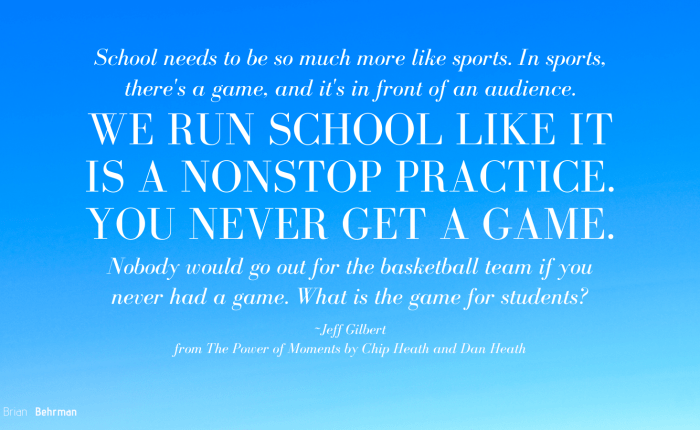
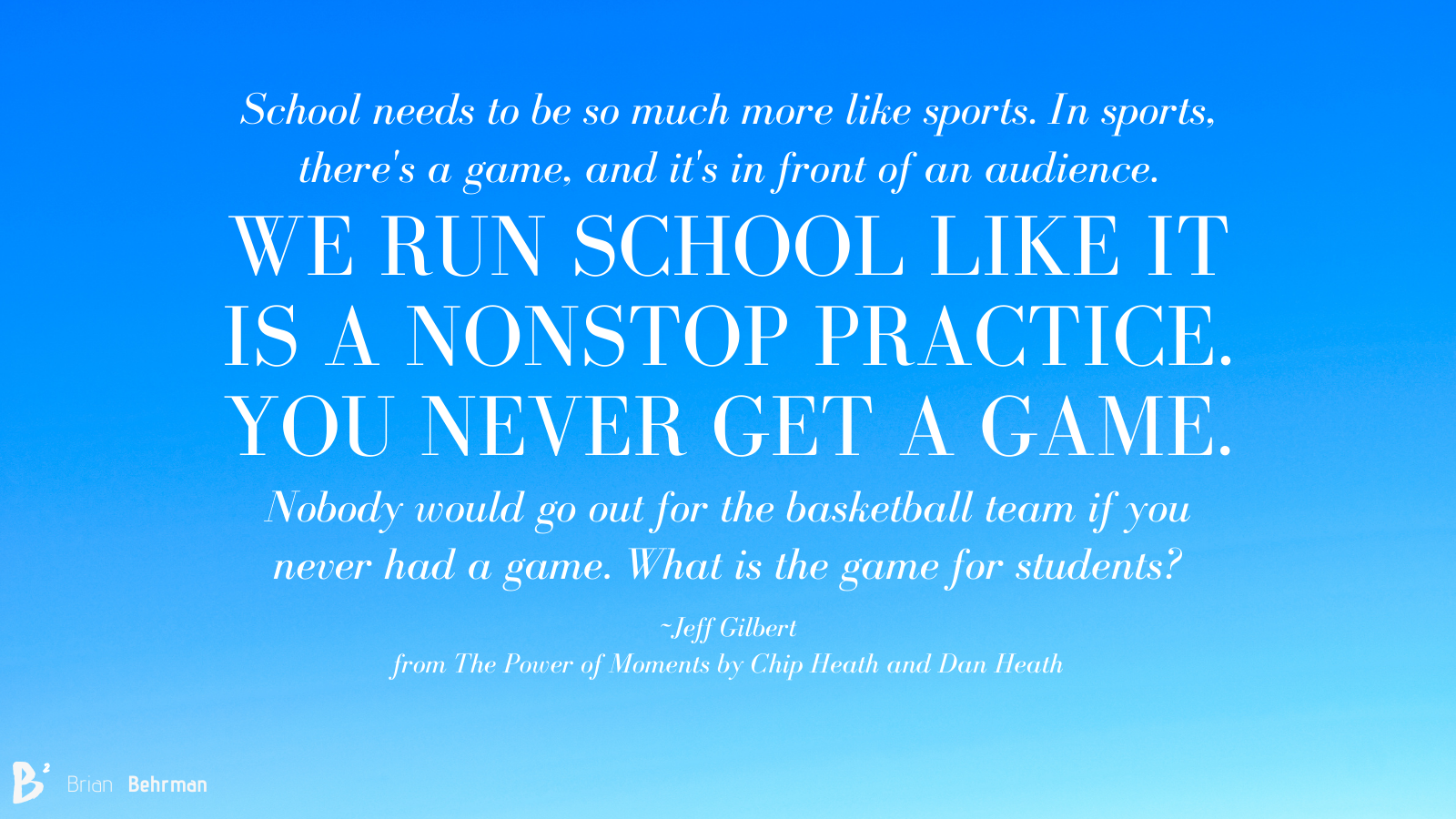
A couple weeks ago, I wrote a post called Practice (you can see that post here). The gist of the post was based on a quote I saw in the book The Power of Moments: Why Certain Experiences Have Extraordinary Impact by Chip Heath and Dan Heath. Here’s that quote again:

The gist of the entire post revolved around building in more opportunities for “game day” experiences for our students. I had a really interesting follow up about that post with a person who works at our school. The question was about how the the “game day” experiences impact the painfully shy or anxious student.

I think those of us in education just had a current or former student come to mind. That kid who never wants to talk in class. Who would never want to share a presentation. Who would never read their writing no matter how good you tell them it is. I definitely have that student in my mind!

This is such a great point. As this person shared with me, no matter our experiences, we probably all know people who are really good at the day to day tasks of their life, but the moment that they have to be “on stage” they just fall apart.

Now, I have to admit, when I wrote this post, I hadn’t read all of The Power of Moments, but what I later came to realize is that maybe it isn’t about creating huge “game day” type experiences, but rather we want to think about ways we can create more peak experiences.

The following pair of graphs come from The Power of Moments, and depict a student’s experience. The graph on the left might represent a typical student’s day-to-day emotions at school. What do you notice? Pretty flat, right? But the graph on the right represents the day-to-day emotions of a student who gets to participate in a bigger experience. This one represents a student who participated in a project called The Trial of Human Nature (I’m not going to go into the details of that experience here, if you want to know more you’ll have to read the book).

What I think I was trying to say in the previous post on this topic was that we need to create more of these peak moments for our students. But as I look back at the post, most of the ideas I suggested involve tasks that border on performance. Not all our students are completely ready for that. Now, there is an argument here to be made for pushing kids outside of their comfort zone, but I also think there’s an argument for letting students work to their strengths. When we have those painfully shy students, asking them to share their invention at the convention or speak about an area of study with adults they don’t know may generate a level or stress in our students that prevent learning. Think about it, stress is a reaction of our lower brain, and when we are living in survival mode, we can’t access the prefrontal cortex. In other words, when you’re stressed out, you don’t learn very much!

This is where some student agency might come into play for these peak moments. What if our students are working in groups and decide that they want to create an informational video about their research. If there’s a shy student in the group, they can still help with the research, be the person behind the camera or directing the action, and then become the master at iMovie to edit the video together. When the video is shared, they get to take just as much pride in the performance as the students who are front and center while not moving too far out of their comfort zone.

Or maybe your class is doing a wax museum project (always a crowd favorite for parents!), and there’s a student who can’t manage the task of speaking to people he doesn’t know. Learning how to research the topic is really what you are probably looking for. Couldn’t that student do the research, then create a blog post? Maybe they then use an animation app to take a picture of their person, and then animate that picture to have their own voice reading a brief introduction. They still do all the same work, without the super stressful public performance. And the technology might act as an accelerator for kids in the learning process by increasing their effort at perfection, which in turn creates a better project.

Ultimately, what I think I was trying to get at in my previous post, was that we want to create more peak moments for our students. Those moments are exciting, which in turn activates a part of the brain that helps make memories. When we create joyful learning environments with peak moments, our students will be banging down the door to get in to school each day. As I’ve heard Dave Burgess say, would your students want to come to class if they had to buy a ticket? We want them to be begging for what we’re offering. And while we can’t offer peak moments every day, we have to be intentional about building those types of moments into the learning environment in a way that students see that what they are doing today will build to a peak moment in the future (and here’s a suggestion – our kids probably don’t see a test or a quiz as a peak moment).

What peak moments have you created for students this year? As you wrap up your school year, ask your students what are the most memorable moments of the school year. Those peak moments will give you ideas of they types of things you might want to create in the future!

Back to normal?

Back to normal?

Recently I’ve been having a LOT of conversations with a wide variety of people about what the future holds for us next school year. Parents of incoming kindergarteners want to know what their child’s kindergarten year will be like. Teachers want to plan for what the learning environment will look like. Neighbors have even stopped me while I’m out walking the dog to ask questions about what’s going to happen. The question I’ve been hearing the most is, “When will we be able to get back to normal?”

I understand the concept of the question. Part of our human condition is to be averse to change. Change creates dissonance, and dissonance makes us uncomfortable. But… I think it’s also worth pointing out that dissonance is where learning and growth happens. If we don’t feel a little bit uncomfortable in our learning, we aren’t stretching ourselves.

Earlier this week though, I saw this quote pop up in my Twitter feed:

I think sometimes we must take a moment to reframe the things that people are asking us. Instead of a focus on what we want to get back to, let’s take a moment to reflect on the learning and growth that has happened in this past school year. What are the things that we want to carry on? Here are a few that stand out to me:

1 – The power of the video chat. As we’ve shifted through various modes of learning here in my district, one of the things that has been a constant is the utilization of Zoom in our classrooms for both student learning events and professional learning. Think about what this technology does for us! We can reach out to anyone in the world and bring them into our classroom. Want to talk to the author of your current read-aloud? Reach out and see if you can set up a zoom. What about an astronaut while you’re studying space science? Or maybe you could hold a virtual celebration of learning where students can share their recent writing piece in the classroom while parents can watch it live from home or their work, or later on a recorded version! There are so many possibilities here!

2 – Options for flipped learning. I’ve had conversations with a couple of teachers who have leveraged the use of recorded lessons that students can watch and return to anytime to do the teaching of the minilesson, which frees up additional time in the classroom for conferring or for individual or small group support. An added benefit? Depending on how your students process information best, a live minilesson might be a challenge for some kids. They need to hear things multiple times; they need to stop and think or jot some notes. Having a video allows them to do all of this without a teacher needing to repeat themselves. Also, those videos can be used by students as a review tool later. Worried about the time it takes to record in advance? Record your minilesson live and then post to your learning management system. The benefits of going back to a recording still exist for your students!

3 – The ease of setting up parent meetings. Think back to pre-Covid times. How hard was it to set up a parent meeting? We’d have to email everyone involved to find a time that would work. Parents needed to be able to leave work or home in time to drive to school which probably added at least a half-hour of time on either side of the meeting for parents. Childcare for siblings could be an issue at times, and that would limit options for meeting times. On the other hand, with Zoom (or similar technology), I have set up meetings on the same day, or sometimes even within just a few minutes later to hold the meeting. Parents can hop on zoom from just about wherever they are.

4 – Relationships. Coming into this past school year, one of the things we were most nervous about was how to build relationships in this new environment. Our school district began the year in a virtual learning setting, and we didn’t know if it would be possible to really get to know our kids when they weren’t here at school. To help with this, we took our first two scheduled student days and set up individual zoom calls between the teacher and student. Parents were invited as well. By about lunch time on the first day, I had teacher sharing with me how powerful this was. Think about the beginning of the typical school year. When would you be able to have a 15 minute, uninterrupted conversation with any of your new students? What we have found in teaching this year is that many teachers feel that they have stronger relationships with this year’s class than any other class before. Considering that we had significant chunks of the year where all or some of our students were learning from home, this is amazing! We plan to create opportunities to build those early relationships with students again next school year even though we will hopefully be starting the year in an in-person learning model.

I am sure that other things come to mind for all of you who are reading this now. Instead of wondering so much about getting back to normal, let’s shift that thought and wonder about how we can get to our next reality!

Share with us in the comments below if you have things that you are planning to do differently moving forward. We’d love to hear your thoughts!

Practice

Practice

Over the years, I have participated in a wide variety of sports. I recall hours spent in the gym at the Boys Club for basketball, summer days on the ball field for baseball, spring and fall nights on the soccer field, and fall evenings on the football field. I also remember the ups and downs of hours of practice for each of those sports. But the best part of playing a sport was always the game. It made sweaty July days on the ball field, or two-a-days in August that much more worth it because we saw that our practice paid off in terms of performance when we were playing against the opposing team.

Recently, I’ve been reading the book The Power of Moments: Why Certain Experiences Have Extraordinary Impact by Chip Heath and Dan Heath. While I’m not finished with the book yet, the main idea that I’m getting so far is that our most memorable positive moments are all made up out of the same elements – elevation, insight, pride, and connection. If we are intentional in what we do and how we design experiences, we can create more of those powerful moments for ourselves and others. This seems to have some pretty obvious translation to the classroom setting.

One of the chapters is titled Build Peaks, and is all about creating experiences that rise above others. Several of the stories that are shared focus on classroom experiences that build peaks for students. In one high school, the teachers wanted to create a peak experience for their seniors, and created what’s called “Senior Exhibition,” which asked students to do what many of us might call a passion project or genius hour activity. Students were able to pick anything they wanted, it did not have to tie directly to curriculum. On the day of the exhibition, students gave an oral defense of their project, which many parents attended. In a normal school setting, parents are not able to see the outcome of student learning in person. Typically, the only outcome of learning that parents see is grades in the gradebook, or maybe an assignment that has been returned with feedback. This experience was different. Jeff Gilbert, one of the creators of the senior exhibition, and now a high school principal, shared:

All this talk about practice has me thinking about one of my all time favorite press conference rants by an athlete.

Now, I’m going to be really honest, I wasn’t a huge fan of Allen Iverson. As an Indiana kid, my heart was with Reggie Miller and the Pacers. But I still use phrases from this clip in everyday conversation. And in this clip, Iverson shares his passion for the game of basketball. In case you need a reminder, that passion isn’t about the practice. It’s about the game.

Going back to the quote above from The Power of Moments, when I read that passage, I had to put the book down for a moment. How do we go about making the experiences in our classrooms feel less like practices, and more like a game?

Let’s pause here for a moment. Grab a piece of scrap paper, or a post-it note, or go to the notes app on your phone. Make a quick list of the peak moments you remember from your schooling experiences? I’m going to focus on elementary since that’s the grade level that I’m working with. Go ahead, stop reading for a moment, jot some notes, and I’ll be here when you come back.

Here are a few of the moments that I recall: In third grade our class made bread – some of the moms came in and as groups we made the dough. Then they took it home, baked it, and brought it back in the afternoon. I can still remember the feeling of getting to take a bite of that warm, soft bread that I had helped to make. In fifth grade, we did an invention convention. Each student was asked to create a new invention. I built a desk that you could remove the back panel from and put on the other side so that it could work for either a right-handed or left-handed person. As a lefty, I was tired of my arm hanging off the side of my desk anytime that I was trying to write. The day of the convention, we presented to classmates and students in the other fifth grade class. That night we came back to school and got to present to parents who came to learn about our various inventions. I had one parent tell me he was a lefty and would buy a desk like that. Many more that were right-handed said they never would have noticed the problem. In sixth grade we researched a foreign country. I worked with a partner to learn as much as I could about Belgium. We took some of our combined kitchen skills and made snacks from Belgium to share with our visitors. We also had a presentation board with pictures and interesting facts. During the day, students from all over the school came to visit our presentations in the gym, and that night we came back and presented to our parents. I was able to share all that I had learned, and found out that the family of one of my good friends had ancestral roots in Belgium. It was an instant connection and conversation piece that night.

What do all of those memories have in common? They weren’t practice. They were the game. If we want students fired up about school and about learning, we’ve got to be intentional about finding opportunities to create more games for students. Could you invite parents to come in so students can share their learning? Could you do a video chat with an expert in the field you’ve been studying? Could you try to connect with the author of the book you’ve been reading in class?

Take a moment to reflect on what some of the favorite things you’ve done with your students. What were the elements that made them a peak moment for your kids? Possibly, one of the indicators is that there were some elements that took the learning beyond the practice phase, and into a realm where it felt more like a game or performance.

What are your thoughts? Do you have any activities that you’ve done in the past that you could make a bit more game like? Or do you have an idea of a way to make learning less like practice and more like a game that I haven’t shared already? Share your thoughts in the comments below!

Rethinking assessments

Rethinking assessments

It’s late spring, and for those of you who know much about education, you know that means we are living through spring testing. We started ILEARN testing this week. ILEARN is the Indiana summative accountability measure for the state of Indiana. The testing window opened last week, and each afternoon since it opened, I have been spending a little more than an hour as a proctor in a fourth-grade classroom.

If you’ve followed my blog for any significant amount of time, you probably know that I get jazzed up for making learning exciting. I love for our schools and our classrooms to be places of joy. The vast majority of times that I walk into classrooms in our school, that is what’s happening. You see, learning is never a quiet activity. One of my professors in college drilled a phrase into us: “Learning is social.” She encouraged us to work in groups, to discuss, to collaborate, to challenge one another so that we could all learn. She constantly reminded us that we would need to do the same type of thing when we had classrooms of our own. To put it another way, she taught us that “The smartest person in the room is the room” (I’ve heard this quote from multiple sources but believe it can first be attributed to David Weinberger). That mindset of social learning followed me for most of my teaching career – sure there were moments where we had to be quiet, but if you walked into my science classroom on most days, students were actively involved in labs, gathering data, doing research, etc.

In fact, if I’m being completely honest, when I walk into a classroom where it is totally silent, I often find myself thinking “What’s wrong?” or “Where is the learning?”

I think that’s part of why I struggle with the testing season so much. I’ve long believed that a child is so much more than a test score. I have seen students who should have been able to soar through the state assessment have a meltdown because of test anxiety. I’ve also personally witnessed a child who probably didn’t read any of the questions end up with an amazing score because of lucky guesses. How they do on a single assessment on a single day may not tell us a whole lot about who that child is.

Recently, I have seen some really well-reasoned arguments on both sides of the assessment spectrum. A recent article from The Fordham Institute argues that assessment data is needed, this year in particular, for 3 reasons: state assessments gauge where students are against grade-level expectations; state assessments provide an “external audit” of proficiency that complements course grades and diagnostic tests; baseline state assessment data is essential to tracking progress moving forward.

On the other side, a recent ASCD (Association for Supervision and Curriculum Development) guest post shares some of the things that make standardized testing problematic any year, not just this year. Some of the reasons include: standardized tests don’t provide feedback on how to perform better; standardized tests don’t value creativity; standardized tests don’t value diversity; standardized tests cause teachers to spend more time “teaching to the test.” This article didn’t even really go into the problems of the added stress that is put onto students when being given a standardized test in a year that has been anything but normal.

The reality is that while I have my personal opinions about standardized assessment, I can’t make up quite which way to go. As an administrator, I know that data helps drive our decision-making processes to be able to better support our students. That data can also be utilized to drive professional learning for our teachers. I also know that a test environment creates stress that can literally be felt when you enter a room during testing time.

Last week, while I was in the testing environment, we were giving a math test. It was a multiple-choice computer adaptive test. What that means is that as you answer questions the following questions are adjusted based on whether your previous answers were correct or incorrect to allow for a more individual test with more precise data about a student. During this math assessment, I saw a student in tears because the test was so hard. Even though we had encouraged students to simply do their best, and not worry about the outcome, this kiddo broke down in tears. At another moment, there was a student who leaned back in his chair and simply stared at the ceiling. When I made my way over to check-in, he said “This is hard. How many more questions are there?” The assessment ended up have 45 questions. He was on number 6.

What I find in practice is that state assessments take the joyful classroom learning environment that we have worked so hard to build and suck all the joy out of it. As I write this, we are nearing the end of the second week of testing, and even I am feeling worn down by the stress it creates. Is this what we want for our kids?

We’re spending several hours a day for 6-7 days in our third and fourth-grade classes on standardized tests. It takes away from time that could be spent on more meaningful learning opportunities. It takes time away from our students digging into projects with their classmates that can help solve problems in our school and community. Plus, because of our Covid-19 protocols, our school day is already shorter than normal. In practice, when you take out that time each day for testing, we are losing the opportunity to extend learning on at least one of the subjects we would normally be working with. Not to mention the fact that it causes stress on our students – kids who struggle feel inadequate, kids who are perfectionists will never think they did well enough, kids who don’t test well might simply shut down or break down from the stress.

The reality is that for our students’ futures, simply having content knowledge isn’t what will make them successful, but rather what students are able to do with the knowledge that they have (For more on that, check out previous posts here and here). It’s time we really start rethinking standardized assessment. We need much more of a focus on performance-based assessments, where students actually have to do something with what they know.

On the bright side, I do have to give some credit. In the ILEARN, there are performance task sections. In the performance task, students have to read passages, analyze data, and then respond to questions about the passages or data. While these tests can be challenging for our students, they are more in line with the future-ready skills that our students will need in order to be successful. And as an added bonus, they don’t seem to be as stressful for the kids because even they realize that all the information they need is right there. The scores on performance tasks are based more on how they use that information. And because of the way the assessments are structured, teaching to the test would actually be in line with some of the better practices that we’re trying to use in our classrooms! Now if we can work towards an assessment system that is completely focused on performance-based assessments, and less on adaptive tests, we might better serve our kids and what their future holds.

What are your thoughts on standardized tests? Are there positives you see? Negatives? Has any of what I’ve shared above caused you to rethink assessment? Let me know in the comments below.

The future of work

The future of work

Last week was kindergarten open house, and it was so great to have our future students and their families come into the school for a brief tour. One of the things that we had set up for students was a picture frame that said: “It’s a great day to be a Tiger” at the top, and Class of 2034 at the bottom. That’s right, the kindergarten class that will be starting this August is the class of 2034!

It’s hard for any of us to imagine what the world might look like in 2034, just 13 years away. So, to give us some perspective, let’s think back 13 years. What do you remember from 2008? That year, Eli Manning and the New York Giants beat Tom Brady and the New England Patriots in what was considered a huge upset after the Patriots had gone undefeated in the regular season (as an Indianapolis Colts fan, this feels like something I must include). Also, since I often think in terms of technology, I think it’s important to come back to the technology that existed in 2008. The first iPhone was released in 2007, so unless you were an early adopter of the iPhone, or you had a Blackberry, you probably didn’t have a smartphone in 2008. In the last 13 years, Apple has released 21 other models of the iPhone, sometimes releasing as many as 3 different models of the iPhone in one year. The first iPad wasn’t released until 2010! In 2008, I wouldn’t have imagined riding in a stranger’s car when I traveled somewhere – that would be hitchhiking. Now that’s called taking an Uber. In 2008, if I didn’t know how to get where I was going, I had to be sure to print a map from MapQuest so that I had directions. Now I can just use a maps app on my phone. I’m sure I could go on and on, but I think it’s safe to say that we all recognize that a lot of changes have taken place in the last 13 years.

I also think it’s worth pointing out some of the jobs that exist today that were not in existence 13 years ago. Here are a few examples: Social Media Manager; SEO Specialist; App Developer; Uber Driver; Driverless Car Engineer; Podcast Producer; Telemedicine Physician; and Zumba Instructor. This is not an exhaustive list. Just Google “Jobs that didn’t exist 10 years ago” and you’ll come up with tons of hits.

The point of sharing these things is to remind us about the cycle of change. We’d all agree that our world changes quickly, and the changes only seem to come faster each year. Think about it, the students in our elementary schools today have not existed in a world before smartphones and on-demand access to music, video, and more.

So that brings me to the point of this post – as educators today, it is imperative that we exist in a future-driven mindset. What we do in our classrooms must constantly be thinking about what children will need in order to be successful, fulfilled, and healthy in all senses in their futures. This means coming to the realization that learners today are different from learners of the past and have different innate aptitudes and abilities.

I’ve said it before, but our schooling system was built based on past influences. The school year runs from the fall to the spring based on the agrarian needs of the past. This was necessary so that children could help their families work the farm in the summertime. The daily schedule and bell model were created to meet the needs of the industrial revolution and having employees who could work based on a start and end time. The bell schedule was also related to that same system of work/breaks in factories. That system is old and outdated.

Not so long ago, I would have said that change in education is a slow process. Imagine trying to turn around a giant ship in the middle of the ocean. It’s not going to turn on a dime. And until March of 2020, I would have said that education was the same way. Then we lived through a global pandemic and in a weekend, we shifted from a system that we knew into a system of emergency remote teaching. Over the course of this school year, we have shifted between a variety of different learning modes and done so with grace. If the pandemic has taught me anything, it’s that change is possible in education, and it can happen quickly.

To be ready to meet the needs of our students, and have them prepared for their futures, we have to be aware of the shifting skills, knowledge, and behaviors that learners need. Instead of teaching students outdated skills that prepare them for our past. We have to filter our thinking through an understanding that our learners will be in a world that will continue to be transformed by technology acceleration, artificial intelligence, cloud computing, and more.

My biggest take-away of what I know about the needs of our learners is that they don’t necessarily need to be content experts, but rather they need to have adaptable skills that could translate to any content. Some of those “soft skills” include problem-solving, ability to work in a team, strong work ethic, analytical/quantitative skills, written communication skills, and leadership.

What implications might this have in your classroom? How does this have you thinking of learning differently in the coming weeks, or as you move towards a new school year?

The gist of this post comes from reading An American Imperative: A New Vision of Public School. You can access the report here.

Think Again

Last week was spring break, which was a great time to rest and recharge. We didn’t go anywhere this year, so I was able to enjoy a lot of time at home with family, some time doing projects around the house, some yardwork, several bike rides and workouts, and lots of time reading. Just prior to the break, I started reading Think Again by Adam Grant. I was first introduced to Grant’s work through his TED Talk: The surprising habits of original thinkers. If you’ve never seen this talk, take a few minutes to watch it now:

This TED Talk led me to Grant’s previous book, Originals. If you’ve never read it, you should pick it up. When I saw that there was a new book coming out, I placed a preorder without even really knowing what the book would be about.

Think Again was such a great read that I wanted to share a few of my takeaways from the book. The gist of the book is that there is a great amount of benefit in doubt. Embracing the unknown and finding joy in being wrong can actually help us to be more creative. In the book, Grant shares that creative geniuses are not attached to one idea or identity, but rather that they are able to rethink. Alvin Toffler, an American writer and futurist, shared that “the illiterate of the 21st century will not be those who cannot read and write, but those who cannot learn, unlearn, and relearn.” My greatest takeaway from this book was the idea of being flexible in our thinking, be willing to treat our ideas as hunches or hypothesis and get really comfortable when admitting that you’re wrong.

Throughout Part 1 of the book, Grant focused in on Individual Rethinking. What I find is that the key is for us to practice moments of intellectual curiosity. Instead of choosing to defend your own belief just because someone else’s idea doesn’t fit, get curious. “How do you know that?” is a great question to ask to try to dig a little deeper. Understanding where someone is coming from may help you find that there is some common ground in your seemingly different opinions.

So, let’s bring this back to education. One of the things that I have found is that there are certain topics that seem to be “sacred cows.” The number of times I’ve been told that’s the way we’ve (or I’ve) always done it is enough to drive me crazy. What if the thing that you learned as a “best practice” actually isn’t really best anymore? What if there is a better practice out there? Maybe one form of rethinking we need to do is throw out the term best practices and replace it with the concept of better practices.

But look, I’m not saying we have to rethink everything about education! In the past year and a half, we’ve been working on forming a new vision for learning for my current school. It’s been a long and arduous process, but after gathering information from a variety of stakeholders, our vision setting team has landed on 5 key concepts that we aspire to bring to our school:

  • Project-Based Learning
  • Innovation
  • Collaboration
  • Empowerment
  • Inclusivity

Now, there may be some that see those phrases – especially project-based learning – and think that this means we are going to have to completely revamp our curriculum. I don’t believe that is accurate. While there may be some changes in the way we do things, I still foresee times of reading, writing and math. There are still times we might use a math book, or a writer’s notebook. When we think about rethinking, finding the aspects that don’t have to change may make us a little more comfortable with the change that’s coming.

I’d like to think that rethinking is a skill that I have. I don’t often get set on an idea until I’ve had some time to think things over, talk to a variety of people, and let my thinking simmer for a bit. There are definitely some ideas that have really shifted in my beliefs in the past 18 years I’ve been in education. I find that often when I take the time to process, and gather thoughts from others, the ideas I have end up being even better than my initial thought. And I hate to be put on the spot and tell someone an exact answer right away. I know that there are times that people come to me with issues seeking an immediate solution. I often will ask them when they need to have a response from me. If it’s not right away, I ask them if we can circle back to the topic at some later date or time so that I have time to think and rethink.

What are your thoughts about rethinking? Have you read Think Again? Or are you tempted to pick it up? I very much recommend the time spent. Also, I’m curious, what’s something that you’ve rethought? Share your thoughts in the comments below!

Sometimes you grab a shovel

About a month ago we had what we, for Indiana, consider a pretty decent snowstorm. Roads weren’t in great shape, sidewalks were a bit slippery, and the parking lot felt like an ice rink as I was walking in. Luckily, the roads were clear enough that all our students were able to get to school, and we had what felt like a pretty normal school day. In the afternoon, after dismissing our buses, I came back inside and was taking my jacket off when one of our people came in looking for some help. She had parked in a street parking spot across from school, and over the course of the day the snowplows had gone by and made it impossible for her to get her car out.

Now, as building principal, there are a lot of things going on at the end of the day. But in that moment, I made a decision. I walked down to our dock area where I knew we had a snow-shovel, grabbed it, and headed back outside. It would have been easy to delegate this task, maybe to a custodian, or someone else, but I believe that relationships are a powerful thing.

(Picture for effect – Not an actual picture of the shovel in use!!!)

It took some digging, and then some pushing, but eventually we were able to get the car out. I gave the person a wave, she headed home, and I headed back inside the building to put the shovel away.

I’m not telling you this story because I need a pat on the back, or to brag about a good deed I did. I think all of us who work in schools (or really just about any position that deals primarily with people) know that there are times that someone might need help from us that isn’t really a part of our job description. It’s easy to find a reason why we can’t help in those moments – I have a meeting to get to, I have lesson planning to finish, etc. But think for a minute about how much helping someone might lift them up. And here’s the reality, when we do something that makes someone else happy, we get a little dopamine hit in our brain too, which makes us feel good.

It doesn’t have to be grabbing a shovel and helping to push a car. Maybe it’s providing some support to a colleague, or a listening ear for a student who is having a rough day. Whatever it is, take just a moment, think about how the other person might feel, and find a way to help.

If we model this mindset for our students, they will learn to look at the world in a similar way.

So here’s what I’m going to encourage you to do in the coming few days: Find a time when you can be the one to “grab a shovel” and do it. See how it helps the other person, and notice how it makes you feel as well!

Negative relationships with math

Negative relationships with math

When I say math class, what do you think of? One of my favorite math podcasts, Making Math Moments that Matter, asks their guests to share a memorable math moment. Pause for a second, close your eyes, and think of math class. What do you see? What do you remember?

For me, the first thing that comes to mind is third grade. During third grade, we did timed math tests every Friday. The page was full of problems. Once you hit a certain level with addition, you moved to subtraction, then multiplication, then division. I hated timed tests. I got through addition and subtraction all right but remember getting stuck on my multiplication facts. For whatever reason, I could not get over the hump on the multiplication timed tests. Here’s the thing though – I did well in math, I always scored high on tests and quizzes, and was successful with my homework assignments. But because I didn’t do well on my timed tests, I felt like I wasn’t good at math.

The next thing that comes to mind is high school math and my Trigonometry / Pre-Calculus class. We would walk into class, sit down, open a notebook, and then take notes of sample problems for the entire 45-minute class period, then we’d go home and do 15-20 homework problems. The monotony of this process was broken up only by test or quiz day. While I liked my teacher, I did not feel like I learned a lot in this class. Often when doing my homework, I would go back to my notes because there was something I didn’t understand, but my notes would not help me solve the problems. I felt like this was a point where I ran into a wall. I did all right in my math classes up to that point, but for whatever reason, that year, I felt like I was no longer a mathematician.

Even with these two experiences, I generally enjoyed math. I felt like I was pretty good at it, so in college when I had to select an area of endorsement to go with my degree in Elementary Education, I selected math. When I was hired for my first teaching position, my school saw that I had a math endorsement and had me teach the advanced math class for our fifth grade. As I think back on how I taught math those first couple of years, I utilized some of the strategies that I hated about math when I was younger. I fell back to those strategies because that’s what math class was supposed to feel like, right?

Recently, I’ve been reading the book Limitless Mind: Learn, Lead, and Live Without Barriers, and it’s taking me back to my days as the advanced math teacher early in my career and wishing that I would have thought of doing things differently. The premise of the book is that there are six keys of learning. Each chapter of the book presents one of the keys. Chapter 4 is titled “The Connected Brain” and focuses on the following learning key:

“Neural pathways and learning are optimized when considering ideas with a multidimensional approach.”

Jo Boaler, Limitless Mind, 2019, p. 101

Reading this chapter has been mind-blowing in helping me understand why I struggled so much with the timed tests in third grade. To me, those papers were just a jumble of numbers on a page. I couldn’t make sense of it all. Even today, I see pictures of worksheets like this, and I feel the anxiety kick in immediately.

So, what is this multidimensional approach that Boaler is talking about? Did you know that even when working on a simple math problem, there are five different areas of the brain that are put to work, and two of them are visual? Our brain wants to take those numbers on a page and create something visual! And when we, as teachers, help our students to access multiple parts of the brain, and communicate with one another, the learning is so much greater!

As I reflect on my learning, I don’t recall exactly when math stopped being visual, but I’m pretty sure that change happened somewhere in my elementary school experience, quite possibly in third grade when I was struggling with those timed tests! So, what are some ways that we can add more visuals to our math practice? Boaler suggests that instead of having our students practice a series of nearly identical questions, have our students practice a small number of questions (like three or four) and think about them in multiple different ways. These are some of the questions that Boaler shares in Limitless Mind (2019, p. 109):

  • Can you solve the questions with numbers?
  • Can you solve the questions with visuals that connect the numbers through color-coding?
  • Can you write a story that captures the question?
  • Can you create another representation of the ideas? A sketch, doodle, physical object, or form of movement?

What does this look like? Here’s an example that I created using a simple division problem:

Boaler credits this “Diamond Paper” approach to Cathy Williams, one of Boaler’s colleague’s and fellow director of youcubed. When I saw Diamond Paper, I immediately thought of the Frayer Model. Earlier in my career, I taught science, and one of the ways that we learned some of our difficult vocabulary words was through the Frayer Model graphic organizer. I found that my students had a better conceptual understanding of our vocabulary words and used them appropriately in their lab write-ups. The reality is that something like the diamond paper method or the Frayer Model can be used in lots of different subject areas. The multi-dimensional thinking that is required to complete something like this activates more regions of the brain, creating stronger connections within the brain, which leads to greater learning.

Those timed tests that I struggled with were not helping me learn. While I did eventually pass my multiplication and division timed tests, it was purely memory-based. I did not have a conceptual understanding of what was going on. I still believe that the wall that I ran into in my year of Trigonometry / Pre-Calculus came about because I didn’t have the flexibility of numbers to understand the concepts behind what happened in multiplication and division.

I’ve defined learning on this blog before, and ultimately that’s what the focus is here. How do we learn and grow, and how do we help our students have greater levels of learning? The more we can do to connect different parts of the brain around a topic, the better the conceptual understanding we have in the long run.