Our resources are not our curriculum

Earlier this summer, I led a group of teachers and the assistant principal from our school to the PLC (Professional Learning Community) at Work Conference in St. Louis. This conference, hosted by Solution Tree, gathered some of the leading experts in PLC. As you read this blog over the fall, you may see a few references to the invaluable learning that occurred there, and this post is the first one that will draw from that experience. Whether you are already engaged in true PLC work or not, the PLC process’s premise, built around 4 key questions, is crucial to our discussion.
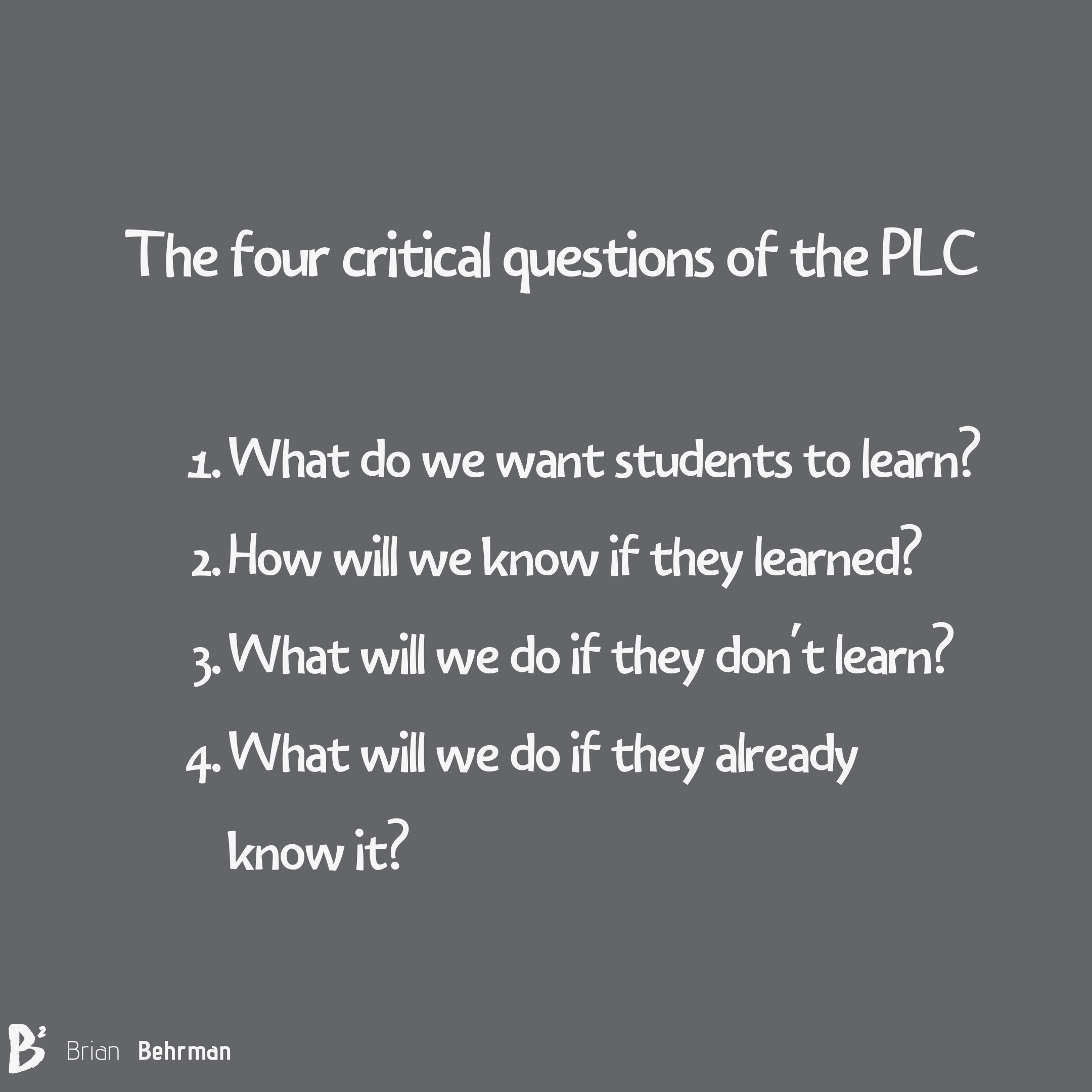
These questions come from Learning by Doing: A Handbook for Professional Learning Communities at Work by DuFour, DuFour, Eaker, Many, and Mattos. Today’s post will focus on question 1. One of the key quotes I’ve heard about question 1 comes from Rick DuFour and explains why we need to spend time thinking about that question: “It does not matter which teacher your child has at our school… your child will receive the highest quality instruction, the best assessment practices, and extra time and support to learn at high levels.”

There have been some swings in education over the years. Do we teach our subjects based on the resources we have? Or do we focus on our standards and the skills our students need based on those standards? I will be honest: the teacher in me causes my eye to twitch when I hear talk about teaching from the resource “with fidelity.” At the same time, I know that when I look at the list of authors involved in the writing of any of our resources, there are lots of people with Ph.D. or Ed.D. after their name and their accolades listed. It tells me that some intelligent people put the resources together to support student learning.

I also know that resources are often put together based on alignment with national, state, and local standards. However, when I look at most of our resources, they list Common Core standards at the front and then list what unit or lesson will cover those standards. Some resources even seem to have created their own standards. And the reality is that, just like anything else, publishers are in the business of making money. That means they often pay attention to states like Texas or California for what should be included in a textbook because those two states are the two biggest buyers of textbooks in the US. It’s essential to know that these states significantly influence textbook content nationwide.

So as a school leader in Indiana, the question arises: is it best practice to encourage my teachers to have a goal of teaching a whole textbook “with fidelity”? I’d argue that the answer to that is no. Instead, we should be guided by the Indiana Academic Standards, the cornerstone of our curriculum. These standards help us identify what to teach, ensuring that we focus on the skills our students need based on those standards.

Standards are the center of everything we do. Based on the standards, we create learning targets written in student-friendly language, design classroom activities, and develop common assessments. When we do this work within the PLC, we develop a shared understanding of our standards and the rigor that they entail.

Committing to the work of the PLC means that we will commit to genuinely understanding the guaranteed and viable curriculum that we offer our students and their families. It means that we know what kids need to do by the end of the year to show mastery of the priority standards and the progression of work that needs to happen for a student to achieve mastery by the end of the year.

Given that it is the beginning of the school year, I encourage you to find a team you can collaborate with. Take some time to dig into your standards and your resources. Once you have a clear understanding of your standards, then review your resources. Can lessons or chapters help your student master those priority standards? Or do you have lessons or chapters that don’t align with your standards? Use this knowledge to help you understand what from your resource will help you move students towards mastery and where you might need to supplement the resource.

The key takeaway: Our resource is not our curriculum, and just because we “did it all” doesn’t mean that we have necessarily moved our students towards mastery of the most essential standards!

Have you done work like this on your own or with a team? What did you learn about your resources and standards? Please share some of your key insights in the comments below.
Page 19 Thinking

Page 19 Thinking

A while back, I was listening to an episode of The Tim Ferris Show. For those of you who don’t know who Tim Ferris is, he is an author, blogger, and businessman, but I came to him as a podcast host. On the podcast, Tim does long-form interviews with a wide variety of people on many different topics. While it is rare that a guest on the podcast has direct ties to education, I often find value as an educator in aspects of the interviews. I will say that at times, the topics are not interesting to me, and when that happens, I’ll skip that episode, but often I find myself sucked into the conversations that I wouldn’t have expected to find interesting.

Last May, Tim had Seth Godin on the podcast (you can find the show page here). Seth is the author of 21 international bestsellers, and while the topics are generally related to marketing, his books and blog often venture into topics far beyond the realm of marketing. In addition, Seth has given multiple TED Talks, each with millions of views.

What stood out to me about the conversation was a five-ish minute clip about the concept of “Page 19 Thinking.” Honestly, the title of this concept could have been any number, but Seth chose to use 19. He described it as thinking about working on a book as part of a team. In the beginning, the team knows that there will be a page 19 in the book, it must be written, illustrated, footnotes added, etc. As a team of authors, you say “We know there will be a page 19. We know it’s coming from this team, but we also know that nobody here knows everything about what’s going to go on page 19.”

In this situation, the solution is to start with somebody writing a sentence, then someone can take that sentence and add to it to create a paragraph. The team may say “Let’s make this better” so then someone else will do some research and add another paragraph. Someone else might create an illustration, and someone else might add a footnote. Eventually, the team gets to a version of page 19 that they are happy with, and they “ship it” to the printer or publisher.

Along the way, team members relentlessly criticize the work, but they never criticize the person who did the work. And remember, criticism is closely related to the concept of a critique, where there is careful judgment, expression of opinion, and evaluation of both the good and bad qualities of something. If the goal is to create the best work possible, we must start somewhere. Rarely is our first idea also our best idea. Criticism forces us to reflect on our work and the ways to make it better.

Page 19 thinking allows people the freedom to speak up and contribute. Think about some of the best-known companies in the world. Whether you’re talking about Google, or Apple, or Amazon, what they are known for today is not necessarily how they began their work. Take a moment to look at your phone – personally, I have an iPhone. This is now the third iteration of the iPhone that I’ve had. Each has been different – they have changed in size, features, etc. Most people feel that the new features added have made the device better. But if we think about what the original iPhone could do, compared to the phone you are probably carrying with you each day, the changes have been dramatic. (If you want to see an interesting comparison between the original and the most recent iPhone, you can check out this short video) Those changes would not be possible without the work of a team to iterate and improve the device. And what’s interesting to think about is that Apple wasn’t a phone company in the beginning. It was formed to create the Apple I computer, but over time has become the maker of the iPod, iPad, Apple Watch, and various other accessories. The company has iterated many times.

Now, when we talk about criticism, sometimes when an idea is criticized, it can feel like personal criticism. But if we’re working as part of a team to create the best thing possible, we understand that the criticism is of the idea or the work, not the person. Hopefully, when we take on a mindset of page 19 thinking, we can allow ourselves the freedom to speak up and contribute, as well as to take feedback. Then as a team, we can iterate our way to excellence.

This whole process has me thinking about the PLC structure. When we get together as a PLC team, we have a goal of helping one another be the best teachers we can be to help our students grow. In the PLC process, questions 3 and 4 are about what we’re going to do if students aren’t learning, or what we will do if they are. In this portion of the process, we’re creating ideas to help our students continue to learn. If our PLC takes on a mindset of page 19 thinking, we know that the ideas we share are going to be criticized, but that criticism is about making the idea better, which in turn leads to better outcomes for students. We must let our own work be generously criticized, and we must generously criticize the work of others.

The teamwork that goes with allowing others to contribute their talent will always help our ideas become better. In a collaborative environment, it’s important to make sure that we all are welcome to the ideas of one another because the work of the team helps all our students.

What are your thoughts on page 19 thinking? How might this way of thinking impact the work your team is engaged in? Is there a time that criticism from someone else helped you to get better at the work you were doing? Let us know about your experiences in the comments below.