Orienteering

Some of you may not know this about me, but many of the core memories from my pre- and teen years relate to my time as a Boy Scout. I attended weekly meetings with my troop; we had campouts throughout the year; each summer, we went to a scout camp; and every other year, there was a high adventure trip. Eventually, I worked my way up the ranks from Scout to Eagle, the highest rank available in scouting. One of the things that has to happen for a scout to advance in rank is to earn merit badges.

A merit badge is a chance for a scout to learn about things they are interested in. Topics include sports, crafts, science, trades, business, and future careers. Currently, there are more than 135 merit badges for scouts to earn. One of the most challenging merit badges I earned was the Orienteering merit badge. With that badge, we learned to use a topographic map and a compass to get from one point to the next. We learned the terrain features of the map, translated them to the environment we were in, and used that knowledge to navigate from point to point. Think of it a bit like a scavenger hunt! Orienteering comes from the word orient, which means finding your position or direction.

But Brian, what does this have to do with learning here at school? Well, recently, we started a Cluster of Professional Development around writing, with a particular focus on adding evidence and elaboration to our students’ pieces. We are engaged in this work because data has shown us that students consistently struggle with this area on our state summative assessments. Last year, only 17% of our students showed proficiency in evidence and elaboration.

As we began planning for this professional development, one thing we did was examine our standards to truly understand where our students needed to be by the end of each grade level. For our students to reach proficiency by grades 3 or 4, steps have to be in place as foundations for learning in kindergarten, first grade, and second grade (see a recent post, The LEGO Conundrum, for more on this approach).

The analogy I’m thinking of related to orienteering is that our standards are a bit like the end point on a map. But if I took you into the woods, handed you a map and a compass, showed you where you needed to get to on the map, and gave you no other information, would you be able to orienteer your way to that location? I’m guessing that for most of us, the answer is no. Why not? We don’t know where we are starting.

I’ve been chatting with teachers about our current cluster and observing classes in writing tasks. We’re doing a great job of staying focused on where our students need to be. There’s a clear understanding of the success criteria for each grade. However, I’m starting to have concerns that we might need to work a little more on understanding where our students are right now. We need to orient ourselves to the starting point.

Just as you wouldn’t be able to orienteer your way to the endpoint on a map without knowing where you are starting, how can we hope to move our students to the standard if we don’t know where they are right now? We must orient our teaching to our students’ present levels.

You see, we (educators) do a great job of thinking about learning progressions in math. We have also grown in our knowledge of learning progressions in foundational literacy skills. But there is also a learning progression in writing skills. As a classroom teacher working to support my students’ writing growth, I must know more than just where I need to get my students. I need to start with where they are.

If we start by thinking about writing as a progression, we begin first with letter formation and handwriting fluency. Then, we work up to explicit spelling instruction. Next, we support students in building sentences, starting with simple sentences and then using sentence-building charts to add more detail to the sentence structure. From there, we progress to a basic paragraph with a topic sentence and supporting details. Then, we can use graphic organizers, color-coded paragraphs, or paragraph frames to help students in multi-paragraph writing. Over time, we slowly pull back those scaffolds for students to do these parts independently.

But here’s the thing: if I were a second-grade teacher, and I asked my students to create multi-paragraph pieces of writing when they are currently still at the simple sentence level, and I only focus on trying to get them to write multi-paragraph writing, they will break down. They will reach frustration. They will believe they are not a good writer.

In math, we meet students where they are in the progression. We must do the same for our writers. If you are looking for a great resource to support your understanding of writing progressions, check out this fantastic resource from Reading Rockets called “Looking at Writing.” You can work through the progressions, beginning with Pre-K writing through grade 3. There are writing samples, suggestions for the next steps, and ideas for instructional strategies to move students forward in their learning.

Awareness of progression is key to orienting our students toward successful growth.

What are your thoughts? How have you used progressions of learning to support student growth? Let us know your thoughts in the comments below!
The LEGO Conundrum

Last week, we began a new round of professional development. One of our School Improvement Goals is to increase the number of students proficient in evidence and elaboration in their writing. In our most recent round of ILEARN testing (the test used in our state to check student proficiency in math and ELA in grades 3-8), only slightly more than 17% showed proficiency in this area. Our working theory is that by helping our students expand their sentences, add more details, and ensure that those details stay on topic, we will also see improvement in other areas of the written portion of the test.

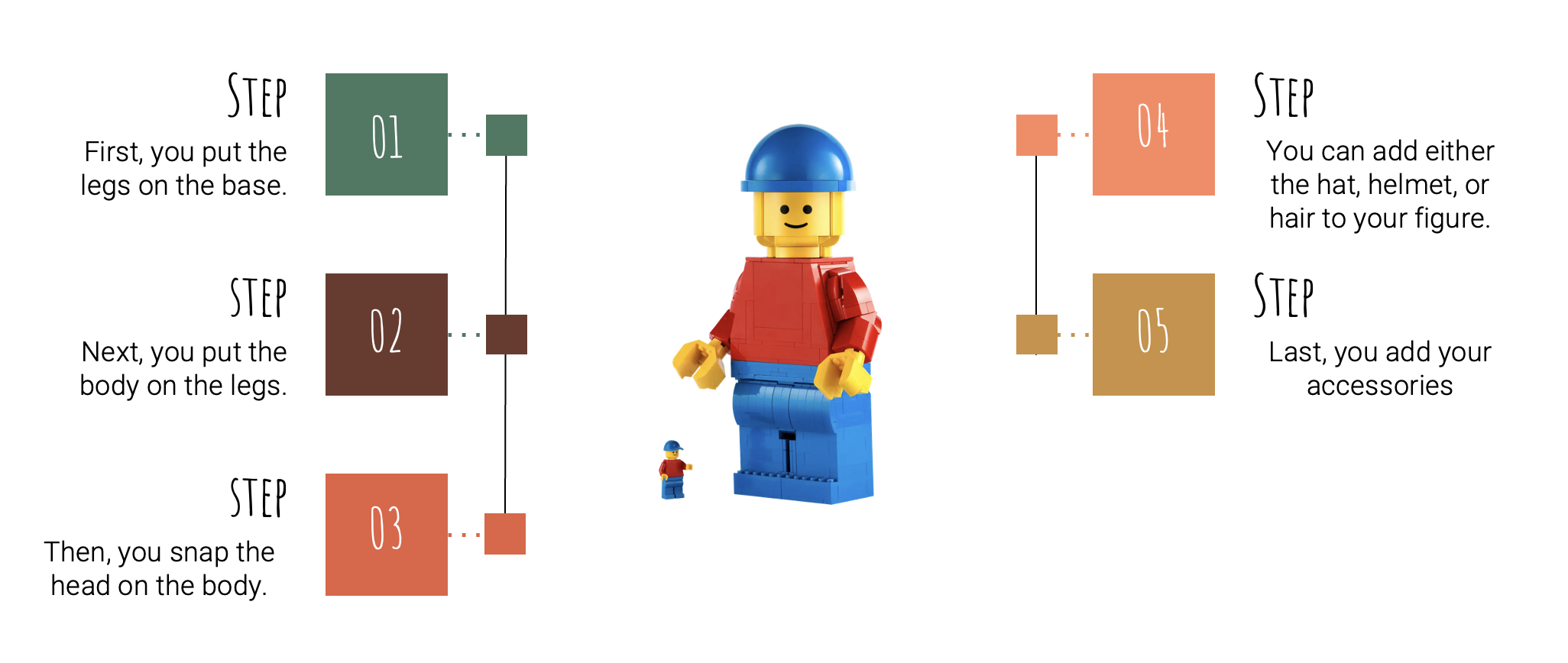
But I also know that when I bring together a group of teachers ranging from kindergarten to fourth grade, some may have difficulty connecting to the data they see on the screen because “we don’t teach those standards.” To help get thinking about each person’s critical role in moving our students towards proficiency, we did an activity with one of my all-time favorite toys, LEGO! Each group received a box with a Minifigure inside, and then we put the following directions on the screen:

We asked one person to follow a step in the directions, revealing them one at a time and then passing the Minifigure to the next person. Once all tables had completed their Minifigures, we displayed the question: Which step could you skip and still have a completed Minifigure? The team reached a consensus that there were no steps we could forget and that we still had completed Minifigures.

So then, we showed this:

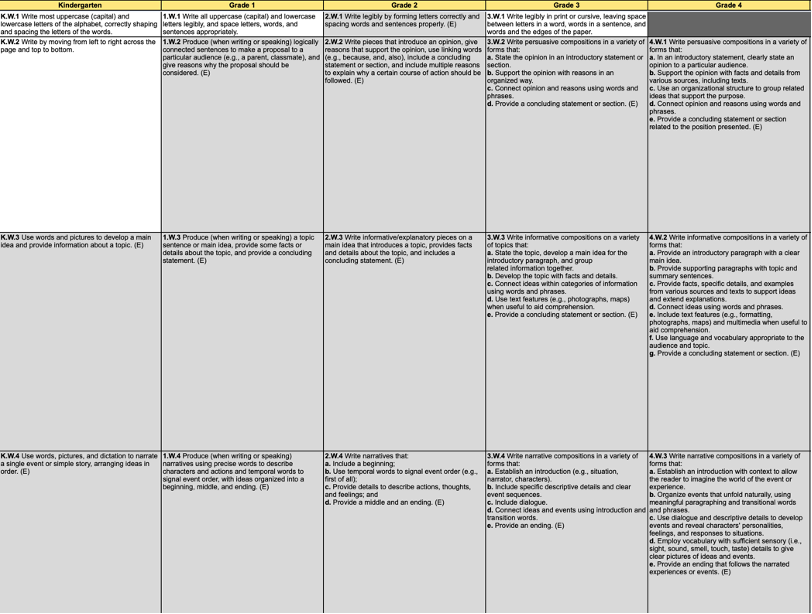
I know the font is tiny, so don’t feel you need to zoom in. This is a vertical articulation guide for the essential writing standards for grades K-4. At first glance, without even digging into what they say, you might notice that they become more detailed as the grades advance. When we looked at this with our staff, several noted that they built upon one another. Suppose you were to look at the third row related to writing informative pieces—every grade level talks about being on a topic or having a central idea, and every grade level has something about including details, but the requirements and expectations of each grade level become more detailed.

The analogy we made as we discussed this is that we think of the writing process as a stairstep. Each grade level has a target level of proficiency. If one grade level does not hit their proficiency level, the work of the following grades becomes more challenging because they have to play “catch-up” with their students.

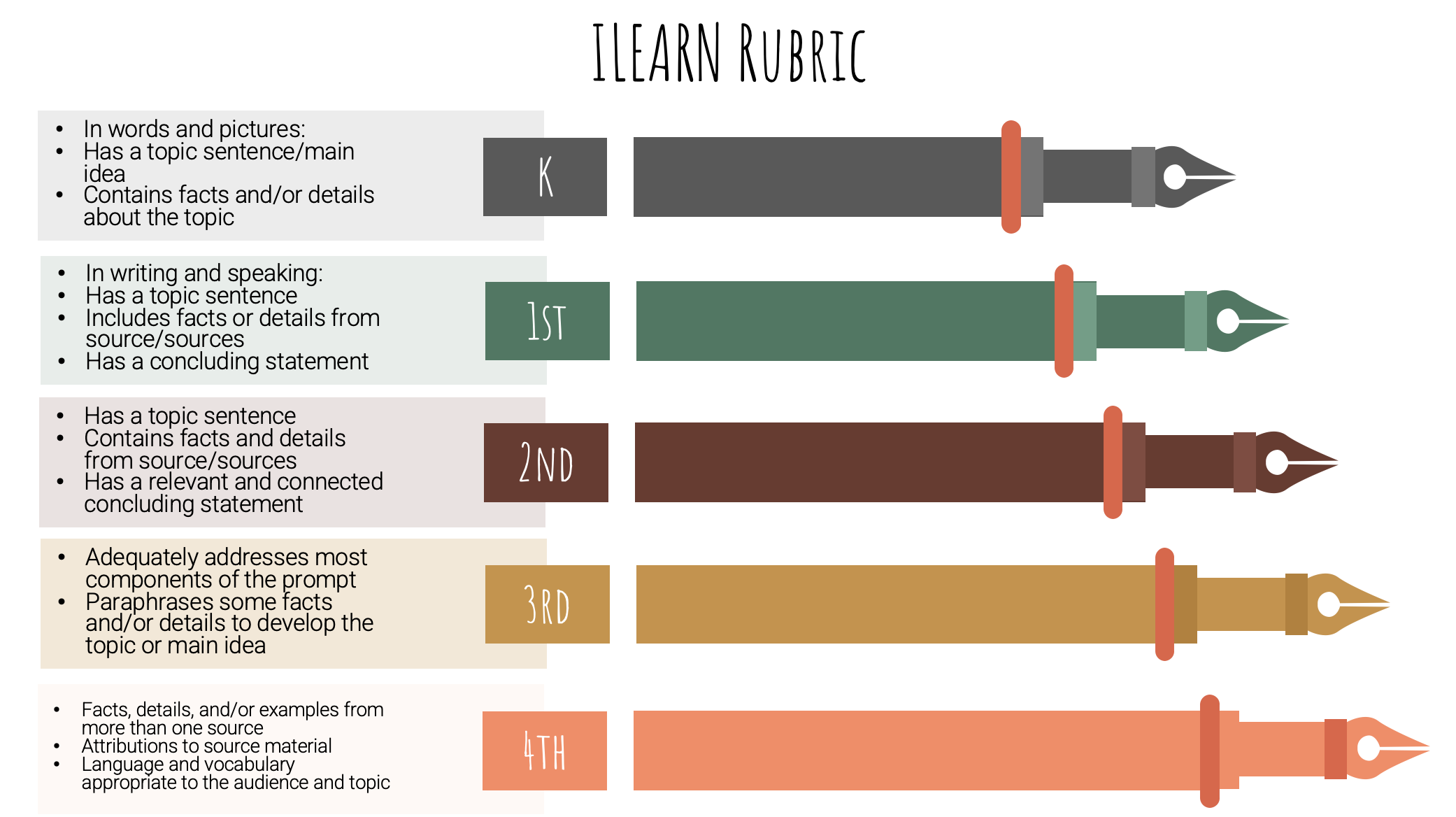
The State of Indiana has provided rubrics that are written based on the academic standards, and they are broken down into the different categories that students are assessed on during the writing portion of the ILEARN assessment. They include three focus areas – organization, evidence and elaboration, and conventions. So, we started by looking at the rubric section based on evidence and elaboration (our goal area). Unfortunately, since the ILEARN rubric only includes grades 3-8, we didn’t have a clear rubric for grades K-2 in this area. So, our leadership team had done some prework. We dug into the standards and rubrics from grades three & four and then walked the rubrics back, referencing what was included in the standards in each grade level, to create a simple bullet-pointed rubric for all grades K-4.

What we came up with was something that looked like this:

Next, we sent each grade level team to dig into their standards, the academic frameworks put together by the state, and the prework our lead team had done. We then took time to define success criteria. We asked ourselves, “What should my students’ writing look like to show they have met proficiency in the areas we’ve identified?” To ensure we clearly understood what proficient writing should look like, we utilized the Vermont Writing Collaborative writing samples, which had been scored based on common core standards. These standards are very close to the ones that we use in Indiana. My favorite thing about these samples is that when you look at the scored samples, there is information on the page about why they fall into the category they did on the rubric. Then, the person who scored it wrote a short section called “Final Thoughts,” which helped us better understand what to look for to show proficiency on the standard.

Moving forward, we will use these rubrics and success criteria to identify where our students currently fall in evidence and evaluation on a cold write (a piece of writing that our students have not had any direct instruction or support to write) and then plan instructional strategies that will support their needs. It was important to us to look at cold writes instead of a piece that the students may have been working on as part of a current unit because that will give us an idea of what our students can do entirely on their own without any direct teaching to support the writing process.

Much like building a LEGO, the writing process is a step-by-step learning process so that students may grow in the vertical articulation of the standard. No step can be missed for our students to get to proficiency. The scores on the ILEARN assessment are often tied to the classroom or grade level that took the assessment. I want our teachers to be fully aware that without the foundational steps that must happen in kindergarten, first grade, and second grade, our students will never get to proficiency in grades three & four. Those scores represent our work to build a student as a writer. If you skip a page in your LEGO instructions, you will encounter problems later in the build. At the same time, if we miss a step in building proficient writers, our students will struggle as they age.

What are your thoughts? Have you, like me, ever been leading a professional development and felt like some weren’t fully engaged because the data “wasn’t from their grade level?” Have you ever been the one who disengaged? How might you think differently about your role moving forward? Let us know your thoughts in the comments below!