Guide to Assessments in Multi-Tiered Systems of Support

At a recent Collaboration Network for the Indiana Literacy Cadre, we discussed the pivotal role of assessments in the Multi-Tiered Systems of Support (MTSS) process. Our session, led by Tracy Hastings, the Executive Director of Education and Early Literacy Initiatives from the Ivy Tech Community College, was a massive support for understanding the different types of assessments and their role. We discovered that assessments are not just tools for evaluating students but also for guiding the next steps in instruction.

One of the resources she shared with us is this chart:

LD@school, a project of the Learning Disabilities Association of Ontario, created the chart. What I love is that it breaks down the different types of assessments and their uses. As a reminder, assessments are about more than just evaluating a student. They are also tools that teachers should use to help guide the next steps in instruction.

Let’s examine each assessment type and its uses, starting with Universal Screeners. These assessments are typically used three times per year (beginning, middle, and end) to identify students or systems that are at risk. These brief assessments measure a student’s performance on a standardized scale. They often give us scores in a percentile range and are given to all students. Screeners can be used to help catch students who are struggling early. One misconception about universal screeners is that the data may be used to help us group students with similar scores for an intervention. The problem is that a Universal Screener often checks various skills, and two students with similar scores have very different needs for intervention. You can think of the universal screener as being like a blood pressure or temperature check. These might tell a doctor that something is wrong, but not what is wrong. When planning tiered interventions for students, you need more information than just the universal screener. Universal screeners can also help identify some potential issues with the core curriculum to ensure that it meets the needs of all students. Our district uses DIBELS and NWEA MAP assessments as universal screeners, although other districts might use Acadience, Aimsweb, FastBridge, or easyCBM.

As I said, the Universal Screener may give us an idea that a student is at risk, but that’s not enough information to know how to solve that problem. Just like how your doctor might do more tests if your blood pressure or temperature is too high or too low, when a Universal Screener tells us that a student is struggling, we next need to do some Diagnostic Assessments to learn more about the child’s needs. A diagnostic will help us to pinpoint specific areas of difficulty. We only use these assessments with students who are at risk to help us identify what the problem is and what intervention or differentiated instruction would best support the learner. Sometimes, we might be tempted to give all the diagnostics to all our students to know more about them. The problem is that it would take too much time from our Tier 1 instruction to do this. If a school’s Tier 1 instruction is where it needs to be, we should only see about 20% or less of our students falling in the at-risk category.

Recently, I’ve been having a lot of conversations about making sure that what we do to support our learners in Tier 2 or Tier 3 is making sure that we are in alignment – meaning that the needs of the child and where they fall in the progression of skills are in alignment with the intervention or differentiated instruction. That way, we know that we are meeting the needs of the child in front of us. Based on the diagnostic, you may find that two students with very similar scores on the Universal Screener have vastly different needs once you do the diagnostic assessments. We’ve been using the CORE Phonics Survey, the LETRS Spelling Assessment, and the PAST in our building. Other diagnostics might include the Really Great Reading Phonological Awareness Survey or the Acadience Comprehension, Fluency, and Oral Language Diagnostic.

Two more types of assessments are considered assessments for learning. First, there’s progress monitoring. These assessments are generally given weekly or bi-weekly and help track student progress and the effectiveness of interventions. Since they are given regularly, they can allow teachers to adjust interventions or increase the intensity of support quickly. If we find students have made progress, we might gradually reduce the intervention or shift to a different intervention that moves them along the learning progression. The last assessment for learning I will discuss here is formative. These assessments are what we use to have ongoing feedback during instruction. This might include things like quizzes, discussions, and exit tickets. These assessments allow us to make sure our Tier 1 instruction is effective for all our learners.

I wanted to dig into assessments today because we must understand the reason for and value of each of the various types of assessments for learning. As educators, we must be prepared to use multiple tools to identify what is causing students to struggle and how well our interventions or instruction meets their needs. Hopefully, this post will provide you with a better understanding of the different types of assessments which in turn will help you find better alignment in your MTSS process. If you don’t know what may be available in your district, there should be people you could turn to for support. In our building, the literacy coach is an excellent resource. If you don’t have a literacy coach, a school psychologist might be another person to help you understand how you might best support your learners. By utilizing assessments these various assessments, you can create a data-informed MTSS framework that meets the various needs of all students.

So again, let’s go back to the analogy of the visit to the doctor’s office:

  • Universal Screeners: The things they do at every appointment for every patient, check you blood pressure and temperature, use the oximeter to measure pulse and oxygen saturation, etc. These things may be a sign of general health, or a sign of a potential problem.
  • Diagnostic: When the doctor notices a problem, they may order some additional tests. Things like an EKG, or a blood test, will give the doctor additional information to help identify the problem.
  • Formative: These are the check-ups along the way after you’ve been given a treatment plan. Your doctor might schedule a few follow-ups to see how things are going.

Have you had previous experiences with these various types of assessments? What have you noticed? How have diagnostics helped you improve your support for students? Let us know in the comments below!
The Basic Questions

Recently, I’ve been doing a lot of research and learning on how to best meet the needs of our students. In LETRS (Language Essentials for Teachers of Reading and Spelling), I’ve come to understand just how important assessments are for us to know two things – first, they help us know where our students are, and second, they help us know what we need to do next to help our students to grow.

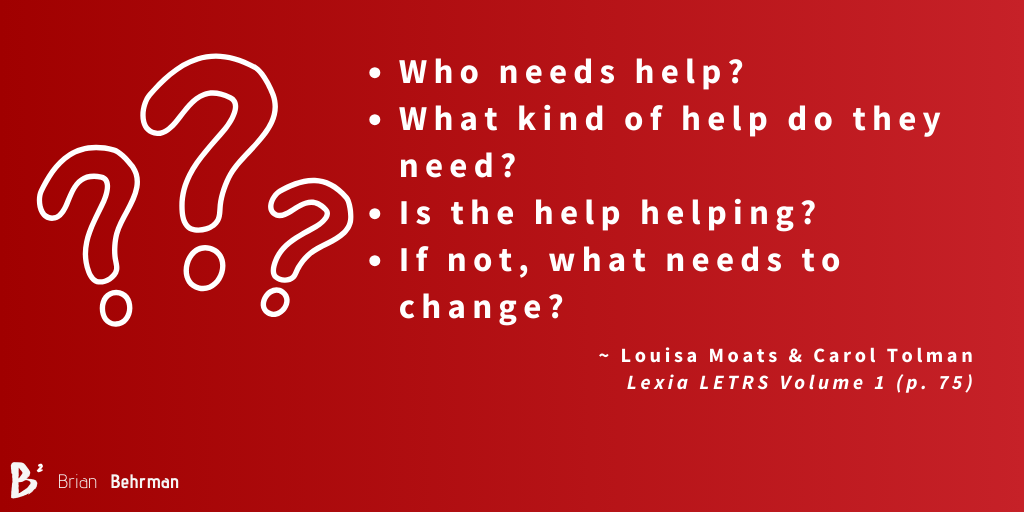
When looking at assessments, LETRS suggests that there are 4 basic questions that we should answer based on the various assessments and the data we collect. Those questions are:

In today’s post, I’ll dig into those questions more to support you when looking at student data. We want to all be on the same page about these things because one of the biggest takeaways, as I learn more about the Science of Reading, is that prevention and early intervention have the greatest impact on avoiding potential reading difficulties. To help with these goals, we should screen our students in grades K-2 individually three times per year with a valid, reliable, and efficient assessment to flag any students who are making inadequate progress in reading. We should be using the results of those screeners to answer the four questions listed above.

Who needs help? – Our initial guide for those who need help should be driven by our academic standards. As an administrator in Indiana, my go-to resource is the Indiana Academic Standards Vertical Articulation Guide. You can find the K-2 version here, or you can get the 2-5 version here. If you live in a different state, look to see if your Department of Education has something similar, or you could utilize your academic standards. In addition to standards, there are other resources that you could use. Your curricular resources typically have a scope and sequence. If you’ve checked how well your resource aligns with your academic standards and know that the resource is highly aligned, then that scope and sequence will help. Another resource you might want to look at is the scope and sequence of a resource such as LETRS. You can find this scope and sequence here. This tool might help you know when most typical students will be ready for a specific skill as a reader, and then as a speller (quick side-note on this – these grade levels are approximate – we know all students develop in different ways at different times, but this can be a good tool to compare to the scope and sequence of your resources, and can serve as a support if there are students who are far off the benchmark). A final tool that can be beneficial in identifying where students should be is the Progression of Word Study, also created by LETRS:

So… to be able to identify just who needs help, we need to look at the students in your class and their data. If there are students who are not meeting the benchmarks of your screeners, that should raise a red flag. If you have a student performing below most other students in your class, that should raise a red flag. And finally, if more than a typical proportion of a class is not meeting the benchmark, that should raise a red flag.

What kind of help do they need? – Once we’ve identified our students who need help, the next goal is how to help them. If that student is below the benchmark, it’s time to do a diagnostic assessment. Recently, the leadership team in my building has been looking at the LETRS Phonics and Word-Reading Survey as a potential tool for diagnostic screening (accessible here). What we like about it is that it’s organized according to the progression of phonic elements. For most students, it will take 5-10 minutes to complete. Once you reach a point of frustration for the student, you stop. When you fill out the summary chart, you should have a clearer picture of where the student’s phonics and phonemic awareness have broken down. Once you know that, you can decide on an intervention for your student, and where you might want to start them.

In our school, we use UFLI Foundations as our core resource for structured literacy, and for most students, it will become our primary tool for Tier 2 Interventions. When we have completed the diagnostic we’d look at the UFLI scope and sequence to identify what lesson might help fill in the gaps for that student. Ideally, I’d form a small group of 3-5 students at a similar level for this work. In our building, we’ve been utilizing a shared RTI time across grade levels to make this happen. Each PLC team can look at their students of concern, group them based on need, and decide which teacher will pull which group for support. If all is going well in your Tier 1 instruction, then this should be around 15-25% of your students who need extra support, which results in a reasonably sized small group.

Once we identify our intervention, and where the students need to start on that intervention, it’s time to create some short-term goals. We’ve been setting goals of approximately 6-8 weeks in the SMART goal format. An example of this SMART goal might look like this: By ___(date)__, __(student name)__ will be able to __(skill)__ using __(intervention)__ as measured by __(Progress Monitoring Tool)__. These clear goals help us know what our students are working on and identify opportunities for early wins with each child.

Is the help helping? – At this point, we’ve identified our students of concern and created groups of students to work with on specific skills. Now it’s time for us to implement a plan of progress monitoring. These assessments should be short, formative assessments that allow teachers to make instructional decisions. Recently, we have been using Aimsweb Plus as our Progress Monitoring tool. Ultimately, the progress monitoring should tell us more about the validity of the intervention and its teaching than it tells us about the student.

If not, what needs to change? – So now we’ve done all the previous steps, screeners have been used, areas of need identified, interventions implemented, and progress monitoring is utilized every 1-3 weeks. Now it’s time to think about what to do for a student who is not growing as we’d like. If a student seems stagnant on the goal after a few rounds of Progress Monitor data, we must change the instructional plan for that student to better meet their needs. This is why we want to set a short-term (6-8 weeks) goal, and then check on student progress towards that goal regularly. If their data does not show growth toward their target, it’s time to do additional digging. In our school, this is where we’d set up a Child Study Team. That team includes the teacher, support staff who work with the students, our instructional coaches, and our administrators. Based on the conversations around the table, we might use an additional screener, put into place a different intervention, or shift the skill we’re working on within the intervention.

Again, the goal is to identify our students who need help, assess what kind of help they need, put that help into place, and make changes as needed. These steps will help us be ready to intervene as early as possible. The earlier we intervene, the easier it will be to close gaps. Ultimately, our goal is 95% proficiency by the end of 3rd grade. That can’t happen unless we look for those red flags in our students and take the appropriate steps.

As you reflect on your students, who raises a red flag for you? What steps should you take to help them be better prepared for next year? What goals could you put into place now to help next year’s teachers better support the students you’re thinking of? Let’s go do it! The sooner we intervene, the better we can support our students!