What really goes into teaching comprehension

As a classroom teacher, I remember spending chunks of time with my students. We’d read, sometimes me to them, sometimes them to me, sometimes to each other, and sometimes on their own. Then, I would do some comprehension activity—maybe some questions to answer, a written response, or something similar. This is how I was trained then, so it’s what I did. I thought I was doing good work.
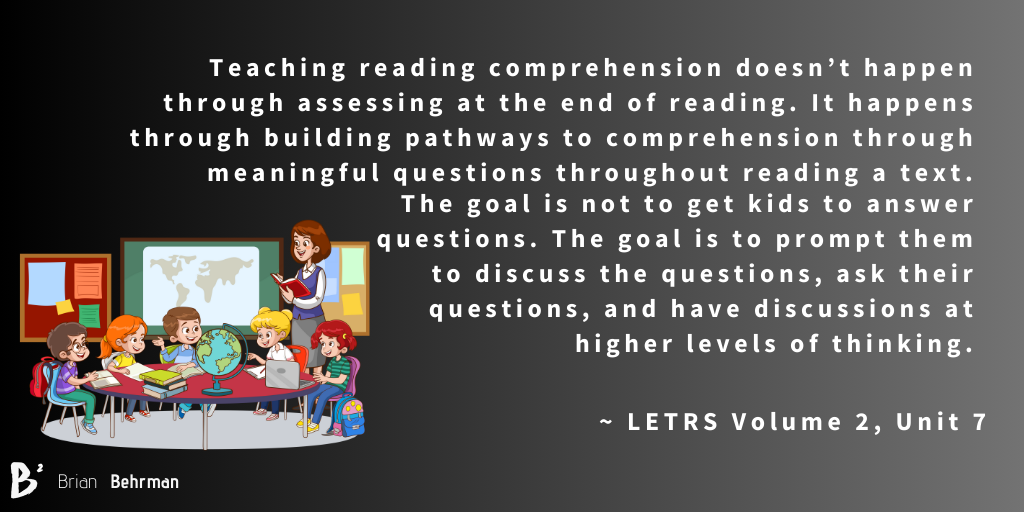
However, in the past couple of training sessions with LETRS, my thinking has been challenged to move students to true comprehension. There was so much more that I could have been doing throughout the reading process to help build higher thinking skills for my students. So let’s dig into some of the things we can do Before, During, and After reading to support building reading comprehension (you can reference the planning checklist below).

Before:

First, we need to establish a purpose for reading—why have we selected this text? What should our students take away? Is there a lesson to be learned? This helps us define the why behind the reading for our students.

Identify text structure – Is this an informational piece? A narrative? What do your students need to know about the text structure to be able to attack it?

Prepare background knowledge – As you look at your text, what do you think your students need to know to comprehend this text? Is there information they may not have already been exposed to?

Select vocabulary – As you preread the text, consider what words your students need to know to comprehend the text. Focus on the Tier 2 words.

Finally, Identify Challenging Language – What language might be challenging for students when pre-reading the text? Are there phrases that could be difficult to understand? Are words used in unusual ways? Mark those spots during your pre-read to be prepared to discuss them during the read-aloud.

During:

We should be sure to Plan Questions & Anticipate Student Questions intentionally – As you pre-read your read-aloud text, have a stack of sticky notes nearby. Mark spots in the text where you will pause to check for understanding. Are there parts that might be tricky to understand? Language that you might want to highlight? And be ready to address spots where students might ask you questions – maybe a place where something confusing happens. By taking the time to prepare, you can ensure that the questions you ask during the reading are more than surface-level questions but comprehension questions that push your students to higher levels of thinking.

Next, Use text structure to organize thinking – graphic organizers like a story framework, a web diagram, a cause/effect map, or a Venn diagram are just a few examples of the types of graphic organizers that can help students track the plot of a narrative story, or organize the information in an informational text.

After:

Once you finish the reading, some things to consider with students include: Was the purpose met & did the students’ thinking change? These questions can help you evaluate students’ understanding of the text. Do you need to reread portions of the story? Is there something unclear? This might help illuminate a need to go back into the text.

Finally, Assessment: Can students express takeaways? Use text evidence? This is where we can evaluate the big ideas and long-term understanding that students take from a text. Did they get the lesson we wanted them to learn when we established the purpose? Can they point to evidence in the text to support their thinking? These are key signs of true comprehension.

If you are like me, you probably wonder when I have time to do that. I read aloud every day! Sometimes, multiple times a day. You’re right! Trying to do this with every text would be very difficult. But that is where the power of teams comes in. When you work as a team and plan units together, you can select common read-alouds. If you have the same 8-10 read-alouds (maybe more, maybe less) in a week across your team, each person can prep 2-3 of these a week, and you can share. Think of the read-aloud library you could build as a team during a school year.

You might choose to do this with the actual books with markings in the book, or if you are a more digital native, you could create shared folders, and your read-aloud notes and outlines could live there. And what if you expanded the creation of the read-aloud library across the school? In a school of 20 teachers, doing two books weekly, that’s 40 books per week, and over 1,400 books in a school year that could be shared for read-aloud purposes. Work smarter – not harder.

So let me leave you with this – remember that building reading comprehension is more than asking questions when you finish the reading. It’s a constant process. If you use your read-aloud as I did, without any prep and mainly as a throwaway time, learn from me and do better. Those 10-15 minutes a day can be such rich opportunities for teaching, but it takes planning and prep to make it so. Please work with your team, or we can work across the school to build a shared read-aloud library that we can all access to benefit our students!

Reading comprehension strategies aren’t the point

As I continue to learn, I find myself spending more time reflecting on the teaching practices I used when I was a classroom teacher. Many times, I think back to a practice I used and realize that I wouldn’t do the same if I were to go back into a classroom teacher position. Today, I was specifically thinking about the way I taught reading comprehension when I was a sixth-grade teacher.

As a new teacher, I frequently searched for ways to enhance my teaching skills, particularly regarding the teaching of reading. I found two books, which I read and utilized often, that helped me in teaching students how to comprehend what they were reading. These books were Guiding Readers and Writers: Teaching Comprehension, Genre, and Content Literacy and Teaching for Comprehension and Fluency: Thinking, Talking, and Writing About Reading, K-8, both authored by Irene Fountas and Gay Su Pinnell. These books significantly influenced my teaching methods for several years, especially when teaching intermediate grade students.

While it would be hard to name a single takeaway from these texts, one of the things that was influenced by these books was the way I thought I needed to teach reading comprehension. I would teach reading comprehension as independent strategies that a reader might just pull out and utilize at the correct moment. When I taught this way, I might choose one text and use it to learn about the main ideas and supporting details. Then I might select another text to work on inferencing. This may sound familiar to any of you who have been in the education realm in the past 30 years (or possibly more!).

This was the primary work that I did to teach comprehension. It seemed like the strategies were the key to comprehension, so we would cycle through lessons in small group, whole group, guided reading, etc. Then last fall, I read the newest version of Shifting the Balance: 6 Ways to Bring the Science of Reading into the Upper Elementary Classroom by Katie Egan Cunningham, Jan Burkins, and Kari Yates. If you are an upper elementary/intermediate grade teacher, I think this is a highly accessible text for you to learn more about The Science of Reading. It does a great job of distilling some of the timeliest research into a format that teaches you a bit about the science behind a shift, and then gives suggestions for new practices.

But, if you’re like me, be prepared to have moments when you begin to doubt what you thought you knew about teaching reading. For me, the first moment (but not the last) came when I got to page 43, Shift 2: Rethinking the Role of Strategy Comprehension in Learning to Comprehend. If you go back a couple of paragraphs to my description of teaching comprehension strategies, I think there was a part of me that believed the teaching of the strategies was the teaching of comprehension. So, when I read this quote from the work of Nell Duke, Alessandra Ward, and P. David Pearson, I had a moment of guilt that I think many of us have when we learn that what we thought was a great practice might not have been so great based on more current research:

What I have now learned is that while those strategies may help with comprehension, by themselves it’s not enough. In addition to those strategies, readers need so much more. Those things include “vocabulary knowledge, executive function skills, working memory, familiarity with language structures, knowledge of text structures, verbal reasoning, and motivation” (Cunningham, Burkins, and Yates, p.44-45).

As a classroom teacher, what are we to do? How can we engage those other skills? I’m definitely not telling you to go throw out any lesson you’ve done in the past on comprehension strategies, because students need to be introduced to those skills. But, just as the purpose behind a systemic and explicit structure literacy program is to help students get to automaticity in their decoding of words, providing readers with the right strategies will help them get to automaticity in comprehension and fluidly move between different strategies to become proficient readers. I really like the kid-friendly language that Cunningham, Burkins, and Yates use to describe what they call “The Strategic Six.” Here are some thoughts on what might help your students move toward proficiency (the headings below come from the intermediate version of Shifting the Balance):

  • Switch on What You Know (Activate Prior Knowledge) – We might teach this skill by engaging in a pre-read of a text. This might involve looking at headings, titles, pictures, and diagrams. Help students ask themselves “What do I already know about this?” (Or maybe, what don’t I know).
  • Map the Text (Notice Structures) – As you do the pre-read, what do you notice about the text? Are there patterns? Section headings or chapter titles that might help you know what to expect? In a fiction piece, who is the narrator? From what point of view is the story told?
  • Keep a Close Eye on Comprehension (Monitor and Clarify) – This is all about metacognition and being aware of our own thinking. This means paying attention to our thoughts as we read. If something doesn’t make sense, where did it break down? Do I need to reread? Slow down? Fix-up strategies like this help improve comprehension.
  • Dig Below the Surface (Ask and Answer Questions) – Long ago, I came across an old comprehension model called SQ3R. This stands for Survey, Question, Read, Recall, Review. During a pre-read (survey), you might jot down a few questions you think could be answered while you are reading. As you read, you monitor your thinking looking for answers to those questions. Then, you go back to your questions and see if you can answer them based on the reading you just did. Finally, you check your answers by going back to the text. This helped my students develop the skill of asking questions prior to and while reading.
  • Fill in the Missing Pieces (Infer) – When we think about inferences, it’s often about the conclusions we draw based on previous experiences. We make inferences all the time. Imagine walking into your home, you see dirty dishes in the sink, the mixer is out on the counter, along with a mess of flour and dough, and you can smell that something is baking. You may not be able to see what, but you know that your daughter is making chocolate chip cookies because she likes baking and is the only one at home. This is an inference. Once students understand that using clues to understand what’s happening is inferencing, they will notice their inferences all the time! An activity that I have seen used is the paper bag mystery person. You can do this, or you can ask students to create their own. In one example you might have a bag with a pair of running shoes, a medal from a 5k, a number bib from a half marathon, and a pair of socks. As you share the items have the students make an inference about the person by creating a list. More items will likely lead to more specific inferences.
  • Sum up the Core Ideas (Summarize) – As students are reading, they should be thinking about some of the key details. In a narrative, this might involve the setting, key characters, the problem and solution, and what happened at the end of the story. If you’re looking for a way to support this, you might consider story frames. Reading Rockets has a couple of great graphic organizers to support this. Here is one option, and here is another. For nonfiction reading, you might use a concept map like this for students to identify main ideas and key details. These tools will support students in thinking about what the key details are that they need to share a meaningful summary.

This is not the end-all, be-all list of important things students “need to know” to comprehend their reading. You might find a dozen other blogs with a dozen other thoughts, but the ideas listed above are supported by research as high-leverage ways to help grow reading comprehension in our students.

As I’ve shared before, the goal of reading should always be to comprehend. But we must remember that proficient readers will use a variety of strategies with automaticity based on their needs while they read. Comprehension is not the use of a single strategy, rather it’s an active and ongoing process that might involve shifting between several different strategies to help with comprehension. This is why teaching strategies in a stand-alone format with a specific text is not the only way to practice our comprehension skills.

What are your thoughts on this topic? Have you been teaching strategies thinking that would help your students learn to comprehend? What is something new you can commit to trying as a result of your reading today? Share with us in your comments below, or have a conversation with your PLC team about how you might be able to integrate some of these thoughts into the work you do in your classroom.

The purpose of reading (part 4)

The purpose of reading (part 4)

Over the last couple of months, my posts here have been focused on the primary purpose of reading. In the first post, I shared that in my belief, the ultimate reason we teach our students to read is so that they can learn how to comprehend text (you can see that first post here). Then over the course of that post, along with part 2 and part 3, I dug into a few of the key concepts that students need to be able to do in order to read with solid comprehension. As a reminder, the 4 key things that students need to be able to do to comprehend what they read is to:

  • Read the words accurately and fluently.
  • Understand the meaning of the words.
  • Have adequate background knowledge.
  • Focus attention on critical content.

In the first 3 posts, we dug into those first 3 concepts. Today’s post is going to primarily be thinking on how we help students to focus on critical content. Much of my thinking around these four concepts comes from a session led by Anita Archer on reading comprehension that I attended while at The Reading League National Conference in Syracuse this fall. She created a checklist for teachers to know what skills students need to so that they can accomplish each of the 4 key things listed above. Here’s the checklist related to focusing on critical content:

  • Ask questions on critical content as we read books to students.
  • Ask text-dependent questions as students are reading text.
  • Have students generate questions on passages they read.
  • Teach text features, both narrative and informative.
  • Use retrieval practice procedures to review key content.
  • Have students write in response to passages.

The first thing that I note as I look over this list, is that as the teacher, we must be prepared in advance with a knowledge of the text. If we want to help our students focus on critical content, we must pre-read a text so that we know what content is critical. During that pre-read, it’s a great time to mark key passages that you might want to ask a question about, and ideally plan what that question might be.

But that last bullet point that you see above regarding writing responses was reiterated in a recent blog post by Timothy Shanahan. A key point that I pulled from that post is:

So, as we are reading to our students, or as our students are reading independently, we need to be able to ask questions that guide and monitor students’ comprehension (that’s what the National Reading Panel said back in the year 2000). Ideally, those questions we ask should be text dependent – in other words, students must also provide evidence from the text to support their answers (I used to call this “Back your Smack” when I was a classroom teacher). We want to be sure that our students have read the text!

But at the same time, it is valuable for our students to develop their own questions as they are reading. They might choose to ask questions about the main character, the setting, the problem in the story and how it was solved, or what happened in the end. We want to be sure that students learn to ask questions like the ones we’d ask – in other words, they must ask questions that can only be answered if you have read the text. This could also be a great time to teach students about Depth of Knowledge – to help them learn about the different types of questions that exist, and how they might develop questions with higher levels of thinking.

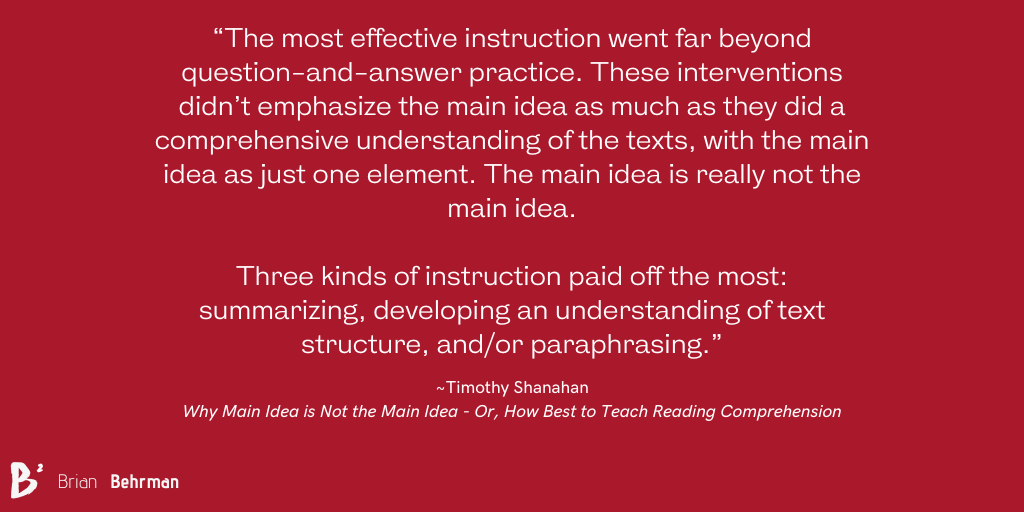
But let’s get into some of what Shanahan was getting at in his post – focusing on those reading comprehension strategies that we often teach as a stand-alone skill do not always support our students in learning to comprehend what they read better. What we’re learning as more research studies are shared is that while there is “nothing wrong with asking questions about what the kids have read, just don’t expect such practice to exert much impact on the ability to deal with specific question categories, nor even to have any impact on reading comprehension.” (Shanahan, 2023).

In the quote in the graphic above, Shanahan suggests that summarizing, developing an understanding of text structure, and/or paraphrasing are much more impactful in growing student comprehension. And that makes sense to me – to do any of those things, readers are required to think deeply about a text, which is certainly going to improve reading comprehension.

So what does that mean in practice? We often talk about how readers are writers, and writers are readers. One thing you might consider implementing with your students is a protocol for writing about the text we’re reading. Not just making connections, but truly thinking about pieces of the text structure – things like the setting, who the main character is, what is the character’s problem/conflict/goal, how does the character comes to a resolution, what happened in the end of the piece, and what are the themes.

To develop these skills with students, you might start with partners doing a shared retell – maybe partner A defines the setting of the story, the main character, and the problem, while partner B shares about the beginning, middle, and end of the story and the eventual resolution of the problem. Through verbal practice, collaboration, and feedback, students will learn how to then craft their own summary. Over time, you might then work towards having students work collaboratively on developing a summary of the story. Creating a list of sentence stems might help in this process. Some ideas for what that might look like include:

The problem that exists with much of our question-and-answer strategies of stand along comprehension skills is that really, all it’s doing is testing a student’s recall of the test. This is something we’d do for an assessment, not a strategy for teaching a student how to comprehend. Through our guidance, we can help our students to analyze what it is they read. This analysis forces our students to dive back into the text, to reread, and to think deeply about what the text is really saying. These thinking skills will support comprehension much more than basic question and answer skills.

Have you ever utilized written or spoken responses in your class? How has it supported your students in developing their comprehension skills? Do you have any new ideas from what’s shared above? Let us know a bit about your thoughts in the comments below!

The purpose of reading (part 3)

In recent posts, I’ve really been focused on how we move our students from the stage of understanding phonemic awareness, phonics, and decoding across the bridge to reading comprehension. Ultimately, the purpose of reading revolves around understanding what it is that we read. That means helping to develop students who are fully literate – able to both read and write fluently. In part 1 (found here) I dug into the purpose of reading, some of the work from Anita Archer around the 4 things all students must be able to do in order to comprehend what they read, and then some ideas about how we make sure that our students are reading fluently.

In part 2 (found here) we looked at the importance of helping our students develop a wide vocabulary. One of the ways we do this is by teaching vocabulary explicitly. That post walks through what an explicit vocabulary routine might look like.

Today’s post is going to dig into the importance of adequate background knowledge. Let me share an example of how background knowledge impacted me recently. I consider myself to be a pretty fluent reader. When I run into vocabulary I don’t know, I have lots of tools to help fix that problem. But a few weeks ago, my daughter had a reading assignment for her biology class. She asked me to help her out a little bit. The article was a 4-page research piece on slime molds. As a former science teacher, I felt like this was something I could definitely help with.

Then I started reading. I clearly did not have enough background knowledge. I was able to read the article quickly, but I could not understand much of what was happening. I was lacking the necessary background knowledge to be able to truly comprehend what the article was saying. After sitting with the article for an hour, googling some terms, and doing some additional research, I was able to build enough schema to truly help my daughter with her assignment.

The moral to this is that even for our fluent readers, if they don’t have the appropriate background knowledge, they will not be able to comprehend the things that they have read.

But what does the research say about background knowledge?

While doing some research for this post, I read about a study that was done that took readers with a wide variety of reading abilities based on fluency and comprehension screeners. All readers read an article about baseball. No matter a student’s ability, the readers who already had background knowledge about baseball scored higher on the comprehension measures. Having background knowledge of the topic built a schema that impacted comprehension more than their reading ability.

With this knowledge in mind, Archer suggests there are some things we can do to be sure to build more background knowledge for our readers:

  1. Read informative read-alouds, especially in the primary grades, including a variety of books on similar topics to build a knowledge network.
  2. Directly teach science, social studies, and health.
  3. Promote wide independent reading
  4. Directly teach critical background knowledge before reading a passage

So, how might we go about directly teaching that critical background knowledge? Well, first of all, as the teacher, we have to be sure we have pre-read the passage. This allows us to identify key knowledge that our students will need to understand. A few of the things you want to be sure to call attention to might include:

  • Is this a fiction or non-fiction piece?
  • If there are characters, who are they? Introduce their identity and some basic information (gender, age, etc.).
  • What is the setting? Describe the time and place. You might show the location on a map or globe, and then zoom in using something like Google Maps.
  • This would also be an excellent time to include key vocabulary from the story. When teaching these words, if you can pull pictures that help build the background knowledge, that can support vocabulary development.
  • If the setting is from a different period, do we need to provide some background knowledge about how people lived at that time?
  • Finally, you might wrap up this section of building background knowledge with some retrieval practice. You might ask students “What are some things you have learned about…?” Since we want everyone to do everything, you might first have them write a few ideas down on a whiteboard or sheet of paper. Then you could partner students up and have them take turns sharing using the sentence stem “One thing I learned about…”

By helping our students build solid background knowledge prior to reading, we help set them up to be able to better comprehend the things they read. What are some of the ways that you go about helping to build background knowledge for your students? Share your methods and ideas in the comments below!