
How many times have you heard about some cool project that a teacher you know is trying, and had the thought “Man, I wish I could do something like that with my class!”
I know that there were times that I would have those exact thoughts – sometimes the thing holding me back had to do with resources, sometimes it was fear that I couldn’t pull something like that off with my class, and sometimes it was that I wasn’t sure if it was something that I would actually be allowed to do with my students.
At the beginning of the school year, our Superintendent shared with all the teachers in the district a catchphrase that he wanted to become a phrase we all used to describe learning: “Incubating Awesome!” If we believe that it is our job to create an amazing learning space that leads to awesome opportunities for students to learn and grow, we cannot allow any doubt to get in the way! We have to move forward and do amazing things for our students because it’s what we know is best for kids!
In his book Creative Schools, Ken Robinson shares that “People everywhere have ideas they would like to develop, but they need permission to try them out and see if they work. If they fear failure or humiliation or disapproval, they usually hold back. If they’re encouraged to try their hand, they usually will.” I want this post to be that encouragement for you! Don’t let any of those fears or that thought of needing permission, be the thing that prevents you from incubating awesome in your own classroom!
It is my goal to create a culture where all the people in our school feel empowered to do what they think is necessary to create awesome learning opportunities for the students they work with! Robinson reminds us that culture is about permission. Not so long ago, the NFL was kind of a no holds barred world. True, there were personal fouls and calls for unnecessary roughness, but this year the NFL put into place new rules regarding leading with the helmet. This rule was put into place as an effort to keep players safe, but in the NFL Preseason there was an uproar over some of the penalties that were called. As a former football coach and player, this one is an example of some of the struggles with the new rule:
To me, this looks like a perfectly clean tackle. However, the referees in the game saw it as a player leading with the helmet, and called a penalty. The reality is that the lines of permission in society have been redrawn. We can see this in sports, or in the real world. The things that once were impermissible become common place, while other things that were once the norm become impermissible. Schools are changing too, and that affects our own lines of permission.
The next time you have an idea to try something new and innovative with your class, you may have something that pulls you back and tells you not to do it. Don’t listen! When we take risks as educators, we encourage our students to take their own risks. When we show our students that we’re willing to try something new, we show them that it’s ok to try something new. We teach in so many ways, and sometimes what students learn from us is not as much about the lessons we have planned as it is about the skills we help them develop through our own efforts to model what it means to be a lifelong learner.
And here’s the reality, if you are trying out new and innovative things, there are going to be times that you fail! We have begun to celebrate failure in our society. One thing that I’ve been thinking about though: it’s not the failure that we need to celebrate. It’s the willingness to reflect on that failure and figure out what we can learn and how we can get better that we should be celebrating.
So, knowing that you have permission to go out there and do something new and innovative, what ideas do you have? What ways are you going to incubate awesome in your classroom this year? Share your thoughts in the comments below! I can’t wait to hear about your ideas!
 Think for a moment about the exponential changes that have happened since the roll out of the smartphone in 2007. Then think for a moment about how exponential curves work (you can see an example to the right)… If there has been that much change since 2007, think how quickly our world is going to continue to change!
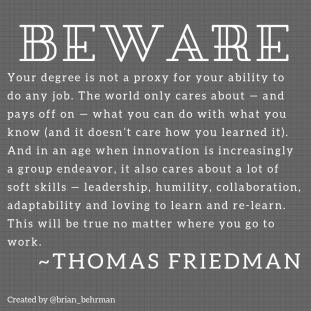 Thomas Friedman says that our students need to be capable of innovative thinking – critical thinking and problem solving should be a given for all in this day and age. He wrote about the importance of those skills in The World is Flat which was originally published in 2005. Now he’s thinking more about that idea of innovative thinking, which to him means not only are you able to do the job you are given, but you are also able to invent, reinvent, and re-engineer the skills necessary to accomplish that job.
 The View from 518