
For as long as I can recall, I’ve heard people talk about how kids these days are just different. I’m sure people said it about my generation when I was a kid, and now we’re adults saying it about the students that we serve. But when you stop to think about how the world is an ever-changing place, how technology leads to innovation, and how knowledge is so much easier to access, it’s not surprising to me that kids these days would be different.
This year, our school district is engaged in phase two of the Ford NGL (Next Generation Learning) Roadmap. This roadmap is all about developing a district-wide vision to help the graduates of our district be ready for college, careers, and life beyond high school. For a long time, I’ve been talking about this idea of helping to prepare our current students for their future reality, not our current reality. When we think about learning, this roadmap will help us to engage community stakeholders to plan for the future of our community.
Recently, all the K-8 administrators in our district attended a two-day conference to learn more about the work we are engaged in as we begin this second phase. One of the pieces that was most fascinating to me was some discussion about generations. Personally, I am a member of Generation X. The experiences of my childhood, the time period that I grew up in, and the technologies I experienced all helped to form me into the person that I am today. What generation are you a part of?
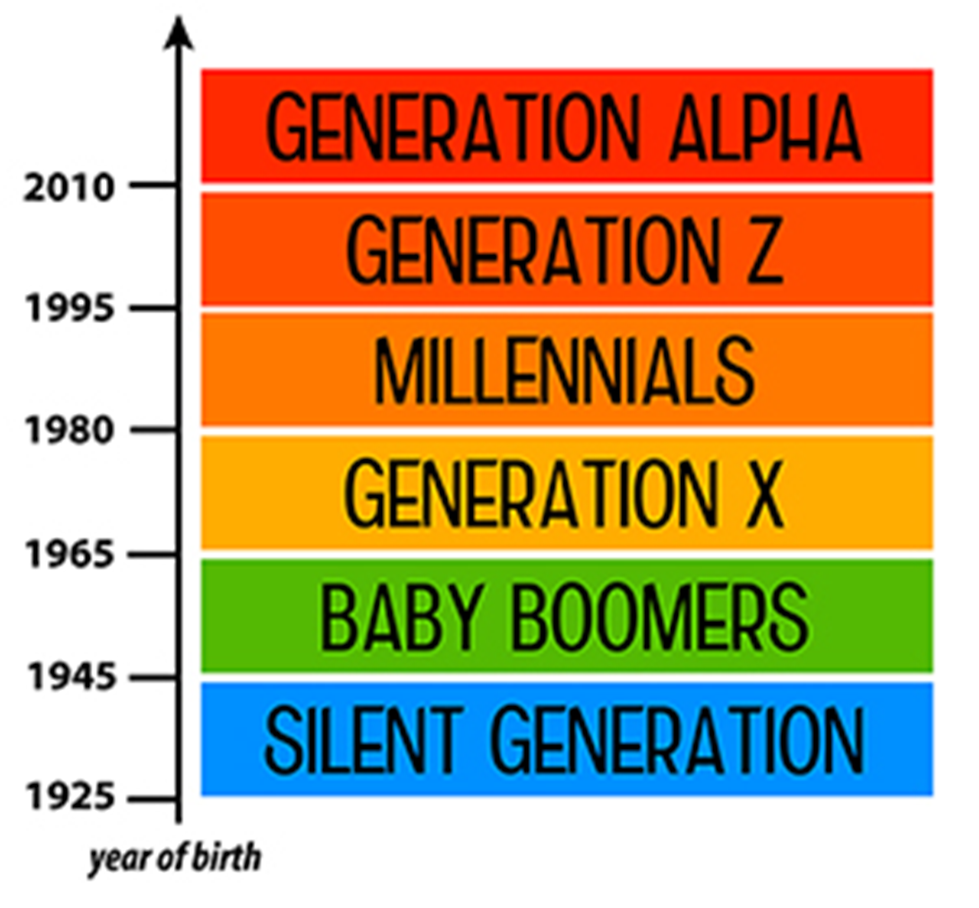
One of the things that was shared with us was that there are certain characteristics that are generally true of most people from any given generation. Take a moment to think about how the generation you were born in might have helped to shape who you are today. Then, take a look at this graphic that will compare a bit about the different generations and the characteristics that helped form them:

As you think about your own generation, what do you notice from this chart that strikes you? I definitely noticed the Rubix cube and the Walkman, two key parts of my own childhood. The day I upgraded to the “Sports Walkman” with the yellow body and matching yellow headphones, whoa! Although I also recall the excitement of the upgrade from the Walkman to the Discman!
Now, here’s the thing, let’s think about the students that you work with most directly. If you work in an elementary setting like me, all the students you interact with on a daily basis are part of Generation Alpha. So let’s think a little bit about who they are, and then what that means for them as learners.
First, a few facts about Generation Alpha (based on the research of McCrindle and found here):
- This is the first generation born entirely in the 21st century
- Their lives have been shaped by:
- A climate crisis
- A pandemic
- A mental health epidemic
- Seeing their parents and relatives working remotely
- Witness the introduction of Artificial Intelligence
- Access to digital devices and screens their entire life
- If current trends continue, Generation Alpha will be the most racially and ethnically diverse generation
- If current trends continue, they will be more likely to be surrounded by college-educated adults than prior generations
- They will be more likely to interact with peers online and through social media, which could result in shorter attention spans and impact their social formation
To go a little bit deeper, take a look at this graphic about Generation Alpha:

So let’s bring it back to learning. Now that we understand a bit about who Generation Alpha is, and what how they have been impacted by the environment, what does that mean for them as learners? According to “Understanding Generation Alpha” from McCrindle:
A shift in educational engagement is occurring for Gen Alpha, with schools switching from structural and auditory learning to engaging, visual, multimodal, and hands-on methods of educating this emerging generation.
Because their parents will indulge them in more formal education and at an earlier age, Generation Alpha will have access to more information than any other generation.
“Understanding Generation Alpha” accessible at https://mccrindle.com.au/article/topic/generation-alpha/generation-alpha-defined/
If we take all that we know about Generation Alpha, we must recognize that teaching students in the ways that may have worked for those of us in other generations will not work for today’s students. So what will education look like for Gen Alphas?
- Skills over degrees – Just mastering a standard is not enough for Gen Alpha. They are seeking learning that feels relevant. They want skills that they know they will be able to use in their future.
- Real-world simulations – How can we connect our learning within the four walls of the classroom to things that exist in the real world? Our students want to know that the things they are learning connect to life beyond school.
- On-the-job training – As our students grow older, we want to seek ways to provide them learning opportunities while in the job setting.
- Personalized learning – Choice for students will be so important! UDL helps to get us there. We want to provide choice and scaffolds in how to learn material, and then choice in how to show what they know.
- Shared learning – Our world is relying on collaboration more and more. Shared learning opportunities will help our students be better able to collaborate.
- Will learn at faster pace due to smart & voice tools, AI, and machine learning – As digital natives, our students understand how technology makes life and learning easier. Knowing that they have access to Google and AI tools, DOK 1 and 2 thinking will not push our students to the levels of thinking they will need for their future. We must work towards higher level thinking skills that technology hasn’t yet caught up with.
As I said earlier, our goal in education is to help prepare our students for their future. With that in mind, the most in-demand skills of the future work force include:
- Communication – The ability to use both spoken and written communication to work with others.
- Collaboration – The ability to develop constructive and cooperative working relationships with others.
- Customer Focus – Actively look for ways to assist customers and clients.
- Personal Learning and Mastery – The ability to acquire knowledge or skills through one’s study or experience.
- Cultural and Social Intelligence – Have awareness and understanding of other’s reactions.
My hope is that you can take this post and use it as a reflection for how to shift learning in a way that better meets the characteristics of our learners. What I believe you’ll find is that as you integrate teaching methods that meet the needs of today’s generation, you will see higher levels of engagement and greater learning for our students! What ideas do you have from this post? Does the information about Gen Alpha resonate with your experiences with students? Share your thoughts in the comments below!
 The View from 518