Thinking about problems

One of the things you should know about me is that I love to solve problems. To the point that sometimes, when I need to listen, my mind goes to suggestions for how to fix the issue. Often, those suggestions are specific to the exact need but don’t necessarily help with general needs in solving all types of problems.

As a classroom teacher, this was sometimes my focus as well. In the first few years of teaching, I often did a “Problem of the Week,” where students worked in a small group to solve a deep-thinking problem that was somehow tied to the curriculum. As a class, we would go over the problems. But when we went over them, we’d focus on how to solve that specific problem. In my mind, I assumed the skills would translate. Sometimes they would, but not always.

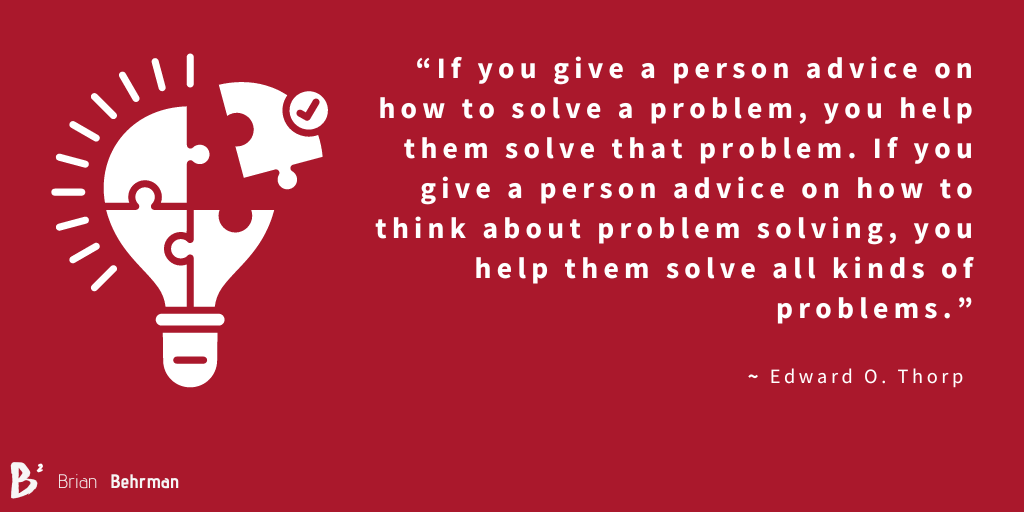
Over time, I have learned more, and one thing that I have considered is that schools need to be learning environments and that students need to develop deep thinking skills. These deep-thinking skills don’t happen when our teaching is based on how to solve a problem. While on a bike ride recently, I listened to an episode of the Tim Ferris Show podcast, and he interviewed Edward O. Thorp. He’s known for many things, but I was thinking about him from his perspective as a math professor. During the podcast, he was talking about teaching a class about investing. In the episode, he said the following:

Ultimately, the goal is to help teach students how to be lifelong problem solvers—whether we’re talking about math or any other skill, thinking is the key to our students’ success! That’s part of what I love about a book we’re reading, Building Thinking Classrooms by Peter Liljedahl. While the book focuses on ways to develop thinking skills in mathematics, we are looking at it from the perspective of how we bring similar shifts to learning in all subject areas.

If you’ve never read this great book from Liljedahl, you should know that it’s based on research he carried out in many classrooms and grade levels. The book’s core concept is that 14 practices, when implemented, will lead to greater student success based on learning measures. While the book is designed so that you can implement different practices as you see fit, Liljedahl suggests implementing the first 3 practices together. Those tasks include:

  • What types of tasks – the tasks should be highly engaging. When starting this process, you might begin with non-curricular tasks, but the goal is to get to tasks developed around the curriculum. These tasks will exist at a higher depth of knowledge, say DOK 3 or 4. For example, in a language arts class, you might have students creating a word web for various vocabulary words – connecting one word to another helps make the learning stickier. In social studies, you might have a task that involves a quick reenactment of an event from history that you’re studying. In science, you might have students exploring a hands-on, engaging lab task before explaining why something works so that they can make connections to what is happening in the real world.
  • How we form groups – According to Liljedahl’s research, the best groups are randomly formed in a way that students know is random (if they are preselected, students may not trust that they are truly random). In primary grades, you might want groups of 2, but from grades 3 and up, it’s best to have groups of 3 or fewer.
  • Where students work – The best place for a group of students is at what’s called “Vertical Non-Permanent Spaces.” These might be whiteboards around the room or something like a Wipebook (some creative teachers even use pieces of white shower board (they can be cut and then mounted to the wall like a whiteboard). Verticality is important because it allows for a flow of knowledge throughout the room. If a group gets stuck, they can see what others are doing. That’s not cheating. That’s using resources! And non permanent is important because it leads to lower stakes. Students are willing to take risks because they know they can erase something that doesn’t work.

When we create a learning environment that encourages thinking, has tasks at a higher DOK, and puts students into groups to collaborate, we encourage 21st-century thinking skills that will help our students know how to solve this problem and, more importantly, how to solve any problem.

What are your thoughts? How do you ensure that students in your classroom are learning to think about how to solve all kinds of problems? Share with us in the comments below!

Assessment to Provide Early Intervention

I know that many of us have opinions about what it is that students need to know by the time they reach the end of any specific grade level. Those opinions are formed in several ways. One way is using grade-level standards, or another might be through our experience working with students at a particular grade. But how do we know if a student is struggling earlier than that? What should raise a red flag for us when a student isn’t progressing as fast as we think they should?

What research shows us, through a longitudinal study of approximately 400 randomly selected kindergarten students from a broad sample of communities across the state of Connecticut (you can see a bit more about this study here) is that early interventions are key. This study followed students until the end of high school. One of the interesting findings of the study is that between grades 1-9, students who started in the bottom 25 percent (the lowest one-quarter) of reading achievement remained there for the duration of the study. Students who were struggling in kindergarten were more likely to struggle throughout their educational career.

This is why early intervention is key to reading support. “Once children are behind – which happens very early – they do not catch up unless intervention is intensive, timely, and well informed” (Moats & Tolman, LETRS Volume 1, p. 63). Recent trainings on foundational skills continue to remind me of the importance of taking the right steps, at the right time.

Sometimes though, I feel like we get a little too caught up in the formality of interventions. If we see a student who is struggling, we shouldn’t feel like we need to wait for the next official MTSS meeting to add in some interventions. We also sometimes get too caught up in how long we need to spend on these skills. When the group is small, and a gap is identified early enough, just 5-10 minutes a day can make a world of difference. And those interventions don’t always have to happen while gathered around a table. If you have 3 kids that you’re concerned about their letter ID or naming of sounds, have them walk near you in line, and do the intervention while you walk them to a restroom break, to their related arts class, or lunch. When we use the small moments, and chunk them together, we can make BIG differences!

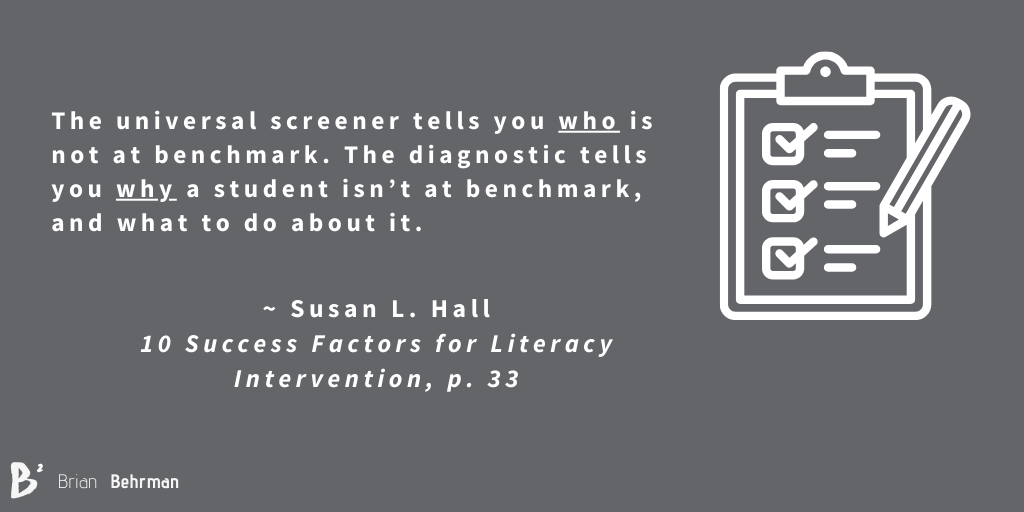
The first step in supporting students is knowing who to support – who falls into that bottom quarter of students. This is where a universal screener is so important. This is an assessment you might use for all students to see who is flagged as struggling with foundational reading skills. In my district, we use NWEA MAP Reading Fluency, however, other districts might use other screeners like Acadience Reading K-6, easyCBM, and others. This helps us locate the students who are at risk for reading difficulties.

Once we identify those students who are at risk, we may not know how we need to support that student That’s where diagnostic screeners are so important. There are lots of resources that you could use to help with screening students. Assessments such as The PAST Test (accessible for free here), or a Phonics and Word Reading Survey can help you see where your students are and identify where you might want to start an intervention. I would suggest using an assessment like this to screen your students of concern, then bring the data to a PLC meeting to see how you might be able to work as a team to support your learners in their continued growth.

The key to identifying the risks of reading struggles is to figure out where your students are as quickly as possible. Quality screeners are a huge part of that. Research suggests that screening should take place at least 3 times per year so that we can identify students who begin struggling later in the school year. Once students of concern are identified, we must get a quality intervention in place to support that student. The science tells us that most of our students can develop strong foundational reading skills – 95% or better – by the end of third grade. But the longer we wait to support students who are at risk, the harder that task becomes. Through appropriate intervention, we can make sure that many of our at-risk students are helped before chronic, serious reading and writing delays develop. This work must start on day 1 of kindergarten. We can’t afford to wait. Our student’s reading skills are too valuable!

Share with us in the comments. What are some of the things that you look for in your grade level to identify students who struggle? How might you intervene? We’d love to learn from one another!

Page 19 Thinking

Page 19 Thinking

A while back, I was listening to an episode of The Tim Ferris Show. For those of you who don’t know who Tim Ferris is, he is an author, blogger, and businessman, but I came to him as a podcast host. On the podcast, Tim does long-form interviews with a wide variety of people on many different topics. While it is rare that a guest on the podcast has direct ties to education, I often find value as an educator in aspects of the interviews. I will say that at times, the topics are not interesting to me, and when that happens, I’ll skip that episode, but often I find myself sucked into the conversations that I wouldn’t have expected to find interesting.

Last May, Tim had Seth Godin on the podcast (you can find the show page here). Seth is the author of 21 international bestsellers, and while the topics are generally related to marketing, his books and blog often venture into topics far beyond the realm of marketing. In addition, Seth has given multiple TED Talks, each with millions of views.

What stood out to me about the conversation was a five-ish minute clip about the concept of “Page 19 Thinking.” Honestly, the title of this concept could have been any number, but Seth chose to use 19. He described it as thinking about working on a book as part of a team. In the beginning, the team knows that there will be a page 19 in the book, it must be written, illustrated, footnotes added, etc. As a team of authors, you say “We know there will be a page 19. We know it’s coming from this team, but we also know that nobody here knows everything about what’s going to go on page 19.”

In this situation, the solution is to start with somebody writing a sentence, then someone can take that sentence and add to it to create a paragraph. The team may say “Let’s make this better” so then someone else will do some research and add another paragraph. Someone else might create an illustration, and someone else might add a footnote. Eventually, the team gets to a version of page 19 that they are happy with, and they “ship it” to the printer or publisher.

Along the way, team members relentlessly criticize the work, but they never criticize the person who did the work. And remember, criticism is closely related to the concept of a critique, where there is careful judgment, expression of opinion, and evaluation of both the good and bad qualities of something. If the goal is to create the best work possible, we must start somewhere. Rarely is our first idea also our best idea. Criticism forces us to reflect on our work and the ways to make it better.

Page 19 thinking allows people the freedom to speak up and contribute. Think about some of the best-known companies in the world. Whether you’re talking about Google, or Apple, or Amazon, what they are known for today is not necessarily how they began their work. Take a moment to look at your phone – personally, I have an iPhone. This is now the third iteration of the iPhone that I’ve had. Each has been different – they have changed in size, features, etc. Most people feel that the new features added have made the device better. But if we think about what the original iPhone could do, compared to the phone you are probably carrying with you each day, the changes have been dramatic. (If you want to see an interesting comparison between the original and the most recent iPhone, you can check out this short video) Those changes would not be possible without the work of a team to iterate and improve the device. And what’s interesting to think about is that Apple wasn’t a phone company in the beginning. It was formed to create the Apple I computer, but over time has become the maker of the iPod, iPad, Apple Watch, and various other accessories. The company has iterated many times.

Now, when we talk about criticism, sometimes when an idea is criticized, it can feel like personal criticism. But if we’re working as part of a team to create the best thing possible, we understand that the criticism is of the idea or the work, not the person. Hopefully, when we take on a mindset of page 19 thinking, we can allow ourselves the freedom to speak up and contribute, as well as to take feedback. Then as a team, we can iterate our way to excellence.

This whole process has me thinking about the PLC structure. When we get together as a PLC team, we have a goal of helping one another be the best teachers we can be to help our students grow. In the PLC process, questions 3 and 4 are about what we’re going to do if students aren’t learning, or what we will do if they are. In this portion of the process, we’re creating ideas to help our students continue to learn. If our PLC takes on a mindset of page 19 thinking, we know that the ideas we share are going to be criticized, but that criticism is about making the idea better, which in turn leads to better outcomes for students. We must let our own work be generously criticized, and we must generously criticize the work of others.

The teamwork that goes with allowing others to contribute their talent will always help our ideas become better. In a collaborative environment, it’s important to make sure that we all are welcome to the ideas of one another because the work of the team helps all our students.

What are your thoughts on page 19 thinking? How might this way of thinking impact the work your team is engaged in? Is there a time that criticism from someone else helped you to get better at the work you were doing? Let us know about your experiences in the comments below.

The connection between oral language and reading instruction

At the beginning of the month, I had the privilege to attend The Reading League’s 7th Annual National Conference in Syracuse, NY. I went with several others from our district. The goal of the conference is to develop a deeper understanding of the science of reading and learn about the implications for teaching and learning. In the coming weeks/months, I look forward to sharing with you some of my key takeaways from this conference. There were several amazing presenters!

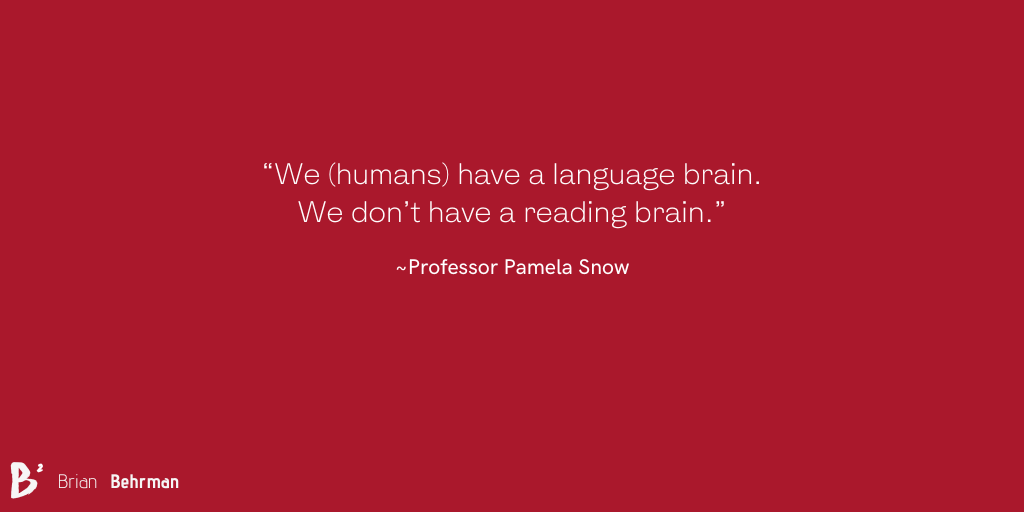
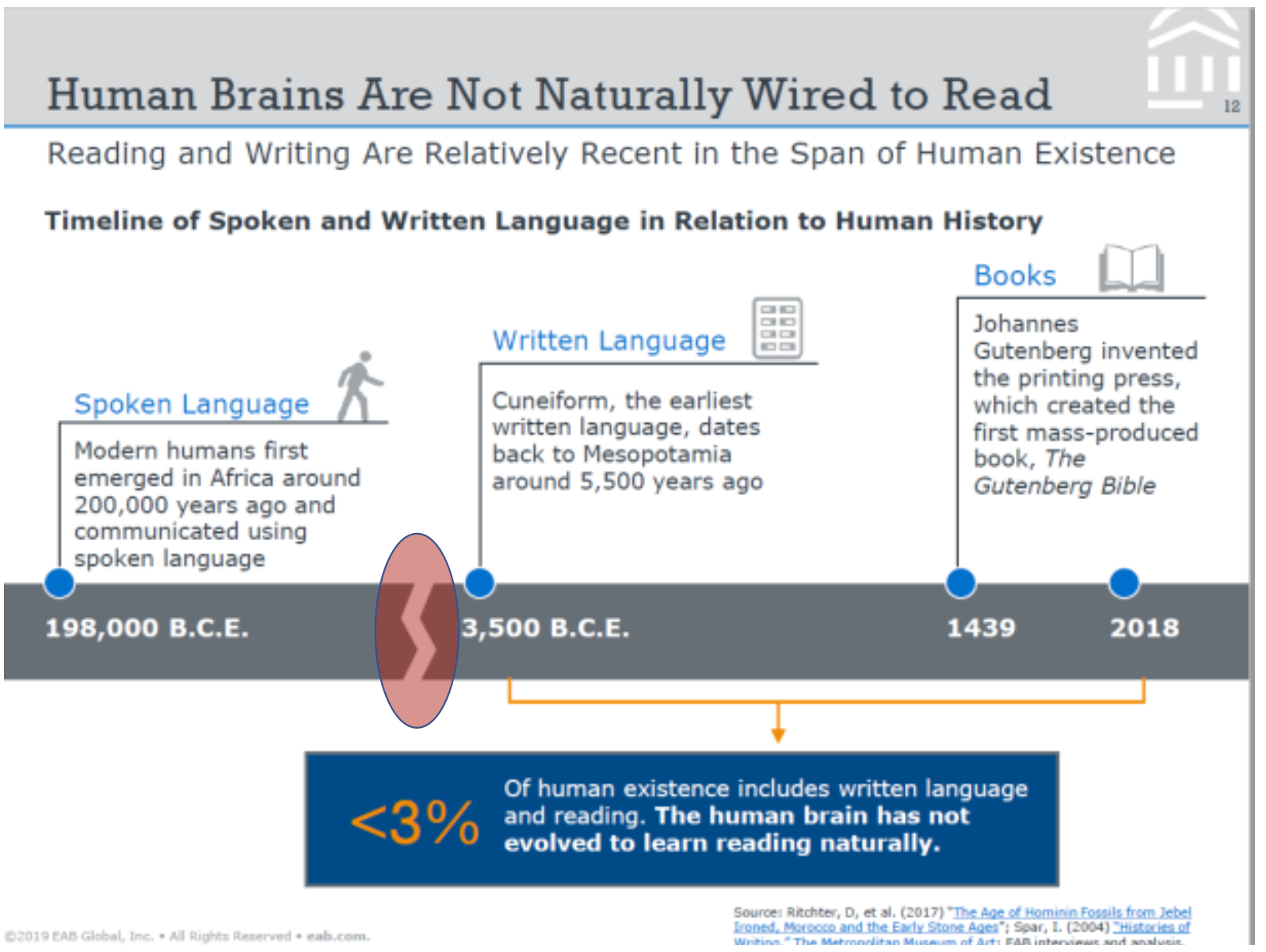
One of the first sessions I attended was led by Pamela Snow. She is a Professor of Cognitive Psychology Much of her work is centered around the early transition from language to literacy and the ways this transition is supported in the classroom. In that session, she reminded me of something that I shared in our recent PD on the Science of Reading – Human brains weren’t originally meant to be a reading brain. 

The chart below was one she shared during her presentation and served as a good reminder that less than 3% of human existence includes the use of written language.

What’s important for us to keep in mind given this information is the reminder that Language is a paradox (this theory comes directly from Pamela Snow) – “Humans have evolved a special facility for oral language, such that it is innate (biologically primary). We have a “language instinct.” However, it is highly vulnerable to a range of developmental conditions (e.g. hearing impairment, intellectual disability, autism spectrum disorder, brain injury, or developmental language disorder). For humans, language is highly sensitive to environmental exposure.”

At times, when a reader is struggling with transitioning from an oral language structure to learning to read a written language structure, or as a student expands their reading skills beyond the oral language skills they have been exposed to, students may struggle with their reading. Literacy (reading and writing), builds upon oral language skills (vocab, speaking/conversation skills, syntax, phonological/phonemic awareness). When students lack language comprehension (remember the reading rope?), they will struggle to read fluently, which will impact their reading comprehension.

Readers with strong oral language abilities are more likely to develop strong reading abilities. Those strong reading abilities in turn will increase a reader’s vocabulary and background knowledge, which will further strengthen their reading abilities.

So what does this mean in practice? It means that our classrooms need to not only be a literacy-rich environment (lots of reading and writing), it also needs to be an oral language-rich environment (listening and speaking). Whenever possible, for all levels of readers, we can strengthen oral language skills by building opportunities for conversation, narrative discourse (think storytelling), procedural discourse (explaining a procedure), and expository discourse (informative or persuasive). Ultimately we can think of the oral language as the engine of literacy skills, while high-quality instruction in language development and reading is the fuel for success.

What are some of the ways you support oral language in your classroom? Share your thoughts and ideas in the comments below!

Kids these days

For as long as I can recall, I’ve heard people talk about how kids these days are just different. I’m sure people said it about my generation when I was a kid, and now we’re adults saying it about the students that we serve. But when you stop to think about how the world is an ever-changing place, how technology leads to innovation, and how knowledge is so much easier to access, it’s not surprising to me that kids these days would be different.

This year, our school district is engaged in phase two of the Ford NGL (Next Generation Learning) Roadmap. This roadmap is all about developing a district-wide vision to help the graduates of our district be ready for college, careers, and life beyond high school. For a long time, I’ve been talking about this idea of helping to prepare our current students for their future reality, not our current reality. When we think about learning, this roadmap will help us to engage community stakeholders to plan for the future of our community.

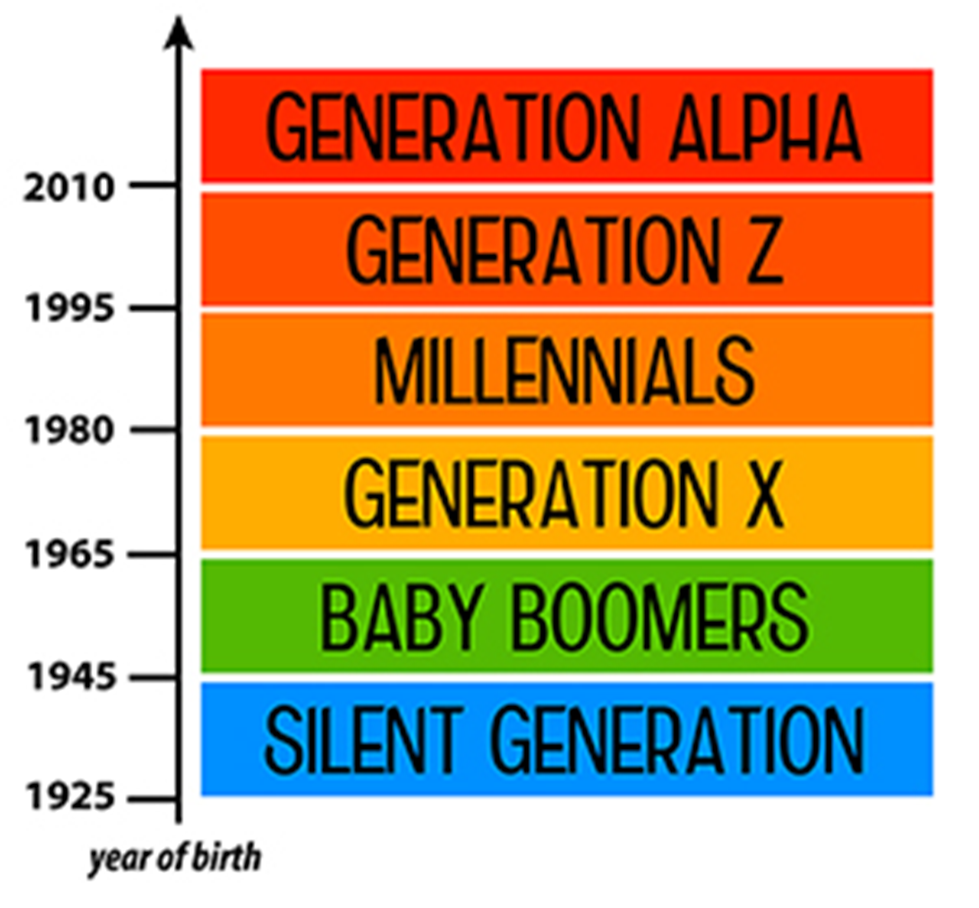
Recently, all the K-8 administrators in our district attended a two-day conference to learn more about the work we are engaged in as we begin this second phase. One of the pieces that was most fascinating to me was some discussion about generations. Personally, I am a member of Generation X. The experiences of my childhood, the time period that I grew up in, and the technologies I experienced all helped to form me into the person that I am today. What generation are you a part of?

One of the things that was shared with us was that there are certain characteristics that are generally true of most people from any given generation. Take a moment to think about how the generation you were born in might have helped to shape who you are today. Then, take a look at this graphic that will compare a bit about the different generations and the characteristics that helped form them:

As you think about your own generation, what do you notice from this chart that strikes you? I definitely noticed the Rubix cube and the Walkman, two key parts of my own childhood. The day I upgraded to the “Sports Walkman” with the yellow body and matching yellow headphones, whoa! Although I also recall the excitement of the upgrade from the Walkman to the Discman!

Now, here’s the thing, let’s think about the students that you work with most directly. If you work in an elementary setting like me, all the students you interact with on a daily basis are part of Generation Alpha. So let’s think a little bit about who they are, and then what that means for them as learners.

First, a few facts about Generation Alpha (based on the research of McCrindle and found here):

  • This is the first generation born entirely in the 21st century
  • Their lives have been shaped by:
    • A climate crisis
    • A pandemic
    • A mental health epidemic
    • Seeing their parents and relatives working remotely
    • Witness the introduction of Artificial Intelligence
    • Access to digital devices and screens their entire life
  • If current trends continue, Generation Alpha will be the most racially and ethnically diverse generation
  • If current trends continue, they will be more likely to be surrounded by college-educated adults than prior generations
  • They will be more likely to interact with peers online and through social media, which could result in shorter attention spans and impact their social formation

To go a little bit deeper, take a look at this graphic about Generation Alpha:

So let’s bring it back to learning. Now that we understand a bit about who Generation Alpha is, and what how they have been impacted by the environment, what does that mean for them as learners? According to “Understanding Generation Alpha” from McCrindle:

A shift in educational engagement is occurring for Gen Alpha, with schools switching from structural and auditory learning to engaging, visual, multimodal, and hands-on methods of educating this emerging generation.

Because their parents will indulge them in more formal education and at an earlier age, Generation Alpha will have access to more information than any other generation.

“Understanding Generation Alpha” accessible at https://mccrindle.com.au/article/topic/generation-alpha/generation-alpha-defined/

If we take all that we know about Generation Alpha, we must recognize that teaching students in the ways that may have worked for those of us in other generations will not work for today’s students. So what will education look like for Gen Alphas?

  • Skills over degrees – Just mastering a standard is not enough for Gen Alpha. They are seeking learning that feels relevant. They want skills that they know they will be able to use in their future.
  • Real-world simulations – How can we connect our learning within the four walls of the classroom to things that exist in the real world? Our students want to know that the things they are learning connect to life beyond school.
  • On-the-job training – As our students grow older, we want to seek ways to provide them learning opportunities while in the job setting.
  • Personalized learning – Choice for students will be so important! UDL helps to get us there. We want to provide choice and scaffolds in how to learn material, and then choice in how to show what they know.
  • Shared learning – Our world is relying on collaboration more and more. Shared learning opportunities will help our students be better able to collaborate.
  • Will learn at faster pace due to smart & voice tools, AI, and machine learning – As digital natives, our students understand how technology makes life and learning easier. Knowing that they have access to Google and AI tools, DOK 1 and 2 thinking will not push our students to the levels of thinking they will need for their future. We must work towards higher level thinking skills that technology hasn’t yet caught up with.

As I said earlier, our goal in education is to help prepare our students for their future. With that in mind, the most in-demand skills of the future work force include:

  • Communication – The ability to use both spoken and written communication to work with others.
  • Collaboration – The ability to develop constructive and cooperative working relationships with others.
  • Customer Focus – Actively look for ways to assist customers and clients.
  • Personal Learning and Mastery – The ability to acquire knowledge or skills through one’s study or experience.
  • Cultural and Social Intelligence – Have awareness and understanding of other’s reactions.

My hope is that you can take this post and use it as a reflection for how to shift learning in a way that better meets the characteristics of our learners. What I believe you’ll find is that as you integrate teaching methods that meet the needs of today’s generation, you will see higher levels of engagement and greater learning for our students! What ideas do you have from this post? Does the information about Gen Alpha resonate with your experiences with students? Share your thoughts in the comments below!

Thoughtful in what we do

Far too often in education, we spend time thinking about a question. It’s a question that will sometimes cause stress. It will sometimes lead us to look for new programs or resources. And at times, it creates overwhelm because we then feel like there is too much to do. The question I’m thinking of is “What more should we be doing?”

Depending on your perspective, that question may not feel like that big of a deal. But here’s the issue, if we always ask about what we should be doing more of, we end up with so much to do that we aren’t able to do any of it well. We can’t sustain the practice. Adam Welcome loves to talk about how schools in general are really good at collecting programs and things, but they are really bad at getting rid of those programs or things that are obsolete. This is something that I have definitely noticed (I have seen your pile of textbooks from 3 adoptions ago that you just can’t bring yourself to get rid of!).

The other issue I see with asking about what more we can do is that it leads us to a deficit mindset. That’s the thinking that leads us to only focus on the things that aren’t going well or the things that we can’t do enough of. Deficit thinking leads to a sense of hopelessness before we have even started anything.

One of the pain points that I have noticed in my time as a leader is that every spring and summer, I spend time with our leadership team. We look at the data we have, the growth we’ve made, and the areas to target for continued growth. Based on that information, we develop a school improvement plan that is focused entirely on the data that we can connect to the learners that we know in our building. Then, invariably, we come together at a beginning of the year administrative meeting, and there seems to be some new initiative or some new curricular resource that must be added to our plans. When that happens, the intentional design of the school improvement plan that was developed as part of our thoughtful work must be either revamped or potentially scrapped for a period of time.

I do have one quick caveat since I know that some of the people who read this blog are colleagues of mine, or maybe even are among the group that sometimes brings those initiatives to us… Oftentimes those initiatives involve us in doing good work that is for the benefit of our students, but it sometimes feels for the leaders in the buildings that we have now been given one more new thing to cram into the already busy schedule of the school year PD plan.

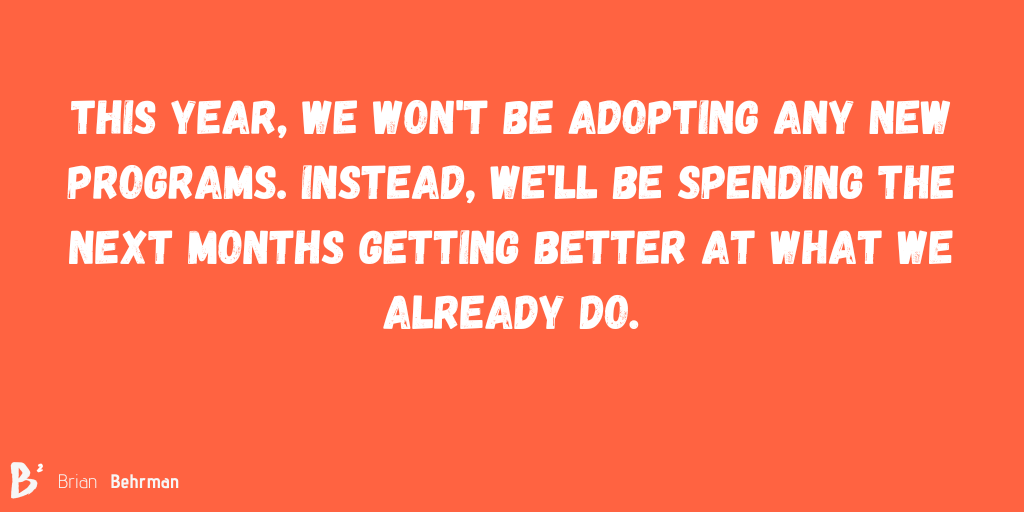
So, imagine if you could, hearing the following statement at your back-to-school meeting:

Much like Chris Lehmann, I believe that “Schools are better when they create spaces and expectations for reflection.” A formalized process for reflection is a necessity. This reflection can certainly occur as an individual, but I think the power of the reflection comes from when you are able to chat with others about what happened in your classroom, how the students responded to the learning opportunity, and what your data shows you about student learning and growth.

This is why I see such value in the PLC process. It’s the perfect place for the reflective process to take place. The four key questions of the PLC guide us toward reflection on a question that is much better than the one I mentioned at the beginning. Instead of asking ourselves “What more can we be doing?” we should be asking “How can we do what we’re already doing, better?”

Think about the power of that mindset shift with your team. Instead of coming into a PLC meeting with a deficit mindset that might imply that we don’t yet have the tools to be successful, we come in with the belief that within our team, we have the answers to help ourselves improve. That’s collective teacher efficacy at work.

And here’s the reality of this process. Sometimes we will start with reflective practices, we will begin by trying to problem-solve within our team, and we may find that the tools we have available to us are not working. This is where things get exciting for me. Now, your PLC team can begin some work in action research. Do some professional reading, ask for help from an administrator, work with your curriculum coach, or collaborate with another team that might not be having the same problem as you. Whatever you do, find a way to keep trying until you find something that does work for your students. Again, this is not about finding something new, it’s about refining something that we were already doing, but wasn’t working as well as we’d like it to be.

Another thing to keep in mind: as you begin to refine your processes, be sure to identify the pieces that you feel are already going well. Having an idea of the things that are working will help us feel more comfortable as we make shifts in the areas that aren’t working as well. Also, keep in mind that if you try to solve too many problems at one time, you probably aren’t going to solve any of them. Pick one area of growth to focus on and stay focused on that. Remember what your team’s limitations are for time and energy!

So, the next time you are together with your team and able to reflect on what’s been happening, be sure to focus on the question “How can we do what we’re already doing, better?”

How do you think that might shift the conversations in your work? As you reflect on what you can do better, how might you use that to set your own short- or long-term goals for your own learning and growth? Share your thoughts in the comments below!

The power of the rerun

I try not to spend too much time sharing about the #educelebrities that I follow, or have had the privilege to meet, but for this week’s post, I’m back again with some more thoughts based on the day I spent recently with Cornelius Minor. One of the things he talked about was something he phrased as “The Power of the Rerun.” As a child of the 80s (I try not to date myself too much, but it’s my reality), reruns were a regular occurrence. Saturdays would often mean getting up, grabbing a bowl of cereal, and turning on cartoons. Unlike you millennials who might be reading or the Gen Z / post-millennials that we’re teaching, when you turned the TV on, you watched what was available. There were no streaming options. We couldn’t find what we wanted to watch on YouTube. Sometimes that meant watching an episode of GI Joe that you’d seen what felt like hundreds of times.

I have to be honest; I’ve always enjoyed reruns of shows. There are episodes of Friends that I have literally seen more than a hundred times, and yet I still laugh (pivot). I don’t know if I want to admit how many times I have watched the entire Breaking Bad series (probably still my favorite series of all time!), but I will share that it’s a lot!

What I love about rewatching a show is that often, I notice things I didn’t notice the first time. Maybe there’s a character that didn’t seem that important on the first watch that I now know is important later in the show. Or I might notice something that I missed in the background of a shot because I was so focused on the main action the first time. The rewatch allows me to dig a little deeper.

Now, I’m sure there are some that are wondering what in the world reruns of TV shows have to do with an education blog. This is where Cornelius comes in. While talking to us about ways we might model specific skills, he talked about the benefit of doing a reread of a text that was previously shared in class. The first pass of a story is a great time to introduce a concept or idea. If you are doing a lesson on character analysis, you might read a text where you want your students to notice what characters do over and over, so you read that text and ask students to pay attention to the actions of a specific character and ask them to think about what this teaches them about this character. That may meet a standard for you, but you recognize that your class seems to show clear understanding, or maybe even mastery right away. That might mean a reread of the book is a great time to do some deeper thinking about the text.

You see, once you’ve read a text one time, you have done most of the heavy lifting. The understanding of the story is already there. Vocabulary words have been defined and used in context. All your students have an initial understanding of what will happen in the story, so now we can go deeper.

Recently in our building, we’ve been spending a lot of our time in Professional Development focused on the power of the PLC. We’re really digging into each of the 4 key questions of the PLC. If you aren’t sure what those questions are, these are them:

  1. What do you want your students to know? (This one’s about knowing our standards, having a map, and identifying priorities)
  2. How will we know they know it? (This is all about how we formatively assess our students along the way, or how we summatively assess at the end of a unit so that we are ensured of student learning)
  3. What will we do if they don’t know it? (This is about what strategies might we try during a reteach to reach a student who didn’t understand the first time)
  4. What will we do if they do know it? (This is about how will we enrich the learning of students who seem to have already mastered the standard or skill)

So, when we think about the rerun of a text, it’s a great opportunity to approach skills that will enrich our students. What is the next level of the standard you are trying to teach? You might check the vertical alignment of your standard so that you know what your students will be expected to know or be able to do next year. During a rerun, you can push your students to a higher depth of knowledge because there is already an initial understanding.

I’d love to hear about other ideas related to the concept of a “rerun” in reading. Have you ever used this strategy? How did it go? What worked well? What would you think about differently? Share your thoughts in the comments below!

What scares you?

What scares you?

When I was younger, I used to love to watch the television show Unsolved Mysteries. I still remember sitting in our basement with the TV on, trying to figure out about these strange things that happened in our world. It was probably during the same phase in my life when I loved books like Scary Stories to Tell in the Dark. I loved these types of things for a while until I didn’t. I don’t know if any of the rest of you went through a phase like that where horror and mystery were exciting. At the point I’m at in my life now, I don’t need fear like that – I have zero desire to read a scary story, or watch a horror movie… I can’t even get into the true crime fad that so many others I know love.

But it’s interesting to think about how much fear can impact us in our day-to-day lives. Most people, like me, have decided that they don’t want to put themselves in situations where they feel scared. That is something that is also true for many of our students too – they don’t want to go outside of their comfort zone, and often will do whatever it takes to avoid a feeling of shame or embarrassment. In fact, sometimes the behaviors that we see that seem outside the norm are actually related to their efforts to avoid shame and embarassment.

I think sometimes that fear of trying something new comes from a feeling of cognitive dissonance. You may know that phrase, but to make sure we’re all on the same page, cognitive dissonance is defined as having inconsistent thoughts, beliefs, or attitudes, especially as relating to behavioral decisions and attitude change. It’s not just our students who will try to avoid feeling embarrassed – many adults will do it too. It could be relating to something in our personal life, or it could have to do with trying that new classroom practice that feels a bit out of our comfort zone.

I’ve said it before, and I’ll say it again: I believe that all schools are learning organizations. Part of what makes a school a learning organization is that all the people who come here – students, teachers, staff members, parents, etc., can learn something while they are here. So, let’s dig into that idea of learning for teachers and staff members.

A previous administrator that I worked with used to talk about being on the “growing edge.” To be on the growing edge, you must feel a little bit uncomfortable. Think about schooling – what it looks like today is different from what it looked like when I was in school, and that is different from what it looked like when my parents were in school. A schoolhouse is a place of innovation. As we learn more about how kids learn, we implement new strategies and see if they help our students. These small changes over the course of many years are part of what has caused the school to look so different than in the past. The more we know about how kids learn, the greater impact we can have on their learning moving forward.

And the things we do in our classroom, that are considered “best practice” are meant to put our students on their own growing edge. In a place where there is some feeling of being uncomfortable, they also must work to figure it out. In a lot of ways, our efforts to move our students to higher levels of thinking is considered best practice because it helps push students beyond their comfort zone. It helps them create new neural pathways in their brain, and suddenly they have learned something new!

But here’s one of the things I’ve noticed – so often we as educators will learn about something new relating to student learning, but we hesitate to implement it. Maybe we want to start implementing Universal Design for Learning, or maybe we have seen some amazing examples of Project-Based Learning out there on social media. As an educator, it might be something we’re curious about, but at the same time are relatively early in the learning process. This is where the fear of teaching can sometimes come in. Does this sound familiar: 1) I’m curious about a new strategy; 2) I have done a little bit of learning about the topic; 3) I want to try, but I’m just not sure where to start; 4) I’m worried it won’t go well; 5) I put that idea on the shelf and go back to what’s comfortable.

The thing I know about most teachers is that there are some personality traits that are similar. One of those similarities has to do with a desire to make sure that whatever we put in front of our students is as close to perfect as possible. I’m sure that there are times that I felt that way, and probably held back on some of my more creative and innovative ideas because they didn’t seem quite perfect. What I’ve learned is:

Here’s the challenge we face as educators – innovative ideas help to push learning forward for our students, but our own perfectionism might get in the way of trying something that would be a benefit for our kids. How do we balance the need for innovative ideas with our personal feelings that our school or our classroom needs to be perfect?

I challenge you to take a moment to reflect on some of your new ideas that you might have been hesitating to try. Pick one and give it a try. What’s the worst that happens? If the lesson is a flop, you can use it as a chance to model for your students that imperfection is ok. And if the lesson goes well, you might find some ways to take that idea, do it again in the future, and make some small changes to make it better.

Learning is all about being on the growing edge. Part of that cognitive dissonance comes from doing the things that scare us before we feel they are perfect. But, it’s how we learn, it pushes learning for our students, and it models risk-taking, which is something we are constantly asking our students to do!

Leaving a legacy

Leaving a legacy

In one of my posts from earlier this fall, I wrote about the work we have been doing to set a vision for teaching and learning at Fishers Elementary School. You can check out that post (Setting a vision) if you’d like to know more about the work we’re doing. With our process, one of the things we want to think about is how do we make sure that whatever the vision is, it becomes ingrained as part of what we do. In the book Thrive, Grant Lichtman talks about the importance of both “short-term goals of this generation of students and the longer-horizon challenges that will face those yet to attend.” Lichtman goes on to discuss the value of building a mission and vision that will last long beyond the time that I’m here as the principal.

That’s a heavy idea to think about. I’m a first-year principal. I still feel like I’m just getting my feet wet, and now I’m being challenged to think about what learning will look like here at FES when I’m no longer here? In fact, in the book Lichtman talks about identifying aiming points that reflect the best version of our school in 10 to 20 years.

The reality is that in the world we are living in, change is inevitable, and the change cycle in most parts of the world just keeps moving faster. But change in schools seems to be on a different time scale. There are classrooms that you walk into today that feel and act much like the classroom I was in as an elementary student in the 1980s. We still have a structure to our day that is much the same (arrive, go to class, related arts, lunch, recess, back to class, head home). We are still grouping kids primarily by age, no matter what their variability may be in preparedness for the subjects we’re teaching. (In previous posts I’ve talked about this variability, probably most clearly in this blog: ‘What is the “average” student? Part II’) And for the most part, we still expect students to attend school from kindergarten to 12th grade, and much of what we are doing during that time is to then prepare students to go to college (with little attention paid to students who might not want/need to attend college for the future they have chosen).

So, what are some of the guiding lights that I believe will help to show where we’re trying to go? Three things stand out to me, in no particular order…

  • Integrated Subject Matter – For years in education, we have been putting subjects into their little buckets. There’s math time, there’s reading time, there’s writing time, not to mention all the other subject areas that we learn in school. But the thing is, they all go together. When was the last time you did math just to do math? Yesterday I had to do some math to figure out percentages so that I had data for a meeting I was preparing. That data then went into a report I created, and later talked about while presenting. At FES, we will create integrated learning opportunities for students so that they see that reading, writing, math, and all other forms of learning act in service of one another. We will research models of integrated learning that are working in other schools to create a system that will work for FES.
  • Cross Grade-Level Collaboration – The only times in my life where the majority of the people that I worked with were all the same age as me was during my time as a student in the K-12 classroom. In the real world, I have had colleagues who were older than me, younger than me, and some who were the same age as me. Depending on the context of my career, there are times where I walk into the room as one of the experts on a topic, others where I may be knowledgeable but still have more to learn, and other times still where I am the novice learner. I think that schools, especially elementary schools, could do a better job of differentiating learning for students by working across grade levels. If there is a first-grade student who is capable of working on the same math that a third-grade teacher is teaching, why do we keep them in the first-grade classroom? And if the second-grade class has been doing a lot of research on rocks and minerals, why can’t they share that knowledge with the fourth-grade class that’s about to embark on a unit in geology. Here at FES, we will create the conditions that allow students to learn from one another and with one another, even if they are not in the same class or grade.
  • High-quality project-based learning – Several years ago, while teaching 6th-grade social studies, it was a couple of weeks before winter break and we had reached our unit on Ancient Rome. We had just done a relatively traditional unit on Ancient Greece, and I was not excited to try to do things the same way. I began looking at the materials I had available for our unit, and I noticed that there was information on lots of interesting topics – clothing, games, architecture, food, and so much more. I decided that we were going to do things differently. I spent a day doing a quick introductory activity to the period and geography that we were going to be studying, and then I set them free. Students were challenged to pick whatever topic they were interested in, do some research on it, and then come up with some way to share what they had learned with others. I fully expected at the end that I would end up with a whole bunch of posters with information, or students creating power points, but that’s not what happened. One student asked if she could create a picture book about her topic. Another student wanted to take class time to teach students the popular game that kids played during the time. Another student built a working, scaled-down model of a Roman aqueduct. Another student designed and made an outfit similar to what a child from Ancient Rome might wear. And when we got to the end of the unit and I gave the unit test, average scores were higher than most tests I gave that year. (Reflection: I probably didn’t need to do the test to assess the learning of my students, but in the time I was working, we still had a traditional report card and I needed grades in the grade book – that’s a whole different issue and conversation) At FES, we will create conditions where high-quality project-based learning is the norm when we talk about what learning will look like at Fishers Elementary School.

Along with these guiding lights, we are currently gathering data in the form of a survey from our school community, both teachers and students, to help identify what it is that we value about FES, as well as what might make us even more valuable to our community. These guiding lights will help us to continue to revamp our mission and vision for learning. In the coming months I look forward to working with a team of stakeholders to analyze the responses we have received, finalize our mission, and then begin the task of identifying the strengths we already have as well as the learning we will need to do to continue to grow.

Setting a vision

In my last post, I spent some time talking about the strategies I used to build relationships with the staff of my school after I transitioned into the role of principal of Fishers Elementary School. After spending that time listening to our staff, it was clear that there was a lot of energy, a lot of ideas, and a willingness to grow. But what it seemed was lacking was a clear direction. During an early meeting with the staff, we started talking about the process of building a vision of learning for Fishers Elementary School. We all agreed that there needed to be one, and that it needed to start with each one of us – our beliefs, ideas, and personal passions about teaching and learning.

In order for someone to understand what they are doing, they have to also be really clear on the how and why that goes with that what. Simon Sinek has a book and a TED Talk titled Start With Why (the book is a quick and easy read, or you can check out the talk here). In both, he shares the idea of The Golden Circle. In both the book and the talk, he explains that the people and companies who are the most successful have a really clear definition of their Why, and then work their way out on the Golden Circle. But most companies or organizations start with the what and work their way in. I felt that if we wanted to have a really clear understanding of what we were trying to accomplish at FES, we needed a clear definition of our why.

For our January staff meeting, I planned, then presented my own version of an Ignite session (if you’ve never done this, it’s a 20 slide presentation, where the slides automatically shift every 15 seconds) titled “My Why” (I wrote a post about it a while ago – you can read about it here). I then encouraged everyone to take some time in the coming weeks to think about their own why.

At our next staff meeting, we came together again. It was a chance for us to all reflect on our personal why. I encouraged everyone to sit in a grade level team, and with that team, they had a short amount of time to discuss and define a shared why. We then used a collaborative powerpoint document, where each team created their own slide. The work around defining our why was so important in helping all of us to be really clear on our beliefs about education and learning. It’s the why that drives what we do, not the other way around.

As we were spending time talking defining our why, we also talked about the importance of a shared vision. A Vision for Learning for FES that is written by one person based on their beliefs is not going to be meaningful to all the stakeholders. We started talking about who else we needed to get input from. In these conversations, we knew we wanted the thoughts of our students, we wanted the thoughts or our families, and if possible, we wanted the thoughts of our community. We wanted to make sure that whatever our Vision for Learning was to be included in the ideas of multiple stakeholders.

In February, we were planning to gather the thoughts about learning from our community. It was a couple of days before an upcoming PTO meeting and I was sitting in the conference room with my leadership team. As we were talking, someone pointed at a bulletin board in the room and said “Well, we already have a vision statement right here.” I was floored. “You mean I’ve been here for almost 3 months, and I’ve talked with all of you about developing a vision, and nobody told me that there was already one on a bulletin board?” (OK, maybe my fault for not noticing.)

But what I quickly came to realize is that the vision that was on that bulletin board was nothing but words on a wall to most of the people in the building. They did not feel that the vision that was on the wall accurately reflected them. I’m not exactly sure who all was involved in the writing of that vision, but it wasn’t a shared vision. It didn’t drive the decisions that we made about learning in our building. It was just words on a wall.

To gather some thoughts, we started with 4 questions. Those questions were driven by the book Thrive by Grant Lichtman and included:

We asked these questions first in a staff meeting, and then in our PTO meeting. The thoughts we gathered were so impressive!

These responses were collected during a staff meeting and then a PTO meeting on March 11th. When we collected these thoughts, we did not fully grasp what was about to happen in our world. On March 13th, we let out of school earlier than scheduled for spring break due to concerns about the risks of Covid-19. We taught from home for a week, then had a 2-week spring break during which the governor of Indiana announced that schools would not reopen.

After spring break, we transitioned to what I would call emergency remote learning. It was nothing close to the ideal learning environment for our students. Initially, when this transition happened, I had big plans. I thought we could still do our work on the Vision of Learning for FES virtually. But what I quickly found is that we weren’t ready for that. Most of us were barely able to tread water to meet the learning needs of our students. In January, my goal was to have a well-defined vision for learning before the start of this school year. By April, it was clear we needed to hit the pause button on that work.

So now, I sit here at the start of September. Students start in our building tomorrow. So much of our mental energy has been devoted to the logistics of opening a school in the middle of a global pandemic. But, my assistant principal, our teacher development specialist, and I are once again reading Thrive. In talking through the first section, we all feel like we’re currently at the point where we need to identify our value proposition – what is the thing that makes us valuable to our community? In the coming couple of weeks, I will be working on writing this up for our school community. I’ll share with our teachers, I’ll share with our PTO, and I’ll share it here, to seek feedback on our value at Fishers Elementary School. That will move us one step closer on the path of a clear Vision for Learning.