Growth Mindset for Teachers

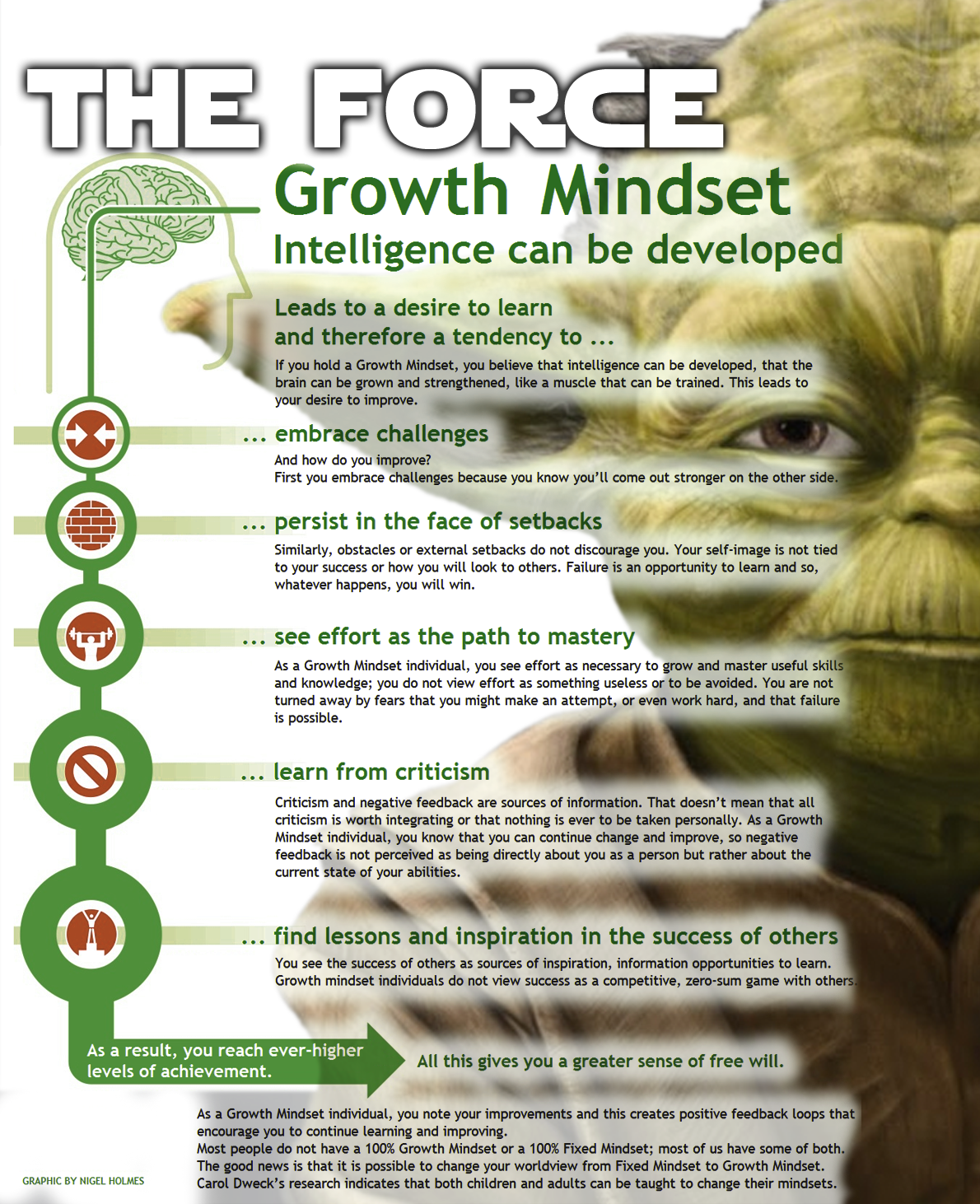
Over the past couple of years I have had several conversations with members of our school community about the idea of Fixed Mindsets vs. Growth Mindsets.  I previously shared a video featuring some of the findings of Carol Dweck.  In those conversations and in that video, the discussion is framed around how to help our students to develop a growth mindset.  What about all of us?  How do our mindsets impact the learning that takes place in our classrooms?  How might those mindsets impact our relationships with students?  As a review, I included a couple of graphics showing the difference between a Fixed or Growth Mindset. (I know the pictures below appear small – if you click on them, they will be easier to read).
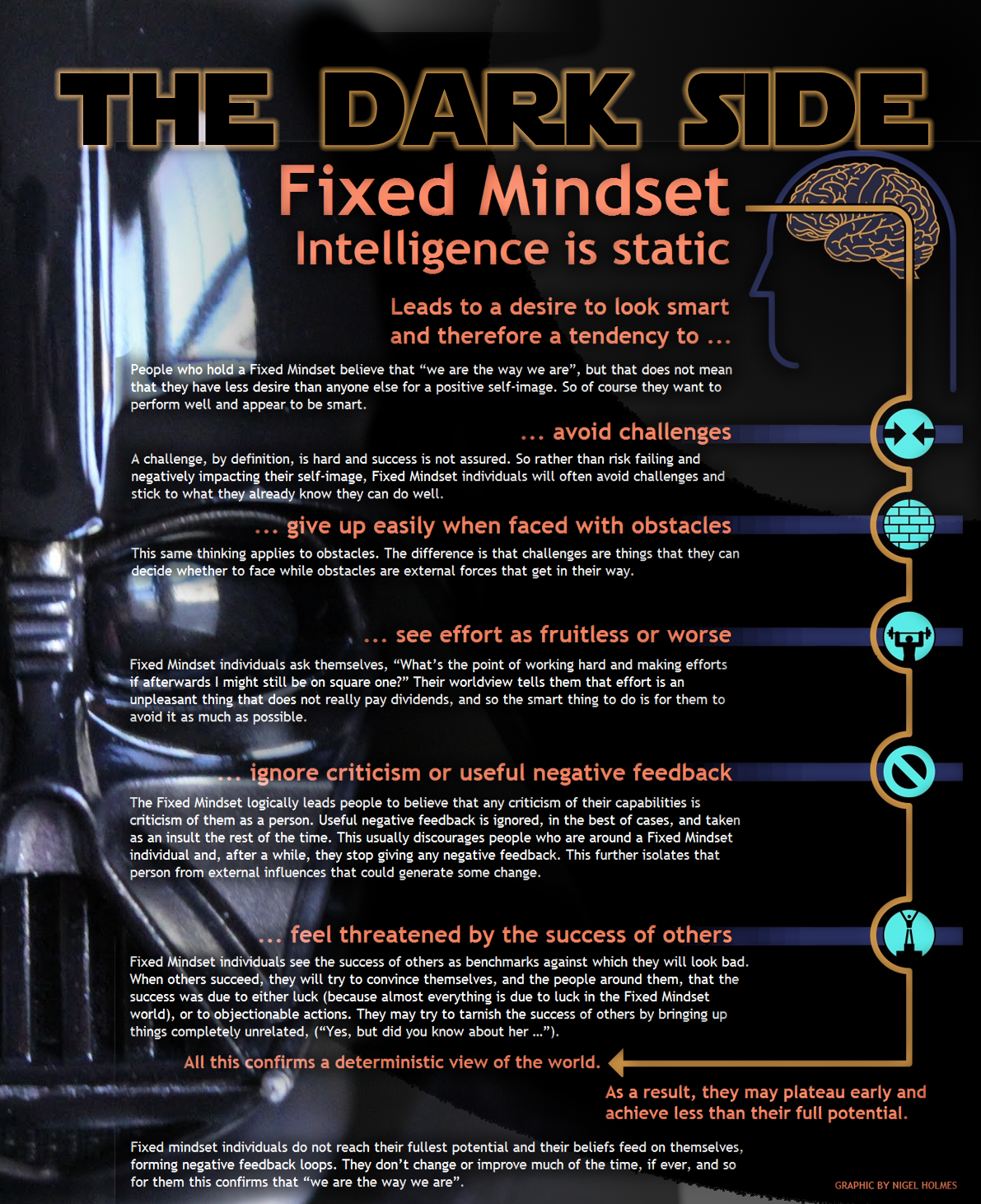
https://teacherpaulp.files.wordpress.com/2014/07/darkside1.png
https://teacherpaulp.files.wordpress.com/2014/07/growth_mindset_poster1.png

According to Dweck:

In a fixed mindset students believe that their basic abilities, their intelligence, their talents, are just fixed traits.  They have a certain amount and that’s that, and then their goal becomes to look smart all the time and never look dumb.  In a growth mindset students understand that their talents and abilities can be developed through effort, good teaching, and persistence.  They don’t necessarily think everyone’s the same or anyone can be Einstein, but they believe everyone can get smarter if they work at it.

What if you reread that statement, but you replace students with teachers?  Where do you fall?  Are your abilities as a teacher a fixed trait, or do you believe that your talents and abilities can be developed through effort?  Are you somewhere in the middle?  Draw a continuum with Fixed on one end, and Growth on the other.  Put an X where you think you are, and then ask if you are comfortable with that location on the continuum.  If the answer is no, how can you move that X to where you want it to be?

Yes, even you have permission to fail! Just make sure that you learn and grow from those failures! https://www.flickr.com/photos/126588706@N08/14826069893/in/album-72157645530010989/

One of the things that concerns me most for teachers comes from the second sentence of Dweck’s definition above.  Is it your goal to “look smart all the time and never look dumb”?  What does that show our students?  If we tell them that they should see failure as a first attempt in learning, but never model for them what it looks like to fail and then improve, what message are we sending our students?  Do we really want to have an attitude of “do as I say, but not as I do”?

I’ll admit, it’s never fun to make a mistake in front of a group of students.  But let’s think about the concept of gradual release – I do, we do, you do.  We would never assign our students something they have never done before without modeling it and expect them to be successful on their first try.  Instilling a growth mindset in our students means we have to be willing to take risks, and sometimes fall flat on our face.  Then, we can model for our students what it looks like to get back up, dust yourself off, make an adjustment, and do better the next time.

If you look at yourself as a learner first, and a teacher second, you will recognize that this craft we carry out is something that we are all learning.  Every day that I’m here at school, I see someone doing something that I’ve never seen before.  When I scroll through my Twitter feed in the evening I often end up reading education related blog posts that provide me with new ideas or ways of thinking.  I see things my friends share on Facebook, and I get new ideas.  Hopefully you see your experiences here at school, and those outside of school, as something that you can learn and grow from as well.  Hopefully you’ll be looking for ways to shift your own mindset further down that continuum towards the ideas of growth.

Throughout this month I hope to use this forum as a way to look further at the Growth Mindset continuum, and in particular focus in on how our mindsets can affect our relationships with the students sitting in our classroom.

In the comments below, feel free to share with us a time that you may have fallen flat on your face.  What steps did you take to correct it?  What did your students learn from your failure?  Or you can share something that you plan to try that you aren’t quite sure how it will work out.  What are you nervous about?  What’s the worst that could happen?  I look forward to hearing from you!
Reflection

To set the scene, imagine that you are in your classroom.  You are getting the kids started on one of your standing assignments that everyone in the room knows will come each week:

You: All right, let’s all get started on (insert that assignment that your students hate to do).

Class: Collective groaning.  From the back you can hear one student say “Why do we always have to do this?”

You find yourself wondering why the reaction is like this – you might think to yourself “they loved doing this earlier in the year!”  Fast forward to the due date.  As you are collecting the assignment, you see that the students who play school well completed the assignment, but it’s clear that they put forth the minimum amount of effort possible.  You also notice that some of your students did not complete the assignment, and no amount of effort from you is going to get them to finish the task – you could have them work in the hall, take away recess, call parents, etc. – nothing is going to make a difference for those students.

As a teacher we have all experienced this.  So here’s the question – why do we keep asking our students to complete assignments that they hate?  Why do we keep giving assignments that students don’t put forth much effort, or simply don’t do the assignment at all?  Why do we keep giving assignments that put the effort on us to run down the missing assignments when the students are putting no effort into the assignment?

HSE21 Best Practice Model

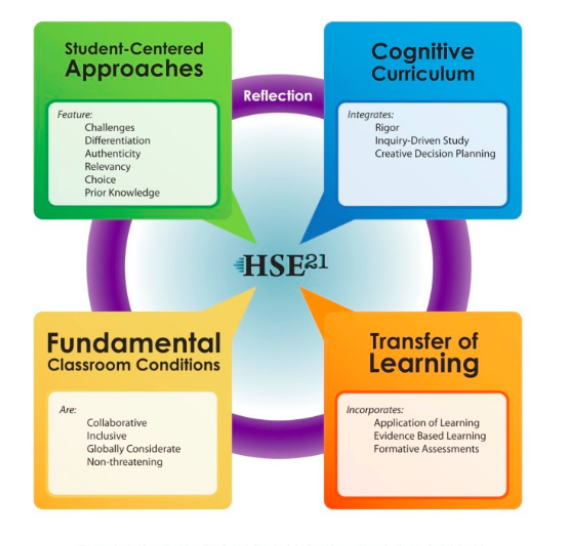
When I was writing last week’s post, I inserted the HSE21 Best Practice Model.  As I put it into the post, something jumped out to me in a different way than ever before.  Look at the Best Practice Model above – in this blog I have spent a lot of time talking about the boxes on the outside: Student-Centered Approaches; Cognitive Curriculum; Fundamental Classroom Conditions; and Transfer of Learning.  Last week for some reason, the purple circle that connects them all jumped out at me – in particular the word at the top “Reflection.”  Given that New Year’s Day is approaching, I would guess that a lot of us are taking time to reflect on the last year, and many of us think first of our personal life, however reflection is an important aspect of teaching as well.  What better time to take a few moments for reflection than to do so over the 2 week winter break?

Think about how your year has gone so far.  What’s working well?  What isn’t?  Do you often have situations like the one that I referenced at the top?  How could you adjust your assignments so that they don’t get stale?  Even the most engaging activity today may get old and stale to our students if we do the same thing every day or every week over a long period of time.  Find some ways to mix up what you are doing in your classroom to increase student engagement.  For me, an important part of reflection is also getting feedback and ideas from my colleagues.  If you have an activity that has gotten stale, talk with your colleagues – see if anyone has an idea of how you could spice up that activity and make it more engaging to your students.  Or maybe you will just decide to let that activity go for a while – replace it with something else that might serve the same purpose.

New Years ResolutionIf you never take the time to reflect, you may miss out on opportunities for growth as a teacher, as well as opportunities to help your students grow.  As I reflect on this school year, one of the things I am most disappointed in is the amount of time I have had to spend in my office rather than out and about during the school day.  One of my resolutions for the new school year is to spend more time out in our classrooms seeing the awesome things that you all do on a daily basis with our students.  Please help hold me accountable to this goal!

What resolutions have you set for yourself?  Personal or professional, share them in the comments below.  We can all help hold each other accountable to our goals and resolutions.

Choosing to Cheat

There have been periods in my career in education where I felt as though I was living at school.  Back in my coaching days I would often arrive at school around 6, work on grading, planning, or whatever else needed to be done, teach a full day, coach my team, come back to my room to do more work, head home for a quick dinner, grade something else, go to bed, and do it again tomorrow.  In those days I was cheating my other priorities – my family, my friends, and my health.  How many times have you looked at your to-do list and felt that there was no way you could get it all done?  I know that there are days that I walk in to my office with 3 things on my to-do list that are left over from yesterday.  Over the course of a day I may add several new items to it, but am not able to cross anything off my list.  In those moments, I choose to cheat.  I can’t do it all.  There are 24 hours in a day, and 168 hours in a week.  Sometimes there are things we can’t make it through.

Do you ever feel like your to do list looks like this?!?!

We all have important things in our life that take up some of those 168 hours in a week, and while we are all professional educators, there are other priorities in everyone’s life.  Here’s the thing about choosing to cheat though: we have to be strategic in the ways that we choose to cheat.  I keep to-do lists (some are on my phone in the reminders app, some are jotted on scraps of paper in my office) and when I create them, I also prioritize them.  Certain things can only be done when there are students here, others can be done first thing in the morning, or after my afternoon bus duty.  Phone calls to parents – that can happen anytime (thank goodness for *67 and the speakerphone feature so that I can call while I’m in the car).  When you look at the things that you are doing in your classroom, prioritize them.  Think about the needs of your learners – are you doing things to help the students in your classroom grow?  If you can’t emphatically say yes, then that may be something you need to choose to cheat on.  Keep in mind, cheating isn’t about slacking off, but rather it’s about making sure you are intentional in how you use the time you have.

Use this to help guide your thinking and the areas where you may choose to cheat.

Throughout the process of HSE21, one of the messages that Danielle and I have always tried to share with you is that we don’t expect you to do it all right now.  When our teaching and learning team (Jan Combs, Phil Lederach, and Stephanie Loane) came to present a few weeks back, one of their slides talked about “More of this” and “Less of this.”  Take a look at that slide to the right.  If you’re spending a lot of time in the less of column, that may be something that you need to reexamine.  It’s also important to look at the HSE21 Best Practice Model (below) to guide our intentional thinking about what is best for the learners who walk into our classroom every day.

HSE21 Best Practice Model

Think about the things that you value most.  Do you devote your time accordingly?  If not, you are probably stressed out, unhappy, and might feel unsuccessful.  To be a good teacher, you have to be in the right mental place.  Think about the choices you make and how they are benefitting you and your students.  If you are making choices that don’t benefit you and your students, try to find a way to make a change.  Be willing to set aside things that do not hold as much value, and instead focus on the things that are most valuable to you and the students in your class.

What are some of the ways you choose to cheat?  Are there things you have given up, or maybe don’t do as often?  Maybe there are things you focus on for a while, then let fall out of focus, only to come back to later.  Share in the comments below how choosing to cheat has helped you to be a better teacher and a more rounded person.

Importance of student feedback

A couple weeks ago I had a post on how to influence students (click here to see it again).  This weekend I was reading a post by A.J. Juliani on his blog titled “The Future of Learning” and I saw an article that related to my previous post, but he looked at things from a slightly different perspective.

What are the best ways to give feedback to our students?

Through reading Juliani’s blog, I ended up reading a research paper written by a team of psychologists from Stanford, Yale, Columbia, and several other well known schools to look at the type of feedback that is given to students.  In this study the authors were testing to see if the type of feedback given on an essay written by 7th graders could result in greater effort (as measured by an increased number of revisions), and improved quality of final drafts.

While there have been many studies on how to provide praise to our students, there has been limited research in how to provide meaningful criticism that will result in improvements for students.  Many of us place our criticism in the format of 3 stars and a wish (or something of this nature) to boost self-esteem before delivering the criticism.

The reality is, self-esteem is not the key to being able to hear criticism, but rather trust is the key.  Boosting self-esteem will not always boost trust.  When trust exists, we are able to see criticism as information to help us improve.

In the experiment, some students received “wise feedback” while other students received “neutral feedback” on their papers.  Simply through the type of feedback that was given to a student, there was a marked improvement in students choosing to revise their paper (a 40% increase in student effort) and improvement in overall performance on the final paper (you can see the study here).

So, what was the magical feedback that led to such extreme improvements?  What note was written on the top of each paper with similar feedback below?  The experimental phrase was:

“I’m giving you these comments because I have very high expectations and I know that you can reach them.”

That’s right – 19 words written on the top of the paper.  In other aspects of the study, these words helped develop greater trust between the student and the teacher, which in turn provided students with a sense of belonging and connection.

For the students who were in the control group, the note at the top of the page looked very different.  It simply said “I’m giving you these comments so that you’ll have feedback on your paper.”

Remember that feedback tells us about the relationship that we hold together.  Feedback like what you see in bold above gives the students some clear messages: you’re part of this group; we have high standards; and I believe you can reach those standards.  So what lessons can we as teachers take away from this?  In the post from Juliani that led me to this research study, he referenced an article by Daniel Coyle, the author of The Talent Code.  His lessons from this study are as follows:

  1. Connect: As John Wooden said, they can’t care how much you know until they know how much you care.
  2. Highlight the group: Seek ways (traditions, mantras, fun little rituals) to show what it meas to belong in your crew.
  3. Don’t soft-pedal high standards: Don’t pretend that it’s easy – do the opposite.  Emphasize the toughness of the task, and your belief that they have what it takes!

Have you found success in sharing feedback in this manner?  If so, share with us how you let students know that they are part of the group, the group has high standards, and your belief that the students can reach those standards.

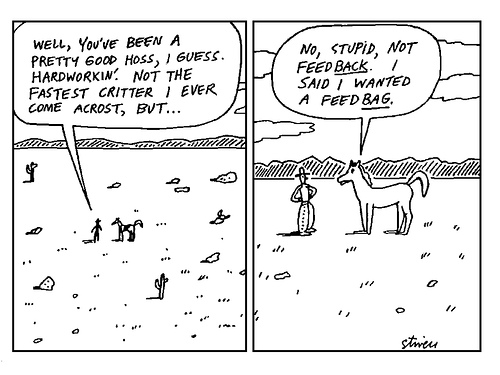
Sometimes our feedback can be a little misguided...
Sometimes our feedback can be a little misguided…

Sometimes it’s ok to ditch the tech too!

WritingIn a previous post I talked about the misconception that some have about HSE21 being all about the device.  Just a reminder here – IT’S NOT!  Technology can allow us to do some really cool things, it can help us be more efficient, we can collaborate more easily, you can create and carry out awesome formative assessments, and you can use technology to help you grade papers more quickly.  There are many more things that technology can help us with, but there are also times it gets in the way.  Remember that the HSE21 best practice model is about so much more than an iPad.  It’s also important to remember that just because you are using an iPad for an activity, it doesn’t mean you are “doing” HSE21.

Sometimes an app doesn’t work the way we expect it to.  Sometimes wifi issues prevent our students from being able to access what we need them to get to.  If you’re using a computer in the lab, the amount of time it takes for a student to log in can take away from their ability to be productive.

Ultimately, our pedagogy must drive our technology, not the other way around.  Good teaching will always trump a good tool.  Someone could put me in a wood shop with every imaginable tool, but without the knowledge of how to use those tools, anything I built would not be something I would want to put into my room (except maybe in the back corner of the garage!).

Avoid the $1000 Pencil

You all know that I love technology.  I consider myself an early adopter of most types of technology, quick to try things out to see if it can fit into my life.  Anymore I can’t go for a run, bike ride, or sometimes even a walk, without my GPS enabled device to tell me how far I went, what my average heart rate was, and the average speed or pace I was traveling.  However, when we look at the classroom, learning has to be the focus.  While I would love to see a classroom where everything is being done digitally, sometimes due to challenges that method is not efficient.  There is nothing wrong with an exit slip that is actually on paper, or a quick formative assessment of thumbs up or down.  Don’t be afraid to try to integrate tech where it works, but don’t do it at the sacrifice of helping our students to learn and grow into the best they can be.

What are some times you have chosen to ditch your tech and had a positive outcome?  Share a few of your experiences in the comment section below!

Gatekeepers or Travel Guides

Prior to the development of written language, the gatekeepers of knowledge were the village elders who could tell stories about the history of a village or society.  Those elders would teach the “smartest” members of the village the old stories so that the history could live on.  Once societies began to develop a written record, this role began to phase out.  In more recent history, the gatekeepers of information were the librarians, teachers, and college professors.  They gave the knowledge to their students through lecture format and rote memorization.

Today the role of a teacher is changing.  Our students don’t need gatekeepers to provide them with the knowledge they need.  Our students won’t quit playing a video game because they get stuck, they watch a YouTube video to show them how to go further.  If they see a reference to someone and they want more information, they grab their phone and find out more from Wikipedia (for base level knowledge, it does a pretty good job!).  If they are arguing a trivia fact they can find the answer through a Google search – for some of our kids, the Google app is one of the most used.

When we provide more students the opportunities to share in the classroom, we are building bridges to the world instead of placing them in a silo. https://www.flickr.com/photos/126588706@N08/14749002232/in/album-72157645530010989/
Matt Miller – https://www.flickr.com/photos/126588706@N08/14749002232/in/album-72157645530010989/

Even though students have the ability to find the answer to their content questions, they still need our help.  They need us as mentors and guides who can help them discover their passions, and then investigate those passions using the skills that will be valued by our changing world.

How have you noticed your role changing in your classroom as it has become easier for students to find the answer to their content questions?  Share some thoughts in the comment section below.

The “Typical” Day

What does a typical school day look like?  Get to school on time, go to class, sit quietly, do your work, write all your answers down, listen and take notes, leave at the end of the day, do more work when you get home.  This sounds pretty routine, and is exactly the model that Ken Robinson was arguing against in his “Changing Education Paradigms.”

Matt Miller - https://www.flickr.com/photos/126588706@N08/14562421540/in/photostream/
Matt Miller – https://www.flickr.com/photos/126588706@N08/14562421540/in/photostream/

In a recent MIT study, researchers identified two categories of work that have been in a fairly consistent decline since 1960.  Those are the jobs that are defined as routine and manual.  The jobs that have been growing are the non-routine tasks.  Those are the tasks that require problem-solving, intuition, persuasion, creativity, situational adaptability, visual and language recognition, and in-person interaction.

In our school improvement plan we say that engagement and inquiry should be in the forefront of our planning.  I believe that it is much more important for our students to know how to ask the right questions, and then how to find the answers themselves, rather than simply answering the questions we ask.  In the book Future Shock, Alvin Toffler said “The illiterate of the twenty-first century will not be those who cannot read and write.  The illiterate will be those who cannot learn, unlearn, and relearn.”  This applies to education just as well as it does to any other part of society.

Matt Miller https://www.flickr.com/photos/126588706@N08/14562423080/in/album-72157645530010989/

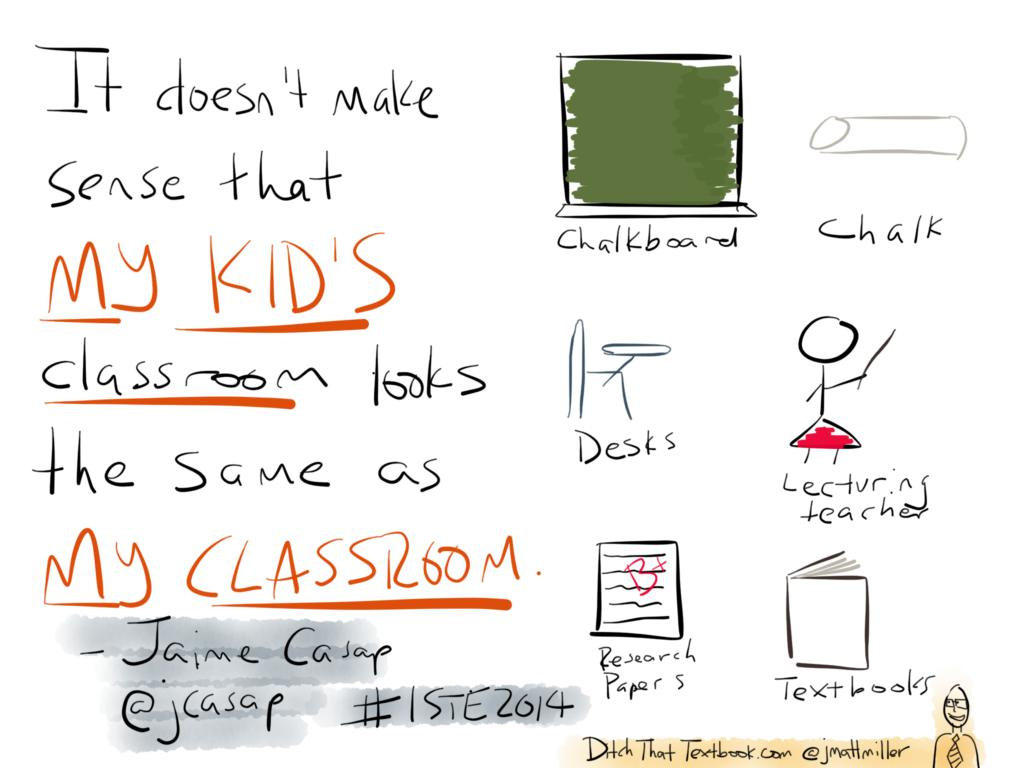
I think that as teachers, many of us think that our classroom should somehow resemble the classrooms of our childhood.  When I first started in education, I thought it was a good thing for my students to be quiet – especially when my principal came in the room.  Now I don’t feel that way.  When a classroom is silent, my first reaction is “are they taking a test?”  Collaboration and problem solving rarely involve silence.  I’m not saying that it should never be silent in a classroom.  There’s a time and a place where that is necessary.  However if we are trying to meet the concepts of the Best Practice Model, should it be silent most of the time?

Reflect on your own classroom.  What does your class look like most of the time?  What changes have you made, or will you continue to make, in order to help your students be ready for the non-routine tasks of their future?  In the comments share some of the things you’ve tried before, or share something that you feel like you want to try soon.

Focus on Student-Centered Activities

Last week I shared a TED Talk from Sir Ken Robinson.  In that video he talked about the factory model that some schools have become.  Our students can be really good at playing the game of school here at RSI, or in junior high, and possibly even in high school.  By playing the game of school I mean finishing homework, not causing issues in the classroom, and being what would generally be considered a “good student” in the old factory model of education.  But when they go on to college, or when they are out in the real world, those students who played the game are not ready for real life.  Know this: Homework completion in fifth and sixth grade are not a sign of success in the future – I consider myself a walking example of that statement.  When graduating from college, our students may have a degree that they don’t really know what to do with, and send out resumes that put them into jobs that they do not find inspiring.

http://www.hse.k12.in.us/resources/pdf/ADM/academics/hse21/best%20practices%20model.pdf

The best way we can break this model is through providing more student centered approaches in our teaching (think back to the post on the HSE21 Best Practice Model).  When students are investigating things that are high interest to them, they find passion and purpose in their learning.  When students want to learn more about their passions, they need only type a few key words into Google.  Through that search they can be directed to pages of information, videos, pictures, and blog posts that may help them learn in a way that fits their learning styles.

Matt Miller - https://www.flickr.com/photos/126588706@N08/14726101996/in/album-72157645530010989/
Matt Miller – https://www.flickr.com/photos/126588706@N08/14726101996/in/album-72157645530010989/

Through integrating the Internet and online tools, you can help students realize that there are things in the world that they want to explore.  You can help provide them with that spark that may ignite their passion.

In what ways have you tried to factor in your students own curiosity in your classroom?  When you try to be more student centered, what do you notice about classroom engagement?  Share some ways that you have tried to keep learning and teaching “student centered” in your class.

Best Practice Model

In the book The World is Flat, Thomas Friedman says that “today’s workers need to approach the workplace much like athletes preparing for the Olympics, with one difference. They have to prepare like someone who is training for the Olympics but doesn’t know what sport they are going to enter.”  When we look at the HSE21 Best Practices Model below, HSE has all the parts necessary to develop students who are prepared for an unknown future.

Best Practice Model

A lot of people immediately think of HSE21 as being all about a device.  This is a misconception that we need to move past.  When the HSE21 team created the best practices model, their ideas were based in transforming learning and teaching to better meet the needs of our world.  Past models of education were focused on rote learning and memorization because our economy needed workers who were able to complete repetitive tasks successfully.  In today’s job market, employers are looking for workers who can problem solve, think creatively, and work collaboratively.  By using the best practice model above, we can help our students be more prepared for whatever role they may take in the future.  It’s about getting our students to think about the big changes that they can help bring to our future.  Check out this video on Moonshot Thinking to see some examples of problems that people are thinking about now:

If you haven’t already done so, print out a copy of the Best Practice model and keep it by your plan book.  As you create activities, don’t worry about hitting all the Best Practices, but rather be thinking about what you can add to the activity you are planning so that you are including some of the HSE Best Practices.

What new things have you tried recently based on the Best Practice model?  What activities are you planning to do that are new and exciting?  Leave a comment below, share it with a colleague, or tweet it out to the world!