
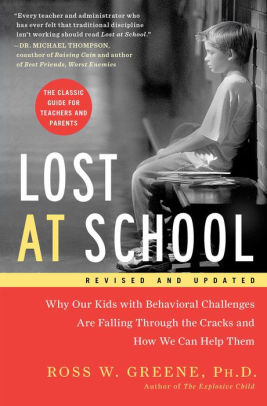
I have recently been reading the book Lost at School by Ross Greene and wanted to share some of my thoughts with all of you as I wrap up the book. For a while now I have wondered if a traditional school discipline system was capable of reaching some of the students that I see who have the most behavioral challenges. I have been an assistant principal for 6 years now, and one thing has remained consistent throughout those years – on average, about 30% of the referrals that are written for students in our school go to the same 10 to 15 students. This small group of kids can take up huge chunks of time for teachers in the classroom. These students also spend huge chunks of time outside of the classroom, which means that they aren’t receiving the access to learning that we want all our students to receive.
One of the main ideas of Greene’s writing is that “kids do well if they can.” My experiences when I was a classroom teacher would have wanted to tweak that statement a bit and say “kids do well if they want to”, but the problem with that version is most kids know exactly how we want them to behave (just ask them what they did wrong), and most of them even want to behave the right way. The reason they don’t is not a question of whether or not they want to behave, rather it’s a question of whether or not they have the tools to be able to behave.
If a student in your class is struggling academically, it’s most likely that they are lacking some skill to be able to perform successfully on the tasks that you are asking them to complete. What do we do when this happens? We take time to work with the student, we figure out where their gaps in learning are, and we try to reinforce those weaknesses. It can be time consuming, but it is what we are charged to do.
Behaviorally, students who struggle the most are not acting out in an effort to make things more difficult for us. They aren’t acting out because they don’t have support at home, and it’s not about the kids that they are around. What it’s really about is that kids with behavioral challenges lack important thinking skills. I believe we need to start thinking of these behaviors as something of a developmental delay.

If we begin to think of behavior as a developmental delay, what does this do for our typical methods of handling student discipline? It definitely has me thinking about things differently.
The facts are that those 10-15 students that I was referencing earlier have received all kinds of different disciplinary actions and interventions throughout their school careers: detentions, in-school suspensions; out-of-school suspensions; conferences with administrators, parents, and teachers; and a variety of other strategies. Even with all these forms of discipline, many times those students are referred to the office again just a day or week after serving a consequence. What this tells me is that traditional discipline simply doesn’t work for some of our kids, and if it doesn’t work for some of our kids, is it truly beneficial for any of our kids?
Greene describes the issues that our struggling students have as lagging skills. Those lagging skills sometimes lead to unsolved problems, which in turn can lead to a behavioral outburst.
As an example, one of the lagging skills that Greene talks about is “Difficulty handling transitions, shifting from one mindset or task to another.” We might see this lagging skill manifest as an unsolved problem of having trouble transitioning from recess where we are running around, making noise, and socializing to the classroom where we need to be quiet and sitting in our seat working independently. When we can identify a lagging skill, and then label an unsolved problem, it becomes much easier to support students in solving this problem.
By shifting to Collaborative and Proactive Solutions (CPS), we might be able to better help our students who struggle most learn coping skills for how to deal with their unsolved problems in more appropriate ways. While it can take time to work through this process with students, the reality is that those students are already taking lots of our time, and most of the time we are working in a reactive mode where we simply respond to the behaviors after they have occurred. The CPS process will allow us to have proactive strategies to support our kids.
In next week’s post, I’m going to go a little deeper in the strategies of CPS, and what it looks/sounds like in a classroom setting.
Lost at School has me completely rethinking the way that we look at student discipline. If you are curious to know more, or like me are feeling that the current student discipline methods are not working for some of our kids, I highly recommend the book as a way to learn more. Add it to your summer reading list!
I know that there are some of you reading this who have probably read Lost at School as well. If you have, let us know your thoughts in the comments below!

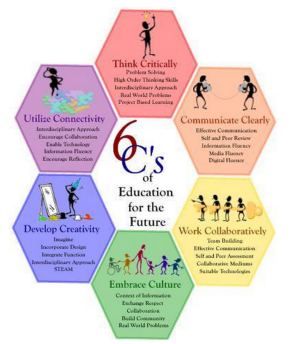 But here’s the thing, if I just accept that creativity isn’t my thing, then I feel like I’m doing a disservice to the students whose life I impact. In previous posts, I have shared the graphic to the right. One of the keys to developing kids who are ready for their unknown future is developing creativity, and if we just throw our hands up and say “But I’m not that creative, so I can’t teach others to be creative” then we are not helping them be ready for whatever their future may hold.
 After reading Miller’s book, I was led to Teach Like a Pirate by Dave Burgess. Burgess spends a huge chunk of time in this book talking about creative ways to hook our students into our lessons. He believes that creativity is something that can be developed in anyone through practice and effort. I have to say that I agree with him on this one – we can help develop creativity in others by giving them the time, space, and opportunity to use their creative ideas in their learning!


 If a student can turn to Google, Siri, Alexa, or whatever smart tool comes out next to find the answer to your question, then maybe we aren’t asking the right questions.
 The students in our school in general are very compliant. Compliant students sometimes struggle with creative tasks because they want specific directions to follow. They may not remember what it feels like to be creative or curious. Years of compliance in the school setting seems to suck creativity and curiosity out of our students. I think that sometimes students lose that ability to be creative and curious because they have grown accustomed to the amount of scaffolding that we provide for learning activities. That scaffolding can begin to feel a bit like a cage, and students forget how to get out.
 So how do we add relevancy to the things that we are teaching our students? I’ve had this conversation with several people recently, and my best suggestion is that we need to help our students see how the thing that they are learning about in class actually applies to their life. Recently in my school, many of the science classes have been learning about outer space. Can we tie last week’s amazing launch of Falcon Heavy into their studies of our solar system? What research could be done on the potential and kinetic energy of a rocket launch? Or what about the fact that there is research on the angle of release of a basketball shot being related to it’s likelihood of going in the hoop? Or maybe there are amazing connections that our students can make to our content that we would never even think of – we just have to get out of the way and let them share!


 The View from 518