Using outdoor spaces

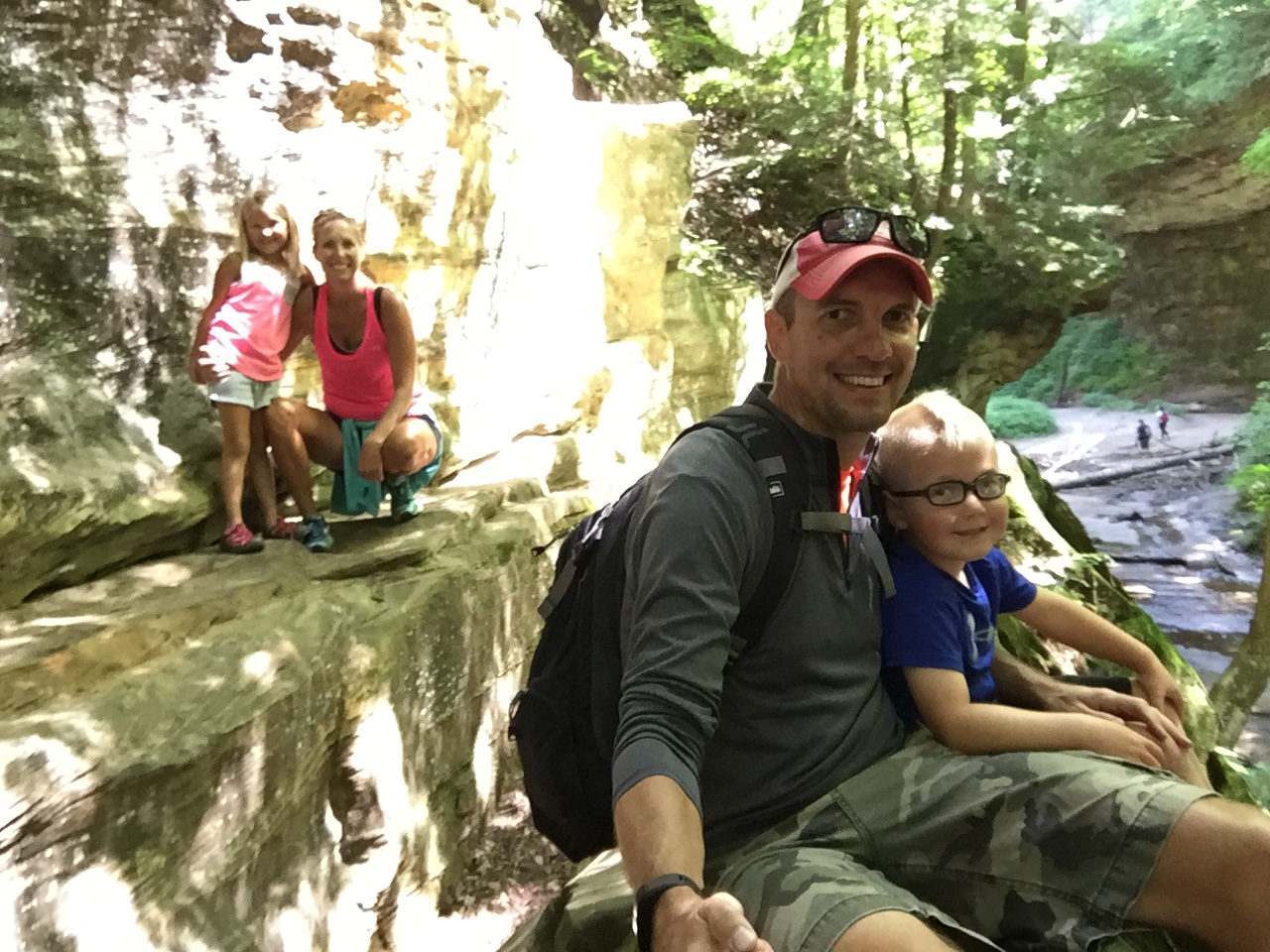
Today I was reading a recent blog post by John Spencer about the ways that nature helps us to be more creative (check it out here).  Personally I love to be out in nature, so the post really caught my attention.  The gist of the post was about the fact that time in nature can lead us to greater levels of creativity.  His 5 ways that nature makes us more creative are listed in bold below, with my own thoughts added:

  1. Nature creates positive disruptions – Life draws us into the natural hustle and bustle of our world. Being in nature helps us get away from technology, current events, and everything else that makes it hard for our brain to stay focused.  That time away from all those distractions allows our brains to think more deeply.
  2. Nature encourages problem-solving – Almost every time I go for a hike, or spend some time in nature, I’m inspired to write a new blog post, or solve a problem, or be creative.
  3. Nature helps us embrace deep work – When do you do your best thinking? There is a lot of research that says that simply being active can lead to deeper thinking.  Simply going for a walk helps us activate our brain in different ways.  According to some research, throw nature into the mix and you multiply that effect.  So what does that mean for you?  Before teaching a particularly important skill, take your class for a walk in the woods outside of school.  Your students brains will be better prepared for deeper thinking when you return.
  4. Nature humbles us while also expanding our worldview – I’m not sure how many of you know this about me, but I was a 10 year 4-H member. I didn’t show animals (we weren’t on the farm), but I did lots of other projects over the years.  One of the projects I did required me to take multiple observations of a natural environment every day over multiple weeks.  I chose a small wooded area with a trail just a little over a mile from my home.  I had to observe at different times in the day, and I began to notice changes in what seemed like an untouched environment.  Some animals were more or less active at certain times of the day, some plants looked different depending on various factors.  The time I have spent in the natural world helps me realize that there are so many things happening in the world around us that we miss when we are in our cars, or on our devices.  Sometimes you really do have to slow down, look around, and smell the flowers in order to be aware of what’s happening in our world, and to realize how little control we have over so much of what’s around us.
  5. Nature can spark innovation – Did you know that Velcro was designed by a Swiss engineer after his dog was covered in burdock burrs after going on a hike? Or that the design of the nose of Japanese high-speed trains was meant to mimic the beak of a kingfisher?  These are just a couple of examples of innovations that came about because of things that people noticed in nature.  Imagine what the future scientists of the world (our students) may be able to develop if they learn to look to nature for ideas and solutions to our problems.

Reading Spencer’s post got me thinking about the natural wonders just waiting to be explored outside of our school.  By walking out the doors of our building, you can access a variety of outdoor environments.  Between the trails in the wooded areas, the stream running through the woods, the untended plain near the baseball fields, or the river, there are so many ways for us to access nature.  And the benefit doesn’t just stop with the kids being out in nature away from their devices.  Something they see while they are with you may inspire creativity and wonder in a way that is totally unexpected.

What have you done with your class in our outdoor areas?  Have you seen increased levels of creativity as a result of the time you have spent outside?  Share your thoughts in the comments below.
The why

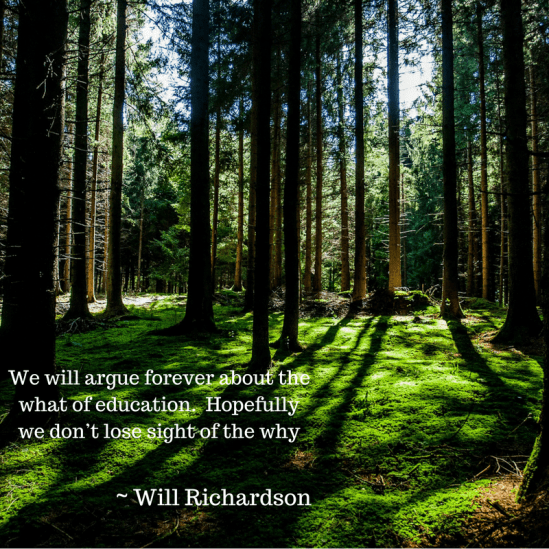
This week was one of the most exciting learning opportunities that I will have all summer.  On Wednesday and Thursday of this week, my home school district held an event called Launching Inquiry.  This 2-day event had a keynote speaker both mornings, and then multiple breakout sessions throughout the day.  Today I’ve been reflecting on my learning from the event, rereading my notes, highlighting things, and thinking about next steps for all of the learning that happened while I was there.  I find myself repeatedly returning to one quote from the event:

This quote came from a breakout session with Will Richardson (@willrich45).  I’ve posted before on a description of my “why” for education (What’s your why?), but after sitting through Richardson’s keynote, and a couple of breakout sessions with him, I find myself re-examining my why.  In my original post, I identified my kids as the primary catalyst for growth, along with each of the students who set foot in my school.

For a fuller context of the quote above, in the breakout session we were talking about new literacies, and the role they may play in self-determined / self-directed learning.  Based on a question from one of the other participants in the breakout session, we began talking about the topics that today’s kids need to know to be able to actively participate in society.  If we let student learning be self-determined, some worry that they will only learn about the things that they are passionate about – so they might only study baseball, or animals, or whatever it might be that draws their attention, and never learn about the things that they aren’t passionate about.  If that’s all they “know” and all they learn, how will they be able to participate in dinner conversations that branch into other topics? (maybe it’s politics, maybe it’s history, etc.)

The issue with this idea of topics that kids “need to know” is that depending on who you talk to and what their background is, that list of things kids need to know is a moving target.  In the session, the example that was brought up was the idea of World War II.  While I consider myself to be a person who is well rounded, and a guy that likes learning about history, I don’t know how much I’d truly be able to offer to a conversation about the intricacies of World War II.  I could share my surface knowledge, but to be able to get into an in-depth conversation, I might need my brain hard wired into Google.

Think about it like this: if you were to put a math teacher, science teacher, English teacher, and history teacher together to create a list of the 3 most important things that all students need to know, odds are it would be impossible for them to come to consensus.  Each would likely put higher value on their own content, and lower value on the content of others.

As I processed this quote, and other aspects of the conference, I wonder if we might be having a hard time seeing the forest through the trees.  The research is solid, kids don’t maintain our “content” for a long period of time.  If you give a kid an end of course assessment in June, and then the exact same kid takes the exact same test in September, you are going to see a significant decline.  The content doesn’t stick – no matter how great a teacher you are, or how great a student you give it to.

So, what are the implications for each of us?  For most of us, when someone asks us what we teach, our answer is our grade level, or our content area.  I’m starting to think that the content area is the individual tree.  But the beauty of the forest is all of the trees together, along with all the other things that are living and growing (or sometimes decomposing) there.  And for me, that forest has to be the concept of learning.  If we know that content doesn’t stick, if we know that kids are probably going to forget a portion of the content that we teach them, then I guess the forest – the thing we need to focus on – isn’t so much what our students learn, but simply that they know how to learn, and have a desire to learn.

In Richardson’s keynote, he used the phrase productive learning.  Seymour Sarason says:

“Productive learning is where the process engenders and reinforces wanting to learn more.  Absent wanting to learn, the learning context is unproductive.”

After processing these thoughts, it’s time to come back to my why.  It’s going to continue to be my kids, and it’s going to continue to be the students that walk into my school building in August, but it’s also going to be about productive learning.  It’s going to be about creating situations where our students want to learn more.

What are your thoughts?  Do you have ideas on how you’re going to help get your kids have the desire to learn?  Share them in the comments below.

When should we try something new?

How many of you are like me, you see something cool that someone else is doing and you think “I want to try that!”  You may be hearing about a cool activity that a colleague is doing, or it might be seeing something on one of your social media accounts that you think would be great for your classroom.

Sometimes, once we are “into” the school year, it can be tempting to see a cool idea and think “I’ll look at that in the summer.”  Maybe you even go so far as to save the idea as a bookmark, or send yourself an email to keep in a folder in your inbox.  I know that happens to me.  Then what happens?  If you’re anything like me, you might actually go back to that folder or bookmark, but all the context is gone, and you don’t remember why you were so excited about the idea.  Or even worse, you might forget to ever go back to the bookmark or folder!  Please tell me that I am not alone in this!

Earlier in the spring semester, I was participating in a massive open online course led by the author of The Innovator’s MindsetGeorge Couros.  I’ve mentioned it in the blog before.  Couros is all about innovation in education – he defines innovation as things that are new AND better for learning.  During one of the activities for the course, there was a conversation between Couros and a couple of his guest hosts.  The question came up – “When is it best to try things that are new?”  While many of us would feel the temptation to wait until our next group of students so that we can set up expectations and “get it right,” Couros and others encouraged a different mindset.  Think about your current students.  How excited are they when you switch things up?  Something as simple as a new seating arrangement can be the biggest deal to your class.  If a new seating arrangement has such an impact, how might a new and exciting teaching method go?  How much might that accelerate the learning in your classroom?

As an added bonus, you have the benefit of trying something new with a group of kids that you actually know.  Does this activity seem to motivate that kid that you’re always trying to pull along?  Maybe you have a winner of an idea that you want to continue to play with and tweak.  On the other hand, if your kids don’t seem that into it, you know that the idea might not be the best, and you can quickly shift gears back to something that you know will probably work better.

At this point in the year, with so many things going on, and the general stress that goes with the approach of the end of the year, it can be comforting to say “I’m just going to keep doing what I’m doing.”  But here’s the thing, as our student’s attention begins to wain – they see the sunshine and recognize the warm weather, they start thinking about their spring/summer activities that are getting started – it can be difficult to maintain that high level of engagement in the best of situations.  Some of us, without thinking about it, react to that by lowering the cognitive load of our students.  We think that slightly lower expectations may lead to higher engagement.  So, how’s that working for you?

I know that these were choices that I sometimes made when I was in the classroom.  An extra video clip instead of a more challenging activity.  Maybe a simplified version of an activity so that my students could just get through it.  I think back to those choices, and wonder how many of my students I may have short changed in the last few weeks of school.

Keep pushing yourself to look for the new and better activities.  Instead of lowering expectations for students to keep them engaged, throw in a new and exciting activity to amp up the learning in your classroom and hopefully lead to higher engagement for all your students!

What cool new things are you thinking about trying as the end of the year approaches?  What hesitations do you have for trying something new at this time of the year?  Share your thoughts in the comments below.

Building on our strengths

When you get up in the morning, what are you excited about?  For most of us, the thing that gets us going in the morning is also the thing that drives us throughout the day.  It’s also typically something that we feel confident about, that we think we do well, and we enjoy doing.  Most importantly, that thing is also something we would identify as a strength.

I feel that often in education, we get drawn into thinking about weaknesses.  As a teacher, we have to identify weaknesses in our students in order to find ways to support their growth.  As an administrator, evaluations often include identifying weaknesses of the staff in our building, and planning to lead to future growth.  We get caught in a cycle of looking for the weaknesses around us.  If our strengths are the things that motivate us, isn’t it safe to assume that our learners would be motivated by their strengths?

A few years ago, as an ongoing activity throughout our unit on Ancient Rome, I provided students with a list of possible ways they could articulate learning.  These choices involved aspects of Roman society and culture.  I was amazed by the projects that students were able to create based on their strengths.  I had students designing roman outfits based on research because they were interested in style and design.  I had a student write a children’s picture book about the Roman Empire because they felt they were good writers and illustrators.  And probably my favorite, I had a student, Patrick, who had struggled all year long but designed and built a scale model of a Roman Aqueduct that was SPECTACULAR (it’s still in my office today) because he liked to build things.  While we were doing in class activities for learning, students were also researching for these projects.  They were able to select a project that fit their strength, and the results were amazing.  Having students present something that they had learned that also fit with their strengths was such a rewarding experience for me, and I’m sure led to a greater transfer of learning for each of them.  I would guarantee that none of them would be able to answer any of the questions we had on a summative exam, however I would also bet they could tell you about what they created for that project.

Knowing how strengths can motivate all of us reminds me to be on the lookout for strengths as I am walking the halls.  I am challenging myself to look for the strengths or everyone, and recognize those strengths!  I challenge you to do the same.
Be thinking about the data that you collect on students.  Don’t just look for patterns in terms of weaknesses.  Also look at the data that supports their strengths.  Give them the opportunity to build upon those strengths.  Most of our students will choose a career path based on their interests and passions.  Wouldn’t school be a better place if we gave our students the opportunity to accentuate their strengths?  I’m not saying we ignore areas where a student needs to grow, but I can tell you that all the time that my sophomore English teacher had me spend diagraming sentences is not what has led me to be a good writer, a good reader, or any of the other skills I have developed.  All it did was make me hate sophomore year English (sorry English teachers!).

Take a few moments in the coming days to seek out the positives in the students that are in your classroom.  Identify the things you see, and share it with your students.  See how they react to some strength-based feedback.

#IMMOOC #IMMOOCB3: Engage or empower

Engagement.  We all say that this is what we’re striving for when our students are in the classroom.  We want our students to be engaged in whatever’s happening in our classroom.  Normally that means getting your students excited about whatever it is that your class is studying.

But as we think about what it takes for any of us to learn something new, being engaged in the activities doesn’t guarantee learning.  I can guarantee that in the next few days I will be engaged in hours of watching NCAA Basketball.  The likelihood of any kind of deep learning happening in that time is not very high.

Bill Ferriter – @plugusin

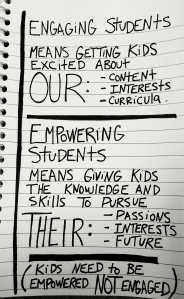
To get students to that deeper understanding, the learning needs to be meaningful.  Bill Ferriter (@plugusin) says “Kids need to be empowered NOT engaged.”  So how do we get there?  Ferriter goes on to say that “Empowering students means giving kids the knowledge and skills to pursue their: Passions, Interests, Future.”

One of the things I believe in education is that we have great power to help our kids be excited about learning.  The more student choice and voice we give, the more authentic and relevant approaches we take, the more we shift our students from engagement to empowerment.

#IMMOOC #IMMOOCB2: School vs. Learning

The graphic above was created by @sylviaduckworth in response to a blog post by @gcouros about the differences between a traditional school setting, and comparing it to what we know best about how people learn.  It makes me think of the TED Talk by Ken Robinson on Changing Education Paradigms (check out this version).

Couros looks at the differences from the graphic above in his post School vs. Learning where he looks at the traditional school model compared to the way that research shows that people and students learn.  Think about the ways you learn best.  Do the descriptions on the left or right of the graphic above fit with your experiences of learning?  The next question – what do the classrooms that you are in most look more like?

Engagement is great, but engagement alone is not learning.  My kids can be engaged with YouTube for hours if I let them.  Does this mean they’re learning?  If we want learning to happen for our students, we need ask “what can I do less of?”

Reflect on what school looks like for you.  If what you reflect on makes you uncomfortable or gives you pause, think about where you can implement change to make learning new and better for your students.

#IMMOOC #IMMOOCB1: A culture of yes!

So we say we want innovation in our schools, in our classrooms.  Many of us feel that this is the best way to get our students past the point of engagement, and moving to the level of empowerment.  But there is one little word that can kill that process – no.

In the past couple of years, we have had many opportunities to interview potential teachers.  Every time we bring an interview team together, we all agree that we are looking for people who are “go-getters” – people who will do whatever it takes to make the learning experiences for their students new and exciting.  They have helped to bring exciting new learning opportunities into our school.  At the same time, many of the teachers in our building continue to learn and evolve – trying new formats of teaching, new activities, new technologies.  This innovation continues to spread, and is so exciting to watch!

If you know much about improvisational comedy, you know that during a scene the key is to not say no.  The mindset has to be to have an attitude of “yes, and…”  This is what we’re seeking for innovation.  When there are new and exciting ideas that will make learning better for students, I strive to say “yes, and…”

My hope is that this culture of yes will allow us all to continue to learn and grow.  Ultimately, our growth will allow us to make learning more innovative for every student!  Isn’t that the goal?

#IMMOOC Week 2 – How did this work for our students?

As I was reading Part 1 of The Innovator’s Mindset by George Couros this past week, one of the “Critical Questions for Educators” really struck a chord for me: “How did this work for our students?”  In the book Couros shares that he used to survey his students at the end of the year, and I often gave my students a similar survey at the end of every school year.  I would ask what their favorite lessons were, and what were the things that they didn’t enjoy as much.  I would analyze the results, and use it to improve my practice for the next school year.

In retrospect, I feel I may have been missing an important piece.  I valued my student’s opinions, and would use their responses to improve, but how did my survey help them?  It didn’t.

Think about it like this: When was the last time that you were out to eat with your family or friends and had poor service?  Or what about a time where you server was so awesome you just wanted to show love in more ways than just a good tip? How did you handle either of those situations?  Did you ask to speak to the manager?  Did you call the restaurant after you left?  Maybe they had comment cards, or a website where you could leave feedback.

Have you ever thought of your students as being kind of like the customers of your classroom?  How often do your students get a chance to leave you feedback about your lessons?  They are in your classroom on a daily basis.  Shouldn’t we all know what our students like or don’t like about our class?

In The Innovator’s Mindset we’re reminded that innovation isn’t just doing things that are new, but doing things that are new AND better.  These days through the use of Google/Microsoft Forms, SurveyMonkey, and other simple survey tools, we can always be seeking the feedback of our students.  Wouldn’t it be a learning experience to take a moment to reflect on your student’s opinion about that lesson you were so excited about?

Create a simple survey.  Make a QR code that students can scan that will take them to the survey.  Encourage students to provide anonymous feedback of what’s happening in your classroom, and take that feedback to grow as a teacher.  What a way to build student empowerment in your classroom – when they see you responding to your feedback in a way that model’s growth, they will see the value in a growth mindset of their own.

Have you ever surveyed your students before?  What kind of questions have you included?  Share your thought in the comments below!

#BookSnaps

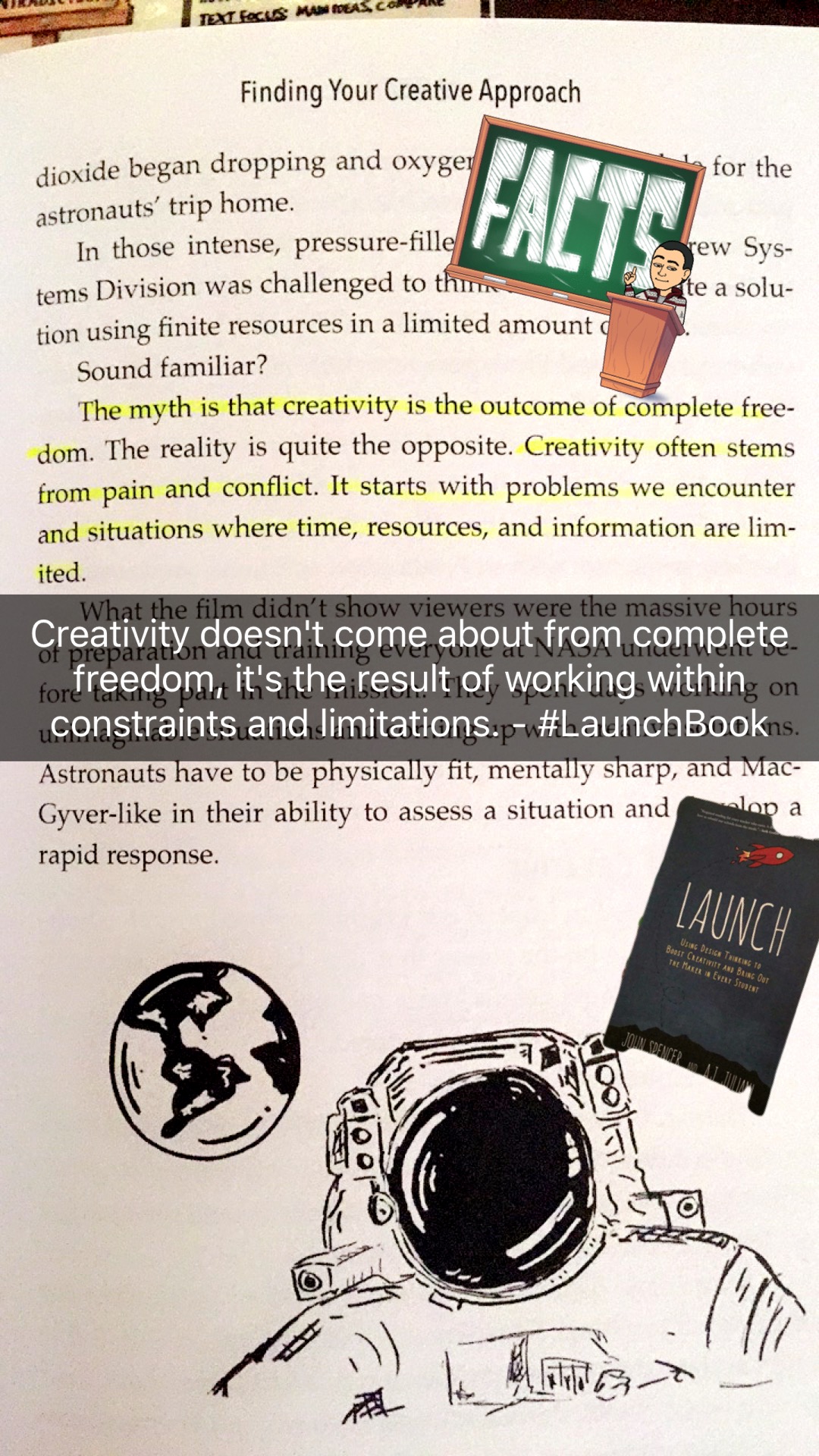
This is a BookSnap I created while reading the second chapter of the book Launch by John Spencer and AJ Juliani

If you are on Twitter and follow any of the same people that I do, you have probably noticed people posting pictures of text, sometimes with highlighting, adding emojis, bitmojis, or text, and then posting it on Twitter with their own comments.  Normally if you look at the comments, you will see the hashtag #BookSnaps linked to it.  Even if you aren’t on Twitter, you can see what people are posting by clicking this link: Twitter #BookSnaps

If you go to Twitter and check this out, you will probably notice that most of the posts here are educators who are sharing their personalized professional reading with their Twitter followers.  If you look closely though, some of what you will find is teachers sharing BookSnaps that students created in their classroom.  It got me started thinking about how some of you might be able to use them in your classroom.  Check out this student created BookSnap that the teacher then added some additional comments to:

This BookSnap was created by a student on SeeSaw and then shared by a teacher.

Most of the ones that you see are using SnapChat in order to create and share.  For those of you that know what technology your students are using, SnapChat is a pretty popular app.  But here’s the thing, there are ways that BookSnaps could be created using other apps that don’t involve the social network aspect of SnapChat.  Any app that allows you to pull in your own pictures and add text, drawings, and emojis could be used in the same way.  The student created example to the left was created using SeeSaw.  Some other examples that come to mind are Skitch, Google Drawings, various PDF annotating apps, and even Instagram.

Think of the potential engagement for your students if you asked them to create their own BookSnaps.  Could you imagine what they would say if you told them to open SnapChat or Instagram in class?  In ELA classes, you could have students create a BookSnap when they run into a Notice and Note signpost.  You could have them create one to identify the climax in the book they’re reading, or create one based on their own writing, identifying specific plot points.

And don’t say “I’m not an ELA teacher, this doesn’t apply.”  I could see real potential for BookSnaps in nonfiction reading as well – identifying the main idea in a science article.  Sharing things that surprised them as they are reading about some historical figure.  Responding to the 3 Big Questions from Reading Nonfiction by Beers and Probst.

I could even see integration into math class – MathSnaps could be a thing (acutally I just checked, and it is a real thing on Twitter)!  You could have a kid snap a picture of the answer to a problem and then add text describing how they came to that answer.  Or there could be ArtSnapsMusicSnaps, or GymSnaps.  The limitations are only bound by the creativity of how to integrate this technology.

As for how to share, again, the options are probably endless.  If you’re already using SeeSaw, that’s an easy option.  Other ideas I’ve seen include Google Slide Decks, a class shared PowerPoint (these options allow everyone can see what BookSnaps other kids have created based on the same reading assignment), or even something as basic as emailing it to you (although a way to share with classmates would make the audience so much more authentic and meaningful).  Once kids have shared them with you, find a way to share beyond the walls of your classroom.  If you’re on Twitter, tweet it out with the #BookSnaps hashtag – others will see it.  You could also put it out on Instagram or Facebook – both have people actively using this hashtag.  If you don’t have social media, you could have students print them out and put on their locker, or create a BookSnaps bulletin board.

If you are still at a loss for how you even create a BookSnap, there are some great resources from Tara Martin.  You can find her on Twitter at @TaraMartinEDU or @BookSnapsREAL.

On Martin’s blog, she’s also created some how to videos that could be useful to see how she puts a BookSnap together.  Check it out here: http://www.tarammartin.com/resources/booksnaps-how-to-videos/

I know I’ve got some creative people in my audience.  If you have an idea for how BookSnaps could be used in the classroom, please share in the comments below.  My ideas above are simply ones that have come to me in the past couple of days.  You might have something that I haven’t thought of – or possibly never would.  Let us know!

If you begin using BookSnaps in the classroom, please share them!  Use the #RSIHawks or #RSIReads hashtag in your post!

#IMMOOC Week 1: The Power of Ice Cream

This week is the beginning of The Innovator’s Mindset Massive Open Online Course.  For the next five weeks, I look forward to the opportunity to reread a great book and interact with educators during the weekly YouTube Live sessions as well as the Twitter chats!  I love this format of PD, and look forward to creating new connections and growing my Personal Learning Network!  If this sounds like something you would be interested in, you can still sign up here: IMMOOC

curiousAs I was reading the introduction to The Innovator’s Mindset this week, there was one line that really stood out to me: “if students leave school less curious than when they started, we have failed them.”  Given the meaningfulness of that line, I was so glad that became a major topic during the YouTube Live event on Monday evening.  During this session, AJ Juliani talked about a self-audit based on 4 questions, and I felt that these questions could really help us think about what we do in the classroom that might encourage students to “play” school and take away some of their self-agency and curiosity.

  • What do I allow for in my classroom/school?
  • What do I make time for in my classroom/school?
  • What do I support in my classroom/school?
  • What do I praise, assess, look for in my classroom/school?

What intrigued me the most about these questions is that students who play school well get there not because of their own desires.  Instead they get there due to the things that the adults in their lives (both educators and family members) value.  Watch kids of any age, and you will see curiosity – whether it’s on the playground, with their friends, or while playing a video game, our students our naturally curious.  But for many, when we put them into a classroom and ask them what makes them curious, the response is “I don’t know.”  If this is happening in your class, then your students are probably well trained to play school.

If we want our students to create, we have to model creativity (or at least a willingness to try).  If we want our students to be problem finders and solvers, that spark has to be modeled through our actions.  All of us have our interests and desires.  A lot of us keep those interests and desires separate from what is happening in our classrooms.  If we want to ignite the fire of curiosity in our students, we need to show them that their interests matter.

Recently in our school building, a student noticed that our cafeteria never served ice cream at lunch.  She knew from talking with friends at other intermediate schools that ours was the only one in the school district that did not ever serve ice cream as part of the school lunch.  Instead of just complaining about it, or even accepting that’s just the way it is, she went into action.  She did research.  She got friends and classmates involved.  She met with our school’s cafeteria manager to understand why we didn’t serve ice cream.  She met with our district facilities manager to learn about options to make ice cream a possibility at our school.  She got the student council on board to do a fundraiser.  All of this started last year with the question of why.

The Creamsicle may not be the fanciest of all ice cream treats, but it was a huge step forward in a school that had not served ice cream at lunch ever before! The Creamsicle may not be the fanciest of all ice cream treats, but it was a huge step forward in a school that had not served ice cream at lunch ever before!

Last Friday at lunch, our school served ice cream for the first time.

I would argue that the learning that happened for this student, and her classmates who were part of this work, was some of the most meaningful learning in the past year.  All of this happened because the adults around this student saw the curiosity and the drive that this student had – for ice cream – and they let her run with it.

What are the ice cream moments that are happening in your classroom?  In your school?  How are you helping to ignite that curiosity?  What are the ice cream moments for you?  Are you modeling that curiosity with your students?  As the leaders of our classrooms and schools, we have the ability to choose a course for our students that inspires them, or we can choose a course that creates students who “play” school well.  Which course do you choose?

I’d love to hear your thoughts in the comments below.  Keep the conversation about innovation in learning going here, or hit me up on Twitter @brian_behrman.