
For a little context depending on the time when you are reading this – as I write this post, it is the last official week of school during the spring of 2020. This means we are living through the effects of the Covid-19 pandemic. We haven’t had students at school since the middle of March here in Indiana. Much of the world has been living through a time of social distancing. I am sitting at the desk in my son’s bedroom because it is the one quiet space that I can find right now that also has (semi) reliable wifi. The nicest shirt I’ve worn in the past 10 weeks is a polo, and I felt weird the day I put it on. My wife and kids are currently working on their eLearning, Diane is a first-grade teacher, Lainey is wrapping up her fifth-grade year, and Brody is finishing up his second-grade year.
I have been sharing with people that this has truly been the strangest school year of my life, and I continue to believe that to be true. I started the year as an assistant principal at an intermediate school in the district where I have lived and worked since the fall of 2006. In October of this school year, I was asked to move into the position of Principal at Fishers Elementary School. That transition took place on the Monday after Thanksgiving break. During the weeks between Thanksgiving and winter break, I was carrying a map of the school around in my pocket because it reminded me of the name of the teacher’s classroom I was about to walk into, and what grade level they taught.
After winter break, I felt like I had a good grasp of who my staff was, now I wanted to get to know them as teachers too. I spent lots of time in classrooms just looking around, listening, asking questions, and learning about personalities, teaching styles, and the feel of the classroom. About the beginning of March I was beginning to feel like I had a pretty good grasp on our school. Then came the announcement that school would be closing – initially it was for a few weeks, then our governor made the decision for the State of Indiana that it would be the rest of the school year.
For about 2 months now, we have been living through an environment of Emergency Remote Learning. In the beginning, we had no idea what this would look like. But soon, teachers were coming up with plans to connect with students. They adapted to teaching kids synchronously and asynchronously, depending on the needs of the students. I was on Zoom calls with teachers, with students. I saw teachers turn walls in their home “office” into a whiteboard type space. I saw other teachers drive in their car to the public library to sit in the parking lot because it was the only place they could get reliable wifi during the day. I think @Wes_Kieschnick says it best:
 But the end of this year comes with lots of questions. What will the start of school look like? Will we be back on the “normal” schedule? Or will it be something different and unique? If you’re anything like me, then the quote to the right probably resonates with you as well (shared by @hansonhallway on Instagram). There are so many things that I simply do not know about what’s going to happen in the next couple of months. Currently August 3rd is scheduled as the first teacher workday of the year. I have big plans for what we will be doing as staff on that day, but I don’t even know if those plans will be possible, or realistic.
All of this has the end of the year having a very different feeling. In a normal year, we’d be thinking about classroom celebrations. There’d be a field day, and picnics, and so many more fun ways to wrap up the year of learning. I was recently talking to my wife, and we were both saying that even though the calendar says it’s the end of the school year, it just doesn’t feel like it should be. There’s so much that it seems we haven’t completed. But, I’ve got to trust that we’ve done our absolute best in unprecedented circumstances, and we can only be stronger after all of this!
I have been so amazingly proud of the work the teachers of Fishers Elementary School have done over the past 10 weeks! While I still am the “New Guy” at FES, I can’t wait for an opportunity to work with my team in some form of normal! I’m looking forward to walking into classrooms, hearing the sounds of learning, and watching the amazing work our staff does every day.
One thing that I am super hopeful for: that this time causes all of us in education to pause for a moment and really reflect. Take just a moment to think about these 3 questions:
- What have you learned during emergency remote learning that you want to keep doing when you get back to school?
- What have you always done that you now realize you should stop doing when you get back to normal?
- What things do you wish you would have done prior to this time of emergency remote learning?
Hopefully through reflection on these questions, we can better identify what it is in education that we value most. What is it that our students need most? What is is that we need most? And then we can help change the system from the inside out to be a better environment for learning and growth for us all!
 But before I get to some of my strategies, I’m going to share with all of you one of the things that causes so much stress to so many of us: Perfectionism. Something I know about educators is that many of us were rule followers when we were in school. A lot of us liked to work hard to get the teachers attention in positive ways because we knew we wanted to be a teacher. And because of those things we did, we developed this drive for perfection that still lives in many of us today. The problem with perfectionism? It’s kind of like counting to infinity. There’s always the one more. We have to be willing to let go of perfection. Sometimes good enough is all you need to take the next step with your students.


 at doing this all on my own. I love to use an app to help guide my mindful moments. Both


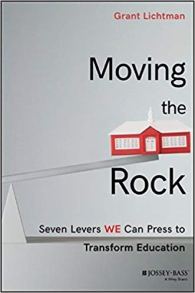 Grant Lichtman, the author of Moving the Rock: Seven Levers WE Can Press to Transform Education, has often used the metaphor of the North Star to talk about the idea of having a shared vision of where we want to get to in terms of great learning. If we don’t agree on where we are going, we have random movement, in random directions, and we end up nowhere! Think about the North Star, no matter where you stand, we can all find it, we can all point to it, we can all figure out our route to get there. In that same way, when we have a shared vision of learning, and we understand that no two educators are moving towards it from the same place, we all have to set a course of our own.
 Recently I’ve been reading the book Sapiens by Yuval Noah Harari. I’m about a third of the way through the book, but its premise is centered on the evolution of Homo sapiens as a species. In a recent chapter, I was struck by the comparison between the biological development of humans versus the cultural development of humans. In biological terms, humans have the ability to learn. Our early hunter gatherer ancestors had to learn how to identify what foods were safe to eat, what predators they needed to stay away from, or what places were safe to drink the water. On the other hand, schools are a cultural development created by humans to pass on learning to students. Traditionally, much of that culture has treated learning as the filling of a vessel, not the awakening of the biological processes that encourage learning. The types of things that we teach in schools are not directly related to the future survival of our students (we don’t directly teach them how to meet their basic needs). As with any system, the culture that surrounds it effects how the system works. My understanding of this was further impacted by my recent trip to China. The system of schooling, while there are some similarities to what we do in the US, also had some rather significant differences that are created by the cultural beliefs that Chinese society has about learning. So this leads me to the bigger question, from a biological level, what is learning? Here are my beliefs:
 This summer a group of educators in my school district did a book study of Moving the Rock: Seven Levers WE Can Press to Transform Education by Grant Lichtman. I was not an original member of the book study, but when that group came to an end, they decided they wanted to keep meeting, and that they wanted to grow the group – so, I was invited to become a member. That group is called the Innovation Task Force. Since I felt a bit behind the other members, I decided to read the Moving the Rock. I picked it up and read it in just a couple of days (I could have finished it in a day if I let myself!).

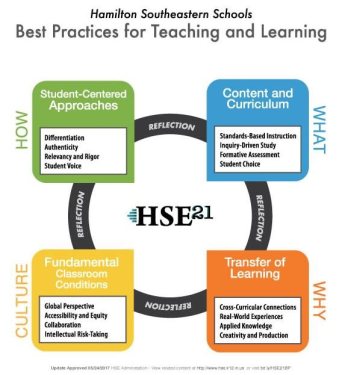 As a district, we also have our Instructional Framework, Called the HSE21 Best Practices for Teaching and Learning (it can be found to the right). As I look at this framework, and compare it to the words that we as a staff selected to define great learning, they seem very well aligned.


 If a student can turn to Google, Siri, Alexa, or whatever smart tool comes out next to find the answer to your question, then maybe we aren’t asking the right questions.
 The students in our school in general are very compliant. Compliant students sometimes struggle with creative tasks because they want specific directions to follow. They may not remember what it feels like to be creative or curious. Years of compliance in the school setting seems to suck creativity and curiosity out of our students. I think that sometimes students lose that ability to be creative and curious because they have grown accustomed to the amount of scaffolding that we provide for learning activities. That scaffolding can begin to feel a bit like a cage, and students forget how to get out.
 The View from 518