What really goes into teaching comprehension

As a classroom teacher, I remember spending chunks of time with my students. We’d read, sometimes me to them, sometimes them to me, sometimes to each other, and sometimes on their own. Then, I would do some comprehension activity—maybe some questions to answer, a written response, or something similar. This is how I was trained then, so it’s what I did. I thought I was doing good work.
However, in the past couple of training sessions with LETRS, my thinking has been challenged to move students to true comprehension. There was so much more that I could have been doing throughout the reading process to help build higher thinking skills for my students. So let’s dig into some of the things we can do Before, During, and After reading to support building reading comprehension (you can reference the planning checklist below).

Before:

First, we need to establish a purpose for reading—why have we selected this text? What should our students take away? Is there a lesson to be learned? This helps us define the why behind the reading for our students.

Identify text structure – Is this an informational piece? A narrative? What do your students need to know about the text structure to be able to attack it?

Prepare background knowledge – As you look at your text, what do you think your students need to know to comprehend this text? Is there information they may not have already been exposed to?

Select vocabulary – As you preread the text, consider what words your students need to know to comprehend the text. Focus on the Tier 2 words.

Finally, Identify Challenging Language – What language might be challenging for students when pre-reading the text? Are there phrases that could be difficult to understand? Are words used in unusual ways? Mark those spots during your pre-read to be prepared to discuss them during the read-aloud.

During:

We should be sure to Plan Questions & Anticipate Student Questions intentionally – As you pre-read your read-aloud text, have a stack of sticky notes nearby. Mark spots in the text where you will pause to check for understanding. Are there parts that might be tricky to understand? Language that you might want to highlight? And be ready to address spots where students might ask you questions – maybe a place where something confusing happens. By taking the time to prepare, you can ensure that the questions you ask during the reading are more than surface-level questions but comprehension questions that push your students to higher levels of thinking.

Next, Use text structure to organize thinking – graphic organizers like a story framework, a web diagram, a cause/effect map, or a Venn diagram are just a few examples of the types of graphic organizers that can help students track the plot of a narrative story, or organize the information in an informational text.

After:

Once you finish the reading, some things to consider with students include: Was the purpose met & did the students’ thinking change? These questions can help you evaluate students’ understanding of the text. Do you need to reread portions of the story? Is there something unclear? This might help illuminate a need to go back into the text.

Finally, Assessment: Can students express takeaways? Use text evidence? This is where we can evaluate the big ideas and long-term understanding that students take from a text. Did they get the lesson we wanted them to learn when we established the purpose? Can they point to evidence in the text to support their thinking? These are key signs of true comprehension.

If you are like me, you probably wonder when I have time to do that. I read aloud every day! Sometimes, multiple times a day. You’re right! Trying to do this with every text would be very difficult. But that is where the power of teams comes in. When you work as a team and plan units together, you can select common read-alouds. If you have the same 8-10 read-alouds (maybe more, maybe less) in a week across your team, each person can prep 2-3 of these a week, and you can share. Think of the read-aloud library you could build as a team during a school year.

You might choose to do this with the actual books with markings in the book, or if you are a more digital native, you could create shared folders, and your read-aloud notes and outlines could live there. And what if you expanded the creation of the read-aloud library across the school? In a school of 20 teachers, doing two books weekly, that’s 40 books per week, and over 1,400 books in a school year that could be shared for read-aloud purposes. Work smarter – not harder.

So let me leave you with this – remember that building reading comprehension is more than asking questions when you finish the reading. It’s a constant process. If you use your read-aloud as I did, without any prep and mainly as a throwaway time, learn from me and do better. Those 10-15 minutes a day can be such rich opportunities for teaching, but it takes planning and prep to make it so. Please work with your team, or we can work across the school to build a shared read-aloud library that we can all access to benefit our students!

The Crossroads of Mario Kart and a Healthy MTSS Program

I’m not sure how much time you spend gaming, but there was a point when my family played quite a bit of Mario Kart. It’s one of the few games we could all get excited about and play simultaneously. The best part was that no matter how good (or bad) you were, you always had a chance to win. You see, the way that Mario Kart works is that the players who are doing the best only get the basic power-ups, but if you are in last place, you often get the best power-ups! I remember on multiple occasions playing the game, leading the whole race, and then getting hit by a blue shell from one of my kids so that they could win the game, while I ended up in 3rd or 4th place!

The game can sense who is the most successful and who might need an additional leg up to be successful. Game designers know the game isn’t fun if the same person always wins. If it isn’t fun, people don’t play it as much, and kids don’t come home from their friend’s house saying, “We have to get Mario Kart!” And ultimately, Nintendo is a company that wants to make money. They make that money by selling more games and getting people to continue to play.

In most of the real world, this is not what happens. The people who are at the top often get the most, and the people who are at the bottom struggle the most. Think about individual finances—the saying goes, “The rich get richer, and the poor get poorer.” This is part of why a healthy MTSS program is so important.

In education, we often find that students who start with the strongest reading skills tend to improve faster than their peers with weaker skills.

When we think about the accumulative advantage in reading instruction (or really in any subject), we have students who show up in our classrooms with a different level of skills than others. Some students’ families may have provided a more literacy-rich pre-K home environment. Some children may have access to more books, technology, and extracurricular activities that have improved their language comprehension skills.

So, let’s return to the connection between Mario Kart and MTSS. Ultimately, what happens is that the game can assess where the players are in terms of skill. Based on those assessments, the game provides players who are not as competent with better power-ups, giving them a chance to be successful in the game.

MTSS is a system that empowers educators. We can assess where our learners are. We understand that all our learners will receive high-quality instruction (Tier 1). Still, some will need targeted small-group interventions (Tier 2), and a few will receive more intensive individual support (Tier 3). Think about Tiers 2 and 3 as being power-ups. Our students who come to us with a strong foundation typically get to where they need to with our typical Tier 1 instruction. But some of our students will need additional power-ups. By providing targeted interventions, we can give our students the tools they need to succeed.

Interventions are one of many ways to provide power-ups to our learners. Other ways to support students might include:

  • Access to high-quality resources such as books and technology that support students’ reading
  • Libraries help encourage selecting high-interest books, borrowing, and reading at home
  • Professional development will provide teachers with the tools they need to know what the best interventions for a student based on their current data and then will support teachers in ongoing assessment of student growth
  • Getting families involved in the literacy development of their children is critical – implement programs and workshops that include families and help them know how to support their child at home best
  • Promote a culture of reading through things like reading challenges, book clubs, and author visits

The more power-ups we provide, our learning environment can be more equitable. This will help all students grow as readers, especially those who struggle, so that they can close gaps in their reading skills.

Let me know what some of your favorite power-ups are to implement. What gets your kids excited to read? How do you develop a passion for lifelong reading? Please share with us in the comments below!

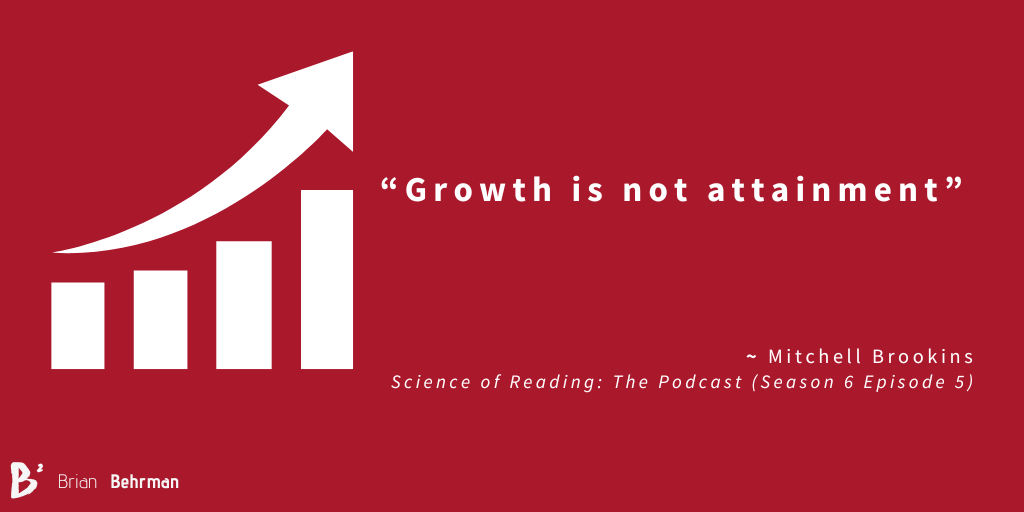
Growth is not attainment

I was recently listening to an old episode of Science of Reading: The Podcast, which is hosted by Susan Lambert. The episode was titled “Leading with the head and the heart” and the guest was Mitchell Brookins. You can find this episode here. Brookins began his career as a teacher on the south side of Chicago, became a school administrator in both New Orleans and Chicago, and now is a consultant working with teachers and educators on the Science of Reading. Much like many of you, he was trained as an educator who believed in a Balanced Literacy format for instruction, but he was seeing students in his classroom who were not learning how to read and not growing despite doing everything that he had learned was supposed to be helping kids learn to read.

Around 2015, Brookins was working on his doctorate, researching instructional leadership, and realized that he needed to research how to teach students to read. This work led him to the National Reading Panel Report, which was published in 2000 (you can find it here). He later came to realize that this research was the beginning of his journey of learning about the Science of Reading.

What I found myself reflecting on as I listened to Brookins was that I was in much the same boat as him. I had students who came to me in 5th and 6th grade, and while most could read, there were always a handful that struggled. Even though I tried the strategies that the literacy coach suggested, and the things that Guiding Readers and Writers by Foutas & Pinnell told me were good practice, I never seemed to make headway with those students. What strikes me now is that the ideas that could have helped me shift my practices, that could have helped me reach more of the children who walked into my class without reading proficiency were sitting there in a report that had been published while I was still in college. The problem is, I didn’t even know about the National Reading Panel Report until sometime around 2020 or 2021.

Brookins and his team of 3rd to 5th grade teachers took the information from the research and first began implementing fluency reads. They spent 10 minutes a day with a short passage. The teacher would read it aloud first, then the class would choral read, then students would re-read and annotate for a purpose. Annotation allows you to closely monitor what is happening in a text – you might notice main points, shifts in perspectives, key areas of focus, and your thoughts as a reader. After seeing some quick gains in student comprehension of reading, the team decided to go deep with fluency reads. Each week they would select a couple of passages and devote 10 minutes a day to reading, re-reading, annotating, and discussing the text. After 20 weeks the teachers had seen major growth in their reading comprehension scores. That year, the school saw a 10% increase in state assessment scores on student reading. Even with all this work though, and seeing kids grow, they noticed that there were still a few students, about 10-12 across the grades, who were not growing.

At this point, Brookins went back to the research and found a section in the National Reading Report that suggested students who were not growing with phonics support might need instruction that falls earlier on the reading progression. This led him to dig into phonics instruction. He found that for his students that were not achieving based on fluency reads, the team needed to look at foundational skills that might be lacking. By adding those skills for intervention work with the 10-12 students who weren’t growing, the team began to see a shift in the data. Students were growing.

But then, Brookins said something that he came to realize, and that shook me to the core:

You see, what I have noticed is that each year, we have students who show growth – in their NWEA data, in screeners, and in formative assessments. Because they grow, they seem to slip through the cracks. But when we start looking at our bubble students – the ones who didn’t pass the IREAD-3 (Indiana’s Assessment of Reading Proficiency) in third grade, we notice that while some students have been growing consistently, their data always puts them in the yellow, on the edge of being at risk. These children have slipped through the cracks because they aren’t waving a big red flag. They are growing. But that growth is not at a rate that will get them to our goal of reading proficiency by the end of grade 3.

So now, that has me reflecting on my own instructional leadership. I know that my eyes often get drawn to the big red flags that pull in our attention. These red flags come from the students who consistently are being flagged by our screeners, who have NWEA scores in the 40th percentile or lower, and who are identified for our RTI support. But when our eyes get drawn to the big red flag, we miss the student who is consistently cruising on the bubble. They are making growth, they may even be meeting their growth goals every year, but they aren’t closing gaps between where they are and where they need to be to reach proficiency.

So here’s what I’m thinking about for next year (as there is less than 2 weeks remaining in this school year here in central Indiana) – I want to make it clear that my vision moving forward is to work towards mastery of literacy. You see, students cannot be strong mathematicians without reading skills. They will struggle with problem or project based learning if they are not masters of literacy. My expectation is 95%.

To get there, I’m going to engage in the work. We’ll be studying the needs of our students. We’re going to learn, and then implement the practices that will meet those needs. We’re going to utilize a system of universal screeners and diagnostics to help us understand where our students are and how to move them forward. And then, we’re going to analyze the growth. Where there are wins, we will celebrate them. Where we still are finding gaps, we’re going back to the drawing board. You see, if growth is not attainment, then as Brookins said a bit later in the episode:

You see, I believe that in order to be successful in our world, children need access to literacy. The best way we can help with that is to provide them with foundational skills and language comprehension skills to support their literacy. The children in our school will become proficient.

Based on what you have learned, either from this post or from your own learning on the Science of Reading, what commitments can you make about your instructional practices for next year? What’s something you are going to implement? What’s something that you are going to let go of? To be truly successful, we cannot let our plate get too full. Make sure you’re thinking about what you’ll let go of as you move into a new mindset where mastery is the mandate. Share your thoughts in the comments below!

The Basic Questions

Recently, I’ve been doing a lot of research and learning on how to best meet the needs of our students. In LETRS (Language Essentials for Teachers of Reading and Spelling), I’ve come to understand just how important assessments are for us to know two things – first, they help us know where our students are, and second, they help us know what we need to do next to help our students to grow.

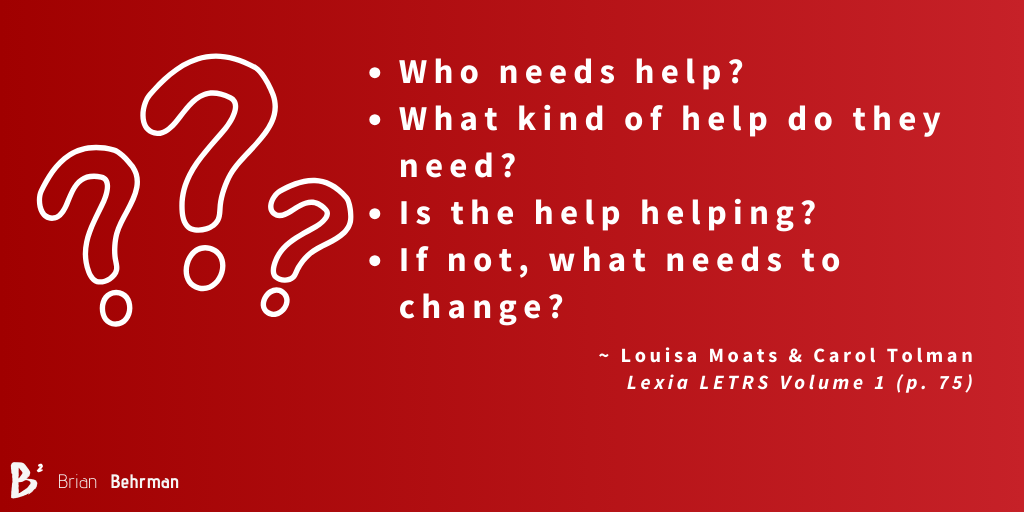
When looking at assessments, LETRS suggests that there are 4 basic questions that we should answer based on the various assessments and the data we collect. Those questions are:

In today’s post, I’ll dig into those questions more to support you when looking at student data. We want to all be on the same page about these things because one of the biggest takeaways, as I learn more about the Science of Reading, is that prevention and early intervention have the greatest impact on avoiding potential reading difficulties. To help with these goals, we should screen our students in grades K-2 individually three times per year with a valid, reliable, and efficient assessment to flag any students who are making inadequate progress in reading. We should be using the results of those screeners to answer the four questions listed above.

Who needs help? – Our initial guide for those who need help should be driven by our academic standards. As an administrator in Indiana, my go-to resource is the Indiana Academic Standards Vertical Articulation Guide. You can find the K-2 version here, or you can get the 2-5 version here. If you live in a different state, look to see if your Department of Education has something similar, or you could utilize your academic standards. In addition to standards, there are other resources that you could use. Your curricular resources typically have a scope and sequence. If you’ve checked how well your resource aligns with your academic standards and know that the resource is highly aligned, then that scope and sequence will help. Another resource you might want to look at is the scope and sequence of a resource such as LETRS. You can find this scope and sequence here. This tool might help you know when most typical students will be ready for a specific skill as a reader, and then as a speller (quick side-note on this – these grade levels are approximate – we know all students develop in different ways at different times, but this can be a good tool to compare to the scope and sequence of your resources, and can serve as a support if there are students who are far off the benchmark). A final tool that can be beneficial in identifying where students should be is the Progression of Word Study, also created by LETRS:

So… to be able to identify just who needs help, we need to look at the students in your class and their data. If there are students who are not meeting the benchmarks of your screeners, that should raise a red flag. If you have a student performing below most other students in your class, that should raise a red flag. And finally, if more than a typical proportion of a class is not meeting the benchmark, that should raise a red flag.

What kind of help do they need? – Once we’ve identified our students who need help, the next goal is how to help them. If that student is below the benchmark, it’s time to do a diagnostic assessment. Recently, the leadership team in my building has been looking at the LETRS Phonics and Word-Reading Survey as a potential tool for diagnostic screening (accessible here). What we like about it is that it’s organized according to the progression of phonic elements. For most students, it will take 5-10 minutes to complete. Once you reach a point of frustration for the student, you stop. When you fill out the summary chart, you should have a clearer picture of where the student’s phonics and phonemic awareness have broken down. Once you know that, you can decide on an intervention for your student, and where you might want to start them.

In our school, we use UFLI Foundations as our core resource for structured literacy, and for most students, it will become our primary tool for Tier 2 Interventions. When we have completed the diagnostic we’d look at the UFLI scope and sequence to identify what lesson might help fill in the gaps for that student. Ideally, I’d form a small group of 3-5 students at a similar level for this work. In our building, we’ve been utilizing a shared RTI time across grade levels to make this happen. Each PLC team can look at their students of concern, group them based on need, and decide which teacher will pull which group for support. If all is going well in your Tier 1 instruction, then this should be around 15-25% of your students who need extra support, which results in a reasonably sized small group.

Once we identify our intervention, and where the students need to start on that intervention, it’s time to create some short-term goals. We’ve been setting goals of approximately 6-8 weeks in the SMART goal format. An example of this SMART goal might look like this: By ___(date)__, __(student name)__ will be able to __(skill)__ using __(intervention)__ as measured by __(Progress Monitoring Tool)__. These clear goals help us know what our students are working on and identify opportunities for early wins with each child.

Is the help helping? – At this point, we’ve identified our students of concern and created groups of students to work with on specific skills. Now it’s time for us to implement a plan of progress monitoring. These assessments should be short, formative assessments that allow teachers to make instructional decisions. Recently, we have been using Aimsweb Plus as our Progress Monitoring tool. Ultimately, the progress monitoring should tell us more about the validity of the intervention and its teaching than it tells us about the student.

If not, what needs to change? – So now we’ve done all the previous steps, screeners have been used, areas of need identified, interventions implemented, and progress monitoring is utilized every 1-3 weeks. Now it’s time to think about what to do for a student who is not growing as we’d like. If a student seems stagnant on the goal after a few rounds of Progress Monitor data, we must change the instructional plan for that student to better meet their needs. This is why we want to set a short-term (6-8 weeks) goal, and then check on student progress towards that goal regularly. If their data does not show growth toward their target, it’s time to do additional digging. In our school, this is where we’d set up a Child Study Team. That team includes the teacher, support staff who work with the students, our instructional coaches, and our administrators. Based on the conversations around the table, we might use an additional screener, put into place a different intervention, or shift the skill we’re working on within the intervention.

Again, the goal is to identify our students who need help, assess what kind of help they need, put that help into place, and make changes as needed. These steps will help us be ready to intervene as early as possible. The earlier we intervene, the easier it will be to close gaps. Ultimately, our goal is 95% proficiency by the end of 3rd grade. That can’t happen unless we look for those red flags in our students and take the appropriate steps.

As you reflect on your students, who raises a red flag for you? What steps should you take to help them be better prepared for next year? What goals could you put into place now to help next year’s teachers better support the students you’re thinking of? Let’s go do it! The sooner we intervene, the better we can support our students!

Reflections on Collective Teacher Efficacy

Reflections on Collective Teacher Efficacy

Recently, in many trainings (various Science of Reading work, the Indiana Literacy Cadre, and LETRS by Lexia), I’ve spent a lot of time thinking about what research tells us about learning to read. One of my biggest aha moments was reading that “all but 2-5 percent of students can learn basic reading skills in first grade, even in populations that are at greatest risk for chronic reading difficulties” (Mathes, Denton, Fletcher, Anthony, Francis, & Schatschneider, 2005). Other studies tell us that “Older students, in grades 3-5, can also improve to the average range and sustain those improvements if their remediation is sufficiently intensive, expert, and long term” (Torgesen, Alexander, Wagner, Rashotte, Voeller, & Conway, 2001). How does that happen? Through solid core instruction and a system of screeners, interventions, and progress monitoring data. The core instruction introduces the important skills students need, and with screeners, we can identify students who are falling behind, put into place supports that meet their needs, and track student work to see if our students are growing.

In January, the MTSS Leadership Team at the school where I work met with every grade level team. We talked about the importance of making sure that all those steps (screeners, interventions, and progress monitoring) are aligned. We also discussed designing goals for each student we had identified in our MTSS process as needing higher tiers of support. In other words, we want to make sure that we use interventions that meet the individual needs of each student. Then we want to use a progress monitoring tool that will appropriately measure data on the skills we are working on.

But alignment on those things is not enough to get all our students to reading proficiency. We also must be aligned in our mindsets. What does that mean? That’s where collective teacher efficacy comes in. The quote above is an important reminder. Through the unified efforts of your PLC, the MTSS Process, and the school, we can and will get our students to the level of proficiency that we expect for our learners.

The things I have learned about reading proficiency have caused me to reflect on some conversations over the years. One of the things that I have heard from teachers is a comment about how they “aren’t surprised” by the results of reading assessments when some students don’t show proficiency. I get it, as teachers, we believe in doing our best, moving kids as far as we can, and sometimes we don’t put a ton of weight on a standardized assessment score that is simply a snapshot in time for your learners. But when the number of students you “aren’t surprised” about is more than 5% of your class, maybe it should give you pause. Again, the research tells us that with explicit and sequential core instruction, reliable and valid screening, and interventions aligned with student needs, 95% of our students should be reading at proficiency by the end of third grade. And when I think about what an elementary school is here to do, teaching literacy skills to all should be job number 1. As Thomas Jefferson said:

“A nation of people who write and read is a nation with the attention span to earn an education and free society if they choose. Public education does not serve a public. It creates a public.”

When you see that research tells us all but 2-5 percent of our students can get to proficiency, what does that make you reflect on with your current students? Are there students in your class that probably should be at proficiency that aren’t? How can collective teacher efficacy help those students get to where they need to be? Remember, you aren’t going it alone! You have your PLC team, your MTSS team, your instructional coaches, and your leadership team to support you in these goals! But also know that a part of collective teacher efficacy is the belief that you can help your students to succeed. While it’s important to lean on your team around you, it’s even more important that you believe that you have the power to make a difference!

Credit for this design goes to @citizenruthbrand on Instagram. I love it so much, I ordered one!

And there’s something else we must keep in mind – the research says that this 95% of students who can reach proficiency includes all subgroups – ENL, Exceptional Learner, Transient students, etc. With that in mind, should we ever be ok with feeling like we “aren’t surprised” if a student isn’t performing at the level that they should be based on standards and learning progression?

Through collective action, starting on the very first day that our students start with us – for most of our students that means starting in kindergarten – and continuing through the last day they are with us at the end of fourth grade (or whatever the grade breakdown of your school may be), we must be diligent in our work to recognize where our students are. If they are not meeting standards, or falling behind others, that must raise red flags for us. The sooner we notice, the sooner we can intervene. And the sooner we intervene, the sooner we can close gaps. On the other hand, the longer we wait, the harder it becomes for us to close the gaps because with each day those gaps grow wider. And while we can close gaps in grades 3-5, those students who get to proficiency will most likely always read at a slower rate.

This means we all must have a laser-like focus on our students. Research tells us that early intervention is the key to getting to our goal of 95% reading proficiency by the end of their third-grade year. What commitment can you make in this last portion of the year to help set your student up for success in their reading future? Do you need to set a new SMART goal for your student? Do you need to utilize a new screener to make sure that you are correctly supporting them? Do you need to review your progress monitoring tool to make sure that it is appropriately assessing the skill that you are working with them on? Let us know what you plan to do in the comments below!

Assessment to Provide Early Intervention

I know that many of us have opinions about what it is that students need to know by the time they reach the end of any specific grade level. Those opinions are formed in several ways. One way is using grade-level standards, or another might be through our experience working with students at a particular grade. But how do we know if a student is struggling earlier than that? What should raise a red flag for us when a student isn’t progressing as fast as we think they should?

What research shows us, through a longitudinal study of approximately 400 randomly selected kindergarten students from a broad sample of communities across the state of Connecticut (you can see a bit more about this study here) is that early interventions are key. This study followed students until the end of high school. One of the interesting findings of the study is that between grades 1-9, students who started in the bottom 25 percent (the lowest one-quarter) of reading achievement remained there for the duration of the study. Students who were struggling in kindergarten were more likely to struggle throughout their educational career.

This is why early intervention is key to reading support. “Once children are behind – which happens very early – they do not catch up unless intervention is intensive, timely, and well informed” (Moats & Tolman, LETRS Volume 1, p. 63). Recent trainings on foundational skills continue to remind me of the importance of taking the right steps, at the right time.

Sometimes though, I feel like we get a little too caught up in the formality of interventions. If we see a student who is struggling, we shouldn’t feel like we need to wait for the next official MTSS meeting to add in some interventions. We also sometimes get too caught up in how long we need to spend on these skills. When the group is small, and a gap is identified early enough, just 5-10 minutes a day can make a world of difference. And those interventions don’t always have to happen while gathered around a table. If you have 3 kids that you’re concerned about their letter ID or naming of sounds, have them walk near you in line, and do the intervention while you walk them to a restroom break, to their related arts class, or lunch. When we use the small moments, and chunk them together, we can make BIG differences!

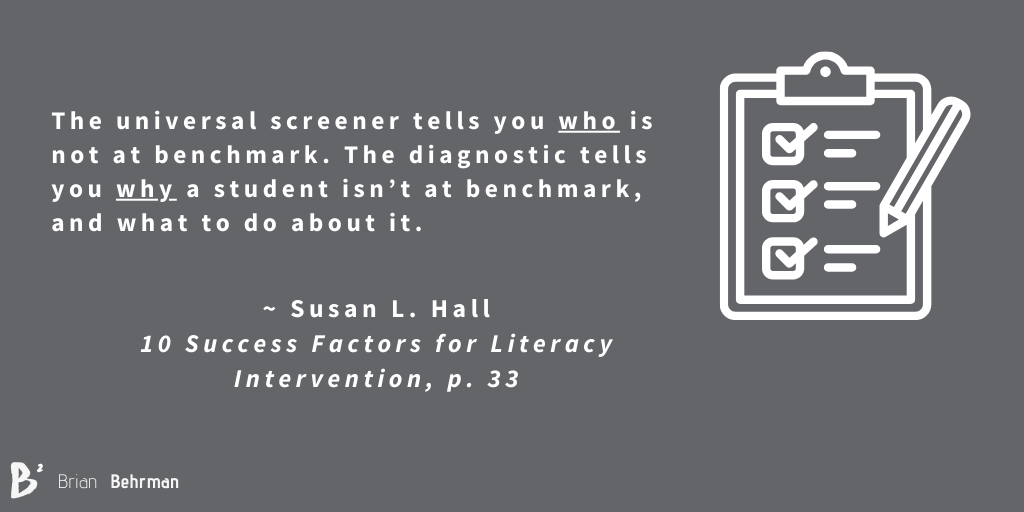
The first step in supporting students is knowing who to support – who falls into that bottom quarter of students. This is where a universal screener is so important. This is an assessment you might use for all students to see who is flagged as struggling with foundational reading skills. In my district, we use NWEA MAP Reading Fluency, however, other districts might use other screeners like Acadience Reading K-6, easyCBM, and others. This helps us locate the students who are at risk for reading difficulties.

Once we identify those students who are at risk, we may not know how we need to support that student That’s where diagnostic screeners are so important. There are lots of resources that you could use to help with screening students. Assessments such as The PAST Test (accessible for free here), or a Phonics and Word Reading Survey can help you see where your students are and identify where you might want to start an intervention. I would suggest using an assessment like this to screen your students of concern, then bring the data to a PLC meeting to see how you might be able to work as a team to support your learners in their continued growth.

The key to identifying the risks of reading struggles is to figure out where your students are as quickly as possible. Quality screeners are a huge part of that. Research suggests that screening should take place at least 3 times per year so that we can identify students who begin struggling later in the school year. Once students of concern are identified, we must get a quality intervention in place to support that student. The science tells us that most of our students can develop strong foundational reading skills – 95% or better – by the end of third grade. But the longer we wait to support students who are at risk, the harder that task becomes. Through appropriate intervention, we can make sure that many of our at-risk students are helped before chronic, serious reading and writing delays develop. This work must start on day 1 of kindergarten. We can’t afford to wait. Our student’s reading skills are too valuable!

Share with us in the comments. What are some of the things that you look for in your grade level to identify students who struggle? How might you intervene? We’d love to learn from one another!

Foundational Reading Skills

This year has been one filled with a lot of learning about the process of reading, how children learn to read, and the knowledge of how to teach reading with the use of any good reading program. I’ve already shared a bit about my experiences at The Reading League’s National Conference, as well as items I’ve learned as part of our experience as members of Cohort 2 of the Indiana Reading Cadre. Currently, I am one of several members of the team in my building engaged in Lexia LETRS Professional Learning. In today’s post, I want to share with you one of my key takeaways from the first unit of LETRS.

First of all, what is LETRS? LETRS stands for Language Essentials for Teachers of Reading and Spelling. It’s a professional development course of study for instructors of reading, spelling, and related language skills. Its goal is to take current research on reading instruction and bridge the gap to classroom practices that allow teachers to feel confident in their instruction.

Unit 1 covers a variety of topics, and I would describe it as something of an introduction to the learning that will be happening throughout the remaining seven units. For me, the most impactful section was on the topic of how children learn to read and spell. One piece of the key takeaways is that for students to develop the skills necessary to be skilled readers, we must teach them deliberately. As I’ve shared before, in previous posts (check out my previous posts on the purpose of reading) the ultimate goal of reading is to comprehend. In a skilled reader, that seems to be somewhat automatic. Their knowledge of word recognition skills combined with their language comprehension makes it seem as though reading is an automatic process. Recent science tells us that’s not true – with the development of eye-tracking software, we know that the human eye of a skilled reader will scan an entire word in 250 milliseconds (that’s a quarter of a second!).

The research of Linnea Ehri does a great job of helping to define the stages of reading development. To learn more about the typical development of reading, check out this post from Reading Rockets here. As teachers of reading, we want to move our students to a consolidated reading practice. For most kids, this happens sometime in 2nd or 3rd grade. Often, as students are moving towards the consolidated phase of reading, and truly skilled reading, we are concerned with their reading rate, or words correct per minute. When students do not become fluent readers, it has a great impact on their ability to comprehend.

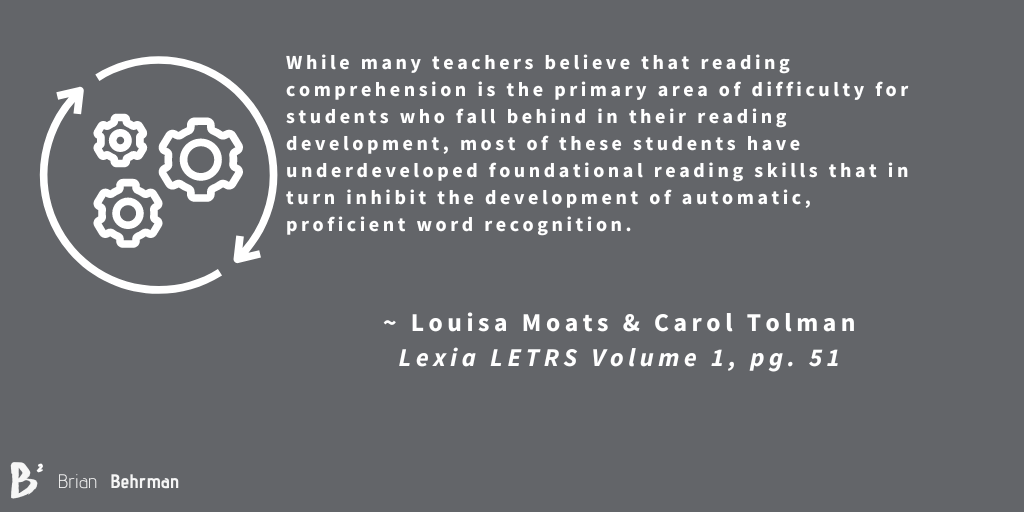
One thing that I see at times when talking with teachers of struggling readers is a focus on their inability to comprehend their reading. But what is important to remember is that most of the time when a student struggles with comprehension, there is some underdeveloped skill that must be in place to get to strong reading comprehension. Instead of using interventions to support a student’s reading comprehension, we have to identify the gaps. Is there an issue with their phonological awareness or phonics skills that impact their comprehension? Or does the student lack key vocabulary? Or could there be a lack of background knowledge in the reading topics?

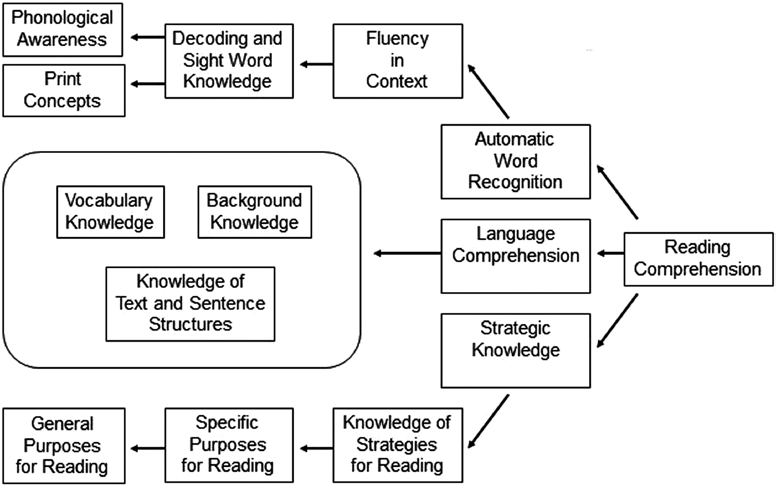
To help us understand where a student is in their reading progression, tools like The Cognitive Model of Reading Assessment (see below, created by Michael McKenna and Katherine Stahl) is a great tool to think of the skills that build solid reading comprehension. I like to think of the skills as building on one another. If I have a student who is struggling with reading fluency, then The Cognitive Model reminds me that maybe the underdeveloped skill is actually in decoding and sight word knowledge. This would impact the type of intervention I might want to use for a student, as well as what my progress monitoring tool might be. If I want to identify more specific needs, I might use a diagnostic tool such as the Phonological Awareness Screening Test (PAST) or some form of a letter naming and word reading survey (LETRS has one included in their assessment resources).

McKenna & Stahl (2009)

Ultimately, we need to remember that the thing we think is the issue is not always the issue. Often, there are underdeveloped skills that come earlier in the progression of reading skills that will lead to the struggles that we see right now.

Think about a student in your class. What is the thing that they seem to be struggling with? Take a look at the cognitive model, and think about the areas that come earlier. Could you do a quick formative assessment on that skill to see if there actually are gaps there that are impacting the reading comprehension? If so, you need to take a step back on the progression. Share with us what you are thinking about as you reflect on the students you serve. Share with us how it might impact your next steps with that child.

Reading comprehension strategies aren’t the point

As I continue to learn, I find myself spending more time reflecting on the teaching practices I used when I was a classroom teacher. Many times, I think back to a practice I used and realize that I wouldn’t do the same if I were to go back into a classroom teacher position. Today, I was specifically thinking about the way I taught reading comprehension when I was a sixth-grade teacher.

As a new teacher, I frequently searched for ways to enhance my teaching skills, particularly regarding the teaching of reading. I found two books, which I read and utilized often, that helped me in teaching students how to comprehend what they were reading. These books were Guiding Readers and Writers: Teaching Comprehension, Genre, and Content Literacy and Teaching for Comprehension and Fluency: Thinking, Talking, and Writing About Reading, K-8, both authored by Irene Fountas and Gay Su Pinnell. These books significantly influenced my teaching methods for several years, especially when teaching intermediate grade students.

While it would be hard to name a single takeaway from these texts, one of the things that was influenced by these books was the way I thought I needed to teach reading comprehension. I would teach reading comprehension as independent strategies that a reader might just pull out and utilize at the correct moment. When I taught this way, I might choose one text and use it to learn about the main ideas and supporting details. Then I might select another text to work on inferencing. This may sound familiar to any of you who have been in the education realm in the past 30 years (or possibly more!).

This was the primary work that I did to teach comprehension. It seemed like the strategies were the key to comprehension, so we would cycle through lessons in small group, whole group, guided reading, etc. Then last fall, I read the newest version of Shifting the Balance: 6 Ways to Bring the Science of Reading into the Upper Elementary Classroom by Katie Egan Cunningham, Jan Burkins, and Kari Yates. If you are an upper elementary/intermediate grade teacher, I think this is a highly accessible text for you to learn more about The Science of Reading. It does a great job of distilling some of the timeliest research into a format that teaches you a bit about the science behind a shift, and then gives suggestions for new practices.

But, if you’re like me, be prepared to have moments when you begin to doubt what you thought you knew about teaching reading. For me, the first moment (but not the last) came when I got to page 43, Shift 2: Rethinking the Role of Strategy Comprehension in Learning to Comprehend. If you go back a couple of paragraphs to my description of teaching comprehension strategies, I think there was a part of me that believed the teaching of the strategies was the teaching of comprehension. So, when I read this quote from the work of Nell Duke, Alessandra Ward, and P. David Pearson, I had a moment of guilt that I think many of us have when we learn that what we thought was a great practice might not have been so great based on more current research:

What I have now learned is that while those strategies may help with comprehension, by themselves it’s not enough. In addition to those strategies, readers need so much more. Those things include “vocabulary knowledge, executive function skills, working memory, familiarity with language structures, knowledge of text structures, verbal reasoning, and motivation” (Cunningham, Burkins, and Yates, p.44-45).

As a classroom teacher, what are we to do? How can we engage those other skills? I’m definitely not telling you to go throw out any lesson you’ve done in the past on comprehension strategies, because students need to be introduced to those skills. But, just as the purpose behind a systemic and explicit structure literacy program is to help students get to automaticity in their decoding of words, providing readers with the right strategies will help them get to automaticity in comprehension and fluidly move between different strategies to become proficient readers. I really like the kid-friendly language that Cunningham, Burkins, and Yates use to describe what they call “The Strategic Six.” Here are some thoughts on what might help your students move toward proficiency (the headings below come from the intermediate version of Shifting the Balance):

  • Switch on What You Know (Activate Prior Knowledge) – We might teach this skill by engaging in a pre-read of a text. This might involve looking at headings, titles, pictures, and diagrams. Help students ask themselves “What do I already know about this?” (Or maybe, what don’t I know).
  • Map the Text (Notice Structures) – As you do the pre-read, what do you notice about the text? Are there patterns? Section headings or chapter titles that might help you know what to expect? In a fiction piece, who is the narrator? From what point of view is the story told?
  • Keep a Close Eye on Comprehension (Monitor and Clarify) – This is all about metacognition and being aware of our own thinking. This means paying attention to our thoughts as we read. If something doesn’t make sense, where did it break down? Do I need to reread? Slow down? Fix-up strategies like this help improve comprehension.
  • Dig Below the Surface (Ask and Answer Questions) – Long ago, I came across an old comprehension model called SQ3R. This stands for Survey, Question, Read, Recall, Review. During a pre-read (survey), you might jot down a few questions you think could be answered while you are reading. As you read, you monitor your thinking looking for answers to those questions. Then, you go back to your questions and see if you can answer them based on the reading you just did. Finally, you check your answers by going back to the text. This helped my students develop the skill of asking questions prior to and while reading.
  • Fill in the Missing Pieces (Infer) – When we think about inferences, it’s often about the conclusions we draw based on previous experiences. We make inferences all the time. Imagine walking into your home, you see dirty dishes in the sink, the mixer is out on the counter, along with a mess of flour and dough, and you can smell that something is baking. You may not be able to see what, but you know that your daughter is making chocolate chip cookies because she likes baking and is the only one at home. This is an inference. Once students understand that using clues to understand what’s happening is inferencing, they will notice their inferences all the time! An activity that I have seen used is the paper bag mystery person. You can do this, or you can ask students to create their own. In one example you might have a bag with a pair of running shoes, a medal from a 5k, a number bib from a half marathon, and a pair of socks. As you share the items have the students make an inference about the person by creating a list. More items will likely lead to more specific inferences.
  • Sum up the Core Ideas (Summarize) – As students are reading, they should be thinking about some of the key details. In a narrative, this might involve the setting, key characters, the problem and solution, and what happened at the end of the story. If you’re looking for a way to support this, you might consider story frames. Reading Rockets has a couple of great graphic organizers to support this. Here is one option, and here is another. For nonfiction reading, you might use a concept map like this for students to identify main ideas and key details. These tools will support students in thinking about what the key details are that they need to share a meaningful summary.

This is not the end-all, be-all list of important things students “need to know” to comprehend their reading. You might find a dozen other blogs with a dozen other thoughts, but the ideas listed above are supported by research as high-leverage ways to help grow reading comprehension in our students.

As I’ve shared before, the goal of reading should always be to comprehend. But we must remember that proficient readers will use a variety of strategies with automaticity based on their needs while they read. Comprehension is not the use of a single strategy, rather it’s an active and ongoing process that might involve shifting between several different strategies to help with comprehension. This is why teaching strategies in a stand-alone format with a specific text is not the only way to practice our comprehension skills.

What are your thoughts on this topic? Have you been teaching strategies thinking that would help your students learn to comprehend? What is something new you can commit to trying as a result of your reading today? Share with us in your comments below, or have a conversation with your PLC team about how you might be able to integrate some of these thoughts into the work you do in your classroom.

The purpose of reading (part 4)

The purpose of reading (part 4)

Over the last couple of months, my posts here have been focused on the primary purpose of reading. In the first post, I shared that in my belief, the ultimate reason we teach our students to read is so that they can learn how to comprehend text (you can see that first post here). Then over the course of that post, along with part 2 and part 3, I dug into a few of the key concepts that students need to be able to do in order to read with solid comprehension. As a reminder, the 4 key things that students need to be able to do to comprehend what they read is to:

  • Read the words accurately and fluently.
  • Understand the meaning of the words.
  • Have adequate background knowledge.
  • Focus attention on critical content.

In the first 3 posts, we dug into those first 3 concepts. Today’s post is going to primarily be thinking on how we help students to focus on critical content. Much of my thinking around these four concepts comes from a session led by Anita Archer on reading comprehension that I attended while at The Reading League National Conference in Syracuse this fall. She created a checklist for teachers to know what skills students need to so that they can accomplish each of the 4 key things listed above. Here’s the checklist related to focusing on critical content:

  • Ask questions on critical content as we read books to students.
  • Ask text-dependent questions as students are reading text.
  • Have students generate questions on passages they read.
  • Teach text features, both narrative and informative.
  • Use retrieval practice procedures to review key content.
  • Have students write in response to passages.

The first thing that I note as I look over this list, is that as the teacher, we must be prepared in advance with a knowledge of the text. If we want to help our students focus on critical content, we must pre-read a text so that we know what content is critical. During that pre-read, it’s a great time to mark key passages that you might want to ask a question about, and ideally plan what that question might be.

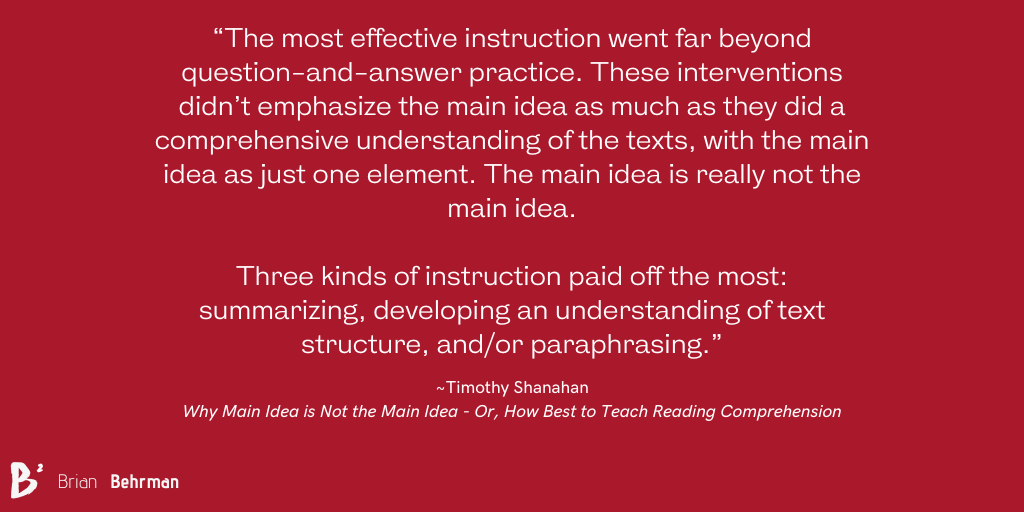
But that last bullet point that you see above regarding writing responses was reiterated in a recent blog post by Timothy Shanahan. A key point that I pulled from that post is:

So, as we are reading to our students, or as our students are reading independently, we need to be able to ask questions that guide and monitor students’ comprehension (that’s what the National Reading Panel said back in the year 2000). Ideally, those questions we ask should be text dependent – in other words, students must also provide evidence from the text to support their answers (I used to call this “Back your Smack” when I was a classroom teacher). We want to be sure that our students have read the text!

But at the same time, it is valuable for our students to develop their own questions as they are reading. They might choose to ask questions about the main character, the setting, the problem in the story and how it was solved, or what happened in the end. We want to be sure that students learn to ask questions like the ones we’d ask – in other words, they must ask questions that can only be answered if you have read the text. This could also be a great time to teach students about Depth of Knowledge – to help them learn about the different types of questions that exist, and how they might develop questions with higher levels of thinking.

But let’s get into some of what Shanahan was getting at in his post – focusing on those reading comprehension strategies that we often teach as a stand-alone skill do not always support our students in learning to comprehend what they read better. What we’re learning as more research studies are shared is that while there is “nothing wrong with asking questions about what the kids have read, just don’t expect such practice to exert much impact on the ability to deal with specific question categories, nor even to have any impact on reading comprehension.” (Shanahan, 2023).

In the quote in the graphic above, Shanahan suggests that summarizing, developing an understanding of text structure, and/or paraphrasing are much more impactful in growing student comprehension. And that makes sense to me – to do any of those things, readers are required to think deeply about a text, which is certainly going to improve reading comprehension.

So what does that mean in practice? We often talk about how readers are writers, and writers are readers. One thing you might consider implementing with your students is a protocol for writing about the text we’re reading. Not just making connections, but truly thinking about pieces of the text structure – things like the setting, who the main character is, what is the character’s problem/conflict/goal, how does the character comes to a resolution, what happened in the end of the piece, and what are the themes.

To develop these skills with students, you might start with partners doing a shared retell – maybe partner A defines the setting of the story, the main character, and the problem, while partner B shares about the beginning, middle, and end of the story and the eventual resolution of the problem. Through verbal practice, collaboration, and feedback, students will learn how to then craft their own summary. Over time, you might then work towards having students work collaboratively on developing a summary of the story. Creating a list of sentence stems might help in this process. Some ideas for what that might look like include:

The problem that exists with much of our question-and-answer strategies of stand along comprehension skills is that really, all it’s doing is testing a student’s recall of the test. This is something we’d do for an assessment, not a strategy for teaching a student how to comprehend. Through our guidance, we can help our students to analyze what it is they read. This analysis forces our students to dive back into the text, to reread, and to think deeply about what the text is really saying. These thinking skills will support comprehension much more than basic question and answer skills.

Have you ever utilized written or spoken responses in your class? How has it supported your students in developing their comprehension skills? Do you have any new ideas from what’s shared above? Let us know a bit about your thoughts in the comments below!

The purpose of reading (part 3)

In recent posts, I’ve really been focused on how we move our students from the stage of understanding phonemic awareness, phonics, and decoding across the bridge to reading comprehension. Ultimately, the purpose of reading revolves around understanding what it is that we read. That means helping to develop students who are fully literate – able to both read and write fluently. In part 1 (found here) I dug into the purpose of reading, some of the work from Anita Archer around the 4 things all students must be able to do in order to comprehend what they read, and then some ideas about how we make sure that our students are reading fluently.

In part 2 (found here) we looked at the importance of helping our students develop a wide vocabulary. One of the ways we do this is by teaching vocabulary explicitly. That post walks through what an explicit vocabulary routine might look like.

Today’s post is going to dig into the importance of adequate background knowledge. Let me share an example of how background knowledge impacted me recently. I consider myself to be a pretty fluent reader. When I run into vocabulary I don’t know, I have lots of tools to help fix that problem. But a few weeks ago, my daughter had a reading assignment for her biology class. She asked me to help her out a little bit. The article was a 4-page research piece on slime molds. As a former science teacher, I felt like this was something I could definitely help with.

Then I started reading. I clearly did not have enough background knowledge. I was able to read the article quickly, but I could not understand much of what was happening. I was lacking the necessary background knowledge to be able to truly comprehend what the article was saying. After sitting with the article for an hour, googling some terms, and doing some additional research, I was able to build enough schema to truly help my daughter with her assignment.

The moral to this is that even for our fluent readers, if they don’t have the appropriate background knowledge, they will not be able to comprehend the things that they have read.

But what does the research say about background knowledge?

While doing some research for this post, I read about a study that was done that took readers with a wide variety of reading abilities based on fluency and comprehension screeners. All readers read an article about baseball. No matter a student’s ability, the readers who already had background knowledge about baseball scored higher on the comprehension measures. Having background knowledge of the topic built a schema that impacted comprehension more than their reading ability.

With this knowledge in mind, Archer suggests there are some things we can do to be sure to build more background knowledge for our readers:

  1. Read informative read-alouds, especially in the primary grades, including a variety of books on similar topics to build a knowledge network.
  2. Directly teach science, social studies, and health.
  3. Promote wide independent reading
  4. Directly teach critical background knowledge before reading a passage

So, how might we go about directly teaching that critical background knowledge? Well, first of all, as the teacher, we have to be sure we have pre-read the passage. This allows us to identify key knowledge that our students will need to understand. A few of the things you want to be sure to call attention to might include:

  • Is this a fiction or non-fiction piece?
  • If there are characters, who are they? Introduce their identity and some basic information (gender, age, etc.).
  • What is the setting? Describe the time and place. You might show the location on a map or globe, and then zoom in using something like Google Maps.
  • This would also be an excellent time to include key vocabulary from the story. When teaching these words, if you can pull pictures that help build the background knowledge, that can support vocabulary development.
  • If the setting is from a different period, do we need to provide some background knowledge about how people lived at that time?
  • Finally, you might wrap up this section of building background knowledge with some retrieval practice. You might ask students “What are some things you have learned about…?” Since we want everyone to do everything, you might first have them write a few ideas down on a whiteboard or sheet of paper. Then you could partner students up and have them take turns sharing using the sentence stem “One thing I learned about…”

By helping our students build solid background knowledge prior to reading, we help set them up to be able to better comprehend the things they read. What are some of the ways that you go about helping to build background knowledge for your students? Share your methods and ideas in the comments below!