The purpose of reading (part 2)

In last week’s post, I began to really dig into the concept of the purpose of reading. With our work around Science of Reading, we have really spent a lot of time, especially in our early grades, focused on structured literacy and skills like phonemic awareness, phonics, and decoding, but as Natalie Wexler reminds us:
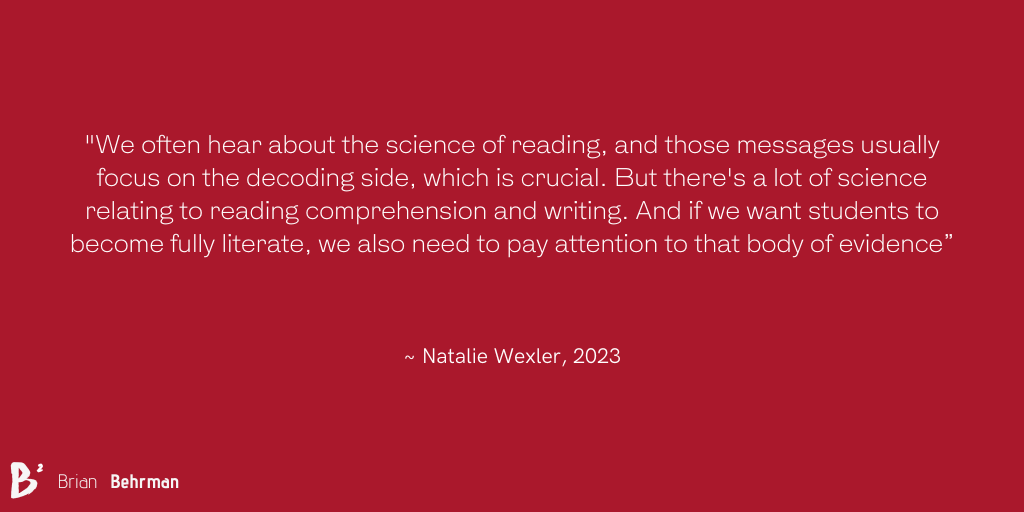
What I was focused on in my last post (which you can see here) is digging into the idea that the ultimate purpose of reading is to comprehend the words that are on the page. At a conference I recently attended, Anita Archer shared the four things that all students must be able to do in order to comprehend:

  • Read the words accurately and fluently.
  • Understand the meaning of the words.
  • Have adequate background knowledge.
  • Focus attention on critical content.

Last week, I focused on the idea of accuracy and fluency. Today I’ll be digging into the idea of understanding words. In future posts, we’ll dig into building background knowledge and focusing on critical content.

As you know, I always love to understand the why behind what we do, so what does the research say about understanding the meaning of the words in relation to comprehension? I think we can all agree that vocabulary is related to reading comprehension. In fact:

“…one of the most eduring findings in reading research is the extent to which students’ vocabulary knowledge relates to their reading comprehension.”

~Osborn & Hiebert, 2004

I think we’d all agree that for our students to be able to read fluently, they need to know the words that they are reading. When our students don’t know the meaning of a word they are decoding during text reading, they must use context to figure out what the words mean. This added cognitive load takes away from fluency – one of the things that must be in place for solid reading comprehension.

There are several ways we can make sure that our students have that strong foundation in their vocabulary. Anita Archer suggests the following checklist to help build vocabulary:

  1. Use high-quality classroom language.
  2. Consistently use academic language.
  3. Read narrative and informative read-alouds in primary grades.
  4. Promote wide independent reading.
  5. Teach word learning strategies (context clues, morphemes, and resources like dictionaries, thesauruses, etc.).
  6. Explicitly teach critical vocabulary terms.

Over the years, I’ve spent time sharing about the work of John Hattie. His research says that vocabulary programs have an effect size of 0.67 (that’s pretty high, and definitely above the “hinge” point). In fact, Bob Marzano says:

“Direct vocabulary instruction has an impressive track record of improving students’ background knowledge and comprehension of academic content.”

So, what might a vocabulary instructional routine look like? This is the format that Archer suggests – just like with any other part of the five pillars of reading, it should be systematic and explicit. To do that, we should introduce the word, introduce the word’s meaning, illustrate the word with an example (and non-examples when it’s helpful), and then check for understanding. Let me take you through those steps a little more in-depth:

Step 1: Introduce the pronunciation of the word: You should display the word in some way, maybe on the screen, written on the board, or on chart paper. Then, read the word to the students and have students repeat it. With multi-syllabic words or more difficult words, repeat it several times. You might also have students read the word by parts, tap the word, etc.

Step 2: Present a student-friendly explanation: Tell the students an explanation, or have the students read an explanation with you. This might include using the word in a sentence, providing synonyms or antonyms, etc.

Step 3: Illustrate the word with examples: You might use concrete examples like having an object or acting the word out. You might use a visual example like an image or picture. Or you might use a verbal example to explain the word.

Step 4: Check students’ understanding: You might choose to do this in a few ways. You could ask deep processing questions, give the students think time, and then ask partner A to tell partner B. You might have students discern between examples and non-examples, so you might share a sentence and then ask students to say whether it is an example of the word or not. A third way you might check for understanding is to have students compare the vocabulary term with another term. You might have partner A share examples of ways the words are similar, and partner B share examples of ways the words are different.

Linnea Ehri tells us that if words have been read before and stored in memory, prediction strategies are not required for a reader to decode. When we can introduce difficult vocabulary words to our students in an explicit way before teaching, then our readers are better able to focus on their primary task in reading, comprehension.

What strategies have you tried in building vocabulary with your students? What has worked well? What hasn’t? Let us know your thoughts in the comments below!

What is the purpose of reading?

In the past few months, I have been deeply engaged in learning a lot about reading. What it takes to support our students in their reading growth, how do we create a foundation for learning to read, how do we assess where our students are as readers, and what do we do when a student is struggling. But even with all that learning, I don’t think I’ve taken a lot of time to reflect on the true purpose of reading. What would you say if you were asked? Pause and reflect on that for a second…

There are several things you might say. Some of the ideas that pop into my head have to do with gaining information about a topic, connecting information in the text to knowledge the reader already has or for the purpose of entertainment. Personally, I love to sit down with a good book and get lost in the words on the page, although I know this is not the case for everyone. But I think we can all agree that whether or not a reader sees reading as a joyful task, it is definitely a necessary task. Ultimately though, whatever the purpose of reading may be, it’s meaningless without comprehension of the words on the page.

In a recent post, I shared a little of what I had learned from Pamela Snow during my time at The Reading League’s Annual Conference (you can see that post on the connection between oral language and literacy here). But her presentation went even deeper than that connection, it also dug into the importance of comprehension in reading. She shared the following about reading comprehension:

Comprehension will suffer if a word has been incorrectly recognized, if the text includes words that are not in the reader’s oral vocabulary, if the linguistic structure of the text is overly complex, or if the topic of the reading material is so unfamiliar that the reader cannot make inferences (“read between the lines”) that are necessary to understanding the text. (Emphasis added by Snow)

Snow, Scarborough, & Burns (1999). What speech-language pathologists need to know about early reading. Topics in Language Disorders, (20)1, 48-58. (p.51)

While I agreed with the concepts of this statement and much of what Snow shared during her presentation, I was left hoping for a bit more on the how. I get the why of reading comprehension, but what can we do in practice to support readers in this area? That’s why I appreciated the afternoon session I attended that same day with Anita Archer. Her session that afternoon was titled Comprehension is an Outcome, not a Strategy. I’ll be honest, I wasn’t immediately familiar with Anita Archer’s name, however, I was mesmerized by her presentation. First, any presenter who can keep a room full of adults fully engaged for an entire one-hour presentation has my utmost respect. Most of the time I’m at a conference, I find myself tweeting out (X-ing out now… that just doesn’t have the same ring!) highlights of almost any session I’m in. I didn’t tweet once during this session. Not because there was nothing worthy of sharing, but because I was so engaged I didn’t want to look away. If you ever have the opportunity to hear Archer in person, you should absolutely take it!

Archer’s simple definition of comprehension is the act of understanding what you have read. But as educators, what do we need to do to make sure this happens? In Archer’s opinion, there are 4 things that all students must be able to do. The student:

  • Reads the words accurately and fluently
  • Understands the meaning of the words
  • Has adequate background knowledge
  • Focuses attention on critical content

What I loved about the presentation was that for each of these sections, she gave a little information on the research of why that skill is important, a checklist of things that we as educators should do to make sure that our readers are able to carry out these skills, and then a way you might go about teaching at least a piece of that skill. Today’s post is going to dig into the way we make sure that our students can read the words accurately and fluently.

First, though, why is this important? Here are a few pieces of research that help explain why our students need to read accurately and fluently:

Cognitive science has shown beyond a doubt that fluent, accurate word recognition is a hallmark of skilled reading with comprehension.

Adams, 1990; Rayner et al., 2001

…poor readers are almost always limited by their ability to use letter-sound skills (e.g., phonics skills) to identify unfamiliar words.

Ehri, 1998; Rack, Snowling, & Olson, 1992

Based on this research, it is imperative that ALL students get to the point of reading fluently and accurately. And it’s also important to remember that reading fluency is about more than just the rate of reading. There are actually three key aspects of reading fluency: Accuracy (decoding and recognizing words correctly), Rate (the pace of reading), and Prosody (use of intonation, stress, and phrasing). But how do we help all our students read fluently? Archer put together a checklist of what we should think about in order to be sure that our students have these skills (and it’s important to remember that these skills apply to all grade levels). If we are committed to making sure that all our students can read accurately and fluently, here are the things that Archer suggests we must do at our school:

  • Teach foundation skills to ALL students to mastery (print skills, phonemic awareness, letter-sound associations, decoding, fluency)
  • Teach advanced decoding of multi-syllabic words
  • Provide systematic interventions on foundational skills for struggling readers
  • Preteach the pronunciation of unfamiliar words before passage reading

A huge part of fluency instruction revolves around modeling, practice, and feedback. Strategies that can support fluency in reading might include scaffolded repeated reading, choral reading (teacher and class read together), echo reading (teacher or partner reads a sentence, and then students read the same sentence), recorded reading (have students record themselves reading a passage, then listen and self-reflect), read-alouds, and performance reading (like a reader’s theater).

When choosing to use a passage for repeated reading or any fluency work, previewing the text as the teacher is important. Are there print structures that might be difficult for students? Are there multi-syllabic words that students need support in decoding? Are there words that students might need to have pronunciation modeled? Once you identify those challenges, take a moment to pre-teach those structures or words. For pronunciation practice, you might read the word, show it to students, and have the class echo it back to you.

When we take the time to practice fluency routines, we set students up for success. When students are more successful in their fluency, they are able to better comprehend their reading. As you begin working toward that purpose of helping your students read more fluently and accurately, you are bound to notice higher levels of comprehension.

What are some of the specific things that you have found support the fluency work in your classroom? Do you have favorite tools or activities? Share with us in the comments below!