
It’s hard for me to believe it, but I have been writing this blog for almost 10 years. In that course of time, some topics might inevitably come up again. A recent social media post prompted me to reflect on the power of relationships in learning. That led me to look back at a post I wrote about 4 years ago titled “The Warm Demander” (you can see it here). I think there are a lot of ideas from that post that I still feel pretty good about, but I wanted to dig a bit more into the research on relationships in the classroom. That’s what I hope to do today, but first, I want to share how I got to this topic.
Recently, I came across a post from one of those educational social media groups that post a lot of memes – you probably can visualize what I’m talking about. Sometimes they are funny, sometimes they are inspirational. On that day, they shared a graphic that said that children learn best when they like their teacher and their teacher likes them. Now, I do not disagree with this statement on its face, but I think some nuance is missing in a post like this.
Let me start by saying that I’m an educator who strongly believes in the importance of solid relationships with my students. By truly knowing them, I can draw on what I know about each child to maintain engagement or use a personal connection to address lagging motivation. At the same time, if you were to talk with my former students, most would likely share that I was one of the “strict” teachers. They would say this because I held high expectations for my students. I gave them honest feedback on the expectations we had, and would either celebrate with them when they found success or provide the scaffolding they needed to move towards it.
That brings me to the lie I’d like to address today: that building relationships and fostering emotional safety must come first. Content can wait until students feel seen. However, I want to emphasize that high expectations and relationship-building are not mutually exclusive; they can and should be integrated simultaneously. When we withhold challenge until a student feels “safe,” we are (unintentionally) signaling low expectations, which can hinder learning and growth.
Now, some people might point to the work of Lobo et al. (2024) as proof that being responsive to children leads to positive outcomes. While relationship responsiveness is important, research also shows that high expectations and rigorous content are critical for academic achievement. The key is not choosing between relationships and standards but understanding that both, when combined, create a more effective learning environment.
In his book Teach Like a Champion 3.0, Doug Lemov refers to this type of teacher as Warm/Strict. Drawing from the research of Zaretta Hammond (whom I referenced in my past “Warm Demander” post), this type of teacher combines personal warmth with high expectations and “active demandingness.” This is an insistence on excellence and academic effort for our students.
Failure in this looks like lowering our standards for the students out of a desire to be liked. Hammond would refer to this type of teacher as the “sentimentalist.” These teachers mean well, but unknowingly choose the short-term benefit of students who like them over the long-term success of our students. Sentimentalism also breeds learned helplessness in our students because when things get hard for our learners, we swoop in to provide them the solution, taking away the important thinking and recall necessary for students to truly learn. This then shows up in the data for these students, where they don’t grow as readers or mathematicians on benchmark and/or state assessments.
Wubbels, T. et al. (2012) share in “Interpersonal Relationships in Education” that decades of research suggest that teachers who combine warm relationships with high expectations achieve the greatest learning outcomes for students. A key point to remember here, though, is that Wubbels’ research is based on both teacher AND STUDENT perception of warmth. In other words, students must feel that the environment is warm. That means that we (educators) must listen to what our students say about both relationships and expectations. Think about it like a classroom culture survey – are we listening to what our students have to say about the environment?
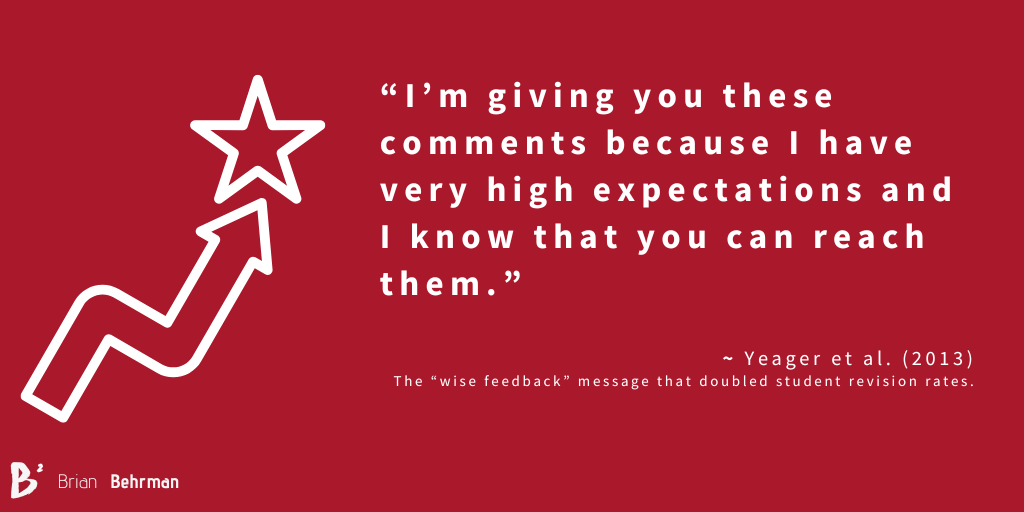
Yeager, D.S. et al. (2013) researched ways to help students listen and apply feedback. The method that showed the most promise was called “wise feedback.” With this strategy, the message shared with students was “I’m giving you these comments because I have very high expectations and I know that you can reach them.” This method showed particularly high results among students who may have felt more mistrustful of school. This study focused on providing feedback to students from the first draft to the final draft of an essay. 64% of students who received this comment as part of their feedback actually revised their work based on it. That compared to only 27% of the students in the group that did not receive this comment.
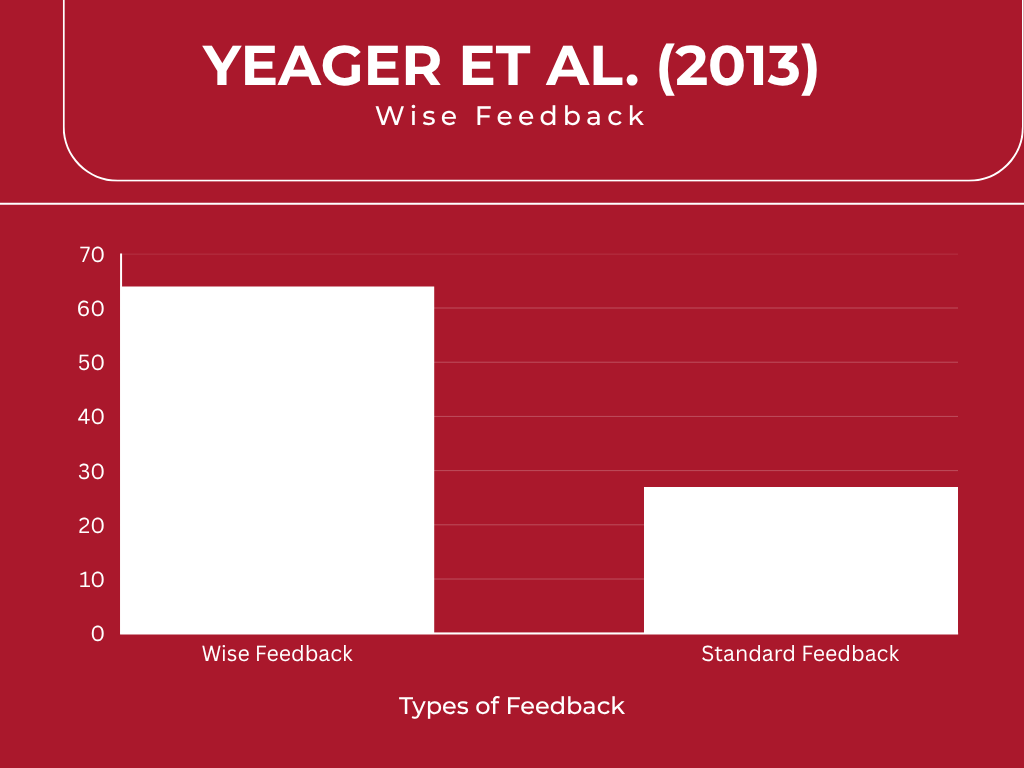
What’s the implication for practice? This research suggests that high expectations, clearly communicated, is an example of a relational act. Students learn that you believe in their ability to learn and grow in the skills that you are teaching them. On the other hand, withholding challenge while waiting to build “safety” can actually communicate the opposite to our learnings – that you don’t believe they are ready to or capable of meeting the standard.
And one of the things that I’ve noticed over my many years of visiting the classrooms of others is that often, as educators, we overpraise mediocre work to boost a student’s self-esteem. This confirms low expectations for a student who knows they don’t meet the standard.
But when I think about the classrooms that really seem to nail the warm demander concept Hammond writes about, I notice some things. First of all, both the teacher and students are happy to be in the classroom. It’s a place we all want to be. Next, there is an intention and focus around the idea that “we have hard work to do, but we’ll do it together.” Finally, I find that a growth mindset prevails among everyone in the classroom. Failure is an option here because it’s part of the learning journey, and because everyone knows the support needed is right there in the classroom.
Again, I am NOT saying that relationships don’t matter – you’ll find that all the research shared above suggests that they do! Rather, I’m saying that relationships can actually be built with our students through our high expectations. Our students are more likely to meet those high expectations when they feel safe, seen, and supported. The key caveat is that this process happens simultaneously, not sequentially.
What has this post caused you to think about regarding building relationships with your students? What might you do differently at the beginning of next school year? Let us know your thoughts in the comments below.

