The Classroom Lie Series: Relationships Come First

It’s hard for me to believe it, but I have been writing this blog for almost 10 years. In that course of time, some topics might inevitably come up again. A recent social media post prompted me to reflect on the power of relationships in learning. That led me to look back at a post I wrote about 4 years ago titled “The Warm Demander” (you can see it here). I think there are a lot of ideas from that post that I still feel pretty good about, but I wanted to dig a bit more into the research on relationships in the classroom. That’s what I hope to do today, but first, I want to share how I got to this topic.

Recently, I came across a post from one of those educational social media groups that post a lot of memes – you probably can visualize what I’m talking about. Sometimes they are funny, sometimes they are inspirational. On that day, they shared a graphic that said that children learn best when they like their teacher and their teacher likes them. Now, I do not disagree with this statement on its face, but I think some nuance is missing in a post like this.

Let me start by saying that I’m an educator who strongly believes in the importance of solid relationships with my students. By truly knowing them, I can draw on what I know about each child to maintain engagement or use a personal connection to address lagging motivation. At the same time, if you were to talk with my former students, most would likely share that I was one of the “strict” teachers. They would say this because I held high expectations for my students. I gave them honest feedback on the expectations we had, and would either celebrate with them when they found success or provide the scaffolding they needed to move towards it. 

That brings me to the lie I’d like to address today: that building relationships and fostering emotional safety must come first. Content can wait until students feel seen. However, I want to emphasize that high expectations and relationship-building are not mutually exclusive; they can and should be integrated simultaneously. When we withhold challenge until a student feels “safe,” we are (unintentionally) signaling low expectations, which can hinder learning and growth. 

Now, some people might point to the work of Lobo et al. (2024) as proof that being responsive to children leads to positive outcomes. While relationship responsiveness is important, research also shows that high expectations and rigorous content are critical for academic achievement. The key is not choosing between relationships and standards but understanding that both, when combined, create a more effective learning environment.

In his book Teach Like a Champion 3.0, Doug Lemov refers to this type of teacher as Warm/Strict. Drawing from the research of Zaretta Hammond (whom I referenced in my past “Warm Demander” post), this type of teacher combines personal warmth with high expectations and “active demandingness.” This is an insistence on excellence and academic effort for our students.

Failure in this looks like lowering our standards for the students out of a desire to be liked. Hammond would refer to this type of teacher as the “sentimentalist.” These teachers mean well, but unknowingly choose the short-term benefit of students who like them over the long-term success of our students. Sentimentalism also breeds learned helplessness in our students because when things get hard for our learners, we swoop in to provide them the solution, taking away the important thinking and recall necessary for students to truly learn. This then shows up in the data for these students, where they don’t grow as readers or mathematicians on benchmark and/or state assessments.

Wubbels, T. et al. (2012) share in “Interpersonal Relationships in Education” that decades of research suggest that teachers who combine warm relationships with high expectations achieve the greatest learning outcomes for students. A key point to remember here, though, is that Wubbels’ research is based on both teacher AND STUDENT perception of warmth. In other words, students must feel that the environment is warm. That means that we (educators) must listen to what our students say about both relationships and expectations. Think about it like a classroom culture survey – are we listening to what our students have to say about the environment?

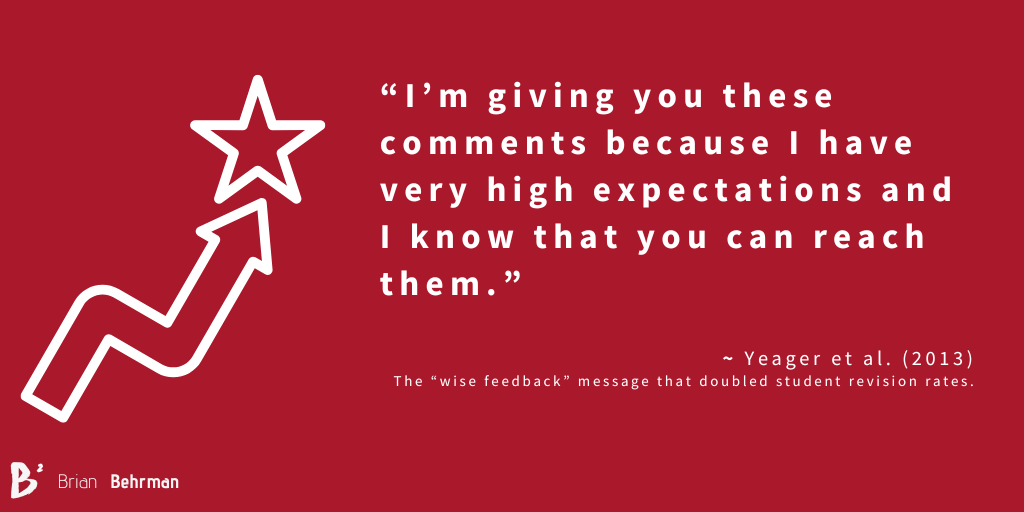
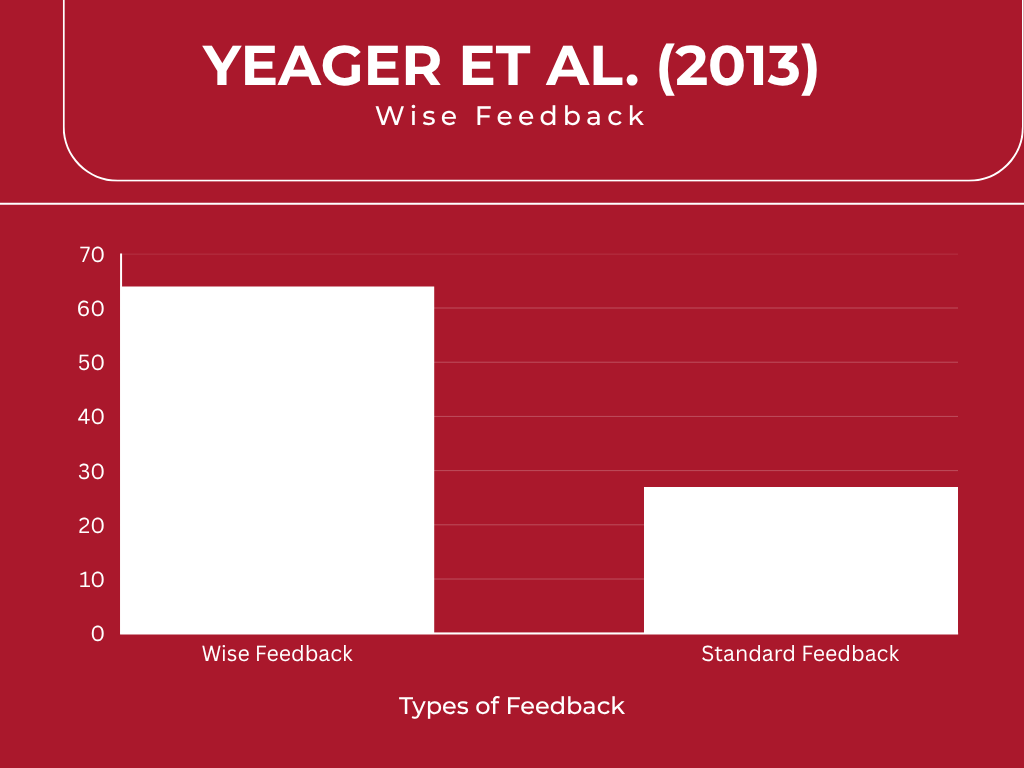
Yeager, D.S. et al. (2013) researched ways to help students listen and apply feedback. The method that showed the most promise was called “wise feedback.” With this strategy, the message shared with students was “I’m giving you these comments because I have very high expectations and I know that you can reach them.” This method showed particularly high results among students who may have felt more mistrustful of school. This study focused on providing feedback to students from the first draft to the final draft of an essay. 64% of students who received this comment as part of their feedback actually revised their work based on it. That compared to only 27% of the students in the group that did not receive this comment.

What’s the implication for practice? This research suggests that high expectations, clearly communicated, is an example of a relational act. Students learn that you believe in their ability to learn and grow in the skills that you are teaching them. On the other hand, withholding challenge while waiting to build “safety” can actually communicate the opposite to our learnings – that you don’t believe they are ready to or capable of meeting the standard.

And one of the things that I’ve noticed over my many years of visiting the classrooms of others is that often, as educators, we overpraise mediocre work to boost a student’s self-esteem. This confirms low expectations for a student who knows they don’t meet the standard. 

But when I think about the classrooms that really seem to nail the warm demander concept Hammond writes about, I notice some things. First of all, both the teacher and students are happy to be in the classroom. It’s a place we all want to be. Next, there is an intention and focus around the idea that “we have hard work to do, but we’ll do it together.” Finally, I find that a growth mindset prevails among everyone in the classroom. Failure is an option here because it’s part of the learning journey, and because everyone knows the support needed is right there in the classroom.

Again, I am NOT saying that relationships don’t matter – you’ll find that all the research shared above suggests that they do! Rather, I’m saying that relationships can actually be built with our students through our high expectations. Our students are more likely to meet those high expectations when they feel safe, seen, and supported. The key caveat is that this process happens simultaneously, not sequentially.

What has this post caused you to think about regarding building relationships with your students? What might you do differently at the beginning of next school year? Let us know your thoughts in the comments below.

The Classroom Lie Series: Rereading is not Studying

At home, we’ve been having some conversations with my oldest about college life. She’s a high school junior, so that’s one of the next big steps around the corner. It’s led to many memories of my time in undergrad. As I was researching this classroom lie, I found myself thinking back on the spring of my sophomore year at Indiana University. It was the weekend before finals, and my first test was my US History final. It was a class that I took with several of the guys in my fraternity. We were sitting in the formal having a review session. In front of me were my textbook, my notes, a pen, and a highlighter. At the time, studying looked like re-reading my textbook and/or notes. In retrospect, that likely left me with a false sense of security because I felt I was familiar with the material. Students and teachers (falsely) assume this is a sign of learning.


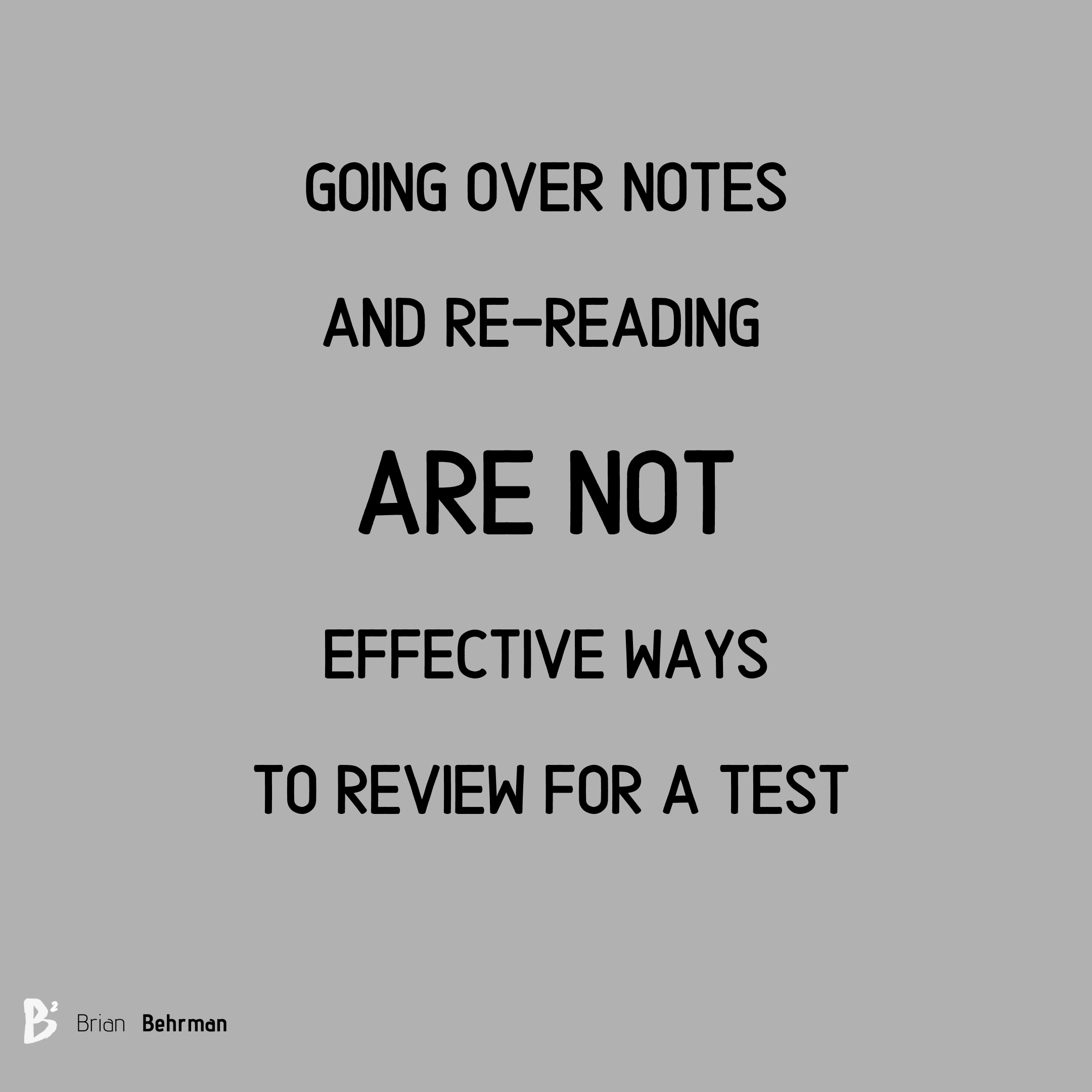
The lie we’re going to address today is that going over notes and re-reading are effective ways to prepare for a test. But the reality is that some practices have a much stronger correlation with true learning. Re-reading may help a student prepare when they are cramming, but if you check their learning at a later date, it’s likely they will have lost it. So what does the research tell us?

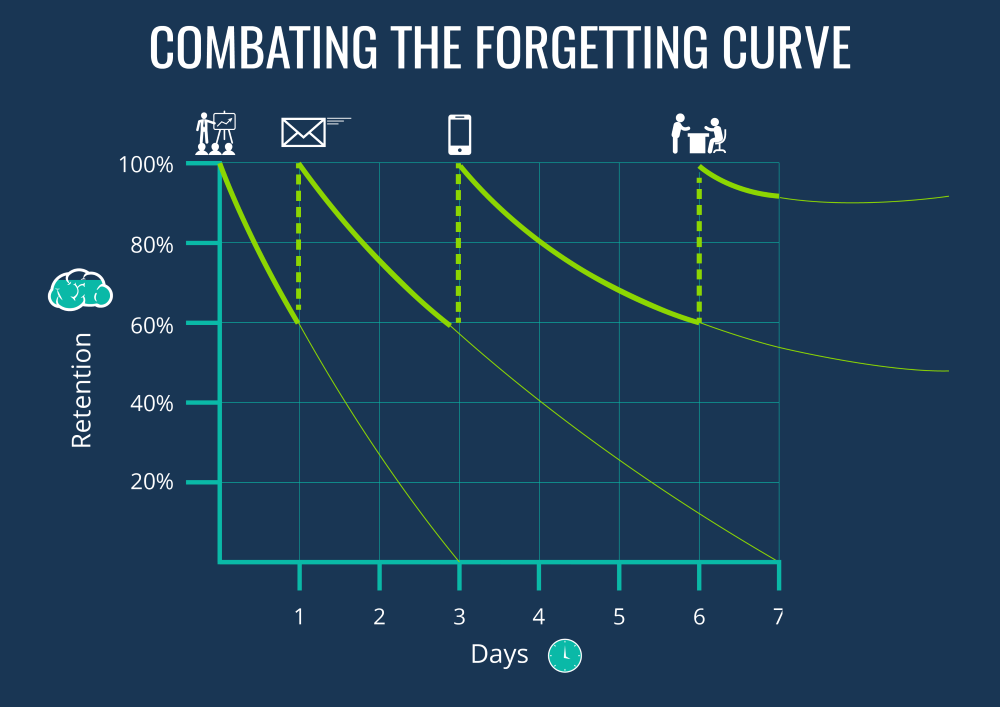
Rodiger & Karpicke (2006) shared in Psychological Science that retrieval practice dramatically outperforms re-reading on delayed tests. The main finding of the study is that if a final test was 2-7 days away, students who had one study session followed by 1-3 no-stakes quizzes were more likely to show greater retention of the learning. The longer you need to remember information, the more powerful the “Testing Effect” is. On the other hand, re-reading is much less effective for long-term memory. In last week’s post, I shared Hermann Ebbinghaus’s work on the forgetting curve.

Based on the work of Hermann Ebbinghaus – learn more at https://elearningindustry.com/forgetting-curve-combat

So if research shows that re-reading is not the best way to study, what should we do instead? There are several effective strategies that we can introduce to our students. One of the most tried-and-true methods is self-quizzing. This can be accomplished by having students create flashcards and using them to review. In teaching this strategy to our students, you might consider showing them how to place a card they got correct and felt confident with to the side, while adding ones they missed or don’t feel confident with to the back of the stack. This way, they can continue practicing the skills they don’t yet feel confident in. Students can go through their flashcards every day or two while learning the skill to build stronger neural pathways for that content. Another strategy that we can show our students is to have them partner up and ask each other the questions from the flashcard. This could be easily replicated with a family member at home.

Another way to build retrieval practice into classroom learning time could be with something like exit tickets at the end of a lesson, a warm-up at the beginning of the next day, or a “brain dump” before reopening notes or a textbook. A guiding question could be “What did we learn yesterday?” that asks students to jot down a main idea or key details from the lesson. 

As an added bonus, when our students engage in low-stakes quizzes given by teachers for review, we help reduce students’ test anxiety by building their confidence in their ability to respond to questions. This feels counterintuitive, because it’s a quiz, but when it is low-stakes and becomes routine for students, research supports it as a high-impact learning tool.

To make the switch from reviewing to retrieving, you might start small. You could have students jot down 1 or 2 things they know or recall about the topic. With time and consistent use, students will become more confident in their knowledge. Another strategy is to plan your spiral review by asking a question from learning yesterday, last week, or last month. If you build a review like this into your planning process, you could add a portion to your lesson plans of a question from this lesson for:

  • Tomorrow 
  • Next week
  • Next month

Then, when it’s time to build your warm-up or review, you pull questions from your past lesson plans.

Here’s an honest caveat: your students will continue to gravitate towards re-reading, highlighting, or underlining because they feel more at ease. But that ease is also why they don’t work as well. When something is easy, you don’t help your brain build the strong neural pathways that support true learning.

One other thing to keep in mind is that retrieval practice works best when students have enough prior knowledge of a skill to attempt to retrieve. Students who are novices at a skill won’t be able to retrieve because they can’t access information that isn’t there. If you are at the beginning of an entirely new unit, you might consider using some retrieval practices from a past unit as review until your students have a base of knowledge.

I’m curious to know, what study strategies do you believe work best for you? What information from this post might have challenged your thinking the most? Share your thoughts in the comments below.

If you’d like more information on these topics, you can check out Roediger & Karpicke’s student here. Or you can check out this landmark review by Dunloski et al. of 10 strategies, which ranks retrieval practice as the highest outcome, and re-reading near the bottom. That study is available here. And if you want to dig deeper into retrieval practices, check out Make it Stick by Brown, Roediger, & McDaniel as an accessible book version of the research. That book is available here.

Next week, we’ll dig into the idea that we must build relationships before we engage in content. This one is challenging even some of my long-standing beliefs. We’ll dig into it here!

The Classroom Lie Series: Learning Styles

If you, like me, attended a traditional education school prior to starting your career in education, you probably spent at least a little time learning about the concept of learning styles. You might recognize the terms visual, auditory, linguistic, or kinesthetic. You may also have been asked to design lessons with different learning styles embedded. If you were like me, you may have even had a poster of the different learning styles in your classroom. Some of us may even still refer to learning styles at times – in fact, the same day I sat down to start writing this post, even after having done some research, I made reference to being a visual learner as I was adding a visual into some notes I was taking.

The lie that we’re trying to dispel today is that students learn better when taught in their preferred learning style. You might have thought, or maybe still believe, that some students learn better anytime they are provided a visual to support the learning, while others learn better when we bring movement into a learning task. But what does the research say?

Decades of controlled studies have failed to find evidence that a teacher’s effort to match a student’s preferred learning style to instructional practices leads to better outcomes. The research suggests that the best instructional learning style is the one that best fits the content being taught. 

In Psychological Science in the Public Interest, Pashler, McDaniel, Rohrer, & Bjork (2008) conducted research on the effects of style-based learning. The study ultimately notes that there is little evidence to support the claim that teaching tailored to students’ learning styles improves student outcomes. Despite this, a 2020 review of educators found that almost 90% of teachers believe their instructional methods should match their students’ preferred learning styles. 

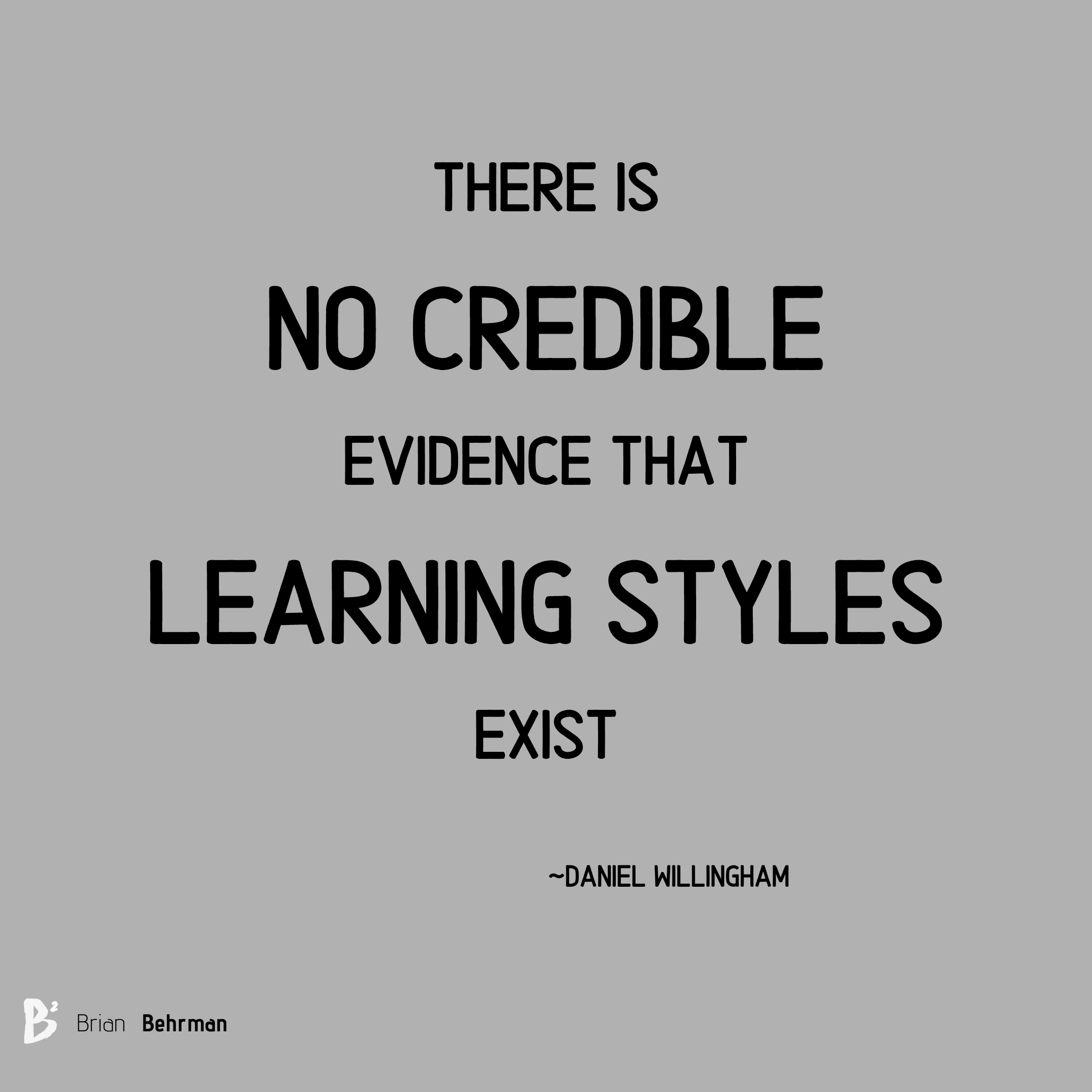
If the research doesn’t support this belief, why does it continue to exist? A 2016 study by the National Council on Teacher Quality found that 67% of teacher preparation programs require learning styles in their lesson planning assignments, and nearly 60% of textbooks continue to advise future teachers to take learning styles into account. Cognitive psychologist Daniel Willingham shares:

This is clearly an example of the research-to-practice gap. Sometimes also referred to as the 17-year gap, this idea holds that it takes about 17 years for educational theory to become educational practice. But that gap represents a passive form of adapting to research. When we know better, we should do better. If the research shows that learning styles do not improve outcomes, we have to make a change.

So if learning styles don’t exist, what should we do? Well, first of all, the research shows that we can improve student outcomes by designing the learning modality around what is best suited to the topic. For example, if you were teaching students about plate tectonics, you’d want to include diagrams to help students visualize the process. If you’re teaching phonics and early reading, the combination of auditory and verbal would be a necessity to help build letter-sound correspondence. In physical education, students would need a worked demonstration of a skill – say, practicing throwing techniques – and then a chance to try it on their own. This might involve the teacher modeling the skill, then allowing students to simulate the throwing technique while receiving feedback from the teacher.

There are other, more research-supported, techniques to improve student outcomes. I’ll share a few of those below:

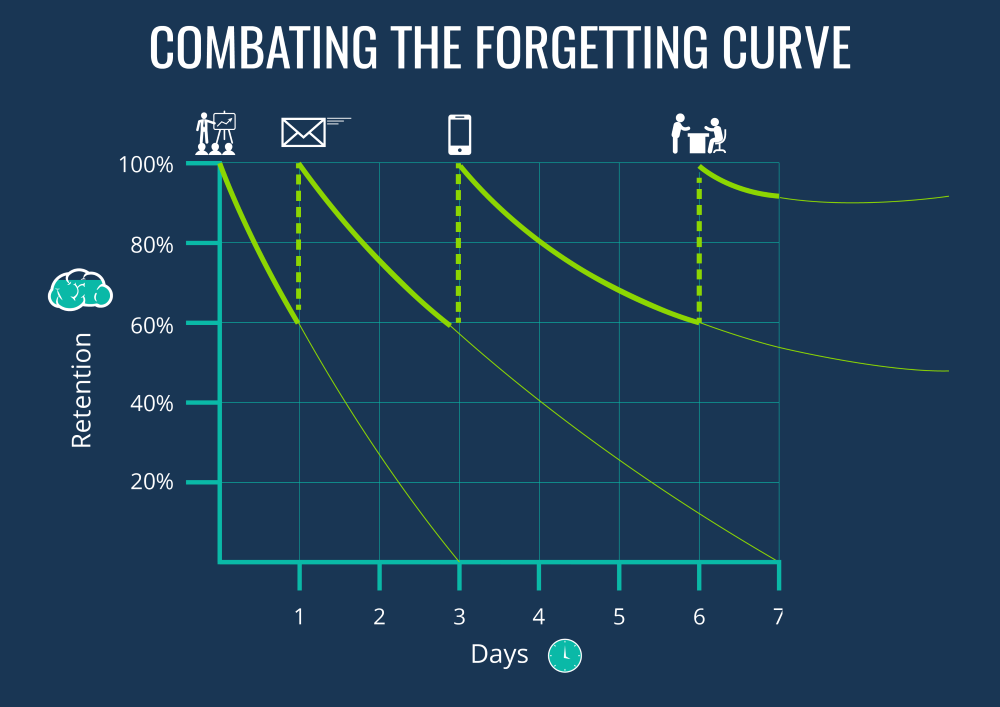
  • Spaced repetition: This would involve reviewing material at increasing intervals over time. This would be like a spiral review or creating flashcards for practice. Spaced repetition suggests that you might review something an hour later, then the next day, then a few days later, then maybe a week later. Each time a skill is reviewed, the neural pathway to that information is strengthened, making the learning more “sticky.”
Based on the work of Hermann Ebbinghaus – learn more at https://elearningindustry.com/forgetting-curve-combat
  • Retrieval practice: Actively recalling information strengthens memory and understanding. Ways to incorporate this would be to have students quiz themselves, use low- or no-stakes quizzes for practice, or have students summarize new learning without looking at notes or resources.
  • Interleaved practice: Mixing different topics or skills into study sessions. In practice, this might mean starting your class with a warm-up that includes a review question from yesterday, last week, and last month. It could also include randomizing the practice questions rather than grouping them by topic.
  • Elaboration: Explaining and describing concepts in detail. You might put this into practice by having a student explain their thinking to others or share their understanding of a concept with a peer. Or you might use follow-up questions like “why does this work?” or “How is this related to something I already know?”

If you’d like to learn more about this topic, one of the best resources for work around learning styles is Daniel Willingham. One option would be to check out his YouTube explainer titled “Learning Styles Don’t Exist” (I shared this below). You could also dig a little deeper by reading his book, “Why Don’t Students Like School?” I’ve added this title to my To-Read List!

What are your beliefs about learning styles? Were you taught about them in your teacher preparation program? What do you think about this research? Share your thoughts in the comments below.

Retrieval Practice: Boosting Memory and Student Success

In past posts, I’ve shared a bit about the Cognitive Science Microcredential I earned through the Center for Excellence in Leadership and Learning. Cognitive science is all about understanding how our minds work. The main point of the microcredential is to know how people learn best and then apply that understanding to support the work we do in the classroom. Today, I want to focus on the concept of Retrieval Practice.

What is retrieval practice? Have you heard the phrase? Jot what you think it is on a post-it, or define it out loud for yourself. Once you’ve done that, read on.


If you actually took the time to define retrieval practice, you just participated in a form of it. It’s sometimes also called the testing effect, and it’s any activity that forces you to generate an answer to a question. It can take on many forms, such as using released repository items to practice a skill, reviewing with multiple-choice questions, or something as simple as quizzing a partner as a form of study.

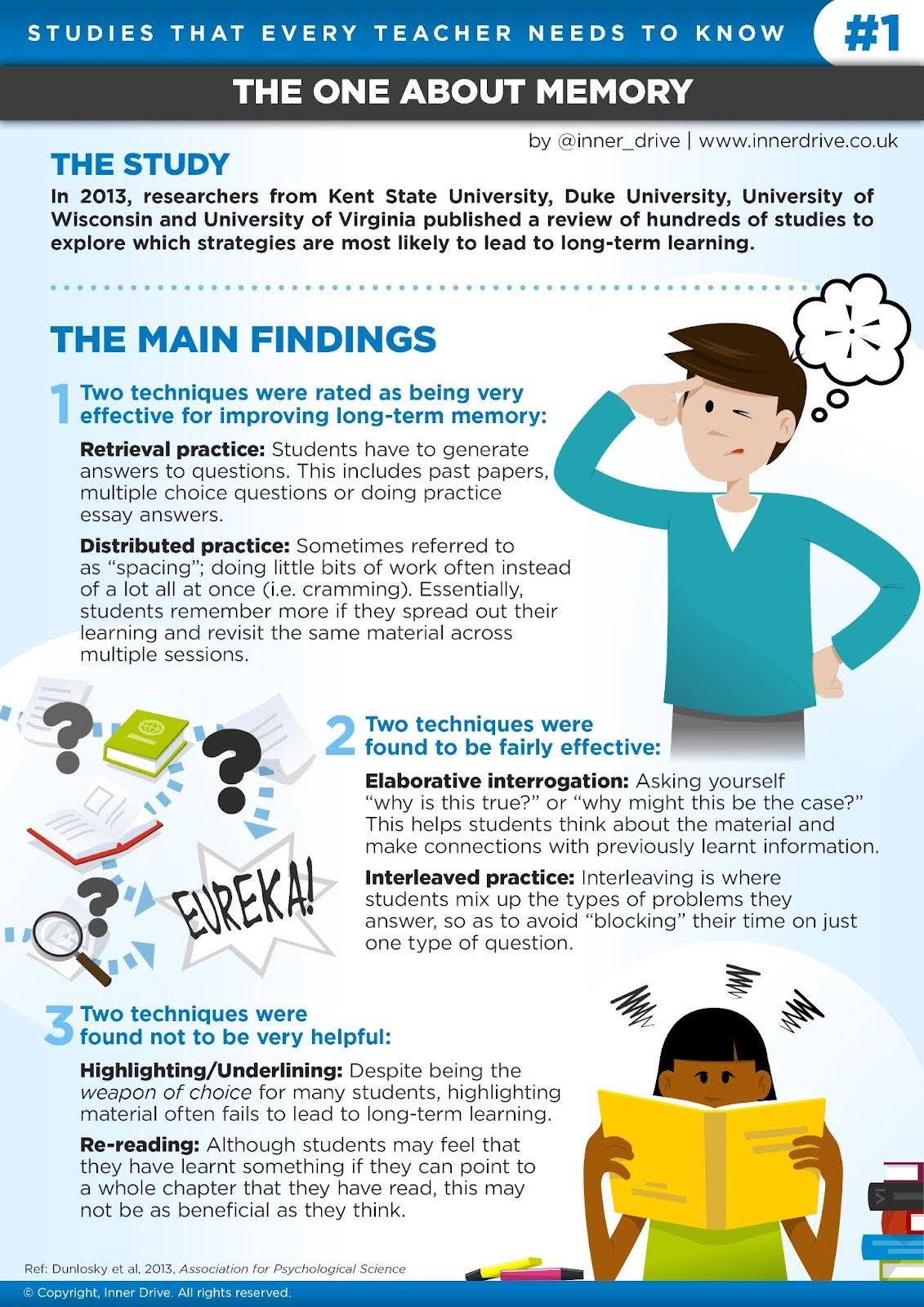
Retrieval practice has been consistently shown to improve students’ retention and recall (with long-term benefits for enhanced performance on summative exams). See the graphic below for some of the research findings:

by @inner_drive, http://www.innerdrive.co.uk

Some of the best research on studying strategies has found some interesting things. First of all, most preferred study methods (rereading, reviewing notes, etc.) are not as effective for authentic learning of the material. Those strategies can be good for cramming, but over time, that information is lost. The truly best options for studying or reviewing are something like participating in practice tests. The research in the What Makes Great Teaching Report states that “having to generate an answer to a question or procedure, or having to retrieve information – even if no feedback is given – leads to better long-term recall than simply studying.”

Why do researchers believe this happens? First, they note that students who have done practice tests or true retrieval practice while studying report that it helped them learn (92%) and made them feel less nervous about summative exams (72%). Another benefit of retrieval practice is that it enhances memory during stressful situations. Too much stress can reduce memory and impair focus, but using retrieval practice consistently reduces that impact because answering questions in a practice situation already stresses you out, reducing the impact during the summative assessment.

Yet another benefit of retrieval practice is that it helps you identify what you do or don’t know. Students (and teachers) have concrete information about what they truly know. By understanding the gaps in knowledge, future review can be more effective.

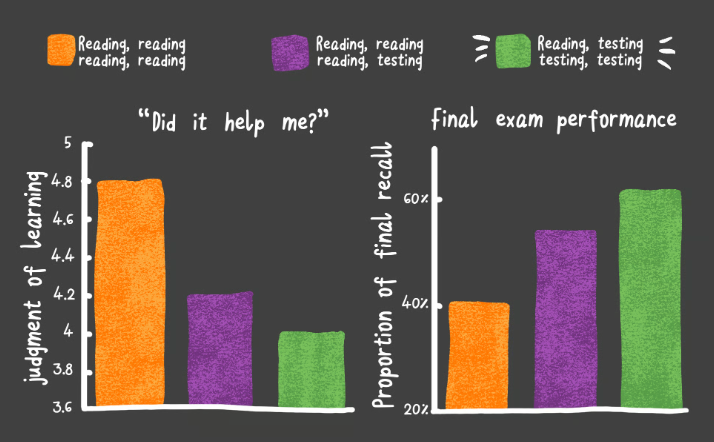
Possibly the most interesting thing about retrieval practice is that it is so much more powerful than students think. Results from a 2006 study by Henry Roediger and Jeffrey Karpicke titled “Test-Enhanced Learning: Taking Memory Tests Improves Long-Term Retention” gave two interesting views of the role of retrieval practice on student learning. See the chart below for results:

What I find most interesting about this data is that a student’s opinion of what would help them learn the material had an inverse relationship with their actual performance on the summative assessment.

The orange bar to the left shows that more students thought that reading and rereading as a study tool would help them the most. However, when looking at the assessment data, students who read the material once and then took practice tests for review had the strongest long-term recall.

This is retrieval practice in action!

So, how can we embed retrieval practice into our formative assessment? There are a few ways we can harness the testing effect to the benefit of our learners:

Past Papers: Past papers are examples of previous quizzes or exams. This could be an alternate version of the assessment provided by your curricular resources, or it could be done by utilizing the released item repository to practice items of similar rigor and level as what will be seen on the summative assessment.

Multiple Choice Questions: Early in the studying process, multiple-choice tests and quizzes can be a valuable way to determine whether students can identify the correct answer from a set of options. This can help you identify the types of questions or problems that students still need support with.

Written Answers: A short written response to a higher-order question can help students craft a fluent response by drawing on the many pieces of information available to them. Answering an essay from multiple sources requires analysis, which improves retention more than simply sharing isolated facts.

Answering Questions Aloud: Replying to a question aloud makes you think about the question and then reflect on the information you have learned to craft a verbal answer. Related research indicates that reading aloud is more beneficial for long-term learning than reading in silence, as it engages more of our senses.

Testing Yourself with Flashcards: Using flashcards for review is a great way to identify what you know and what you still need to review.

Having Someone Ask You Questions: Sharing answers to questions someone asks you helps you discover how well you understand the material.


Based on what you’ve learned here, what are some steps you could take in your classroom in the next couple of weeks to bring retrieval practice into the learning environment? It could be as simple as asking students to “think, pair, share” a description of what your class did yesterday in math as you are leading into your mini-lesson. It could be taking a moment at the end of a lesson to review the key takeaway that students should have. Asking them to stop and jot the most important thing is a great example of retrieval practice at the end of a lesson.

These strategies will solidify learning within your setting, leading to greater growth and mastery! Take a look at the examples of retrieval practice above. What can you bring to your classroom to help students solidify learning in the next week? Make a note of it, and be sure to add it to your practice next week!