
This past week I had the opportunity to participate in an awesome professional development experience put on by 2 amazing school districts – Hamilton Southeastern Schools (my home district) and Noblesville Schools. Each day was filled with a morning keynote, followed by tons of choices in concurrent sessions. Anytime I attend something of this nature, I feel it’s successful if I can take at least one idea from each session that I can implement into my practices. As I look at my own notes today, I have so many more ideas than that, but I want to share a few of my key takeaways.
Our opening keynote came from Mark Wagner, President & CEO of EdTech Team. During his keynote he asked us the question “What do you want to learn?” and then challenged us to think about whether or not we were spending time asking our kids this same question. While we have standards to meet, that doesn’t have to be done always based on our expert decisions as the teacher. Wagner argued quite convincingly that learning will be more meaningful for our students if we share with them our goals, what we need them to learn, and then ask them how they want to learn those skills. Wagner encouraged us to think of the changing role of educators, and rather than seeing ourselves as the keepers of knowledge, who then dispense that knowledge to our students, we should start thinking of our role as that of a connector.
Within our own community, there are people who have skills and experiences that are much greater than any of us could ever hope to be able to share with our students. Our job, in part, is to connect our students to the experts they need in order to learn the skills they want to learn.

During the second day I had the privilege to listen to Luke Reks, a recent graduate of Noblesville High School. Luke shared with us his experiences in the Innovations class he participated in during his sophomore through senior years of high school. In that time, Luke connected with filmmakers, CEOs, and philanthropists. As part of his learning, he interned on the set of a low budget film starring James Franco and was able to network with Hollywood producers and directors. In a partnership with one of his classmates, Luke is now working to build a school in Africa that will serve youth, bringing them access to learning, and including the Innovations model of learning within its curriculum. Luke reminded me that opportunities are everywhere for our students. As teachers, sometimes we just have to get out of the way of the passions of our learners, and they will take their learning much further than anywhere we can hope to take them.
Also on the second day of the conference, Kerry Gallagher was the keynote speaker. After listening to her keynote, I made it a point to attend one of her concurrent sessions as well. Her keynote was on the effects of technology on our brain, while her concurrent session talked about best practices related to screen time. The information shared in both was based on research from sources that I know and trust – Common Sense Media and the American Association of Pediatrics to name just a couple. There are many people who spend time talking about the bad aspects of screens, and there’s plenty of research and opinion that support the drawbacks of screen time, but as educators, we have to also remember a couple of important things about technology. First, technology is an opportunity that provides our students access to resources, tools, and experts that would never be available to them without the use of technology. Along with that, Gallagher reminded us that increasingly our students will need to be able to interact with people through the screens in front of them. Google, Airbnb, Uber, and other transformative companies require their employees to be able to interact with customers through screens. How are we teaching our students to interact appropriately?
If a student’s first time to interact with a screen is as a preteen using an iPhone with unlimited access to the rest of the world, they won’t have the tools to be able to use that power responsibly. This has me thinking about the importance of digital citizenship lessons for even our earliest learners. As a district that is 1:1 in all grades, kindergarten – 12th grade, we can’t wait until kids are in the middle grades to begin talking about appropriate ways to interact through screens. We can use developmentally appropriate apps to help our students learn those skills beginning at the earliest levels.
Overall, there were so many great takeaways from the 2 days, these are just a few of the highlights for me. Did you attend? What were your main takeaways? Do the thoughts above have you reflecting on your own practices? Share your thoughts in the comments below.


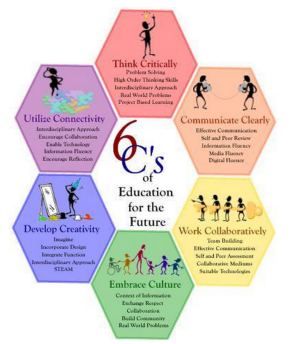 But here’s the thing, if I just accept that creativity isn’t my thing, then I feel like I’m doing a disservice to the students whose life I impact. In previous posts, I have shared the graphic to the right. One of the keys to developing kids who are ready for their unknown future is developing creativity, and if we just throw our hands up and say “But I’m not that creative, so I can’t teach others to be creative” then we are not helping them be ready for whatever their future may hold.
 After reading Miller’s book, I was led to Teach Like a Pirate by Dave Burgess. Burgess spends a huge chunk of time in this book talking about creative ways to hook our students into our lessons. He believes that creativity is something that can be developed in anyone through practice and effort. I have to say that I agree with him on this one – we can help develop creativity in others by giving them the time, space, and opportunity to use their creative ideas in their learning!


 If a student can turn to Google, Siri, Alexa, or whatever smart tool comes out next to find the answer to your question, then maybe we aren’t asking the right questions.
 The students in our school in general are very compliant. Compliant students sometimes struggle with creative tasks because they want specific directions to follow. They may not remember what it feels like to be creative or curious. Years of compliance in the school setting seems to suck creativity and curiosity out of our students. I think that sometimes students lose that ability to be creative and curious because they have grown accustomed to the amount of scaffolding that we provide for learning activities. That scaffolding can begin to feel a bit like a cage, and students forget how to get out.
 So how do we add relevancy to the things that we are teaching our students? I’ve had this conversation with several people recently, and my best suggestion is that we need to help our students see how the thing that they are learning about in class actually applies to their life. Recently in my school, many of the science classes have been learning about outer space. Can we tie last week’s amazing launch of Falcon Heavy into their studies of our solar system? What research could be done on the potential and kinetic energy of a rocket launch? Or what about the fact that there is research on the angle of release of a basketball shot being related to it’s likelihood of going in the hoop? Or maybe there are amazing connections that our students can make to our content that we would never even think of – we just have to get out of the way and let them share!
 The View from 518