Over spring break, I had the opportunity to do some reading, and finished 3 different books that were awesome. One of those books was Creativity, Inc. by Ed Catmull (the president of Pixar and Disney Animation Studios). Primarily, the book is about creativity, but Catmull also describes it as “an expression of the ideas that I believe make the best in us possible.”
I have been reading a lot about creativity recently. I’ll be honest, I sometimes struggle to describe myself at a “creative” person. I always felt that I struggled in the related arts classes – while I enjoyed going to art class in elementary school, my work was never the type of thing that would have been chosen to hang in the display case outside of the art room. Even today I sometimes doodle in my notes and have been playing with the idea of sketchnoting as a way to increase learning and memory on certain tasks, but those sketches aren’t something that I feel very comfortable to share publicly. While I learned to play several different instruments in elementary, middle, and high school, I have not stuck with any of them beyond my school career. I have a guitar that spends more time in my closet than anywhere else in my house.
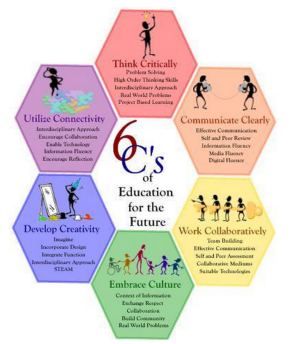 But here’s the thing, if I just accept that creativity isn’t my thing, then I feel like I’m doing a disservice to the students whose life I impact. In previous posts, I have shared the graphic to the right. One of the keys to developing kids who are ready for their unknown future is developing creativity, and if we just throw our hands up and say “But I’m not that creative, so I can’t teach others to be creative” then we are not helping them be ready for whatever their future may hold.
One of the first books that I read that really got me thinking about the importance of creativity in teaching and learning was the book Ditch that Textbook by Matt Miller (also the book that got me thinking about starting this blog – one of the ways that I express my own creativity). If you haven’t read DITCH That Textbook, DITCH is actually an acronym for Matt Miller’s teaching model. DITCH stands for: Different; Innovative; Tech-laden; Creative; and Hands-on.
 After reading Miller’s book, I was led to Teach Like a Pirate by Dave Burgess. Burgess spends a huge chunk of time in this book talking about creative ways to hook our students into our lessons. He believes that creativity is something that can be developed in anyone through practice and effort. I have to say that I agree with him on this one – we can help develop creativity in others by giving them the time, space, and opportunity to use their creative ideas in their learning!
I’ve shared before that I often think of teaching as an art. Developing lessons that are interesting, exciting, and engaging takes time and effort. Some days our lessons nail it, and our kids are totally into it. Sometimes the lessons that we think are going to be “so cool” just fall flat.
In Creativity, Inc., Catmull shares that “If we can constantly change and improve our models by using technology in the pursuit of art, we keep ourselves fresh.” For many of our students, they continue to look at their iPad, their phone, or other pieces of technology, as a tool for entertainment purposes. They can play games, watch videos, and consume in so many ways. While there are times that consumption can be necessary for the purpose of learning, we generally retain so much more when we take our knowledge and create something with it. When we use the technology that our students see as a tool for consumption, and help our students see that they can use it for creation, they can go so much further in their learning. I’ve said it before, technology can be an accelerator that pushes our learning to new heights.
With that in mind, here’s the gentle nudge – think about ways that your students can use technology to create something that would never have been possible without the iPad they have in their hands. Help them to think about how they could make something that reminds them of the things they most like to consume. Then, set them free to be creative.
In Ditch that Textbook, Miller encourages us to think about how to integrate more creativity with the following questions:
Creative: What types of products do you and/or your students consume a lot? How can the role of consumer be flipped to creator? How do you or your students demonstrate original ideas? How can those translate to the classroom?
What are some ways that you have integrated creative thinking into learning opportunities successfully? What are some ideas you have to add a creative piece to what you are already doing? I believe that most kids want to be creative, but they don’t often get the opportunity to in service of learning. When we set those creative juices free for our kids, they will be so much more likely to retain the learning that was going on in connection with their creative thinking.


 If a student can turn to Google, Siri, Alexa, or whatever smart tool comes out next to find the answer to your question, then maybe we aren’t asking the right questions.
 The students in our school in general are very compliant. Compliant students sometimes struggle with creative tasks because they want specific directions to follow. They may not remember what it feels like to be creative or curious. Years of compliance in the school setting seems to suck creativity and curiosity out of our students. I think that sometimes students lose that ability to be creative and curious because they have grown accustomed to the amount of scaffolding that we provide for learning activities. That scaffolding can begin to feel a bit like a cage, and students forget how to get out.
 So how do we add relevancy to the things that we are teaching our students? I’ve had this conversation with several people recently, and my best suggestion is that we need to help our students see how the thing that they are learning about in class actually applies to their life. Recently in my school, many of the science classes have been learning about outer space. Can we tie last week’s amazing launch of Falcon Heavy into their studies of our solar system? What research could be done on the potential and kinetic energy of a rocket launch? Or what about the fact that there is research on the angle of release of a basketball shot being related to it’s likelihood of going in the hoop? Or maybe there are amazing connections that our students can make to our content that we would never even think of – we just have to get out of the way and let them share!