Solar eclipse memories

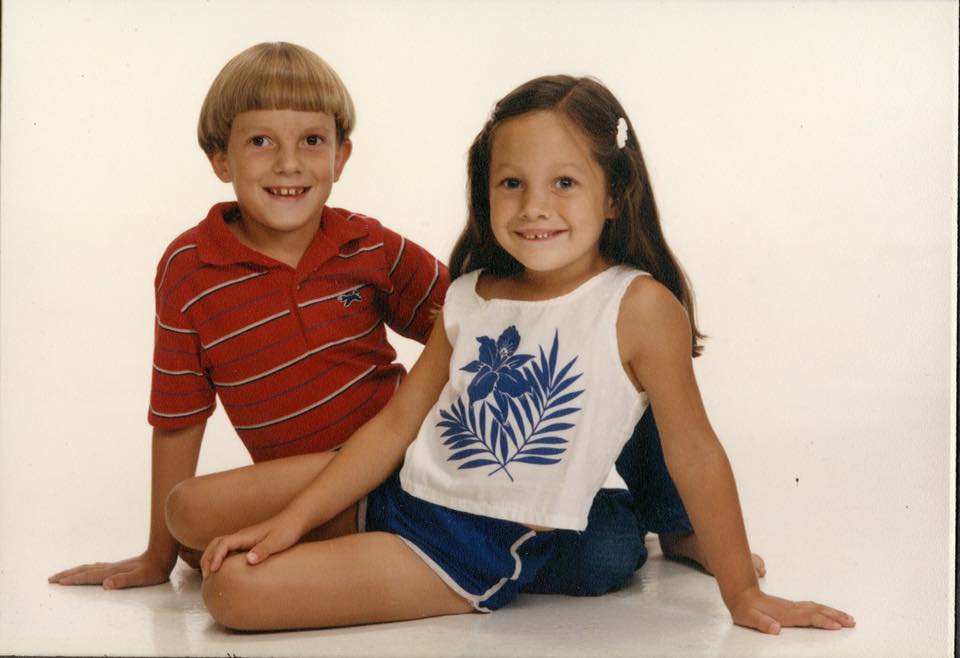
This is my sister and I – probably summer of 1985, just to give a frame of reference!

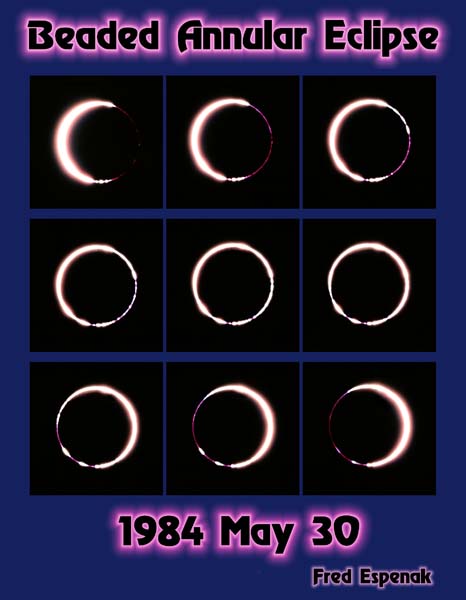
As we build up to Monday’s solar eclipse, I was thinking back to the only other solar eclipse that I recall seeing.  The date was May 30th, 1984. That May was the beginning of my last summer before I became a “school kid.”  I would be starting kindergarten that fall.  My mom ran an in-home daycare, which was great because that meant I had friends to play with every day.  She had been collecting shoe boxes for a few weeks leading up to the eclipse, and on the day before the eclipse we turned them into pinhole cameras. (One fun fact for all of you who are at RSI – Dave Bradley was one of the kids that was at the daycare on the day of the eclipse).

http://www.mreclipse.com/SEphoto/SEgallery1/image/A1984Mosaic.JPG

While I don’t remember exactly what the sky looked like that day, I remember that there was a lot of excitement about the event.  I also remember that there wasn’t a lot of talk about NASA approved sunglasses (maybe there was and I was too young to know about it).  That day my mom reminded all the kids not to look at the sun, we took out pinhole cameras outside, and we watched the eclipse.  I do remember that the big trees in our backyard were making it hard to see, so Dave and I moved to the backyard behind mine, and we had a much better view.

As many of you know, when I was still a classroom teacher, my favorite subject to teach was science, and my favorite unit was always space science.  I think that my experience with the solar eclipse set me up with curiosity about outer space.  As a kid I loved watching shuttle launches.  I remember crying when the Challenger disaster happened.  I had the chance to go to space camp during my first year as a teacher.  Even today, I can get sucked into a livestream of a SpaceX launch or landing and not be able to turn away.

http://www.history.com/topics/challenger-disaster

I know that there are some who are concerned about safety for our students, but I would hope you seriously consider finding a way to give your students an opportunity to see the eclipse.  My experiences that day have helped lead to the things I am still curious about today, and for our kids it could be such a great provocation to lead into student wonder.  Who knows, a future space scientist, astronaut, or science teacher could be sitting in your classroom!  If you have something cool planned for the solar eclipse, share with us in the comments below!

Building on our strengths

When you get up in the morning, what are you excited about?  For most of us, the thing that gets us going in the morning is also the thing that drives us throughout the day.  It’s also typically something that we feel confident about, that we think we do well, and we enjoy doing.  Most importantly, that thing is also something we would identify as a strength.

I feel that often in education, we get drawn into thinking about weaknesses.  As a teacher, we have to identify weaknesses in our students in order to find ways to support their growth.  As an administrator, evaluations often include identifying weaknesses of the staff in our building, and planning to lead to future growth.  We get caught in a cycle of looking for the weaknesses around us.  If our strengths are the things that motivate us, isn’t it safe to assume that our learners would be motivated by their strengths?

A few years ago, as an ongoing activity throughout our unit on Ancient Rome, I provided students with a list of possible ways they could articulate learning.  These choices involved aspects of Roman society and culture.  I was amazed by the projects that students were able to create based on their strengths.  I had students designing roman outfits based on research because they were interested in style and design.  I had a student write a children’s picture book about the Roman Empire because they felt they were good writers and illustrators.  And probably my favorite, I had a student, Patrick, who had struggled all year long but designed and built a scale model of a Roman Aqueduct that was SPECTACULAR (it’s still in my office today) because he liked to build things.  While we were doing in class activities for learning, students were also researching for these projects.  They were able to select a project that fit their strength, and the results were amazing.  Having students present something that they had learned that also fit with their strengths was such a rewarding experience for me, and I’m sure led to a greater transfer of learning for each of them.  I would guarantee that none of them would be able to answer any of the questions we had on a summative exam, however I would also bet they could tell you about what they created for that project.

Knowing how strengths can motivate all of us reminds me to be on the lookout for strengths as I am walking the halls.  I am challenging myself to look for the strengths or everyone, and recognize those strengths!  I challenge you to do the same.

Be thinking about the data that you collect on students.  Don’t just look for patterns in terms of weaknesses.  Also look at the data that supports their strengths.  Give them the opportunity to build upon those strengths.  Most of our students will choose a career path based on their interests and passions.  Wouldn’t school be a better place if we gave our students the opportunity to accentuate their strengths?  I’m not saying we ignore areas where a student needs to grow, but I can tell you that all the time that my sophomore English teacher had me spend diagraming sentences is not what has led me to be a good writer, a good reader, or any of the other skills I have developed.  All it did was make me hate sophomore year English (sorry English teachers!).

Take a few moments in the coming days to seek out the positives in the students that are in your classroom.  Identify the things you see, and share it with your students.  See how they react to some strength-based feedback.

#IMMOOC #IMMOOCB3: Engage or empower

Engagement.  We all say that this is what we’re striving for when our students are in the classroom.  We want our students to be engaged in whatever’s happening in our classroom.  Normally that means getting your students excited about whatever it is that your class is studying.

But as we think about what it takes for any of us to learn something new, being engaged in the activities doesn’t guarantee learning.  I can guarantee that in the next few days I will be engaged in hours of watching NCAA Basketball.  The likelihood of any kind of deep learning happening in that time is not very high.

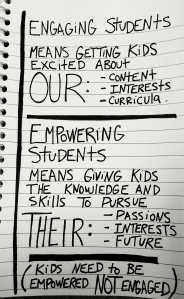
Bill Ferriter – @plugusin

To get students to that deeper understanding, the learning needs to be meaningful.  Bill Ferriter (@plugusin) says “Kids need to be empowered NOT engaged.”  So how do we get there?  Ferriter goes on to say that “Empowering students means giving kids the knowledge and skills to pursue their: Passions, Interests, Future.”

One of the things I believe in education is that we have great power to help our kids be excited about learning.  The more student choice and voice we give, the more authentic and relevant approaches we take, the more we shift our students from engagement to empowerment.

#IMMOOC #IMMOOCB2: School vs. Learning

The graphic above was created by @sylviaduckworth in response to a blog post by @gcouros about the differences between a traditional school setting, and comparing it to what we know best about how people learn.  It makes me think of the TED Talk by Ken Robinson on Changing Education Paradigms (check out this version).

Couros looks at the differences from the graphic above in his post School vs. Learning where he looks at the traditional school model compared to the way that research shows that people and students learn.  Think about the ways you learn best.  Do the descriptions on the left or right of the graphic above fit with your experiences of learning?  The next question – what do the classrooms that you are in most look more like?

Engagement is great, but engagement alone is not learning.  My kids can be engaged with YouTube for hours if I let them.  Does this mean they’re learning?  If we want learning to happen for our students, we need ask “what can I do less of?”

Reflect on what school looks like for you.  If what you reflect on makes you uncomfortable or gives you pause, think about where you can implement change to make learning new and better for your students.

#IMMOOC #IMMOOCB1: A culture of yes!

So we say we want innovation in our schools, in our classrooms.  Many of us feel that this is the best way to get our students past the point of engagement, and moving to the level of empowerment.  But there is one little word that can kill that process – no.

In the past couple of years, we have had many opportunities to interview potential teachers.  Every time we bring an interview team together, we all agree that we are looking for people who are “go-getters” – people who will do whatever it takes to make the learning experiences for their students new and exciting.  They have helped to bring exciting new learning opportunities into our school.  At the same time, many of the teachers in our building continue to learn and evolve – trying new formats of teaching, new activities, new technologies.  This innovation continues to spread, and is so exciting to watch!

If you know much about improvisational comedy, you know that during a scene the key is to not say no.  The mindset has to be to have an attitude of “yes, and…”  This is what we’re seeking for innovation.  When there are new and exciting ideas that will make learning better for students, I strive to say “yes, and…”

My hope is that this culture of yes will allow us all to continue to learn and grow.  Ultimately, our growth will allow us to make learning more innovative for every student!  Isn’t that the goal?

#IMMOOC Week 2 – How did this work for our students?

As I was reading Part 1 of The Innovator’s Mindset by George Couros this past week, one of the “Critical Questions for Educators” really struck a chord for me: “How did this work for our students?”  In the book Couros shares that he used to survey his students at the end of the year, and I often gave my students a similar survey at the end of every school year.  I would ask what their favorite lessons were, and what were the things that they didn’t enjoy as much.  I would analyze the results, and use it to improve my practice for the next school year.

In retrospect, I feel I may have been missing an important piece.  I valued my student’s opinions, and would use their responses to improve, but how did my survey help them?  It didn’t.

Think about it like this: When was the last time that you were out to eat with your family or friends and had poor service?  Or what about a time where you server was so awesome you just wanted to show love in more ways than just a good tip? How did you handle either of those situations?  Did you ask to speak to the manager?  Did you call the restaurant after you left?  Maybe they had comment cards, or a website where you could leave feedback.

Have you ever thought of your students as being kind of like the customers of your classroom?  How often do your students get a chance to leave you feedback about your lessons?  They are in your classroom on a daily basis.  Shouldn’t we all know what our students like or don’t like about our class?

In The Innovator’s Mindset we’re reminded that innovation isn’t just doing things that are new, but doing things that are new AND better.  These days through the use of Google/Microsoft Forms, SurveyMonkey, and other simple survey tools, we can always be seeking the feedback of our students.  Wouldn’t it be a learning experience to take a moment to reflect on your student’s opinion about that lesson you were so excited about?

Create a simple survey.  Make a QR code that students can scan that will take them to the survey.  Encourage students to provide anonymous feedback of what’s happening in your classroom, and take that feedback to grow as a teacher.  What a way to build student empowerment in your classroom – when they see you responding to your feedback in a way that model’s growth, they will see the value in a growth mindset of their own.

Have you ever surveyed your students before?  What kind of questions have you included?  Share your thought in the comments below!

#BookSnaps

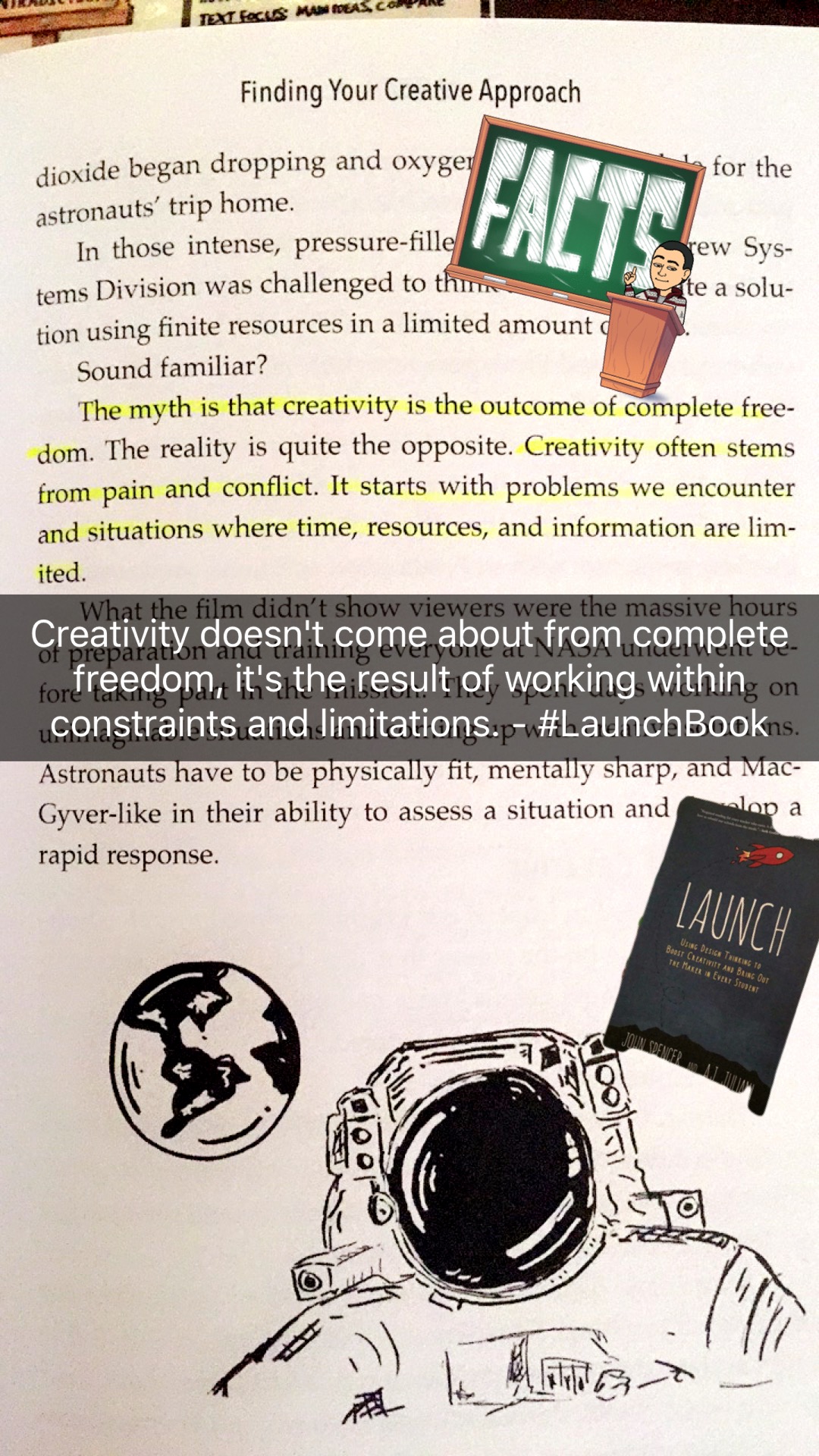
This is a BookSnap I created while reading the second chapter of the book Launch by John Spencer and AJ Juliani

If you are on Twitter and follow any of the same people that I do, you have probably noticed people posting pictures of text, sometimes with highlighting, adding emojis, bitmojis, or text, and then posting it on Twitter with their own comments.  Normally if you look at the comments, you will see the hashtag #BookSnaps linked to it.  Even if you aren’t on Twitter, you can see what people are posting by clicking this link: Twitter #BookSnaps

If you go to Twitter and check this out, you will probably notice that most of the posts here are educators who are sharing their personalized professional reading with their Twitter followers.  If you look closely though, some of what you will find is teachers sharing BookSnaps that students created in their classroom.  It got me started thinking about how some of you might be able to use them in your classroom.  Check out this student created BookSnap that the teacher then added some additional comments to:

This BookSnap was created by a student on SeeSaw and then shared by a teacher.

Most of the ones that you see are using SnapChat in order to create and share.  For those of you that know what technology your students are using, SnapChat is a pretty popular app.  But here’s the thing, there are ways that BookSnaps could be created using other apps that don’t involve the social network aspect of SnapChat.  Any app that allows you to pull in your own pictures and add text, drawings, and emojis could be used in the same way.  The student created example to the left was created using SeeSaw.  Some other examples that come to mind are Skitch, Google Drawings, various PDF annotating apps, and even Instagram.

Think of the potential engagement for your students if you asked them to create their own BookSnaps.  Could you imagine what they would say if you told them to open SnapChat or Instagram in class?  In ELA classes, you could have students create a BookSnap when they run into a Notice and Note signpost.  You could have them create one to identify the climax in the book they’re reading, or create one based on their own writing, identifying specific plot points.

And don’t say “I’m not an ELA teacher, this doesn’t apply.”  I could see real potential for BookSnaps in nonfiction reading as well – identifying the main idea in a science article.  Sharing things that surprised them as they are reading about some historical figure.  Responding to the 3 Big Questions from Reading Nonfiction by Beers and Probst.

I could even see integration into math class – MathSnaps could be a thing (acutally I just checked, and it is a real thing on Twitter)!  You could have a kid snap a picture of the answer to a problem and then add text describing how they came to that answer.  Or there could be ArtSnapsMusicSnaps, or GymSnaps.  The limitations are only bound by the creativity of how to integrate this technology.

As for how to share, again, the options are probably endless.  If you’re already using SeeSaw, that’s an easy option.  Other ideas I’ve seen include Google Slide Decks, a class shared PowerPoint (these options allow everyone can see what BookSnaps other kids have created based on the same reading assignment), or even something as basic as emailing it to you (although a way to share with classmates would make the audience so much more authentic and meaningful).  Once kids have shared them with you, find a way to share beyond the walls of your classroom.  If you’re on Twitter, tweet it out with the #BookSnaps hashtag – others will see it.  You could also put it out on Instagram or Facebook – both have people actively using this hashtag.  If you don’t have social media, you could have students print them out and put on their locker, or create a BookSnaps bulletin board.

If you are still at a loss for how you even create a BookSnap, there are some great resources from Tara Martin.  You can find her on Twitter at @TaraMartinEDU or @BookSnapsREAL.

On Martin’s blog, she’s also created some how to videos that could be useful to see how she puts a BookSnap together.  Check it out here: http://www.tarammartin.com/resources/booksnaps-how-to-videos/

I know I’ve got some creative people in my audience.  If you have an idea for how BookSnaps could be used in the classroom, please share in the comments below.  My ideas above are simply ones that have come to me in the past couple of days.  You might have something that I haven’t thought of – or possibly never would.  Let us know!

If you begin using BookSnaps in the classroom, please share them!  Use the #RSIHawks or #RSIReads hashtag in your post!

#IMMOOC Week 1: The Power of Ice Cream

This week is the beginning of The Innovator’s Mindset Massive Open Online Course.  For the next five weeks, I look forward to the opportunity to reread a great book and interact with educators during the weekly YouTube Live sessions as well as the Twitter chats!  I love this format of PD, and look forward to creating new connections and growing my Personal Learning Network!  If this sounds like something you would be interested in, you can still sign up here: IMMOOC

curiousAs I was reading the introduction to The Innovator’s Mindset this week, there was one line that really stood out to me: “if students leave school less curious than when they started, we have failed them.”  Given the meaningfulness of that line, I was so glad that became a major topic during the YouTube Live event on Monday evening.  During this session, AJ Juliani talked about a self-audit based on 4 questions, and I felt that these questions could really help us think about what we do in the classroom that might encourage students to “play” school and take away some of their self-agency and curiosity.

  • What do I allow for in my classroom/school?
  • What do I make time for in my classroom/school?
  • What do I support in my classroom/school?
  • What do I praise, assess, look for in my classroom/school?

What intrigued me the most about these questions is that students who play school well get there not because of their own desires.  Instead they get there due to the things that the adults in their lives (both educators and family members) value.  Watch kids of any age, and you will see curiosity – whether it’s on the playground, with their friends, or while playing a video game, our students our naturally curious.  But for many, when we put them into a classroom and ask them what makes them curious, the response is “I don’t know.”  If this is happening in your class, then your students are probably well trained to play school.

If we want our students to create, we have to model creativity (or at least a willingness to try).  If we want our students to be problem finders and solvers, that spark has to be modeled through our actions.  All of us have our interests and desires.  A lot of us keep those interests and desires separate from what is happening in our classrooms.  If we want to ignite the fire of curiosity in our students, we need to show them that their interests matter.

Recently in our school building, a student noticed that our cafeteria never served ice cream at lunch.  She knew from talking with friends at other intermediate schools that ours was the only one in the school district that did not ever serve ice cream as part of the school lunch.  Instead of just complaining about it, or even accepting that’s just the way it is, she went into action.  She did research.  She got friends and classmates involved.  She met with our school’s cafeteria manager to understand why we didn’t serve ice cream.  She met with our district facilities manager to learn about options to make ice cream a possibility at our school.  She got the student council on board to do a fundraiser.  All of this started last year with the question of why.

The Creamsicle may not be the fanciest of all ice cream treats, but it was a huge step forward in a school that had not served ice cream at lunch ever before! The Creamsicle may not be the fanciest of all ice cream treats, but it was a huge step forward in a school that had not served ice cream at lunch ever before!

Last Friday at lunch, our school served ice cream for the first time.

I would argue that the learning that happened for this student, and her classmates who were part of this work, was some of the most meaningful learning in the past year.  All of this happened because the adults around this student saw the curiosity and the drive that this student had – for ice cream – and they let her run with it.

What are the ice cream moments that are happening in your classroom?  In your school?  How are you helping to ignite that curiosity?  What are the ice cream moments for you?  Are you modeling that curiosity with your students?  As the leaders of our classrooms and schools, we have the ability to choose a course for our students that inspires them, or we can choose a course that creates students who “play” school well.  Which course do you choose?

I’d love to hear your thoughts in the comments below.  Keep the conversation about innovation in learning going here, or hit me up on Twitter @brian_behrman.

This class just can’t handle it…

When I was in high school, I remember taking a physics class – I believe it was my sophomore year.  At my high school, physics classes were taught in the wing that had once been the area for “shop” classes.  My physics classroom was this huge open space.  One side had a large garage door that once allowed cars to come into the building for students to be able to learn how to work on them. By the time I was in high school, the “shop” classes had been shifted to the Hoosier Hills Career Center across town, and the shop classrooms had been converted for other uses.  On any given day, I would walk into this classroom, and around the outside of the class I would see various experiments in process.  There were large lab tables – at one point there were lasers on every table that were being used to make holograms.  Another time there were these air rails that were angled and allowed people to measure velocity and acceleration based on the time it took an object to travel across the rail.  In one corner, there was Newton’s Cradle built out of cable and bowling balls and hanging from the rafters high up in the room.  I could go on…largest-newtons-cradle2-500x334

As a sophomore, I would walk in and see these awesome experiments that would pique my curiosity.  I made it a point to arrive to physics class as early as possible to check out these things.  I remember wondering how you could use a laser to create a hologram, or just how the timing controllers worked on the air rails.  But then, the bell would ring, I would make my way over to my desk in the middle of the room in front of the chalk board, have a seat, and take out my textbook.  You see, as a sophomore, I was in the basic physics class.  Those experiments were not set up for our class, but were there for the AP Physics class that also met in the same classroom.  Now, I don’t want to imply that we never got to do experiments in my physics class that year, but it was nothing on the level of what the AP class was doing.

Thinking back to my experience as a sophomore in high school in my physics class, I know that some of those experiments probably were things that I did not yet have the true theoretical understanding to be able to carry out and understand, but that doesn’t take away how bummed I was to see cool things set up in my classroom and feel as though I could not participate.  The reality is though, there were probably variations on many of those experiments that would have tied to the standards that my basic physics class was expected to cover.  There were probably ways my teacher could have provided scaffolding and support to allow the students in my basic physics class to participate in those cool experiments.  Would we have gone as deep with the experiments?  No, but we would have had that hands-on experience that was sometimes lacking from my physics curriculum that year.

This memory comes to me when I occasionally hear teachers say things like “My regular class just isn’t ready for this.”  Or “this group is my resource group, so they may not be able to do that activity.”  (I’ll admit – I may have made statements like this when I was a classroom teacher).  That fear that students aren’t ready or aren’t capable can hold us back from such cool learning opportunities for our students.  If you’re worried about kids not being ready, you should know that there are some second-grade classes in this district that have been doing some of the same experiments that I have seen happening this year in some of our sixth-grade classrooms.  I’m sure there were adaptations to make the learning accessible for a second grader, but if a second grade student can successfully carry out activities that our sixth grade students are doing, isn’t it worth finding ways to adapt our activities so that all our fifth and sixth grade students can do them?

Whether we’re talking about a socrative seminar, a hands-on experience, an experiment, or a project, we need to makes sure that all our students have the opportunity to learn in exciting ways.  Think critically about how you might be able to adapt your class so that no matter what level your students are at, they have the opportunity to be challenged.  How could you scaffold and support those students that some might say just aren’t ready?  If you’re struggling to find ways to integrate some of these higher-level experiences into your classroom, find someone to collaborate with – it could be with a teammate, a teacher down the hall, a teacher in another grade level, a TDS, one of our resource teachers, or maybe it’s one of our related arts teachers.  We have lots of great people working in this building, and through working together, we can make sure that all our students are able to participate in amazing learning opportunities!

Also, just so that you aren’t too worried about my long-term well-being, I apparently liked that basic physics class enough to go on and take the AP Physics class the next year.  I was able to participate in all those cool experiments that I was so curious about as a sophomore.  I learned how to create a hologram of a die using a laser, I got to do those experiments with the air rails while learning about acceleration and velocity.  I also remember AP Physics as the most difficult class that I took that year, but at the same time it was the most interesting and rewarding because of the hands-on experiences that we had throughout the year.

The cool stuff, the fun stuff, those are the things that get students excited about learning.  Those are the things that students will talk to you about when they run into you in the future.  Those are the activities that stick with them as they get older, that they can go back to and recall what they learned while they were in your classroom.

Do you have memories similar to mine?  How did it make you feel to not be able to do some of the “cool” things that your teachers did with other classes?  Have you ever talked to your students who don’t get to do some of those things because they “just aren’t ready?”  Share your thoughts in the comments below.
Self-Assessment

In the most recent post of the blog Teaching and Learning in HSE, Phil included a link to a short (under 2 minutes) video clip from Tom Guskey.  I’ll include the link below if you didn’t watch the clip yet.

guskeyThere were a couple of quotes that were intriguing to me.  At the very beginning, Guskey states “Every time an assessment is given…that is an opportunity to learn.”  However, he’s not talking only about an opportunity for the students to learn.  He’s also talking about the assessment as an opportunity for us to learn.  One of the best ways to assess the job that we are doing is on the consistent performance of our students.  Don’t just look at standardized scores like the ISTEP or NWEA, look at anything that you treat as an assessment, whether formative or summative, as something that is also assessing you.

I loved the strategy that he suggests of keeping a tally of the problems that students have missed.  He shares that “If every kid missed a question, that is not a kid learning problem.  That is a teacher problem.”

If you are using good planning methods, with backwards planning of your units of study, and you start with the end in mind, and you get to that end and the kids missed something that you feel you taught, take a moment to reflect on how you taught that skill.  The easy out is to say “the kids didn’t get it”.  The much harder reflection for any of us to make is to say “maybe I didn’t do a great job of teaching this”.  When that is the reflection we make, it allows us to use the assessment as a way to improve our own teaching.

hl-podcast-cover-large-1024x1024As I watched this clip from Guskey, the comments about self-assessment made me think of a recent episode of the Hack Learning Podcast titled How One Simple Tool Helps Uncover Your Biases (you can follow this link to go to a page where you can listen to this episode).  Hack Learning is a podcast that was created by Mark Barnes, a classroom teacher, author, and publisher of the Hack Learning Series.  While the topic in this podcast is a different form of self-assessment, I feel it is worth sharing.

As you know, we all have biases.  If you have never taken an implicit bias test, google it and give it a shot – you might be shocked by the results.  Our biases can creep into our conversations in the classroom with students.  What we have to remember though is that those biases can have an impact on the learning that happens in your classroom.

hacking-engagementIn this episode of Hack Learning, Barnes shares a portion of the book Hacking Engagement by Jim Sturtevant.  In the book Sturtevant shares a story from early in his teaching career where, as a world history teacher, he professed his position on what might be considered a controversial subject.  He felt that the majority of the class was on board with him, there were some head nods, and they agreed.  After the lesson, one student came up and said “You should be careful about promoting your views so passionately.  I don’t agree with you, and I’m not alone.”

Sturtevant’s initial reaction was that it was no big deal – this is the opinion of one student.  Who cares?  But as he reflected further, he came to the realization that by sharing his controversial beliefs, he was erecting barriers between himself and students.  As he goes on to say in the text “Why in the world would I want to alienate certain kids who may not agree with me on an issue.”

Think about your own interactions with peers, in person or on social media.  When someone expresses a bias that you don’t agree with, what do you do?  You might choose to avoid that person, you might end your friendship, or you might choose to block the person on social media (this is something that I definitely saw happening on Facebook during the most recent election cycle – I saw several friends share that they had blocked or unfriended everyone who’s beliefs opposed their own).  Our students will do the same things if we express our own biases, especially if they do not view things the same way as us.  We might even end up alienating the families of those students as well.

So, what can we do to help us identify our biases and avoid building those barriers between ourselves and our students?  What Sturtevant did was to create a Teacher Disposition Assessment (TDA).  As a world history teacher, there were several aspects of his curriculum that could be seen as controversial.  He identified those things that had the greatest potential to be controversial, and then created a statement from it.  Here is an example of one question on his TDA:

“Muslims should be restricted from entering the United States”

  1. Sturtevant strongly agrees
  2. Sturtevant somewhat agrees
  3. Sturtevant somewhat disagrees
  4. Sturtevant strongly disagrees
  5. Sturtevant’s opinions on this issue are unclear

Every statement included the same five options as a response.  He then took the statements and created a SurveyMonkey to be able to allow students to respond anonymously to the TDA.  As he says “It’s fine to be provocative; such statements will engage your audience.”  Sturtevant uses the TDA as an exit ticket at the end of the semester, but he feels that it could be used at any time of the year.

Sturtevant suggests debriefing after you receive the responses.  You can share the results with your class and ask students what it says about you and their perceptions of you.  He has even gone so far as to create an anonymous Google Form where students can give advice a feedback on times that biases pop up in the classroom.  Finally, Sturtevant asks his students to monitor their own actions moving forward.  He has found that completing the TDA has led students to think about their own actions and behaviors, and has led to some amazing in class conversations.

Talk about a strong self-assessment.  Asking your students to assess your biases based on statements and action in your class – that takes some guts.  But think about what that says to your students.  You are telling them that you are aware of the fact that you might have some biases, and based on your results, it may even lead you to make adjustments to your own statements and actions.  You are also showing them that you want to prevent the barriers that we might accidentally create when we let our biases creep into our teaching.  It’s important to remember that we all have biases, and those biases can impact teaching and learning.

I’m curious if there are any out there who have had issues with biases creating barriers.  Maybe it happened when you were a student and a teacher or professor said something that didn’t sit well with you.  Or maybe you realized later that something you had said or done had created a barrier between you and one of your own students.  If you’re willing, share your experience in the comments below.