What’s the last thing that you “consumed”? Maybe it’s a new series on Netflix, or a great book, or maybe you listened to a playlist of songs you love. All of those could be examples of consumption. Our students are experts at consumption! Playing a game while listening to music, and with something on the TV. I know that often in our classrooms we are seeking to help our students to create something for the world. In your ELA class you might expect them to create a presentation to go with their persuasive research paper. In science it could be creating an experiment that shows some of the scientific properties that you have been studying. In math you might ask them to create a model of some of the geometric shapes you have been learning about. This list could go on.
Oftentimes we think of consumption as fairly low level thinking, while creating is higher level thinking. But I want to challenge that a bit today with certain types of consumption. Recently my family decided that we wanted to have a vegetable garden in our back yard, but didn’t know exactly what that might entail. I consumed information from websites and blog posts to think about where we should put it, and how we would create it. After looking at a variety of options, we decided that we were going to do a raised bed in the back yard.
Next we had to come up with a design. Again, I consumed resources. I jumped on Pinterest and looked at pictures of examples of raised bed gardens. Did we want to use stone or lumber? Once we decided on wood, then it was a question of what kind. My searches on Pinterest took me to various websites that talked about the advantage of cedar compared to redwood compared to treated lumber. The options (and the opinions) seemed endless. Eventually we decided to go with treated lumber. Check out the pictures below documenting some of our process!
We have out supplies and tools!
The raised bed is complete.
We placed it in the backyard where there would be plenty of sunshine.
Brody helped me fill it with dirt.
Creating a garden plan (we went a little overboard here! )
We’ve got plants and seeds! Let’s plant a garden!
Lainey was a huge help on planting day!
It’s all growing! 2 weeks after planting day and we can already see changes.
I guess what I’m getting at is that all of us have to consume from time to time, and so do our students. Part of 21st Century Learning requires consumption, but I think we would all agree that there is a difference in consumption of a series on Netflix or a book that we are reading for enjoyment as compared to the type of consumption that we do when we want to learn about a new teaching strategy or a project that we want to do at home. That’s where we come in – through guiding our students in how to consume information, we can help make sure that consumption is for the purpose of learning and creation.
What strategies have been successful to guide your students to meaningful consumption? What things have you consumed that have led to additional learning? As lifelong learners, it’s important to verbalize what we are still learning about! That’s part of what I am documenting in these weekly posts, my own learning! Share with us in the comments below things that you have taken in that have led you to create something – for your students, your classroom, your family, or just for you. Or share with us some of the things you students have created!
If you find the idea of creation and consumption interesting and would like to dig a little bit deeper, check out the Ted Talk by Larry Lessig titled Laws that choke creativity. It might lead you to think about consumption a little bit differently!
“Nobody else can make anybody else learn anything. You don’t make the flowers grow. You don’t sit there and stick the petals on and put the leaves on and paint it. You don’t do that. The flower grows itself. Your job, if you are any good at it, is to provide the optimum conditions for it to do that, to allow it to grow.”
I love the quote above from Sir Ken Robinson. It goes with the old saying of “You can lead a horse to water, but you can’t force him to drink.” Recently I was sitting in a meeting with a wise member of our district curriculum team who pointed out that it’s true you can’t make the horse drink, but you can make sure they are thirsty. Sometime getting our students to learn is a bit like selling them something, and that something is the content you are trying to get your students to learn.
A few weeks ago I shared a TED Talk from Daniel Pink, and now I’m going to use some of the ideas from Daniel Pink’s book To Sell Is Human. Think about how you might take his messages on his career in sales and translate it into selling content to your students.
Let them tell you why they agree with you. If your students are able to find a connection between your message and their own life, they will take whatever you have to offer. Set up your lesson so that students have no choice but to agree with you.
Decide whether to pitch with facts or questions. How do you persuade someone to agree with your opinions? Most of us have figured out that basic persuasion typically requires a combination of facts and opinions.
Remember that your digital audience is wider than ever. Think about the last great lesson you did – if your students were excited about it, you probably had a teammate or colleague asking about it. Word of mouth spreads it from your students to other students, to colleagues, parents, and administrators. And in a digital age those activities can easily go viral. If you have an audience excited to see what’s happening next, they’ll be thirsty for whatever you have to offer.
Be a servant leader. Relationships! You know it works. Did you have a good experience the last time you bought a car? Some of that experience is because the salesman was able to build report with you, and then followed up on your needs. Students will feel the same way – if they feel there is a relationship with you, they will listen to more of what you have to offer.
Help people find their needs. One of your jobs as a teacher in this new age is to identify problems for your students to solve that cannot be solved by going to Google. If your students trust you to help them find the problems that need to be solved, they’ll listen to you when you help them learn how to evaluate solutions.
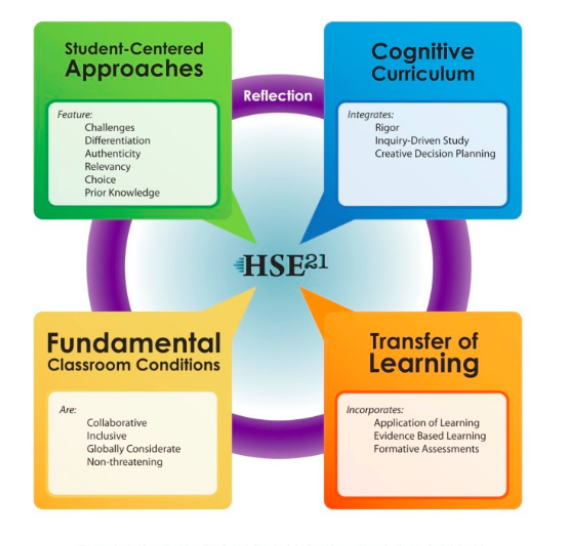
I know that most of us didn’t go into education to be able to “sell” our students information. We want our students to have a desire to learn. But just as we can’t force the horse to take a drink, we have no way to force our students to learn. In addition to the sales techniques listed below, the HSE21 best practice model is a good guide for creating the conditions in our classrooms and the learning environments that will cause our students to be thirsty for the knowledge we have to offer. Work to include the core pieces of the best practice model in your classroom everyday – don’t reinvent your lessons, just find ways to remodel them to bring the aspects that will sell our students on our content.
HSE21 Best Practice Model
How have you sold knowledge to your students? What strategies have you used that made your students excited to learn whatever you had to share with them? Share some of your successes in the comments below!
Last week I shared the following question for us to think about: Should we be worried about whether the kids are ready for the school, or should we be worried about whether the school is ready for the kids? Today I am going to share my experiences visiting a few elementary classrooms here in HSE a few weeks ago. I share these not as a way of saying that our classrooms need to mirror these classrooms, but rather to get us thinking about the learning environments that our students will be coming to us from, and in turn thinking about how the changes at elementary schools might change our practices.
A couple weeks ago I had the privilege to visit FCE and see 2 of the kindergarten classrooms that have transitioned to a Reggio Emilia approach (if you don’t know what that is, click here to learn a little more). A few of the things that stood out to me while I was there: there were no typical student desks or tables, instead there was a large picnic table (that almost the whole class could sit at) as well as a couple of coffee tables, end tables and in one of the rooms, an old dining room table; seating was flexible, there were chairs, stools, benches, tree stumps, and the floor; everything on the wall was student created, the numbers chart, the alphabet, a color chart with labels, and of course student work, I didn’t see a single thing that you would buy at “a teacher store”; all around the room there were stations with questions to get kids thinking, one allowed students to build their own birds nest, another had a mixture of various items in a pan and they could write about their thoughts; this list could go on! We were there right at the beginning of the school day, and when the students came in they put their things away and then began to explore the room. In the time that we were there, we saw high levels of engagement, and almost only heard the student voice in the classroom. I can hear some of you right now – but that was a kindergarten classroom! I agree, but are there aspects of that classroom that could translate to what we know about the developmental stages of our 5th and 6th graders?
Kindergartners explaining their mathematical thinking.
Unique seating, exploring the room, and you may notice an open door to the garden outside.
Student created patterns, and pictures of things students have noticed that include a pattern.
Unique seating choices existed all over the room, you can see a couple of the options here.
Post-it notes from an activity on things that can be built – even the chart paper is written by students.
The next stop was BSE to visit a 4th grade classroom. When we walked in, students were in the process of coming up with the essential questions for their unit on the Civil War – let me reiterate, Studentswere coming up with the essential questions. They had been provided copies of various primary source documents and artwork from the Civil War. In addition to the primary source documents, the teacher had also created a Symbaloo (if you’ve never used Symbaloo, click here to see what that is) students could use to navigate to preselected safe websites to research additional Civil War information. As I walked around, students were completely engaged in their work. As they came up with a question they were interested in, they would share with a neighbor. Eventually some of these questions would be written on a post-it and added to the essential questions chart paper at the front of the room. The role of the teacher in this classroom was one of a guide who hopped from group to group checking in to see what they were coming up with and thinking about, and at times asking questions to get them to think deeper.
Both of these classrooms were great examples of HSE21 Best Practices in action.The learning was student centered, highly rigorous, collaborative, and inclusive. So often as teachers at the intermediate level we build our expectations for our students based on where the students need to get to. Intermediate schools in HSE were not originally created to be mini junior highs, and in many districts 5th and 6th graders are still in the elementary school. Again, I’m not saying that we’re doing something wrong, or we need to imitate the examples above, but based on what we know about the developmental stages of our students, what aspects of these classrooms might be beneficial to our students?
What ideas do you take away from the descriptions of these classrooms? Are there things you could see translating to your own classroom? What might it be? How might the physical appearance of your classroom change as you think about the students that will be joining us? How might teaching and learning look different in your classroom based on these descriptions? Are any of you interested in thinking about what a Reggio approach might look like in an intermediate setting? Share your thoughts in the comments below!
Last week I received an email from one of my favorite blogs directing me to a post titled “What Teachers Can Learn About Failure From Elon Musk” (you can click on the link if you’d like to see the original post). The gist of the post is that as teachers and learners, we have to fail, and be willing to share those failures, as part of the learning process. I thought of the saying “Fail Forward” as I read one of the early paragraphs.
The post then talked a lot about Elon Musk. This is a guy I had heard of – I’ve seen his TED Talk, Tesla makes some pretty cool cars, and as a self described nerd, I have watched multiple SpaceX launches and attempts at landing with interest. So as I was reading about Musk, I was curious to be directed to a series of posts about Elon Musk from the blog Wait But Why (Check it out here: Elon Musk: The World’s Raddest Man). After going deep into some background on the history of fossil fuels, automotives, space travel, and a few other topics, I also walked away with a newfound interest in Elon Musk, as well as an understanding of why Tim Urban, the author of Wait But Why, describes Musk as such a rad dude.
As a college student what were you thinking about? When Musk was in college, he asked himself “What will most affect the future of humanity?” His list contained 5 things: “The internet; sustainable energy; space exploration with a goal of life beyond Earth; artificial intelligence; and reprogramming the human genetic code.” I can tell you that as a college student, this is most certainly not what I was thinking about!
So here’s a brief rundown of Musk’s career:
1995 – starts Zip2 – think Yelp and Google Maps in a pre-smartphone era – in 1999 at the age of 27 Zip2 sells for $307 million, and Musk’s take was $22 million.
1999 – Musk takes three quarters of his personal net worth to start X.com – an online bank (before those really existed). X.com merged with Confinity to create a money-transfer service that we now know of as PayPal.
2000 – Musk is replaced as CEO of PayPal, but stays on the team in a senior role.
2002 – eBay bought PayPal for $1.5 billion, and Musk walked away this time with $180 million. He was 34 years old.
Also in 2002 – Musk begins researching rocket technology and after the finalization of the sale of PayPal, he invests $100 million of his own money in a rocket company called SpaceX. The stated goal of the company was to revolutionize the cost of space travel in order to make humans a multi-planetary species by colonizing Mars with at least a million people over the next century.
Let that sink in for a minute… In the span of 7 years he went from dropping out of a Stanford PhD program to starting SpaceX.
And he wasn’t done yet…
2004 – still in the middle of the SpaceX experiment, Musk personally invested $70 million into an electric car company called Tesla. The last successful US car startup was Chrysler in 1925.
2006 – invests $10 million to found another company – SolarCity with the goal of revolutionizing energy production by creating a large distributed utility that would install solar panel systems on millions of people’s homes and reducing their consumption of fossil fuel generated electricity. Because, I mean, what else did he have to do?!!
Side note: As I was reading through this, especially in reading about what Musk has done since 2002, I couldn’t help thinking of someone winning the PowerBall and deciding that they are going to use their money to feed the people of Africa, only to go bankrupt before they send anything across the Atlantic! I wonder what I would have done if I was in his shoes when PayPal sold to eBay – it would be so tempting to take that money and go live on a tropical island for the rest of my days!
So, what does this have to do with failing forward you might ask. Looking over the list of accomplishments above, it might be hard to find the failure. During a 2005 interview with Fast Company, Musk was quoted as saying “Failure is an option here. If things are not failing, you are not innovating enough.” He was speaking about the culture of business at SpaceX.
Let’s look at some of the failures in his time at SpaceX:
I’ll admit – this isn’t a picture of one of the failed launches, but look at it! How cool is that???
2006: First launch – failure
2007: Second launch – failure
2008: Third launch – failure
At this point, it was easy to have doubts in the likelihood of success for SpaceX. They had yet to prove that they had the ability to be successful. And yet, those who worked at SpaceX, Musk included, were supremely confident. With each of the failures, that had been livestreamed to the world, the company had learned and made improvements. The engineers and scientists at SpaceX would go back to the drawing board and try to improve.
In the fall of 2008 SpaceX only had enough money to try one more launch. Failure here would mean failure to the entire company. But on the fourth launch they achieved complete success. With it came new funding in the form of funds from NASA to make multiple deliveries to the International Space Station. So what does this have to do with education?
In reading about SpaceX, Tesla, and other companies that Musk has been involved in, the key to their success is the feedback that the company seeks from it’s failure. They are working in fields where there has been little to no success, so there isn’t a blueprint of how to succeed. Failure is part of the process, whether they are building a rocket, a car, a battery for the car, or some other component in the process.
We can all agree that failure is an important part of the learning process. But for it to be a learning experience, failure can’t be the end point for our students. We can’t just put a failing grade in the grade book and move on. Instead we mark that section at ‘needs improvement’ and we get back to work through meaningful feedback. At SpaceX and Tesla, that feedback is an important part of the process to innovate.
Check out this video of a launch in June of this year. It will pick up about 10 seconds before launch. If you watch until about 2 minutes after lift-off, you’ll see the result:
As you can see, SpaceX still has failure. But those failures continue to result in innovation!
We need to be providing that same type of feedback for our students. There should be a two-way feedback loop between a teacher and student. You have to provide your students feedback on the work that they are submitting. It must be specific and lead to action that your students can take in their learning. At the same time, your students have to be able to provide you feedback about their learning. They need opportunities to make choices – in what they are learning, how they are learning it, how they are showing their learning.
Students can feel defeated when they try something new and things don’t go as they hope. We have to continue to help them to understand that the journey is just as important, if not more so, than the end point. We all learn from our failures, and getting up and trying it again shows that we are truly working for something better.
And just to show that success in one place doesn’t mean an endpoint, it’s important to think about what Musk and SpaceX are up to now. They’ve shown they can successfully launch a rocket a get a payload to the ISS, but now they are trying to learn how to land a rocket that has just been in orbit onto a landing pad in the ocean. Because, duh! Why not???
So far, no success. All four attempts have been failures. But think back to Musk’s earlier quote – failure is an option. I’m guessing that before too long, we’ll see a successful landing by SpaceX on a launch pad in the middle of the ocean. When you see that landing, remember that it didn’t just happen. It took tons of man-hours to get the feedback necessary to learn and adapt. In the same way, our students need our feedback in order to continue to learn and grow.
Think back to a time that you learned something from a failure. What steps did you take to improve? Did you eventually find success? Share with us in the comments below. Or share your own example of a person who has show you what it means to “fail forward.”
In last week’s post I shared a little about the value that connectedness can provide to educators. This week I want to share some of the ways that you can use social media for personalized PD. As I shared last week, online educator communities provide you with 24/7 access to people, ideas, resources, philosophies, and opportunities that can expand your world (and the world of our students). So here are some of the reasons I get excited to connect online:
Inspiration: Many of the new things that I try here at school are because of something I have learned through a tweet, blog post, or somewhere online.
Motivation: Several of the twitter accounts I follow are educators who love to tweet out pictures and quotes that motivate me to try to be better. That little bit of motivation can be such an awesome help!
Challenge: I intentionally follow some people because they have different opinions than me. I do this because I want to have a full background. Every once in a while something that someone shares truly challenges my thinking in a way that makes me reflect on my beliefs.
Camaraderie: I have been able to find connections with many other teachers and administrators all over the country/world!
Apps: You can use your digital connections to learn about new apps for a specific purpose, or ideas for better ways to use the apps you already have.
Humor: Just like our Friday funnies, there are funny things that happen in schools every day. Some of those things show up in my timeline and give me the opportunity to laugh.
Collaboration: Through online connections you can work with almost anyone in the world. You can find teachers all over the world teaching the same material, and create connections that allow you to learn from them, and they can learn from you.
So how do we connect? And how do we find the time? That’s total up to you, but there are a couple of options that you could try, and the amount of effort you put into them is totally up to you!
Social Media: For me, this is the best way to connect. Twitter is my favorite choice, but Facebook, Instagram, and Pinterest are good ones as well. My favorite thing about Twitter is that every post is 140 characters or less. It’s amazing how much info can be packed into such a short amount of space. The biggest thing to know on Twitter is how to use a hashtag. A couple of my favorites are #edchat and #edtech. Tons of great ideas get shared, and if you post something with one of those hashtags, you will get a ton of people to see your post. (For more education hashtags, take a look at the links in last week’s post)
Blogs: There are thousands of blogs about education out there! Most of my favorite blogs that I follow are because of connections I have made on Twitter. I use Feedly.com as an RSS aggregator that keeps all my blogs in one place. Each time a new blog that I follow posts, it shows up in my feed. When I have time, I’ll peek at it. If my day is too busy, I’ll skip it. Feedly can also help you find other blogs based on topics you are interested in. In addition to reading blogs, you can also start writing a blog. Share the things you know – creation is one of the highest levels of thinking. It can also be a huge time commitment – these posts don’t write themselves! Some post daily, some are a few days a week, some are less regular than that.
Being a connected educator will make it easier to transform education in your classroom. You will find new ideas, you will be able to ask questions, and you will be able to share your own thinking and give back to the community! Invest the time that makes sense to you. There are days I don’t get on Twitter at all, and there are days where I have extra time and might spend an hour or two reading, adding, and building connections.
What tools have allowed you to connect and change the way you teach? Share with the rest of us below!
In this week’s post, I would like to build upon the ideas of a post from before winter break titled Choosing to Cheat. The concept of that post was built on the idea that we don’t have an unlimited amount of time in our days to be able to fulfill all of our priorities. Feel free to go back to that post if you would like.
For some of us it is difficult thing to think about cheating at anything. We might think “If I skimp here, my students might not get it.” Or we might say “If it doesn’t look pretty and perfect, I won’t feel as proud of it.” There are a lot of people who spend a lot of time in this school building. They are all effective or highly effective teachers. Sometimes it’s hard to leave the building knowing that there is more that could be done. But for all the teachers who put in long hours, there are others who do not spend that amount of time in the building. Does that mean that the teachers who spend less time are less effective? Or is there something more to the story?
In order to be more effective in our time management, we have to think about the concept of the minimum effective dose (MED). Tim Ferriss, the author of The 4-Hour Workweek, defines the MED as:
“the smallest dose that will produce the desired outcome. Anything beyond the MED is wasteful. To boil water, the MED is 212 degrees Fahrenheit at standard air pressure. Boiled is boiled. Higher temperatures will not make it more boiled. High temperatures will just consume more resources that could be used for something more productive.”
There are lots of examples out there of people who have cut back the amount of time spent, only to find that it actually improved their outcome. As a runner I always taper the amount I run in the last couple of weeks leading up to a big event so that I will feel fresh on the day of the race. Every year at the end of the NFL season you hear analysts arguing about whether a certain team should rest their star players prior to the playoffs. I follow a couple of blogs that post daily, but rarely do I have time to read them every day. On the days I miss a post, I feel as though I am missing something that could be important. If the authors of those blogs cut back to 3 posts a week, I wouldn’t be upset. I might actually be able to read everything they post!
Ultimately, we have to remember that our audience are the kids sitting in our classroom. No matter how hard we work, they are only going to take in as much as they think is necessary to be able to complete your upcoming performance task. So think, are you trying to over boil the water in your classroom? Remember, water temp can’t go over 212 degrees, no matter how much energy you put in. At the same time, no amount of overwork will cram more info into your students’ heads if they can’t absorb it. Keep your focus on your goals and what you want to accomplish. Try to reduce the wasteful or ineffective things we do, and ultimately we will use our time in more valuable ways! In the Choosing to Cheat post, I shared the chart below. Focus on placing your energy in the activities that we believe will help our students grow.
Use this to help guide your thinking and the areas where you may choose to cheat.
As for how much time to spend at school, I can’t say that there is a correct answer to that questions. At different phases in my life there have been different amounts of time spent. I feel that through appropriate time management, we can all do our job to the best of our ability, and meet the needs of our students in a reasonable amount of time.
Have you ever tried to over boil the water? What are some of the things you cut when your realized you were doing more than you actually had to? Share in the comments below!
It’s the beginning of class, and you are checking to see what students came to class prepared, and you get to “that” student (admit it, a name just came to your mind!), and of course, they are not prepared for class today. This is the third time this week, and who knows how many times this month…
All of us have been there at one time or another. It can be so hard not to take it personally. In your mind you may think about the amount of time you have invested in that student, or the help that you provided yesterday to make sure that student was organized and prepared to be able to finish the homework, or maybe you think of the assurances you had from the parents who told you they would help make sure work was being completed. How can we not take it personally?
Of course, the reality is that for the vast majority of our students, they are not doing this purposely (although on the day I am writing this, I did see a student with a t-shirt that said “I’m just here to annoy you!”). In fact, you are probably the furthest thing from their mind when a student does not complete his work. Instead, the lack of completion could be for a lot of reasons (maybe they didn’t understand how to do the assignment, maybe they didn’t want to do it, maybe they thought it was boring, or maybe there was nobody at home to make sure they did it – you get the idea, there are lots of possible reasons). I think logically all of us understand that students are not intentionally coming to class unprepared in an effort to drive us crazy, and yet we can’t help but feel that way.
One of the great beliefs I have about education is that relationships are one of the keys to success for our students. I know that many of you feel the same way. We take the time to build relationships with all our students. We feel invested in each of them. We can’t help but believe that the feeling is mutual. Unfortunately, our students don’t always feel the same way. Sometimes even with our best effort, it is hard to help all our students to feel connected here at school.
When “that” student comes to class unprepared, the simple solution is often to get angry or frustrated. It is much more difficult to figure out the answer to the key question – why?
Finding the answer to the question of why is not easy. The answers that students will give run the gamut – I forgot, I had a basketball game last night, my parents couldn’t help me, etc. A lot of time we see these answers as excuses. Instead, maybe we should look at them as clues. If they say they forgot, are they disorganized? Do they need additional support so that they won’t forget in the future? Could you help them set an alert on the iPad or phone to go off in the evening to remind them of the work they have to do tonight? If they say that they had another activity, can we assess what they do have done to see if they understood the concept? Do they need more work time here at school? We can’t control how their time is scheduled outside of school hours, but we can help control how that student uses their time here at school. If they say they didn’t have a parent to help them, then do they need to have the concept retaught to them? If a student needs a parent’s help to be able to complete a homework assignment, then they don’t really understand the material.
In last week’s post we discussed growth mindset in teachers. An argument could be made that situations like the one described at the beginning of this post could be the perfect opportunity to use some of what we learned about having a growth mindset. Instead of taking it personally when a student isn’t prepared for class, look at it as a puzzle to be solved. Try to understand why the student isn’t prepared. Once you understand the why, it will be much more likely that we can approach a solution. If you don’t have an idea of how to help the student, talk to your colleagues, counselors, or administrators to see what ideas they may have (collaboration = more opportunities for growth!).
If you’re still struggling to come up with a way to motivate the student, come at the problem from a PBIS perspective. Most of our kids who struggle simply want attention of some kind. Getting negative attention is easy, but when given a choice between a positive and a negative consequence, most kids will choose the positive (it’s amazing what I used to get kids to do for a sticker or a jolly rancher!). And if you show them that it is possible to earn that positive consequence, then they find success. Once they show a pattern of success, you can make it more difficult to earn that positive feedback, and hopefully the student will begin to learn that the feeling of success from a job well done is a good enough reward (I know that this process takes longer than we like, but it does work!).
Instead of looking at the unprepared student as the enemy, spend some time thinking about them as a puzzle. If you don’t know what will motivate him, spend some time to get to know him (2 for 10 strategy). Look back on one of our earlier posts: Know your kids – Love you kids for a little more on how a 2 minute conversation can help you learn about your kids.
What success have you had in motivating the unmotivated or reaching the unreachable? Spread the wealth! Share some of your experiences in the comments below.
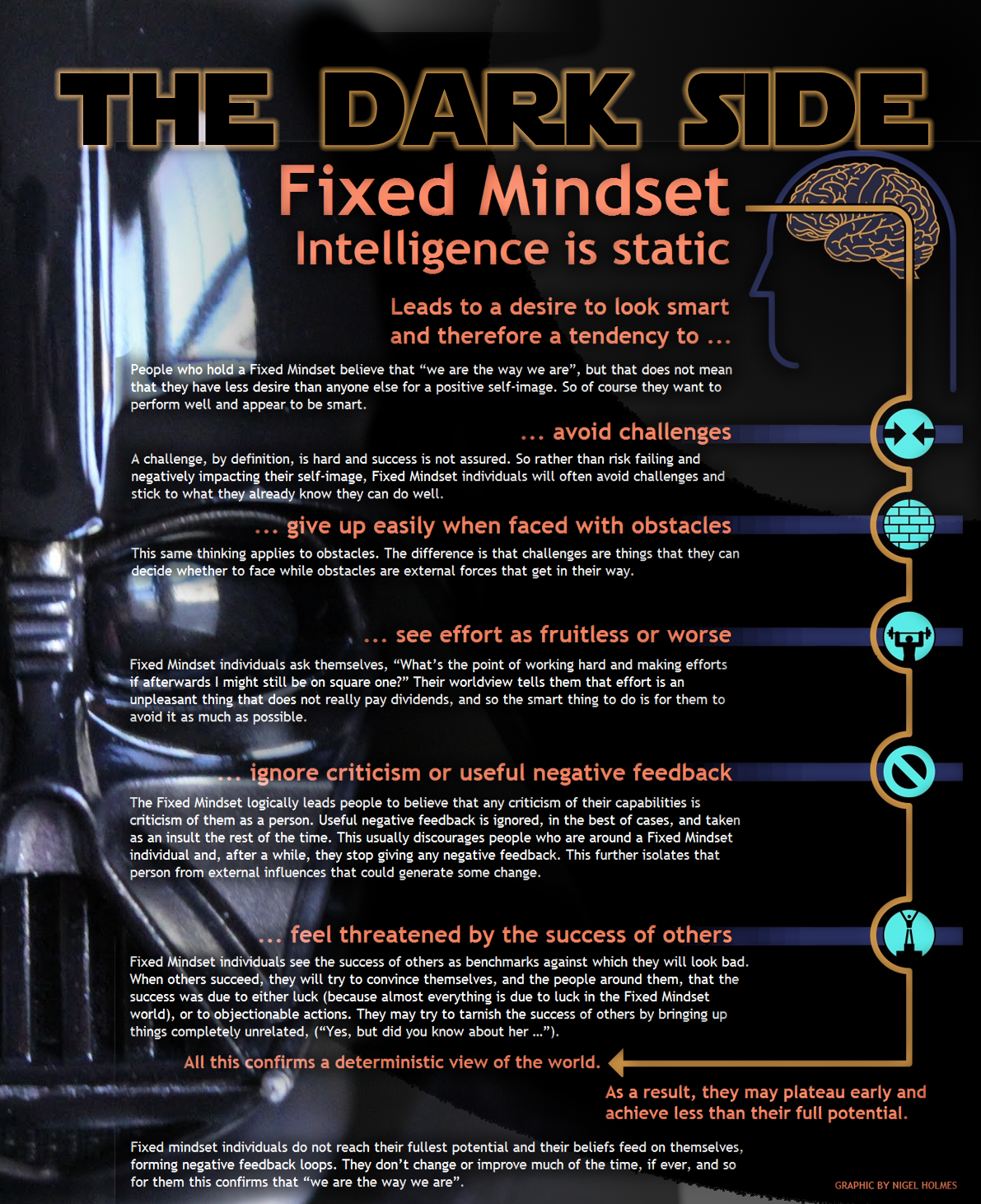
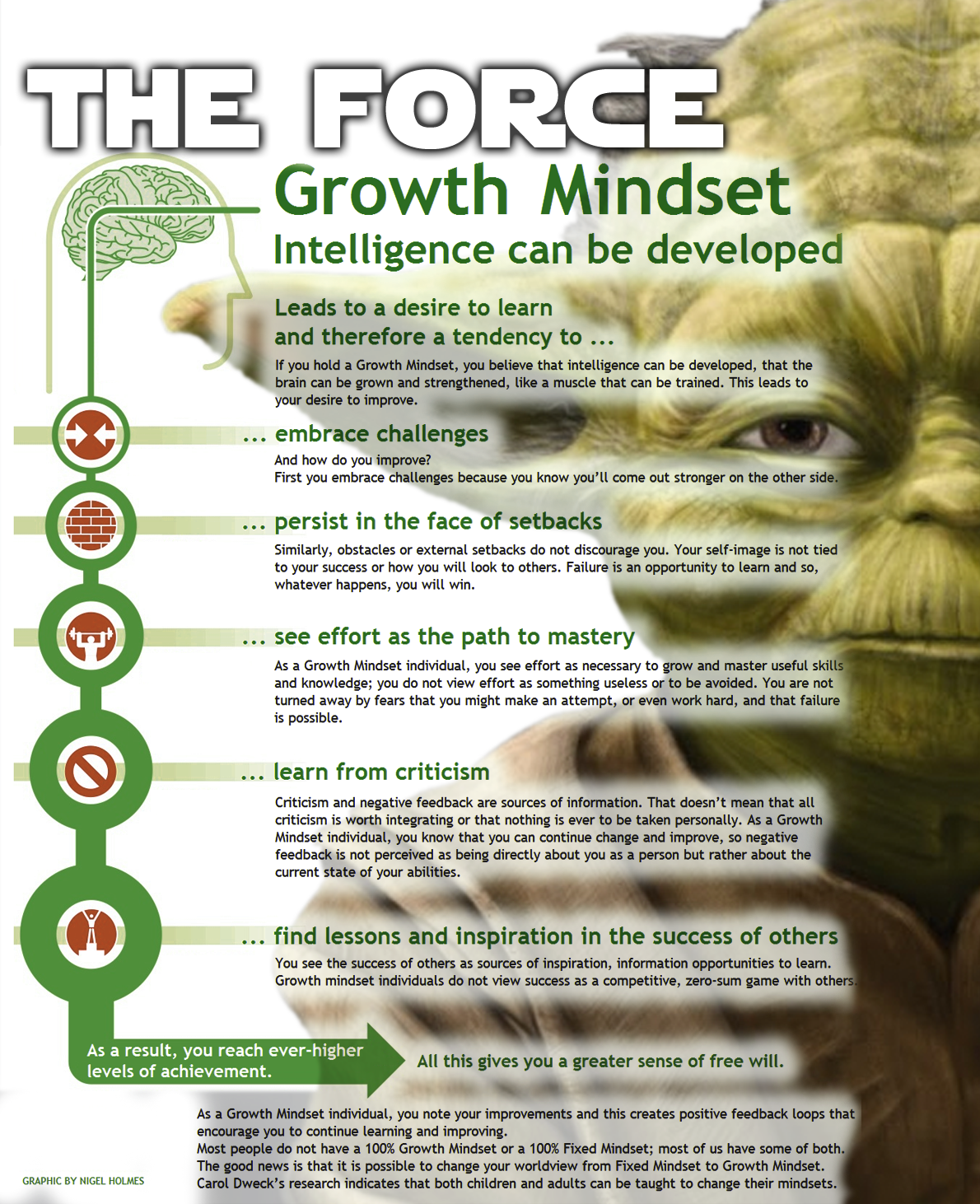
Over the past couple of years I have had several conversations with members of our school community about the idea of Fixed Mindsets vs. Growth Mindsets. I previously shared a video featuring some of the findings of Carol Dweck. In those conversations and in that video, the discussion is framed around how to help our students to develop a growth mindset. What about all of us? How do our mindsets impact the learning that takes place in our classrooms? How might those mindsets impact our relationships with students? As a review, I included a couple of graphics showing the difference between a Fixed or Growth Mindset. (I know the pictures below appear small – if you click on them, they will be easier to read).
In a fixed mindset students believe that their basic abilities, their intelligence, their talents, are just fixed traits. They have a certain amount and that’s that, and then their goal becomes to look smart all the time and never look dumb. In a growth mindset students understand that their talents and abilities can be developed through effort, good teaching, and persistence. They don’t necessarily think everyone’s the same or anyone can be Einstein, but they believe everyone can get smarter if they work at it.
What if you reread that statement, but you replace students with teachers? Where do you fall? Are your abilities as a teacher a fixed trait, or do you believe that your talents and abilities can be developed through effort? Are you somewhere in the middle? Draw a continuum with Fixed on one end, and Growth on the other. Put an X where you think you are, and then ask if you are comfortable with that location on the continuum. If the answer is no, how can you move that X to where you want it to be?
One of the things that concerns me most for teachers comes from the second sentence of Dweck’s definition above. Is it your goal to “look smart all the time and never look dumb”? What does that show our students? If we tell them that they should see failure as a first attempt in learning, but never model for them what it looks like to fail and then improve, what message are we sending our students? Do we really want to have an attitude of “do as I say, but not as I do”?
I’ll admit, it’s never fun to make a mistake in front of a group of students. But let’s think about the concept of gradual release – I do, we do, you do. We would never assign our students something they have never done before without modeling it and expect them to be successful on their first try. Instilling a growth mindset in our students means we have to be willing to take risks, and sometimes fall flat on our face. Then, we can model for our students what it looks like to get back up, dust yourself off, make an adjustment, and do better the next time.
If you look at yourself as a learner first, and a teacher second, you will recognize that this craft we carry out is something that we are all learning. Every day that I’m here at school, I see someone doing something that I’ve never seen before. When I scroll through my Twitter feed in the evening I often end up reading education related blog posts that provide me with new ideas or ways of thinking. I see things my friends share on Facebook, and I get new ideas. Hopefully you see your experiences here at school, and those outside of school, as something that you can learn and grow from as well. Hopefully you’ll be looking for ways to shift your own mindset further down that continuum towards the ideas of growth.
Throughout this month I hope to use this forum as a way to look further at the Growth Mindset continuum, and in particular focus in on how our mindsets can affect our relationships with the students sitting in our classroom.
In the comments below, feel free to share with us a time that you may have fallen flat on your face. What steps did you take to correct it? What did your students learn from your failure? Or you can share something that you plan to try that you aren’t quite sure how it will work out. What are you nervous about? What’s the worst that could happen? I look forward to hearing from you!




















 The View from 518

