The importance of failure (and a little about Elon Musk)

Last week I received an email from one of my favorite blogs directing me to a post titled “What Teachers Can Learn About Failure From Elon Musk” (you can click on the link if you’d like to see the original post).  The gist of the post is that as teachers and learners, we have to fail, and be willing to share those failures, as part of the learning process.  I thought of the saying “Fail Forward” as I read one of the early paragraphs.

elon-muskThe post then talked a lot about Elon Musk.  This is a guy I had heard of – I’ve seen his TED Talk, Tesla makes some pretty cool cars, and as a self described nerd, I have watched multiple SpaceX launches and attempts at landing with interest.  So as I was reading about Musk, I was curious to be directed to a series of posts about Elon Musk from the blog Wait But Why (Check it out here: Elon Musk: The World’s Raddest Man).  After going deep into some background on the history of fossil fuels, automotives, space travel, and a few other topics, I also walked away with a newfound interest in Elon Musk, as well as an understanding of why Tim Urban, the author of Wait But Why, describes Musk as such a rad dude.

As a college student what were you thinking about?  When Musk was in college, he asked himself “What will most affect the future of humanity?”  His list contained 5 things: “The internet; sustainable energy; space exploration with a goal of life beyond Earth; artificial intelligence; and reprogramming the human genetic code.”  I can tell you that as a college student, this is most certainly not what I was thinking about!

Whatever skeptics have said can't be done, Elon has gone out and made it real. Remember in the 1990s, when we would call strangers and give them our credit-card numbers- Elon dreamed upSo here’s a brief rundown of Musk’s career:

1995 – starts Zip2 – think Yelp and Google Maps in a pre-smartphone era – in 1999 at the age of 27 Zip2 sells for $307 million, and Musk’s take was $22 million.

1999 – Musk takes three quarters of his personal net worth to start X.com – an online bank (before those really existed).  X.com merged with Confinity to create a money-transfer service that we now know of as PayPal.

2000 – Musk is replaced as CEO of PayPal, but stays on the team in a senior role.

2002 – eBay bought PayPal for $1.5 billion, and Musk walked away this time with $180 million.  He was 34 years old.

Also in 2002 – Musk begins researching rocket technology and after the finalization of the sale of PayPal, he invests $100 million of his own money in a rocket company called SpaceX.  The stated goal of the company was to revolutionize the cost of space travel in order to make humans a multi-planetary species by colonizing Mars with at least a million people over the next century.

SpaceX Logo

Let that sink in for a minute…  In the span of 7 years he went from dropping out of a Stanford PhD program to starting SpaceX.

And he wasn’t done yet…

Tesla-Motors-logo-2

2004 – still in the middle of the SpaceX experiment, Musk personally invested $70 million into an electric car company called Tesla.  The last successful US car startup was Chrysler in 1925.

2006 – invests $10 million to found another company – SolarCity with the goal of revolutionizing energy production by creating a large distributed utility that would install solar panel systems on millions of people’s homes and reducing their consumption of fossil fuel generated electricity. Because, I mean, what else did he have to do?!!

Side note: As I was reading through this, especially in reading about what Musk has done since 2002, I couldn’t help thinking of someone winning the PowerBall and deciding that they are going to use their money to feed the people of Africa, only to go bankrupt before they send anything across the Atlantic!  I wonder what I would have done if I was in his shoes when PayPal sold to eBay – it would be so tempting to take that money and go live on a tropical island for the rest of my days!

So, what does this have to do with failing forward you might ask.  Looking over the list of accomplishments above, it might be hard to find the failure.  During a 2005 interview with Fast Company, Musk was quoted as saying “Failure is an option here.  If things are not failing, you are not innovating enough.”  He was speaking about the culture of business at SpaceX.

Let’s look at some of the failures in his time at SpaceX:

I'll admit - this isn't a picture of one of the failed launches, but look at it! How cool is that???
I’ll admit – this isn’t a picture of one of the failed launches, but look at it! How cool is that???

2006: First launch – failure

2007: Second launch – failure

2008: Third launch – failure

At this point, it was easy to have doubts in the likelihood of success for SpaceX.  They had yet to prove that they had the ability to be successful.  And yet, those who worked at SpaceX, Musk included, were supremely confident.  With each of the failures, that had been livestreamed to the world, the company had learned and made improvements.  The engineers and scientists at SpaceX would go back to the drawing board and try to improve.

In the fall of 2008 SpaceX only had enough money to try one more launch.  Failure here would mean failure to the entire company.  But on the fourth launch they achieved complete success.  With it came new funding in the form of funds from NASA to make multiple deliveries to the International Space Station.  So what does this have to do with education?

In reading about SpaceX, Tesla, and other companies that Musk has been involved in, the key to their success is the feedback that the company seeks from it’s failure.  They are working in fields where there has been little to no success, so there isn’t a blueprint of how to succeed.  Failure is part of the process, whether they are building a rocket, a car, a battery for the car, or some other component in the process.

We can all agree that failure is an important part of the learning process.  But for it to be a learning experience, failure can’t be the end point for our students.  We can’t just put a failing grade in the grade book and move on.  Instead we mark that section at ‘needs improvement’ and we get back to work through meaningful feedback.  At SpaceX and Tesla, that feedback is an important part of the process to innovate.

Check out this video of a launch in June of this year.  It will pick up about 10 seconds before launch.  If you watch until about 2 minutes after lift-off, you’ll see the result:

As you can see, SpaceX still has failure.  But those failures continue to result in innovation!

We need to be providing that same type of feedback for our students.  There should be a two-way feedback loop between a teacher and student.  You have to provide your students feedback on the work that they are submitting.  It must be specific and lead to action that your students can take in their learning.  At the same time, your students have to be able to provide you feedback about their learning.  They need opportunities to make choices – in what they are learning, how they are learning it, how they are showing their learning.

Students can feel defeated when they try something new and things don’t go as they hope.  We have to continue to help them to understand that the journey is just as important, if not more so, than the end point.  We all learn from our failures, and getting up and trying it again shows that we are truly working for something better.

And just to show that success in one place doesn’t mean an endpoint, it’s important to think about what Musk and SpaceX are up to now.  They’ve shown they can successfully launch a rocket a get a payload to the ISS, but now they are trying to learn how to land a rocket that has just been in orbit onto a landing pad in the ocean.  Because, duh!  Why not???
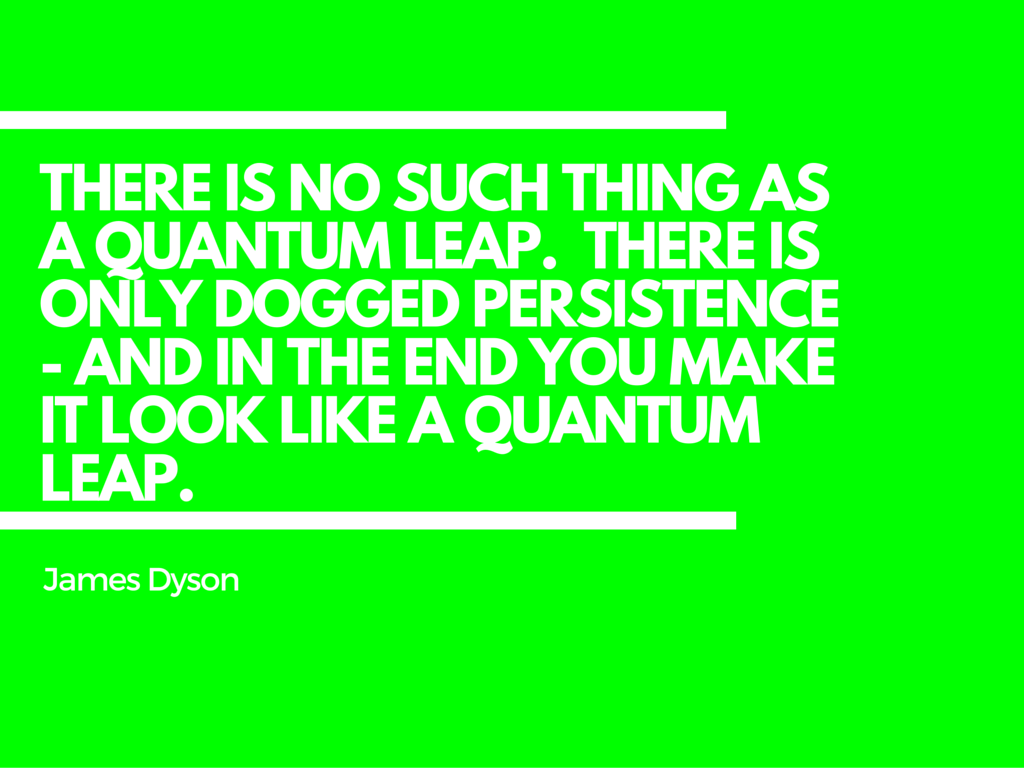
There is no such thing as a quantum leap. There is only dogged persistence - and in the end you make it look like a quantum leap.So far, no success.  All four attempts have been failures.  But think back to Musk’s earlier quote – failure is an option.  I’m guessing that before too long, we’ll see a successful landing by SpaceX on a launch pad in the middle of the ocean.  When you see that landing, remember that it didn’t just happen.  It took tons of man-hours to get the feedback necessary to learn and adapt.  In the same way, our students need our feedback in order to continue to learn and grow.

Think back to a time that you learned something from a failure.  What steps did you take to improve?  Did you eventually find success?  Share with us in the comments below.  Or share your own example of a person who has show you what it means to “fail forward.”

Be a Connected Educator (Part 2)

https://plus.google.com/+SylviaDuckworth/posts/61rTzdcJ1yG?pid=6097161572876797314&oid=114228444007154433856

In last week’s post I shared a little about the value that connectedness can provide to educators.  This week I want to share some of the ways that you can use social media for personalized PD.  As I shared last week, online educator communities provide you with 24/7 access to people, ideas, resources, philosophies, and opportunities that can expand your world (and the world of our students).  So here are some of the reasons I get excited to connect online:


  • Inspiration: Many of the new things that I try here at school are because of something I have learned through a tweet, blog post, or somewhere online.
  • Motivation: Several of the twitter accounts I follow are educators who love to tweet out pictures and quotes that motivate me to try to be better. That little bit of motivation can be such an awesome help!
  • Challenge: I intentionally follow some people because they have different opinions than me. I do this because I want to have a full background.  Every once in a while something that someone shares truly challenges my thinking in a way that makes me reflect on my beliefs.
  • Camaraderie: I have been able to find connections with many other teachers and administrators all over the country/world!
  • Apps: You can use your digital connections to learn about new apps for a specific purpose, or ideas for better ways to use the apps you already have.
  • Humor: Just like our Friday funnies, there are funny things that happen in schools every day. Some of those things show up in my timeline and give me the opportunity to laugh.
  • Collaboration: Through online connections you can work with almost anyone in the world. You can find teachers all over the world teaching the same material, and create connections that allow you to learn from them, and they can learn from you.

So how do we connect?  And how do we find the time?  That’s total up to you, but there are a couple of options that you could try, and the amount of effort you put into them is totally up to you!

Our connections on social media allow us to connect with educators like never before!  Matt Miller - https://www.flickr.com/photos/126588706@N08/14562418440/in/album-72157645530010989/
Our connections on social media allow us to connect with educators like never before!
Matt Miller – https://www.flickr.com/photos/126588706@N08/14562418440/in/album-72157645530010989/

Social Media: For me, this is the best way to connect.  Twitter is my favorite choice, but Facebook, Instagram, and Pinterest are good ones as well.  My favorite thing about Twitter is that every post is 140 characters or less.  It’s amazing how much info can be packed into such a short amount of space.  The biggest thing to know on Twitter is how to use a hashtag.  A couple of my favorites are #edchat and #edtech.  Tons of great ideas get shared, and if you post something with one of those hashtags, you will get a ton of people to see your post.  (For more education hashtags, take a look at the links in last week’s post)

Blogs: There are thousands of blogs about education out there!  Most of my favorite blogs that I follow are because of connections I have made on Twitter.  I use Feedly.com as an RSS aggregator that keeps all my blogs in one place.  Each time a new blog that I follow posts, it shows up in my feed.  When I have time, I’ll peek at it.  If my day is too busy, I’ll skip it.  Feedly can also help you find other blogs based on topics you are interested in.  In addition to reading blogs, you can also start writing a blog.  Share the things you know – creation is one of the highest levels of thinking.  It can also be a huge time commitment – these posts don’t write themselves!  Some post daily, some are a few days a week, some are less regular than that.

Being a connected educator will make it easier to transform education in your classroom.  You will find new ideas, you will be able to ask questions, and you will be able to share your own thinking and give back to the community!  Invest the time that makes sense to you.  There are days I don’t get on Twitter at all, and there are days where I have extra time and might spend an hour or two reading, adding, and building connections.

What tools have allowed you to connect and change the way you teach?  Share with the rest of us below!

Be a connected educator (Part 1)

How often have you felt that you were “alone” in your classroom?  You plan for your students – nobody else’s class is quite like yours.  You plan for your content – nobody else is at quite the same place as you.  It’s easy to build up walls and confine yourself to them.  But think for a second…  Is that what’s best for you?  Is that what’s best for the kids in your class?

When we provide more students the opportunities to share in the classroom, we are building bridges to the world instead of placing them in a silo. https://www.flickr.com/photos/126588706@N08/14749002232/in/album-72157645530010989/
When we provide more students the opportunities to share in the classroom, we are building bridges to the world instead of placing them in a silo.
https://www.flickr.com/photos/126588706@N08/14749002232/in/album-72157645530010989/

If the answer you find yourself coming to is no, then it’s time to think about how to connect beyond the walls of you classroom.  I think we all know that there is a wealth of information out there on the internet.  Can you imagine what teaching was like before Google? (I’m sure some of you are saying “Yes!  I lived it!”).  I think we all know that we can find great resources with a simple web search, but sometimes we find a lot of junk too!  Taking the time to sift through it all can be time consuming!  What if there was a way to connect with others who did have students similar to ours, or who were sharing something that was just right for your class to do as well.

14746748124_db83c93b04_b
One of the best ways to connect with other educators is through Twitter! Matt Miller: https://www.flickr.com/photos/126588706@N08/14746748124/in/album-72157645530010989/

In addition to websites, there are also other educators out there waiting and eager to help you!  Or they might be looking for the help that you can provide them.  The community of educators on Twitter grows every week.  According to one report from Twitter, about 1 in every 100 tweets are related to education, and there are about a half-billion tweets a day!  You can tweet at someone, or just to a hashtag, and get a response in moments.  For an overwhelmingly long list of education hashtags, check out this link: http://cybraryman.com/edhashtags.html.  Some of those hashtags are related to education twitter chats – you can see a calendar of what’s out there here: Education Chat Calendar.

You can also connect with other schools and teachers for your students benefit.  Earlier this year, my daughter’s first grade class did a Skype session with a class in New Hampshire to learn about geography and discuss a book from the Global Read Aloud.  This was the third Skype session (that I’m aware of).  Their online connections included chatting with the author of a book they read, and talking with another class in Colorado.

Last week Barbara tried out a Mystery Skype with her class (she can tell you more about how it went), and once the technology was working correctly, it was a cool experience for the kids in her class.  All over HSE, there are elementary classrooms participating in mystery Skype’s to learn about new places and things.  Want to know more about the idea behind a Mystery Skype, click here!

It’s also important to point out that here at RSI, we have several staff members who already use Twitter from their classroom.  If you want to know more about it, just ask Jenna, Mary Lynn, Barbara, Christian, Samantha, Mary, or Krista and Jennifer (you can also click on their name to go to their Twitter page) about how they use Twitter to connect with the world beyond our walls.  As a parent I also feel that Twitter enriches my understanding of what is happening in my daughter’s class.  I have followed and subscribed to Lainey’s teacher, Courtney Gibson, and I get alerts whenever she posts a tweet (typically just once or twice a week).  Sometimes she shares what they are doing, sometimes there is a picture, but always it tells me something about what the class has been doing which in turn allows me to have a conversation with Lainey about her learning.  If you want to see how it’s used by her teacher, click here.

Online educator communities provide you with 24/7 access to people, ideas, resources, philosophies, and opportunities that can expand your world (and the world of our students).  In next week’s post, I’ll talk a little more about some of the benefits of an online presence.

How have you used digital connections to improve learning opportunities for your students?  What new things have you learned or tried?  Share with us below!

Reading as a way of learning

ReadingWhen posting on the blog this year, I have mentioned several books that I have read in connection to my topics.  A few of you have asked me questions along the lines of “how do you find time to read that much?”  The reality is that I, much like any of you, have a pretty busy schedule with lots of things to do.  If I wanted to, I could work all day on things in my office and never truly feel done, however if I did that, I would be stressed, overworked, and unhappy.  Outside of school I have responsibilities too; my family, my friends, and my own fitness and health.  With all of these things, it would be easy to say that I don’t have time to read, but I’m not willing to do that!  I love reading!

Reading is one of the things I really really love!

So, with all those responsibilities, how do I find the time to read as much as I do?  There are a couple of ways.  First is at the beginning of the day.  Most days I arrive here at school, log into my computer, and before doing anything else, I pick up a book and read for 10-15 minutes.  I try to make sure that reading is professional in nature.  If you expand that over the course of a school year, 10-15 minutes a school day turns into 30-45 hours of reading in a school yer!  Give me that much time and I can knock out a ton of books and learn so much!  In addition to those 10-15 minutes, I always have a book in iBooks that I am reading.  That means I have it on my phone and I can pick it up anytime – waiting at the shop for them to finish my oil change?  I could waste my time on Facebook or Twitter, or I could read some of my book.  I also try to take a little bit of time at the end of the day before bed to read.  It helps me wind down my day and clears up any stress I may have previously felt.  I know a lot of people love to get on their favorite social media site at the end of the day, but that just doesn’t do it for me.  I’m intentional in my practice of finding time to read.  I could watch a random basketball game, or another episode of whatever I’ve been watching on Netflix, and sometimes I do, but often I end up feeling like I’m wasting my time.

I'd love to have a room that looks like this!
I’d love to have a room that looks like this!

So then the question comes, how do you pick a new book?  I’m always looking for book ideas.  One book I am currently reading was mentioned during a conference I was at.  Another book I saw on a colleague’s bookshelf, and a third book I’m reading because I heard an awesome interview of the author on the radio.  I get book ideas from people I follow on Twitter, blog posts I read, conversations with friends and colleagues, or just going to Amazon and looking at the “Customers who bought this item also bought” for books that I might like.

Ultimately I see my reading as my own best form of PD.  While many of the books I read are not tied directly to education, I can often find connections in my reading.  Below I’m going to list a few of the books that I am currently reading, as well as some of the ones I have finished reading recently.  Maybe it will inspire you to pick up a new book over Thanksgiving Break, or add it to your wish list.  The books I read are things that I am interested in, but also things that I feel help me grow as an educator.  And they help me keep my sanity!

My current reading list:

  1. Thinking Fast and Slow by Daniel Kahneman.  In his research, Kahneman has studied how the human brain works, and he breaks it down into 2 systems.  System 1 is our fast, intuitive, and emotional part of the brain, while system 2 is slower, more deliberative, and more logical.  Most of us would believe that the slower more deliberate part of the brain rules most of our choices, but based on the research, System 1 is much more in control than we might realize.  Understanding the 2 systems and how they interact can help us be more intentional in our thought processes.
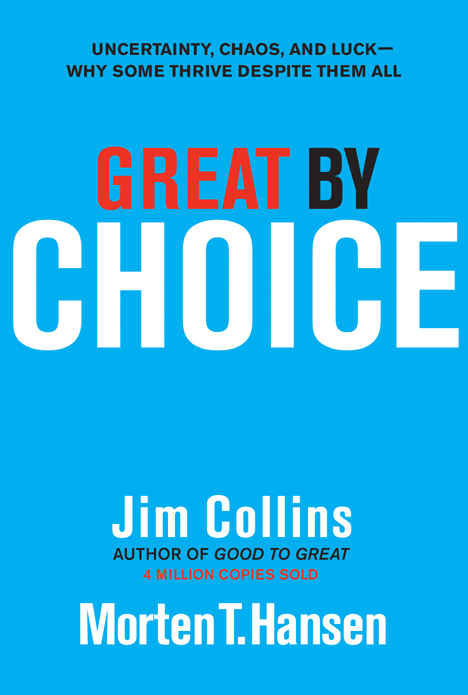
  2. Great by Choice by Jim Collins & Morten T. Hansen.  In this follow up to Good to Great and Built to Last, Collins looks at why some companies are able to thrive in times of chaos and uncertainty when others are not.  In the book Collins compares companies that find the way to be successful in difficult times with comparison companies were not able to be as successful (think Intel vs. AMD, or Microsoft vs. Apple, or Progressive vs. Safeco).  While there are no direct ties to education, some of his theories on success could be used in creating the mission or vision for our schools.
  3. The Food Lab by J. Kenji Lopez-Alt.  This book combines 2 of my personal passions: Science and Cooking; and it has proven to me that you can truly “read” a cookbook.  This book is much more than just a cookbook.  Each chapter or section talks first about the science of cooking – a couple of nights ago I read about the pros and cons of brining a turkey, and have decided that I am going to try a dry brine for our bird this year – and then it gets into the recipe.  I love understanding the science behind the steps I am taking, and seeing new ways to achieve some of my family’s favorite recipes!

And now for some of my recent reads (I included some fiction too, because sometimes you just have to read for fun!):

  1. Ditch that Textbook by Matt Miller
  2. Teach Like a Pirate by Dave Burgess
  3. David & Goliath by Malcolm Gladwell
  4. Hatching Twitter by Nick Bilton
  5. Gray Mountain by John Grisham
  6. The Wright Brothers by David McCullough
  7. King and Maxwell by David Baldacci
  8. Gods of Guilt by Michael Connelly
  9. A Song of Ice and Fire (series) by George R. R. Martin

I’m curious!  What books are you reading?  What have you read?  What are you learning about from your reading?  Share in the comments below so that others can add your ideas to their reading list!