Choosing to Cheat

There have been periods in my career in education where I felt as though I was living at school.  Back in my coaching days I would often arrive at school around 6, work on grading, planning, or whatever else needed to be done, teach a full day, coach my team, come back to my room to do more work, head home for a quick dinner, grade something else, go to bed, and do it again tomorrow.  In those days I was cheating my other priorities – my family, my friends, and my health.  How many times have you looked at your to-do list and felt that there was no way you could get it all done?  I know that there are days that I walk in to my office with 3 things on my to-do list that are left over from yesterday.  Over the course of a day I may add several new items to it, but am not able to cross anything off my list.  In those moments, I choose to cheat.  I can’t do it all.  There are 24 hours in a day, and 168 hours in a week.  Sometimes there are things we can’t make it through.

Do you ever feel like your to do list looks like this?!?!

We all have important things in our life that take up some of those 168 hours in a week, and while we are all professional educators, there are other priorities in everyone’s life.  Here’s the thing about choosing to cheat though: we have to be strategic in the ways that we choose to cheat.  I keep to-do lists (some are on my phone in the reminders app, some are jotted on scraps of paper in my office) and when I create them, I also prioritize them.  Certain things can only be done when there are students here, others can be done first thing in the morning, or after my afternoon bus duty.  Phone calls to parents – that can happen anytime (thank goodness for *67 and the speakerphone feature so that I can call while I’m in the car).  When you look at the things that you are doing in your classroom, prioritize them.  Think about the needs of your learners – are you doing things to help the students in your classroom grow?  If you can’t emphatically say yes, then that may be something you need to choose to cheat on.  Keep in mind, cheating isn’t about slacking off, but rather it’s about making sure you are intentional in how you use the time you have.

Use this to help guide your thinking and the areas where you may choose to cheat.

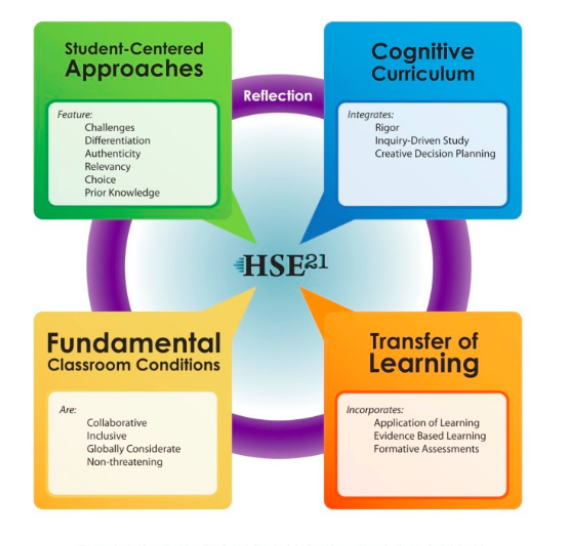
Throughout the process of HSE21, one of the messages that Danielle and I have always tried to share with you is that we don’t expect you to do it all right now.  When our teaching and learning team (Jan Combs, Phil Lederach, and Stephanie Loane) came to present a few weeks back, one of their slides talked about “More of this” and “Less of this.”  Take a look at that slide to the right.  If you’re spending a lot of time in the less of column, that may be something that you need to reexamine.  It’s also important to look at the HSE21 Best Practice Model (below) to guide our intentional thinking about what is best for the learners who walk into our classroom every day.
HSE21 Best Practice Model

Think about the things that you value most.  Do you devote your time accordingly?  If not, you are probably stressed out, unhappy, and might feel unsuccessful.  To be a good teacher, you have to be in the right mental place.  Think about the choices you make and how they are benefitting you and your students.  If you are making choices that don’t benefit you and your students, try to find a way to make a change.  Be willing to set aside things that do not hold as much value, and instead focus on the things that are most valuable to you and the students in your class.

What are some of the ways you choose to cheat?  Are there things you have given up, or maybe don’t do as often?  Maybe there are things you focus on for a while, then let fall out of focus, only to come back to later.  Share in the comments below how choosing to cheat has helped you to be a better teacher and a more rounded person.

Enhancement or Transformation?

Avoid the $1000 Pencil

Being that we are in the second year of a 1:1 program, we all know that adding technology to education comes at a cost – money, time, and effort.  If it’s done well, technology can transform teaching and learning.  If it’s done poorly, our students are left holding a “$1,000 pencil” according to George Couros (@gcouros), a Canadian principal and education speaker.  As I said last week, our pedagogy must drive our technology.  Don’t use tech just because our kids have an iPad; instead use tech to create a learning experience that would not have been possible otherwise.  Remember, we want to integrate tech where it works.  Hopefully the rest of this post will provide some ideas about how to transform education for our students.

SAMR Model
SAMR Model

Most of us have seen the SAMR model (to the left) as a framework to help you evaluate the best technology in your classroom.  This framework is developed from the bottom up.  As you see in the graphic, the creator of SAMR places Substitution and Augmentation in the Enhancement group (think of enhancement as the most basic change – it may improve the lesson, but maybe not the thinking).  Then there is a dashed line before you get to Modification and Redefinition which fall in the Transformation group (think of transformation as a thorough change in the form of education – it will improve the lesson and the thinking).  Many teachers find that dashed line to be a tall fence to climb.  In essence, to get over that fence, teachers sometimes have to throw previous activities out the window and create something new, and other times it requires a complete redesign of the activity.  In order to make that jump from augmentation to modification, here are some ideas:

  1. Know your goals – don’t think task or app, think learning outcome.
  2. Think about things you’ve done in the past and identify their strengths – what experiences were important for students, and what were the areas of growth from those experiences?
  3. Find a tool that can meet your goals and has similar strengths – with a quick Google search you can find websites and apps that might work. Scan their features to see if something does what you need it to do.
  4. Keep an open mind – don’t eliminate a tool just because you’ve never used it before.
  5. Generate several ideas for activities – make a list of possible tools. Cross out the ones that you don’t think will work.
  6. Put the plan into action – remember that the best way to learn new tech is to play with it. If you don’t know a tool yet, don’t feel like you can’t let students use it.  I have yet to have a student tell me “I can’t use this, we haven’t had PD on it!”  Students are just as capable of playing with an app or website to figure out what it can do, and if they’re really stuck, they’ll use Google or YouTube to help them figure it out.  Plus, if it’s new, students will be more excited and engaged!
  7. Be ready to adjust on the fly – remember, failure is part of the learning process. If something doesn’t work, go back to the drawing board.  Sometimes our willingness to model failure will help our students accept the idea that we learn and grow in times of failure.

One other idea that may help you to transform education for your students is through collaboration.  Don’t feel like you have to redevelop everything you are doing on your own.  Get together with others who teach the same subject as you and pick a topic.  Bring some of your favorite activities that fit that topic, and collaborate to find a way to make the jump from enhancement to transformation.  Then, after you try something, come back together to talk about what worked well, what didn’t, and what you would do next.  And if meeting together is not possible, use tech to collaborate – create a shared planning document in Office 365, or Facetime with your colleagues to plan when you both are free but cannot be together.

On Matt Miller’s website there is an excellent article titled 10 ways to reach SAMR’s redefinition level.  Follow the hyperlink for some great ways to take it up a notch!

Where are you in terms of the SAMR model with the tech you are using in your room?  Do you feel you are sticking to the enhancement zone, or have you jumped the fence into the transformation zone?

Mindsets


growth word cloud

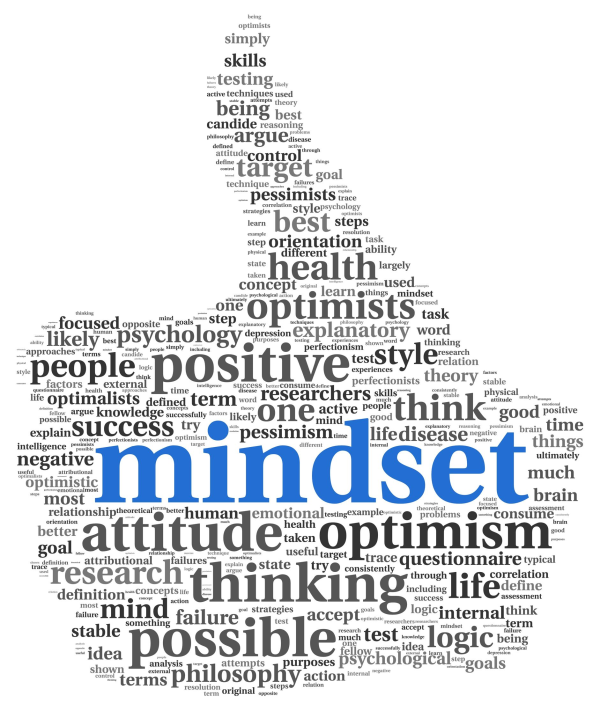
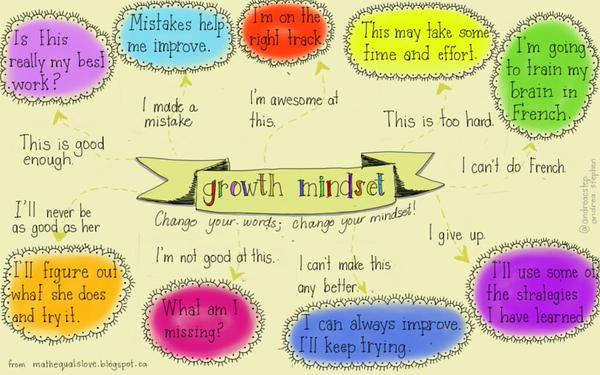
What is your mindset?  Do you see the glass as half empty, or half full?  Attitude and mindset are two of the greatest determinants of success.  Having our minds open to new approaches can allow huge changes in schools, which in turn could make life easier for all of us.  In the coming weeks we’ll be talking about various mindsets that may be affecting us in our classroom, and by extension be affecting our students.

Growth Mindset

Today I wanted to share a short YouTube video that shares the results of a study on praise and mindset.  The video has a run time of just under 5 minutes.


Something like this could help our students change their fixed mindset ideas into growth mindset thoughts.

If you’d like to see the TED Talk that relates to the research by Carol Dweck on growth mindsets, here you go:

A swift kick in the butt

How can this knowledge of mindsets impact your teaching right now?  Share something that you might do differently based on these videos.