Boundaries and Supports

Last week, we were lucky enough to have Kristina Hulvershorn from Peace Learning Center come visit our school to lead us in a Level 1 Training on Restorative Practices. I have attended this training before, but was excited to participate with the teachers in my building so that we could have a shared understanding of what Restorative Practices are, why we want to integrate this way of thinking into our classroom setting, and have some support on the role of proactive circles in developing a classroom community.

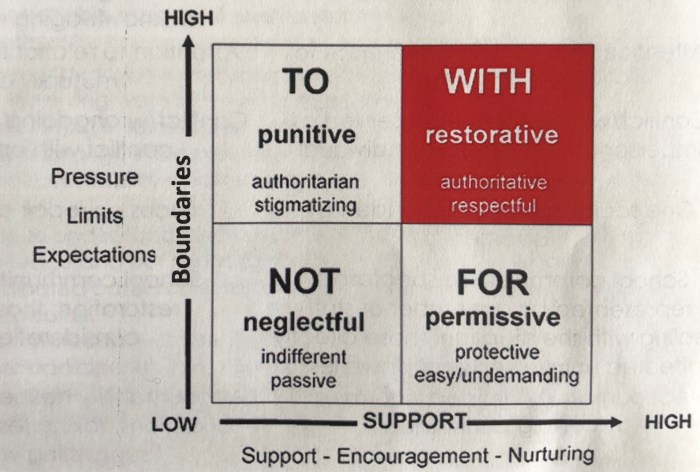
While there were many aspects of the training that were valuable, one of the things that really resonated with me this time was this chart:
IMG_3126

As I have reflected on the training, this chart has come back to me several times and got me thinking about the person I have become, as well as how I got here. All of us have had people in our past who helped us to get to where we are now. As I think back on the mentors who helped shape me, many of them offered me support in the form of encouragement. But along with that support, there were definitely boundaries, that put limits on me and created guardrails that helped to keep me on the path. This combination of boundaries and supports are what I credit in leading me to where I am today and continue to push me to be on the growing edge where I feel a little bit uncomfortable. I’m ok with that feeling though, because I know I still have mentors and colleagues that will offer support as I travel my path. If you think back on what has molded you into the person you are, you’ll probably be able to identify examples of boundaries and supports that helped you grow.

Our students need the same thing to be able to learn and grow. Each child needs someone (or many people) who can offer them support so that if they fail, there is someone to help them. At the same time, there have to be boundaries too, expectations for all our students that push them to be their best self. In our training, Kristina used an analogy that really allowed me to think about this combination of boundaries and supports. I wanted to share it with you.

Imagine that it is a school morning, and you are running late. As you approach school, you see the flashing yellow lights to signify the school zone, but you’re running late. You keep right on at the speed you were going. As you crest the hill by school, you see a police officer. Let’s look at the four different quadrants of boundaries and supports and imagine an officer from each one:

Neglectful: This officer is in position, but he’s got better things to do. He sees you speeding but doesn’t bother to chase you down. No boundaries, but also no support! So, what happens if you’re running late tomorrow? No lesson learned, so you might as well speed again!

Permissive: This officer actually pulls you over, but when you share that you’re a teacher who’s running late, he puts his lights and sirens on, escorts you to school, and then calls your principal to let them know that it’s his fault you were late. This time you’ve got lots of support, but no boundaries. When you’re running late the next time, you’re hoping that he’s the officer on duty! Again, no lesson has been learned.

Punitive: This is the officer who pulls you over, asks for your license and registration, but doesn’t want to hear anything about why you were speeding. He doesn’t care you were running late, or anything about why. He’s writing a ticket, and all you feel is mad and unheard. When this guy lets you go, all you’re doing is fuming about what happened, and seeing the experience as his fault. There are strong boundaries, but no support. Since you’re so caught up in being mad at the officer, you aren’t going to learn anything about the experience. Tomorrow you will probably speed, and hope that he’s not the officer on duty.

Restorative: Like the punitive officer, he pulls you over, but this time the experience is completely different. He approaches the car and asks if you knew you were speeding. When you say yes, he asks why and listens compassionately to your story. This officer starts asking you questions like: What time did you get up? What time did you leave home? In the process of the conversation, the officer talks to you about setting your alarm earlier, and actually asks you to set a new alarm on your phone for 15 minutes earlier so that you don’t have to be in such a rush tomorrow. Finally, the officer talks to you about a family he knows that was impacted by someone speeding in a school zone. In the end, the officer still writes you a ticket, but unlike last time, you feel that you were heard, you have some strategies to avoid being late tomorrow, and you better understand why there are lower speed limits in school zones. There are definitely boundaries here, but you also have lots of support. After this experience, you make a commitment to be sure to be out the house earlier so that you don’t have to speed.

So, what might these quadrants look like in a classroom setting? Let’s take a look:

Neglectful: In this classroom, there are no boundaries, and no supports. If you were to walk into this classroom, it would probably appear to be in chaos. Students are doing what they want, but it’s probably not got anything to do with the content they are supposed to be learning. The teacher probably has the best of intentions but doesn’t understand how to provide more support or appropriate boundaries for their students. When problems arise, this teacher looks the other way, or simply ships the students causing the problem out to someone else to deal with. Chances are, everyone walks out feeling stressed at the end of the day, and very little learning has happened for anyone.

Permissive: You might hear this teacher say something like “My sweet babies just can’t handle anything more.” The students feel like they are supported. So much so, that they don’t really accomplish anything. They are never pushed out of their comfort zone, and as a result they don’t learn much either. In this classroom, the teacher does all the work. When you walk in, it may appear that students are engaged in learning, but the learning that is happening is simply surface level. And when problems arise, this teacher steps in the middle and works to solve the problems between students. The efforts may lead to short term solutions, but in no time at all the problems are occurring again. At the end of the day, students walk out of the room feeling mostly happy, while the teacher probably walks out feeling tired.

Punitive: I think any of us who have been in education have a memory of this type of teacher in their past. I’m not going to name anyone here, but some examples from my past: The teacher who took away the baseball cards that I brought to school because someone else took them out and was looking at them. They were never returned. Or the teacher who would throw chalk at anyone who did not appear to be paying attention. One time I was writing notes about the class in my notebook, but he threw chalk at me because he thought I was drawing. These are the classrooms where students are living on the edge of fear. The only kids that are successful in this classroom are the ones who “play school” well. Kids may appear to be well behaved and on task, but really, they are living on the edge, waiting for the next moment that the teacher will yell. When problems happen in this classroom, they are handled quickly by the teacher with severe consequences. Students may not understand the why behind what went wrong, which means that the problem may occur again. Learning may happen, but again it is probably surface level because students are more concerned about not upsetting the teacher than focusing on learning the skills in the class. At the end of the day, the teacher probably feels pretty good about things, but the students probably are still in fear of what might happen tomorrow.

Restorative: In this classroom, there is a different feel in the air. When you walk into the class, you can feel a sense of community. Problems are rare, but when they arise students are able to try to work it out with their own conflict managements strategies. When these don’t work, they may get help from peers or the teacher. Students trust their peers and teacher because of the community they have created. When a major problem happens, the class is able to circle up and talk about it. It may sound like this is time consuming, but the time invested in early community building saves so much time later in the year. This teacher intentionally chose to not begin content work until the second full week of school, devoting all the earlier time to community and team building strategies. Since students have learned to solve their own problems, things that happen at recess or during unstructured time are less likely to take time away from classroom because the teacher can allow students to hash it out on their own or with the help of a peer mediator. At the end of the day, people walk out of the room feeling happy about their experience. Learning has happened, and the community has continued to be strengthened.

So, take a moment to think about where you fall as a teacher. Which quadrant are you in? As with any continuum, you could fall in lots of different locations, and it may be that you feel pretty comfortable with where you are and what you are doing. But remember what it was that helped you become the successful person you are. It took boundaries and supports to be successful. Keep looking for ways to make those boundaries and supports clear to your students. Everyone will benefit from it!

What are your thoughts? Have you thought about integrating Restorative Practices into your classroom? What do you see as the benefits? What are the potential hurdles? Share your ideas in the comments below!

What’s luck got to do with it?

Recently I was listening to an episode of the TED Radio Hour. If you’ve never heard it before, this show takes a theme, then pulls clips from a few existing TED Talks that tie in to that theme. The host, Guy Raz, interviews the speakers about how their talk ties in with the theme. One of the recent episodes was titled Luck, Fortune, and Chance, and one of the segments in particular got me thinking about the work we have been doing around Equity in my school district. You can listen to just the segment of the show here:

https://www.npr.org/player/embed/697809215/699112445

Mark Sutcliffe, a talk show host from Canada who is also an entrepreneur and runner gave a recent TEDx Talk on the role that hard work and luck play in our stories of success. Our society has traditionally put an emphasis on the idea that hard work can lead to success. The reality is though, that this is not true for all.

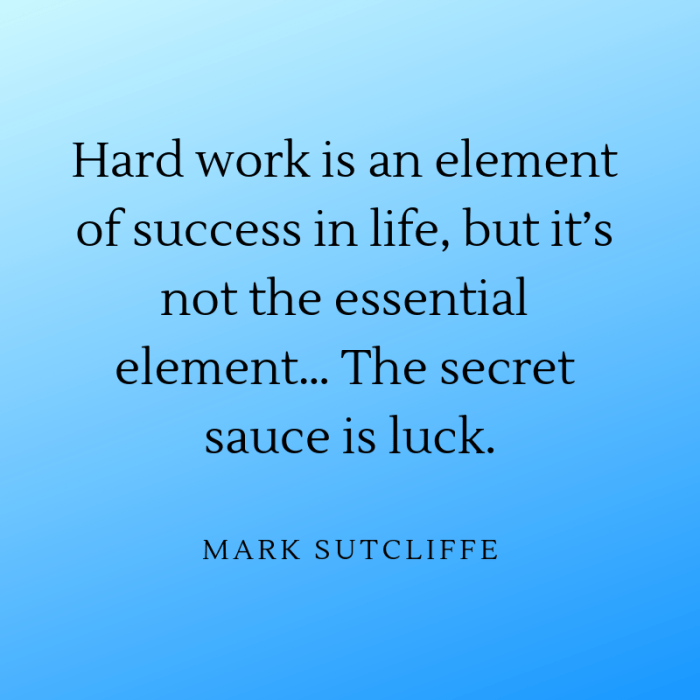
Hard work is an element of success in life, but it’s not the essential element… The secret sauce is luck.

Sutcliffe shares that he won the genetic lottery the day he was born. Because of the makeup of his family, their experiences, education level, socio-economic status, and so much more, Mark had an excellent starting point on the day he was born. Not everyone has those same chances. As a runner, Mark makes the analogy between our starting point in life, and the starting point in a marathon.

If you’ve ever run an organized marathon, half-marathon, or possibly even 5k, you’ve started the race with a timing chip attached to you in some way. When the starter at the front of the race says go, the timer starts for everyone that is right at the start line. But if you’re anything like me, you probably aren’t at the front of the pack. In the last half marathon I ran, it was almost 20 minutes between the time the starter said go and the time I crossed the official start line. Thanks to the help of that timing chip, my time didn’t officially start until I crossed that start line.

Sutcliffe shares that life isn’t quite like that. There is no computer chip that levels the playing field. As he points out, if you’re born as a visible minority, a member of a lower socio-economic class, with a physical disability, with a mental illness, or of a different sex, then you start your life further back. And, as Sutcliffe goes on to point out, “You carry that disadvantage your whole life.”

I was raised as the child of a middle class, college educated, white family. I remember conversations about the key to being successful was through my effort. I remember sitting at the kitchen table and being told that if I worked hard in life, I would be more likely to be successful. And when I think about the life that I have led, I know that I have worked hard to get to where I am. But as I come to grips with what I am learning in my work with equity, I’m beginning to realize that not every one of my students starts at the same point. Merit does not drive all success in life, and what Sutcliffe is trying to get at is that when you start your life in one of those lucky situations, chances are pretty good that we will continue to be lucky throughout our life.

In the actual TED Talk the Sutcliffe gave (linked at the end of this post), he shares his plan to run his next marathon starting 3 hours after the official start time. His reason: he wants to remember that anyone who starts life at the back of the pack is likely to get a lot less help and support. He knows that he will most likely be running alone when he runs this marathon.

Some of our students are the ones who are starting the race a little farther back. As the people in their life who make it our goal to help them learn and grow, we have to keep remembering that some of our students may have started their life a little further back in the pack. As a result of that starting point, they may need a little more support in order to be successful.

And some of you may be thinking of someone who likely started further back in the pack and led a truly successful life. Sutcliffe shares that “When the winner comes from the back, it’s an exception, not a rule.” Hard work simply doesn’t do it all.

This past weekend, as the ideas for this post were bouncing around in my mind, the following tweet showed up in my timeline:

Before my work with equity, I probably would have said something very similar. I would have believed that everyone started on an equal playing field. The reality is though, and I think Sutcliffe’s talk does an excellent job of putting it into words, is that not all of us start at the same point. As one of the “lucky ones” who got to start near the front of the pack, I now make it a point to take Sutcliffe’s suggestion of what to do with our luck: be humble; kind; and generous. I can help those who may have started a little further back than me. I do it because it’s fair, it’s smart (there’s a cost of others not having the same opportunities that I do), and it makes me happy.

What are your thoughts? As you reflect on your starting point, where were you in relation to the start line? Do you believe that you have led a lucky life, or is your position in life based solely on hard work and effort? What steps to you take to help level the playing field? Share your thoughts in the comments below.

If you’d like to listen to the entire episode of TED Radio Hour that the idea of this post came from, you can find it here:

https://www.npr.org/programs/ted-radio-hour/697805275/luck-fortune-and-chance

And if you’d like to see Mark’s full TED Talk, check it out here:

Trauma-informed as a way of being

maya-angelou-know-betterI’ve always loved this quote from Maya Angelou. Over the past several years, there’s been a lot of opportunities for learning about better ways to interact with our students. In the summer of 2017, several of us had the chance to learn from Jim Sporleder about the idea of Trauma-Informed Care based on the work he did in his school in Washington. Many of us walked away with new ideas about how we work with kids. Others of us may have seen the movie “Paper Tigers” documenting his work with trauma-informed schools. Last year, several teachers read the book Lost at School by Ross W. Greene, and it gave us more to think about. Last semester several of our teachers attended a training on Restorative Practices at the Peace Learning Center. We are currently working on a plan to be able to provide this training to all of our teachers. At the beginning of this school year, we did a training on de-escalation techniques. For the past 2 years, I have worked as a member of our district wide Trauma-Informed Team, where we have talked about ways to expand this knowledge. All of this learning has taught us new strategies for how to handle difficult situations with kids.

Some of you have heard about the concepts of trauma-informed care, and many of us have tried to implement strategies that we’ve learned through our various experiences to better support our kids. That said, there is a question that I continue to hear from time to time: “How do I know if this kid has trauma?” My response, more and more, is “Many times we won’t know.” But then I also wonder, does it matter?

Between what we have learned about Trauma-Informed Care, through Lost at School, Restorative Practices, and so much more, I’m beginning to think of these strategies not so much as something we do with “those kids” but more as something that we do with ALL KIDS because we know they work for everyone!

Let’s start thinking of all of these various new strategies not so much as something that we do with some kids or with the kids that need it, rather, these are strategies that we can use to support all kids because they work for all kids! Trauma-Informed should become part of our tier 1 process that we use with every child every day.

Want to learn more? Check out these resources:

So I’m curious, what have been your experiences? Have you tried using more trama-informed practices in your classroom? Or have you begun instituting proactive circles (sometimes called community circles) as a part of your learning about restorative practices? What have you noticed with your students? What works? What are you still struggling with? Share your thoughts in the comments below!

This is hard…

Recently I was talking to a friend who is a teacher. I noticed some cool project-based learning activities that she shared on Twitter, and I was talking to her about them. She’s a fairly experienced teacher, and one of the things that she said really struck a chord with me:

“You know, I used to teach really differently than I do now. Ten years ago, the things I was doing were easier for me. The things I do now are harder, and I keep hoping that those things will get easier. As I reflect though, while things have gotten harder for me, the learning experiences for my students have gotten better. I guess I’m not sure that I’m hoping for the right things. It’s not easy for us, but it’s the right thing to do.”

Woah! What a powerful statement! A favorite author of mine is George Couros. In his book The Innovator’s Mindset, he says:

“I’m defining innovation as a way of thinking that creates something new and better. Innovation can come from either ‘invention’ (something totally new) or ‘iteration’ (a change to something that already exists), but if it does not meet the idea of ‘new and better,’ it is not innovative. That means change for the sake of change is never good enough. Neither is using innovation as a buzzword as many organizations do to appear current and relevant.”

And in a recent blog post, AJ Juliani took it a step further… He argued that just being new and better isn’t quite enough. We need to make sure that it is also better for our learners.

Our job is not to prepare students for something. Our job is to help students prepare themselves for anything.

And here’s the thing about that – we all know it is difficult to plan for a project-based learning experience. It’s difficult to build an inquiry project for your students. It’s difficult to create learning opportunities that integrate Language Arts, Math, Science, and more into a single unit of study. But what about the opportunities it creates for our students?

We talk about preparation for the next in education all the time. Whether we’re thinking about the next year, the next step, the first job, whatever… The reality is that with the world changing so rapidly, we’re naïve to think that we have any idea what the future really holds. I’m sure my elementary and middle school teachers never imagined that some of the kids in their class would be making money by taking pictures and posting them to Instagram. What amazing things that we can’t even imagine will our students be doing when they are out in “the world”?

So, given the fact that we can’t predict the future, more than anything we need to provide a skill set to our young people that prepares them for anything. We have no way to know where they might go!

So often we have been talking about 21st century skills, but we have to remember that we are now almost 2 decades into the 21st century, and some of the students sitting in our classroom will actually see the 22nd century!

So here’s the question. Why do we do these hard things? We know that it takes us more time and effort to create these deep learning experiences for our students but look at the results. Most students are more highly engaged when given true project-based learning experiences, or student driven inquiry projects. And with that higher level of engagement comes stronger learning experiences. And with those stronger learning experiences our students will be better prepared for whatever their future may hold.

If we’re worried about preparing kids for the “real world,” then this should concern us:

Yes, it’s harder to teach this way. The reality is that it’s harder for administrators to lead this style of learning. But when we look at the children walking into our building, and we remember that we have no way to know what their future may hold, we’ve got to focus on those skills that take them anywhere – critical thinking, creativity, collaboration, communication.

As you have shifted to deeper learning activities, what has been your experience? Have you noticed a greater desire and drive for learning from your students? Share your experiences in the comments below!

Gone sailing…

Gone sailing…

As I sit at my kitchen table tonight, just after having received the news that school has been cancelled tomorrow, and trying to wrap my mind around how cold a -40°F wind chill will actually feel like (yes, I do plan to go outside just to say I did it!), I find myself thinking about summer and much warmer weather. For some reason, I started thinking about my summers spent on Elkhart Lake in Wisconsin at Camp Brosius, and the time I spent learning to sail on one of the many Sunfish sailboats.

campbrosius
The sunfish that I learned on may very well be one of the boats in this picture, with one of the buildings of Camp Brosius in the background.

My first experience with sailboats involved a Hobie 16, my dad, and a little help from the rescue boat. We were both learning what we were doing! Over time he became better, and I recall as a young boy enjoying riding with him while he guided us around the lake – sometimes on the Hobie, other times on a Sunfish, or any one of the other boats that the camp had available to use.

Eventually, around middle school, I decided I wanted to learn to sail all by myself. I remember Jim, the camp director, pulling one of the Sunfish into the swim area one morning, teaching me about the various parts of the boat, and what they did. As I reflect on it now, after a shockingly short lesson (probably not over 30 minutes), he had me climbing aboard and shoving me out into the lake. I can hear Jim saying “You don’t learn by talking about it and looking at it, you learn by getting out there and trying!” The wind wasn’t that strong yet that morning, it normally picked up in the afternoon, so I was planning to tool around just off the shore in front of the camp’s waterfront. I grabbed the rudder and main sheet, set my sails, and I was off! Or so I thought…

As I got further from the shore, the wind caught a bit more of my sail, and instead of heading straight, as my rudder was pointing, my boat seemed to be sliding sideways across the top of the water. No matter how I moved my rudder, the boat just wouldn’t go in the direction I wanted.

As I drifted further from the shore, without any real control, I could hear someone yelling at me from the swimming t. Jim, the camp director, was yelling “You forgot the centerboard!” I looked, and sure enough, the centerboard was laying inside the cockpit. I quickly pulled it out and placed it down the middle of the hull. Next thing I knew, I was moving (mostly) in the direction I wanted (remember, I was just learning).

Thinking about sailing got me thinking a bit about teaching and learning. Part of what I love about the Sunfish is how simple of a boat it really is. There’s the hull (or body of the boat), the mast that holds the sail up. Then there’s the sail that absorbs the energy of the wind and translates that into motion. The rudder helps the sailor to guide the boat in the correct direction. And finally, there’s the centerboard. Even if everything else is working in perfect harmony, without the centerboard, the best sailor isn’t too likely to stay on course.

What’s the connection to learning? The hull of the boat is our classroom. Then let’s think of the rudder as being our standards. They help us decide on what our students “need” to be learning about. It gives our boat direction. The sailor on the boat (most of the time) is the teacher. You get to make the decisions about how to set the rudder and the mainsail (although hopefully your students are getting some input here too). You point the boat in the direction you think it needs to go. The sail is our students, and the wind is the constant opportunity for learning. So that sounds like most all that we need to think about, right?

Not quite. For true learning, we need to have the centerboard to help keep us on course. That is our North Star of Learning.

Moving the RockGrant Lichtman, the author of Moving the Rock: Seven Levers WE Can Press to Transform Education, has often used the metaphor of the North Star to talk about the idea of having a shared vision of where we want to get to in terms of great learning. If we don’t agree on where we are going, we have random movement, in random directions, and we end up nowhere! Think about the North Star, no matter where you stand, we can all find it, we can all point to it, we can all figure out our route to get there. In that same way, when we have a shared vision of learning, and we understand that no two educators are moving towards it from the same place, we all have to set a course of our own.

As educators, we are used to the idea that our students all come to us from a different starting point, and we have to adjust our teaching to meet them where they are in order to get them to where they need to be. What does it mean though if not all educators are starting their trip towards the North Star from the same place?

It means the day of one size fits all professional development has passed us by. It means that each of us has to be reflective on where we are on our path towards our North Star. It means recognizing our own strengths and weaknesses, accentuating our strengths, and being willing to seek out opportunities to professionally grow in order to move closer to our North Star. It means deciding to take your own learning into your own hands. If there’s something you need to get better at, seek out a resource. It might be someone just down the hall, it might be a blog post or article, it might be a book. It could also mean approaching your administrator to ask for ideas on how you might continue to grow in that area. Given that our focus is on LEARNING, I would hope anyone would feel comfortable to ask for assistance in finding the best possible resources for their personal growth. I know that I am constantly seeking resources from colleagues, mentors, and leaders that are around me.

As an educator, I’m hopeful that this post encourages you to reflect on a couple of things. First and foremost, do you feel that there is a North Star for your district or school? If not, start a conversation with your colleagues, ask your administrator, reflect on your own opinions and beliefs, and start that conversation for a true shared understanding. Next, take a moment to reflect on where you are as an educator, and what it is that you need to do to course correct so that you can help your students to reach that North Star.

As we come to the end of this post, take a moment and think about what your beliefs are about students. What is your personal North Star of Learning? Share with us in the comments below!

Indiana STEM Education Conference

Last week I had the privilege to attend the Fourth Annual Indiana STEM Education Conference at Purdue University. Purdue’s College of Education sees K-12 STEM education as one of its two signature areas of focus for pre-service teachers. In this K-12 STEM path, Purdue is “preparing teachers who can weave STEM subjects throughout their curriculum and introduce the concepts through real-world application. Our focus goes beyond the specific STEM subjects – science, technology, engineering, and math – to include literacy, social studies, problem-solving, critical thinking and communication.” This belief fits well with the Indiana Department of Education’s STEM Six-Year Strategic Plan (can be found here: http://bit.ly/IndianaSTEMPlan). This plan has the stated mission to “Ensure Indiana teachers are prepared to provide every student in grades K-12 with an evidence-based, effective STEM education…”

aldrinThe opening of the conference included a guest speaker that I was super excited to see – Buzz Aldrin!  It was cool to hear Aldrin talk about his experiences, as well as his hopes for continued space exploration. Aldrin is a huge supporter of getting a human being to Mars. Not to mention, there’s something pretty awesome about being in the same room as someone who actually walked on the moon.

The rest of the conference was made up of several break-out sessions, and I have to say that every one I attended was excellent. I want to share some of the tidbits I picked up while I was there.

My first session was on the connection between STEM and Project Based Learning. In that session, we began by talking a little about the Science and Engineering Process Standards (SEPS). If you look at the science standards of any grade level or science curriculum, the first two pages of the standards are made up of these process standards focusing on 8 key areas:

  • SEPS.1 Posing questions (for science) and defining problems (for engineering)
  • SEPS.2 Developing and using models and tools
  • SEPS.3 Constructing and performing investigations
  • SEPS.4 Analyzing and interpreting data
  • SEPS.5 Using mathematics and computational thinking
  • SEPS.6 Constructing explanations (for science) and designing solutions (for engineering)
  • SEPS.7 Engaging in argument from evidence
  • SEPS.8 Obtaining, evaluating, and communicating information

By looking at the specific standards for your grade level or subject area, you can see a deeper description of those process standards. Look here for more info: https://www.doe.in.gov/standards/science-computer-science

In two of the sessions I attended, presenters talked about the value of STEM Challenges or Engineering Projects as a way to help meet some of these process standards. Here are a couple of examples:

  • The Paper Chain Challenge: For this challenge, students need 1 piece of paper, scissors, and tape. The challenge? Try to make the longest possible paper chain. As a constraint, you could change the materials allowed. Another variation on this was that you do not provide tape, and you had to make the longest continuous piece of paper without using tape, paperclips, or any other objects to connect the paper back together. When we did this challenge, we were only given 5 minutes, then had a 5 minute conversation to process our designs, compare the length of each chain, etc. In those 10 minutes, we hit on 5 of the SEPS!


  • Drop Copter Challenge: Have you ever made a drop copter? For directions, click here: http://bit.ly/DropCopter. Once you have the students create their drop copter, then you add in the challenge. Now they have to make one modification to their copter to improve the way the copter falls to the ground. I’m sure there are a variety of ways you could define “improve”, so you can figure out what it means for you (or even better, let the students decide!). After the adjustment and testing, spend another 5-10 minutes processing the challenge with students. Again, several SEPS hit in less than a half hour!


  • Parachute Challenge: Provide students with large sheets of tissue paper (like for wrapping a present), tape, 5 paperclips, and 2 pieces of string (you can decide on the length). Give students 5-10 minutes to design, build, test, and redesign a parachute. The goal is to design a parachute that takes the longest to reach the ground. When time is up, have all the students come to the front, drop from the same height, and compare the fall time. Finally, spend some time processing the challenge with the kids. Again, we’ve just hit on multiple SEPS in less than a half hour!

These are just a couple of the potential STEM Challenges that were fairly short. Another session I attended also hit on the SEPS, but they were coming at it from the Engineering Design process. I’ve seen lots of different models for the Engineering Design Process, but I liked the language that was used by Science Learning through Engineering Design (SLED). Check it out:

sled

SLED has an awesome website, STEMEdhub.org, but I wanted to direct you in particular to their Design Resources page (check that out here). This page lists a multitude of activities and various grade levels. When you click on a title, it takes you to a page with more information about the project. Want to see more (like the lesson plans, materials needed, etc.)? Click the purple Download button to the right of the title. Unlike the STEM Challenges above that could be done in a half hour or less, these are more in depth, long term projects that will take your students through the design process you see above.

real worldI wanted to briefly touch on my final two sessions, which were on similar topics. One was about an intermediate school in Ellettsville that implemented a school-wide genius hour program. At this school, every other Friday, the entire school basically shuts down for the last hour of the day. Students then work on their genius hour projects. These projects are ungraded, student-led, and lead to a STEAM Night Showcase where students share their findings from their genius hour project. The teachers, administrators, counselors, custodians, and other adults in the building are all able to serve as advisors for students who choose projects on a topic that they have an interest or understanding in. The school has even partnered with outside professionals who can come in and help be mentors for topics students are interested in. Being located near Crane Naval Surface Warfare Center and Cook Inc. opens up the possibility of some great partnerships for this school.

recipeThe final session of the day that I attended was put on by the innovation director and principal from New Palestine Intermediate. This year they created a new day in their related arts rotation called Innovation Hour. Other schools might call this learning clubs, or choice activity time. To create the clubs, staff members signed up with something they were passionate about. Examples include gardening, drones, coding, woodworking, etc. Students then sign up for their top three choices. Once assigned to an Innovation Hour, then they meet every 4th day from 8:30 to 9:20, and all the students are able to participate in the club they are assigned to. So far, everyone has been able to get one of their top 3 choices.

One of my current goals is to figure out how to bring something like either the Genius Hour project, or the innovation hour to Riverside Intermediate. On February 6th, our students will be participating in the Global School Play Day, and we have it set up with choice activities that students will be able to get involved in. It is my hope that this will serve as a jumping off point for one of these more long term learning opportunities for our students!

So, what are your thoughts? Anything here that you plan to use in your classroom? Anything that you already do that you can share with our readers? I’d love to hear what you have to say!

What is learning

Earlier this week, our district hosted it’s monthly admin meeting. During our meeting, our superintendent led us in an activity to think about defining what learning is. He encouraged us to think beyond the contexts that lead to learning, but the actual understanding of what learning is. After our activity, we were given a homework assignment – to write our beliefs about learning. I decided to be a little vulnerable and share my thoughts publicly. What you see below is what I wrote as a result of that activity.


SapiensRecently I’ve been reading the book Sapiens by Yuval Noah Harari. I’m about a third of the way through the book, but its premise is centered on the evolution of Homo sapiens as a species. In a recent chapter, I was struck by the comparison between the biological development of humans versus the cultural development of humans. In biological terms, humans have the ability to learn. Our early hunter gatherer ancestors had to learn how to identify what foods were safe to eat, what predators they needed to stay away from, or what places were safe to drink the water. On the other hand, schools are a cultural development created by humans to pass on learning to students. Traditionally, much of that culture has treated learning as the filling of a vessel, not the awakening of the biological processes that encourage learning. The types of things that we teach in schools are not directly related to the future survival of our students (we don’t directly teach them how to meet their basic needs). As with any system, the culture that surrounds it effects how the system works. My understanding of this was further impacted by my recent trip to China. The system of schooling, while there are some similarities to what we do in the US, also had some rather significant differences that are created by the cultural beliefs that Chinese society has about learning. So this leads me to the bigger question, from a biological level, what is learning? Here are my beliefs:

  • Learning builds on prior knowledge – It involves adding to a learner’s current knowledge and beliefs. As a learner encounters a new experience, it changes those beliefs.
  • Learning is ongoing – All people have the ability to learn, and are doing it constantly no matter their beliefs, background, or location.
  • Learning is authentic – It relates to the things that a learner feels they need or want to know.
  • Learning is social – It involves a learner’s interactions with others, and the shared experience that occurs during those interactions.
  • Learning is active – It involves interaction between a learner and the world. These interactions could be through an experiment, a hands-on experience, or through talking with others.

Going back to that comparison between the biological processes that lead to learning, as compared to the cultural systems that exist in schools, these core beliefs should help guide our future decisions on the systems that exist in school. If we want to encourage learning, then our schools need to meet the biological demands, not simply the cultural expectations that some might have for schools. We have a lot to reflect on. Let’s get to work!


So… I’m curious to know your thoughts. If you were to write a response to the question “What is learning?” what would you say? We aren’t talking about the context of learning. We aren’t talking about the environment that leads to learning. I encourage you to really drill down to what happens when we learn. Are there things you think I got right? Things I missed the boat on? Share your thoughts in the comments below!

Cognitive Complexity

At a recent PLC meeting of the Humanities teachers at my school, we were spending some time digging into the concept of Cognitive Complexity vs. that of Difficulty. This conversation was rolled into a much deeper conversation about the ILEARN, Indiana’s new computer-adaptive assessment that all students will be taking in grades 3-8. We began talking about the differences in difficulty and cognitive complexity because we were learning that no matter what difficulty level a student fell into on the adaptive test, all students will be solving problems that are cognitively complex. So, what’s the difference between the two concepts?

Difficulty:

When we try to define the concept of difficulty, it is considered a measure of the effort required to complete a task. In the purpose of an assessment, a problem that many students missed would be considered more difficult than a problem that everyone got right. So when looking at the difficulty of a problem or task in your classroom, the more likely it is that all students will get it correct, the less difficult it is.

As we know, all our students come to us varying levels of understanding. In his book The End of Average, Todd Rose talks about the jaggedness of people. Not only do our students walk into our classrooms with physical differences that we can all see, they walk in with different abilities in math, reading, etc. In adaptive testing, an assessment will adjust its level of difficulty based on the answers students get correct or incorrect. As one student gets a question correct, the next question will most likely be more difficult. On the other hand, a student who gets a question wrong will then see a question that is less difficult. All standards can be measured at varying levels of difficulty. Take for example the following two math problems that are working on the same skill:

Easy: Sarah planted 5 rows of 7 flowers in each row. Write a multiplication equation that shows the number of flowers in Sarah’s rectangular garden.

Difficult: Tom told Mary he planted 48 flowers in the rectangular-shaped garden. Select the correct number sentence Mary could use to describe how the flowers were planted.

 As you can see, both questions require students to solve the same type of problem, using a similar level of thinking, but because of the wording, the second question would be considered more difficult.

Cognitive Complexity:

To define the idea of complexity, we have to think about it as a measure of the thinking action, or knowledge that you need to complete a task. One way to think about this is to think about how many different ways can a task be accomplished. I think the best way to think about the idea of complexity is to think in relation to Webb’s Depth of Knowledge. DOK can be broken down into 4 different levels: Recall and Reproduction; Basic Application of Skills; Strategic Thinking; and Extended Thinking.

So basically, cognitive complexity is a way to measure how demanding of a thought process is necessary to complete a specific task. Items that simply ask a student to recall basic facts from an article they just read would be much less complex than an item that required analyzing the points of view of two separate authors and making a comparison of their purpose for writing.

So… How should an understanding of these two concepts impact our teaching in the classroom? The reality is, no matter what level of difficulty a student may be working at – whether they are reading below grade level, or working on math that is above grade level – all our students need to see the types of problems that have a high level of cognitive complexity, because no matter what level of difficulty they are working with, they need to be able to use a variety of levels of thinking in carrying out tasks in the classroom.

There are a couple of great resources that you can use to help find ways to up the level of cognitive complexity no matter what level of difficulty your students are working at.

EngageNY: A huge collection of resources for both math and language arts (and everything is FREE!!!) that will include performance tasks and opportunities for students to perform cognitively complex activities. You can search by specific topics, or seek things out based on grade level and topic.

YouCubed: A wealth of activities for math instruction, based on the work of Jo Boaler. You can seek out tasks for your students to complete, find resources for your students or parents, and so much more!

Open Middle: Another math based site that provides tons of challenging math problems. Again, you can search by grade level, topic, and more. Carrying out a problem like this a couple times a week in your classroom will up the DOK immensely!

I’m sure that there are lots of other ideas you may have to help increase the cognitive complexity within your classroom. What resources do you have? How do you make sure that all your students have opportunities to carry out tasks that are truly cognitively challenging to them? Share your thoughts in the comments below!

Principles of Restorative Practices in Our Classrooms

Recently, I had the opportunity to attend a workshop on the Introduction to Restorative Practices. It was one of the most powerful learning events that I have attended in my many years in education. For the past couple of years, I have been dabbling in the concepts of restorative practices, trying to gain an understanding of just what it is, and how we could use the ideas in my school building. Until attending this workshop, I’ve struggled to figure out just how to implement some of the things I have learned. This seemed like the perfect opportunity!

Restorative PracticeToday’s post will focus primarily on the principles of restorative practices as shared by Kristina Hulvershorn of the Peace Learning Center in Indianapolis, Indiana. But before we get into the principles, let’s talk about why we should be looking at restorative practices as a piece of our plan for handling behavior and conflict.

One of the things that I think we can agree on is that our more traditional methods of blame, shame, punishment, and exclusion just don’t effectively work for our stakeholders. It may make you as the teacher feel better when the student who has made a poor choice is removed from the room, but does it really solve the underlying problem? When we push students out, we’re providing the opposite of what they really need – an opportunity to learn to do better. When misbehavior occurs, it’s the perfect time to help students learn the skills they are lacking. As Dr. Ross Greene reminds us in his book Lost at School, “Kids do well if they can.” In addition, restorative practices help to address disproportionality of discipline on students of color. I hope we can look at restorative practices not as something new and different, but another tool to use when incidents of misbehavior occur.

So, what are the principles of restorative practices?

  • Acknowledges that relationships are central to building community.
  • Builds systems that address misbehavior and harm in a way that strengthens relationships.
  • Focuses on the harm done rather than only the rule-breaking.
  • Gives voice to the person harmed.
  • Engages in collaborative problem solving.
  • Empowers change and growth.
  • Enhances responsibility.

Traditionally, our system of discipline in schools has been mostly based in punitive measures. Things like detention, suspension, or expulsion has been the primary method of handling student discipline. I know that in my own history, I had moments of discipline where the consequences were purely punitive. But let’s remember for a moment the root of the word discipline – it comes from discipulus, the Latin word for pupil. That word is also the source of the word disciple. What if we began shifting our mindset on discipline towards the idea that it’s based on teaching, not on consequences? How might that change what you do when a student misbehaves?

Now I know the pushback from some of you – the real world won’t look at discipline as a teaching tool. If our students make these mistakes in the “real world” when they are older, they will face serious consequences, like losing their job, facing fines, or maybe even jail. You’d probably be able to come up with some great examples of times where this has happened. I agree that maybe this isn’t how the real world works. But here’s the thing: We’re a school, we’re dealing with kids who are bound to make mistakes, and we’re teachers. Shouldn’t we make it our goal to teach students how they should behave while they are still with us?

So, what can you do to start building a more restorative setting in your classroom? There are a few universal steps that will help you start down that path:

  • Daily community circles – Think about sitting in a circle with your class every day. Take a few minutes to have students share how their feeling, a high or low point of the weekend, what they are looking forward to, etc. The ideas are endless, and if you are struggling to come up with topics, ask your students to submit them for you! These circles will help build safety and trust among your class, help kids make connections, and help you build relationships with your kids because you know more about their interests.
  • Student-led norms/rules – What if all your classroom norms and rules were set by the students? I know there are a few classrooms in my school that use this. If you don’t, what ownership do students have in the norms? Most of the time, students will create norms that all can agree on, that meet your needs as the teacher, and then we can all agree to those norms and refer back to them on a regular basis.
  • Explicit teaching of SEL skills – Social Emotional Learning is such an important piece that too often gets shoved to the bottom of the to-do list (which means it doesn’t get done). If we want students to understand what is appropriate in our school, we have to take the time to teach them. It’s tempting to say “they should already know this!” but if their actions show that they don’t, then maybe it’s something they need to be retaught. Just like how you’d reteach a math or English lesson if you realized that students don’t understand, it’s important to reteach behavioral skills too!
  • Affective StatementsRestorative language (the use of affective language) – To the right you’ll see a screen shot of a document with sentence starters for affective statements (I’ve also included a link to the document at the bottom of this post). If you share this with your students, post it in your room, and begin using statements like these, the kids will too!
  • Effort to build relationships – I think all teachers have stories they can share about “that kid” who has given them so much trouble, but then when you take the time to get to know them and what they care about, you begin to have more success. Building real relationships can help you get there with any kid! The community circle is one way to learn about kids, which can then help you find connections and conversations that you can have with that kid.

I hope to share more about restorative practices in the future, but here’s my ask to you: Take one of the 5 universal steps and give it a try. See what happens in your classroom. Does it change the way students treat one another? Does it lead to better relationships?

I know there are some of you who are already doing these things. If you have tried any of the ideas offered here, share with us what your experience has been. Let us know that positives (or struggles) you have found with these ideas?

Affective Statements

What’s the goal of education?

As many of you know, I love to listen to podcasts. I probably spend more time listening to podcasts than listening to music. I see them as an awesome learning tool. In past posts, I’ve shared tidbits that I gained from some of those various podcasts. Recently I’ve become a big fan of Reimagine Schools hosted by Dr. Greg Goins. Goins is currently the Director of the Educational Leadership Program at Georgetown College in Kentucky, and previously has worked in many different roles in schools, including time as a district superintendent in Illinois. The podcast is a way to share some of his ideas on transforming our schools.

He’s had several great guests on the podcast, but a recent episode really struck a chord with me. That episode was an interview of Alfie Kohn. Kohn is a writer and speaker on topics such as human behavior, education, and parenting. He has written 14 books, as well as numerous articles over the years. I must be honest, some of Kohn’s ideas really push me to the brink of being a little uncomfortable, but they cause me to pause and reflect on his thinking. I’ve said it before, no growth takes place when we are entirely comfortable, so I’m hoping these ideas will help me grow in my thinking. I’ll include a link to the podcast episode at the bottom of this post.

There were several things about the conversation that really made me pause and think. While the conversation meandered between topics, I’m going to break up my thoughts into what I saw as the 3 primary topics: what’s the goal of education; measuring student growth without traditional assessment; and the role of homework in education.

What’s the goal of education

During the conversation, Kohn shared that “Traditionalism has ill-served the students of today.” Much of the current American system of education is based in economic and competitive ways. Things like standardized assessments were often instituted and created by people who look at education from a purely economic perspective – we put in this amount per student, and based on that, this percentage of students can pass a test at the end of the school year. For those of us in education, we understand that this economic perspective is not where learning happens. Kohn pushes that we need to move beyond stuffing kids with facts, and instead get to understanding ideas from the inside out.

Many schools are still focused on grades, rubrics, tests, quizzes, homework, and worksheets. Kohn calls this “intellectually unengaging” and shares that based on research, learning shouldn’t be this way. Instead, true learning should grow from kids questions. Our role as educators is to empower our students and create welcoming communities that encourage student learning. We as the teachers have to start by minimizing our own power, and providing students with the opportunities to make decisions because the only way to learn to make good decisions is by making decisions.

Student growth without traditional assessment

Most of the timeIn his conversation with Goins, Kohn challenges us that there is no way to measure or quantify true learning. The moment we try to put a numerical or letter-based score onto a learning task, we take away much of the motivation that students have to learn, and instead we create a system that trains our students for compliance. The things that can be easily measured in an assessment are not the things that truly matter. The example that Kohn used here was that on an assessment of a writing task, we may spend more time and effort in measuring the number of times that a student used punctuation correctly, however we don’t spend nearly as much time on whether the student expressed meaningful ideas in their writing. If we are developing learners in our world, what’s more important? I think most would agree that the ideas are the most important part, but ideas are hard to quantify, so we struggle to factor that into our assessments. As Kohn puts it “More focus on data in teaching means that we teach the trivial stuff more than the important stuff.”

This was an area that I really struggled. Currently we live in a system that we are judged based on our data. For better or worse, that is the system that we live in. If I as a teacher, or we as a school, decided to shy away from that data and focus on the so called “more important stuff,” there may be stakeholders who question our choices because the data is important to them. It’s a struggle between what we feel is best for students, and what our community and society expect for students. What to do?

Kohn did have some awesome suggestions for ways to assess students in more authentic ways. He talked a little about performance tasks, which I know there are teachers in my current building who do this at times. He talked about exhibitions of mastery – imagine a gallery walk at the end of a unit, or grading period, or school year at least, where students are able to share something that they learned with an audience of more than just their teachers and peers. Another suggestion that I know that I’ve mentioned below is a portfolio with a place for reflections by students. I see this blog as my own personal learning portfolio – by scrolling through past posts you can see what I’ve learned about, what I’m passionate about, and you can see my own reflections on those topics. You may even notice that opinions on some of the topics have evolved in the time I’ve been posting. A final suggestion from Kohn is something that a teacher, or even school as a whole could do to assess overall learning – that’s a random sample of students achievements (notice that both are plural, that’s important). By looking at the achievements of various students, you can see a little about the types of learning that have happened within your classroom / school over a given period of time.

The role of homework in education

For those of you who know of Alfie Kohn, you may know what to expect here. Kohn is not a fan of homework. As a short precursor, Kohn sees homework, especially before high school, as educational malpractice, and he has a few reasons for his opinions. First a foremost, he doesn’t feel that a kid should have a “second shift” of school at home. Most people, when they leave work, are done with work, but in education we send students home with more to do.

Now I know, some of you are saying “not my homework, it’s meaningful,” but let’s keep in mind what we are asking when we send work home with a student. First, homework can be tough on families and kids. By assigning homework we are imposing our demands on their family time, and Kohn feels that families should be able to determine how to use their family time. Second, according to Kohn, no study has found any benefit of any kind to any student before high school. And finally, Kohn says that homework leads to several potential negative outcomes for our students: frustration; exhaustion; family conflict; less interest in learning; and less time for kids to develop in other ways (socially, artistically, etc.).

I’m not saying that we should never assign homework ever again, but Kohn’s thoughts fit with some of the opinions that I have as a father. Our family time is precious, and I don’t want to spend it fighting with my kids about whether they have their assignments done from school. We’ve got much better ways to spend our time. Kohn’s definition of appropriate homework is “on those rare occasions when we can say that this will help kids think more deeply about questions that matter, and when it will make kids more excited about learning, then and only then will we infringe upon family time.”

So what are your thoughts? Are you going to listen to the conversation (the link is just below)? Do any of the ideas shared above cause you to reflect on your own practice? Do they make you uncomfortable? I can say for sure that there are things from this post that make me a little uncomfortable, but I’m trying to live on the growing edge! Share your thoughts in the comments below!

Progressive Education with Alfie Kohn