

I recently had a post titled Why are we teaching the stuff we’re teaching? The post was based primarily on a single quote from Will Richardson about the fact that we’re aware of all the things that our students are interested in, but today, what we have to focus on is our geometry lesson that we know most of our students won’t be likely to ever use. Reading the quote above got me thinking about that post again. In that post, I was looking at what we can do about our teaching to make sure that we are finding ways to make learning relevant to our students. Today, I’m thinking more about the things that teachers do in their classroom and making sure that the things we ask of them are relevant in the eyes of teachers.
This year in my school, we began the school year with two slogans we wanted to focus on:
- The Power of Why
- The Power of Yet
We encouraged our teachers to think about why they did the things they did, and also to focus on having a growth mindset. When we met our students on the first day of school, we encouraged them to do the same. Throughout the year I’ve had conversations with teachers and students about these two ideas – why do we do the things that we do, and what does it mean to have a growth mindset about whatever we are learning or doing.
Even though we have encouraged these ideas, I still think there are things that happen in classrooms that we can’t really identify why we are doing it. And not knowing why we are doing something takes away from the potential value.
For several years now, many of the teachers in my school have had the standards and objectives for their lessons posted on the board, or in their agenda PowerPoints, or however they communicate to their students what they will be doing today. For some teachers, I think the main reason that it’s put there is because the Teacher Effectiveness Rubric that we are all assessed on has a section about lesson objectives, so they include it because that’s what the rubric says to do. That’s all about compliance.
Here’s the thing though. If the only reason you’re doing something is because it’s what you’re supposed to do, how is it serving the learning in your classroom? In her book Learner Centered Innovation, Katie Martin points out that putting the standards and objectives on the board is not just about checking some box. As Martin reminds us in her book: “The reason “they” make teachers put the standards and learning objectives on the board is because when students know what they are supposed to be learning or where they are headed, that knowledge impacts student engagement and achievement.”
So, why are you placing the standards and objectives on your board? Is it about checking some box, or is it done in service of the learning and growth of your students? If we do things with our learners in mind, and we think carefully about how those choices will impact the learning of our students, we can use our actions to guide coaching conversations with our students so that they better understand the reason behind what we do.
In Martin’s book, she talks about the idea of an Innovation Ecosystem, where teachers should feel trusted to learn, improve, and innovate in order to better serve our kids. I hope that through my actions, through the things I say and do around my building, that the staff in my school understand that I hope we all see our school as an innovation ecosystem. I hope the teachers in my school don’t feel bogged down by compliance-based tasks, but rather feel empowered to push the innovative envelope in order to create amazing learning opportunities for our students.
It is my hope that as I continue with my learning throughout this round of #IMMOOC, I learn new ways to help the teachers in my building feel that empowerment! And to the teachers in my building that may not currently feel empowered, and feel that you are bogged down by compliance, please remember that we all have the power of why. If we don’t know why we are doing something, we aren’t going to do it well. Feel free to ask why when something doesn’t square with what you believe is best for your students. Hopefully we can work together to create a solution to those problems.
I’m curious what you do to make sure that there is an Innovation Ecosystem in your school? Or, do you have ideas about how we can create a better innovation ecosystem within our schools? Share your thoughts with all of us in the comments below!


 If a student can turn to Google, Siri, Alexa, or whatever smart tool comes out next to find the answer to your question, then maybe we aren’t asking the right questions.
 The students in our school in general are very compliant. Compliant students sometimes struggle with creative tasks because they want specific directions to follow. They may not remember what it feels like to be creative or curious. Years of compliance in the school setting seems to suck creativity and curiosity out of our students. I think that sometimes students lose that ability to be creative and curious because they have grown accustomed to the amount of scaffolding that we provide for learning activities. That scaffolding can begin to feel a bit like a cage, and students forget how to get out.
 So how do we add relevancy to the things that we are teaching our students? I’ve had this conversation with several people recently, and my best suggestion is that we need to help our students see how the thing that they are learning about in class actually applies to their life. Recently in my school, many of the science classes have been learning about outer space. Can we tie last week’s amazing launch of Falcon Heavy into their studies of our solar system? What research could be done on the potential and kinetic energy of a rocket launch? Or what about the fact that there is research on the angle of release of a basketball shot being related to it’s likelihood of going in the hoop? Or maybe there are amazing connections that our students can make to our content that we would never even think of – we just have to get out of the way and let them share!
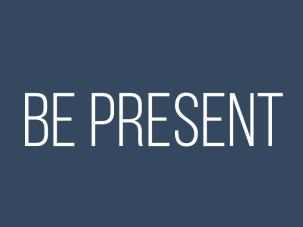 Present – For 2 years I have had an index card pinned to the wall next to my desk that says Be Present! This serves as a reminder to me of what my true purpose is. The role of assistant principal can pull me in a lot of different directions, but many of the things I have to do can be done outside of normal school hours. But my opportunity to connect with kids, to see the amazing teaching that happens in our classroom, and to witness the learning that takes place can only happen during the school day. This year I’m re-upping my goal to be present with students and teachers during the school day.
 seek opportunities to learn and grow. This summer I will be attending ISTE for the first time, and I’m pumped about that. It’s also my goal to work on getting rid of some of the books in my to read pile (not by tossing them, but by reading and learning from them). Hopefully this year can continue to be one of growth for me!
 Uncomfortable – This year is my sixth as an assistant principal. I have gotten to the point that I feel pretty comfortable in the tasks I need to complete in this role. With that level of comfort, it’s time to push myself to try some new things. I have heard the phrase cognitive dissonance to describe that point where we are stepping out of our comfort zone. Being a little bit uncomfortable is where learning and growth take place. I’m trying to step outside of my comfort zone a little more this year!

 The View from 518