Growth mindset and the innovator’s mindset

In the past 6 weeks I have been participating in #IMMOOC (Innovator’s Mindset Massive Open Online Course). For those of you who aren’t aware of #IMMOOC, the course is centered around the book The Innovator’s Mindset by George Couros. The book focuses on these guiding questions:

  • How do you move from “pockets of innovation” to a “culture of innovation”?
  • How do we start to innovate inside the box?
  • How do we move from “engagement” to “empowerment”?
  • What does innovation mean for education, and should every educator be an innovator?

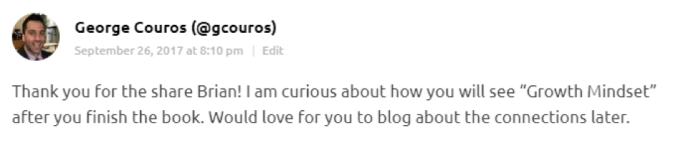
In the first week I wrote a blog post titled Innovate…why? in which I pointed out my 3 main reasons for innovation in education. One of the items I shared was on the role growth mindset plays in innovation in education. After posting my blog, I got the comment below from George:

Couros Comment

With this comment, I began thinking about the role that growth mindset plays in The Innovator’s Mindset.  Couros defines this mindset as:

the belief that the abilities, intelligences, and talents are developed so that they lead to the creation of new and better ideas.

I believe that all teachers agree that we are looking for ways to help the learning that happens in their classroom be “new and better”.  As I read more and more of The Innovators Mindset, I began making connections between what I read from Couros, and the book Mindset by Carol Dweck.  In this book, Dweck shares a quote from Benjamin Bloom that I feel relates to The Innovator’s Mindset:

After forty years of intensive research on school learning in the United States as well as abroad, my conclusion is: What any person in the world can learn, almost all persons can learn, if provided with the appropriate prior and current conditions of learning.

Think about the power of that statement. This is not about the top 1-2 percent – the ones we might call geniuses – being able to learn anything. It’s the belief that with the right circumstances, anyone can learn anything.  What does that fact do for you as a teacher? I know that for me, that drives me to think about what those appropriate conditions are that will lead to the best possible conditions for learning.

I don’t think that the traditional model of school creates those best possible conditions for learning. I think that we as educators reflect on what we can do to learn and grow in ways that will create new and better learning environments for our students. As I think back on the conversations through Twitter, through the guest sessions, and the text of The Innovator’s Mindset, there are a few things that I see as imperatives, and all of them take a growth mindset from us.  Here are 4 of them:

  • Risk Taking: This is not just about getting our students to take risks, it’s about modeling our own risk taking as educators. During our course kick off with Jo Boaler, a statement really resonated with me – “It’s hard to give kids a growth mindset if you don’t have a growth mindset about your own learning.” Statements like “I’m not good at technology” or “Math was never my strong suit” show your students a fixed mindset, and does nothing to encourage their own risk taking. Instead, we might say things like “We’re going to try this and see how it works out.” Even if you fall flat on your face, you modeled for your students a willingness to step outside your own box, which encourages them to do the same.
  • Homework: You better be coming at me with research on this one, because I know some of us in education view homework as a must. As Alice Keeler pointed out, that 10 minute per grade level rule of thumb for homework is totally bunk with no research to support it.  “Some dude just made that up” she says.  The research on homework, especially at the elementary and intermediate grade, shows that the effectiveness is very low. On the other hand, relationships have a very high correlation to learning and growth. What gets in the way of those relationships? One thing is the negative interactions that happen at the start of class when we are discussing homework that wasn’t completed last night. If we take that away, we instantly remove one of the barriers to great relationships with all kids! If you must give homework, assign 20 minutes of free reading time. That reading is correlated with a lot more success than any worksheet! And if the worksheet is so important, shouldn’t you be doing it in class so that the students have appropriate guidance?
  • Grading Practices: For years, there has been a tradition of teach the lesson, hand out the homework, collect it the next day, grade it, put it in the gradebook, and hand it back (that’s what was done to me, and at least for a while, it’s what I did in my classroom). Let’s be honest though – most of those papers we hand back end up in the trash. Kids didn’t value them. Parents often only valued the grade in the gradebook, and how it affected their child’s overall grade. Learning was not the focus, an A-F letter grade was all that mattered. When we put a grade on anything, that signifies an end of learning on that topic. If we want to continue the learning, meaningful feedback is so much more powerful.  And I have to ask, are there times that you don’t pick something up as quickly as a colleague? Maybe some new tech is taking you a while to get used to, maybe you’re trying to figure out how to embed more inquiry into your math, whatever it is, there’s probably somebody who “got it” more quickly than you. Should you be evaluated lower because it takes you longer to make it work in your classroom? I want to applaud those who try something new – even if it takes longer than the teacher next door to them! Students are entitled to the same chance. If the focus of your classroom is on learning, how can we not reteach to those who struggle? How can we not offer a retake to someone who wants to show that they are learning and growing? We need to celebrate that learning, whenever it happens!
  • Flexible Seating: This isn’t just about putting fancy furniture into your classroom and then assigning seats just like you did with desks. True flexible seating is like what happens each time you go to Starbucks to work. I know that sometimes I like the table and chair so that I can spread out. Other times I like the high table so that I can stand while I am typing, or use the stool if I must sit. And every once in a while, that comfy chair in the corner calls may name. How sad would it be if every time I walked into Starbucks, they told me where I had to sit? Kayla Delzer reminded me that “Starbucks is a better learning environment than our classrooms.” A true flexible learning space leads to ownership and choice, which leads to more motivation, which leads to better learning. And here’s the fact – if flexible seating can work in kindergarten classrooms, there’s no way you can’t set the norms for your class to make flexible seating successful! Have kids try out each seating choice, have them reflect on what is their best learning space and why, and then encourage them to choose the spot that works best for them! As you set the norms, remind them that you always have veto power on any poor choices that they make, and then give it a whirl. Why wouldn’t we want our students excited to get to class so that they can pick their just right seat?

OK teachers, how many of you are feeling challenged by some of the things in this post? That’s ok! Are you feeling intrigued to make a shift? Then just do it! Don’t wait for the weekend, don’t wait for Thanksgiving Break, if you believe that a change here could impact learning for your students, then take that leap. Have a growth mindset, but even more, have an innovator’s mindset to try something that will be new and better for your students!

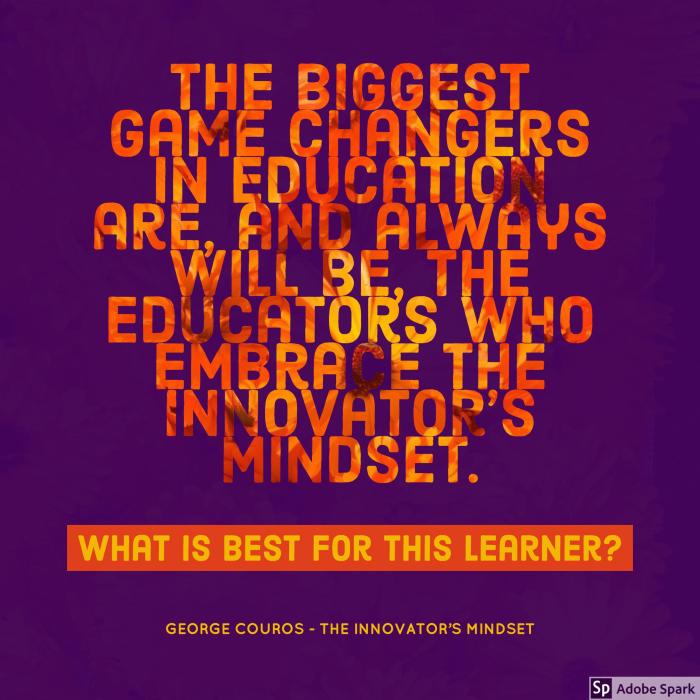
Couros - Best for this learner

Research, meta-analysis, and John Hattie

Marzano on Research

All right, be honest, how many of you have begun to dig into some educational research article, and before you make it all the way through the abstract, you’re feeling a little bit overwhelmed? Trust me, my hand is up too! As educators, we all know the value of research based strategies and skills, of using best practices, and of trying new ideas to meet the needs of our kids. Even with that knowledge, there are times that it is so hard to try to make it through the research.

Add to that another frustration that I sometimes come across when reading research… The fact that they don’t all seem to agree! I can read study A and it says to try one strategy, but study B gives me another option, and before I can make my mind up, someone shares study C with me, and it tells me something totally different. Talk about frustrating!

So imagine my happiness when I started to learn about the idea of a meta-analysis. For those of you that aren’t familiar with that phrase, a meta-analysis will combine data from multiple studies and develop conclusions that have a greater statistical power.

That brings me to the work of John Hattie, the author of Visible Learning. In his work, Hattie developed a system of ranking a variety of influences based on how great an effect they had on student learning. The study was most recently updated in 2015, and includes a list of 195 effects. When you look at the effect sizes, you will see a variety of items with a number score based on the effect size. In Hattie’s work, he identified the average effect size as a 0.40, and uses that as his guide for what works best in education. The things that fall above the 0.40 are considered successful, while things that fall below do not have as meaningful of an effect.

While not every strategy will work for every kid in every situation, the more you rely on the strategies that have higher effect sizes, the more likely you are to provide meaningful learning opportunities for your students.

So I guess all that’s left is to look at the rankings. This link will take you to an interactive visualization of Hattie’s rankings: Hattie Rankings Interactive

Some advice on how to read this visualization:

  • The larger the effect size (in other words the higher the number or larger the bar) the more likely this strategy would be listed in a “What works best in education?” blog post.
  • Several things that we often think of as “go to” reasons for student success and failure (home life and things that happen outside of school) fall pretty low on the list.
  • Many things that are within our control have very large effect sizes.

Hopefully you take some time to analyze the items that appear on this list, think about what it means, and think about how integrating some of these strategies into your teaching (or maybe just your thinking) could have an impact on learning for your students. One of my big takeaways as I analyzed the data that appears here is that we should change the things that are within our control, and ignore the things that we can’t control.  The data here, along with our own common sense of what’s best for kids, tell us that we do have control over the learning that happens in our classroom every day.

What are your thoughts on Hattie’s rankings? Are there any that you feel missed the mark and are too high or too low? What about things that aren’t on the list? Anything that you think needs to be there? Share with us in your thoughts below!

What are you learning?

“What are you learning?” It’s one of my favorite questions to ask kids when I am visiting a classroom, or when I see them working in the hallway.  More often than not, their answers will relate to the specific content they are working on in that moment.  The reality is though that they are learning so much more than the math, social studies, science, or whatever the content area may be.

We ask so much of our students when we put them to work.  We expect them to pay attention in class, to be engaged, to think critically, to work collaboratively.  Just think about how much work we are expecting our students to do.  All in the service of learning and growing.

Your role in the learning process of our students is so important.  They need us every day in order to learn, grow, and find success.  It’s such an important job!

But stop for a minute to think – when someone asks you what you teach, what is your answer?  Do you respond with your content area?  Do you respond with your grade level?

I’m going to share something with you that you may not like to hear though – the content is irrelevant.  That may be an uncomfortable thing to think about, but let me share with you why I believe this.  In my role, I get to walk into a lot of classrooms, I get to see a lot of lessons, and I get to see a LOT of GREAT TEACHING!  But in my role, I also get to notice some things that as a classroom teacher you might not get to see.

This year I saw a 6th grade science class doing a lab activity that was identical to something my daughter did as a 2nd grader.  Even the paper that went with the lab looked the same.  The teacher who was leading the lesson was teaching as though the students had never seen anything like this before.  I asked one of the students about the lab, and he shared that he did the same activity when he was in elementary school.  I can’t imagine the depth of knowledge on this activity was as great as the teacher might have believed since the student had already done it.  Another time I was visiting a junior high classroom and I saw a lesson on scientific method being taught in an 8th grade classroom as though the students had never seen anything like it before – it was identical to one I had just seen in a 5th grade classroom.  I know that when I taught 6th grade, my scientific method lesson was very similar as well.  Where’s the rigor in a lesson that is being taught to our students so many different times in basically the same way?  Where’s the depth of knowledge?

If the content was truly relevant for our learners, we wouldn’t be wasting our student’s time teaching them things that they already know as if they have never seen it.  I know what some of you are probably thinking though – maybe some of the students forgot!  Maybe there are students that weren’t in our district who have never done this before!  I’m going to push back on those ideas – what about the students who didn’t forget?  What about the students who were here, did this exact activity, and are bored out of their mind?  Even if the lesson is fun or one of our favorites, how are we serving the learning of our students?  A good formative assessment at the beginning of the unit may lead you to realize that what you were planning to teach isn’t valuable because the students already know it.

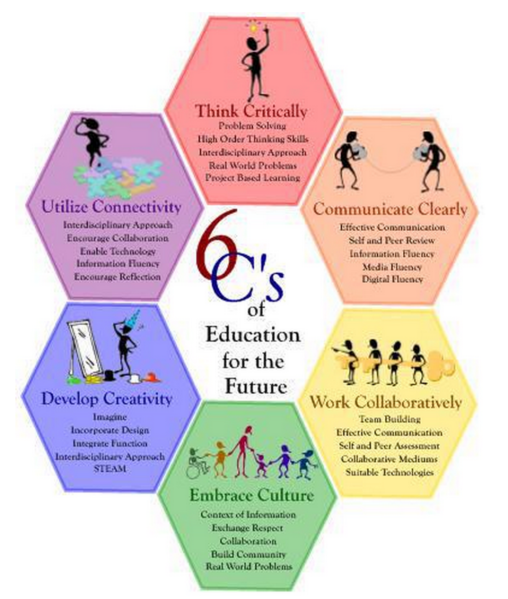
And that’s the thing, the most valuable commodity we have is time.  In education we are always asking for more of it.  One of the biggest complaints I hear from teachers about innovation and change is we don’t have enough time to do new things.  If we can gain some of our time back by not teaching a lesson of material that our students already know as if they have never heard it before, we might be able to do something new and innovative.  Instead of continuing on that lab that a student did in elementary school, what could we have our students do that would develop creativity?  How could we let our students communicate the knowledge they already have?  Is there some way they could work collaboratively?  The image below is one that I have seen shared on Twitter by so many people, I can’t even begin to guess exactly where it came from, but it’s an important reminder of the things that our students need to know for their future.

6 Cs of Learning

If the image above isn’t enough for you, what about some research?  According to the National Association of Colleges and Employees in a recent job outlook survey, reported in 2016, these are the top 5 attributes that employers are looking for: 1) Leadership; 2) Ability to work in a team; 3) Communication skills (written); 4) Problem-solving skills; 5) Communication skills (verbal).

As I was researching this post, one of the other topics that kept coming up is the ability to apply knowledge and skills in real-world settings.

Hopefully, like me, you notice that none of the things listed in any of this research is specific to content knowledge.  That should challenge us to think a little differently about the question what do you teach.  I think the answer to what do you teach should probably be something like this: “I am teaching my students to have strong dispositions of learning.”

Our students don’t need to be able to recite back the scientific method.  They need to be able to use the process to solve problems they encounter in the world.  Our students don’t need to be able to solve stand-alone multiplication or division problems.  They need to be able to apply those math skills in real world situations.  If this is what our students need, what does that do to the way you might plan a lesson?  Assess your students?  Create a project?

I would love to hear your thoughts.  How do you get your students to have the dispositions for learning?  What would you do if you found that several of the kids in your class had already done the activity you had planned for today?  Share your thoughts in the comments below.

Reaching all our students

One of the challenges of teaching kids in the middle grades (I’m calling that 5th through 8th grade for the purpose of this post) is that physical maturity and social emotional maturity do not always match up.  A couple days ago I was talking with a teacher about the immature behavior of a student.  A comment that stuck with me after I walked away was “But he’s the biggest one in the class…”

Sometimes there is a misconception that the tallest kids are going to be the most mature and therefore capable of doing the most, and that the smallest ones are the least mature.  But in my experience, that expectation doesn’t always work hold true.

The next chance you get, just scan your room.  As you look, you will see a huge variety in physical differences among the kids that are sitting in your room.  Not only are each of those kiddos physically different, they all have differences in their cognitive, social, and emotional needs.  While it’s easy to recognize those physical differences, perceiving what’s going on inside a child is much more difficult.  With all of these differences, how do we try to meet those needs?

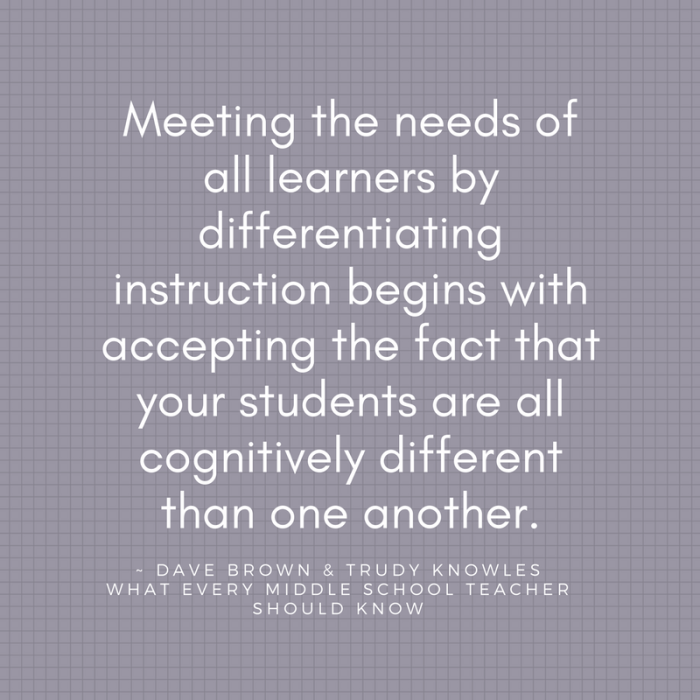
Meeting the needs of all learners by differentiating instruction begins with accepting the fact that your students are all cognitively different than one another.

The Center for Applied Special Technology has been focusing their work on the Universal Design for Learning (UDL).  There are three main principles of UDL, and thinking about these principles as you design learning experiences will help you better to reach the diverse needs of your students.

  • Principle 1: Provide multiple means of representation: We can all agree that our students all learn in different ways.  This means it is so important for us to present and represent learning in multiple ways.  Some students would learn best from a video clip.  Others might learn best from a reading assignment.  Others might need graphic organizers to help them to capture their learning.  The key is to remember that if you only provide one entry point for learning, you probably will not reach all your students.
  • Principle 2: Provide multiple means of action and expression: We all have our preferred ways to be able to express our knowledge.  For me, I love to share my learning through written expression. Others might prefer to record a quick video clip, while still others might want to create a presentation through Power Point. The same is true of our students.  While we can have our big ideas and learning targets that we want students to reach, they don’t all have to show what they know in the exact same way. The more choices we offer students in expressing their learning, the more likely we are to meet the needs of every student.
  • Principle 3: Provide multiple means of engagement: We all know that if learners are not engaged, they are not going to be learning.  Students are most engaged when they are given the opportunity to participate in authentic learning experiences that are responding to their questions, concerns, or interests.  If we can give students opportunities to develop they questions or look into their concerns and interests within the scope of our learning goals, they will be more engaged, and feel empowered

Ultimately, our goal for all students is that they learn and grow.  Through the use of these 3 principles, you can design learning experiences that allow our students to feel engaged and invested in their learning, and in turn you will be more likely to move our students forward in their learning.  What are your thoughts?  Have you seen these principles help your students find more success in the classroom?  Are there any principles that you would add to this list?  Share your thoughts in the comments below!

What do you know about each of your students?

At the beginning of this school year we held a back to school retreat.  One of the slides was based on something that Aaron Hogan, author of Shattering the Perfect Teacher Myth, had shared in his Twitter feed this summer.

My Challenge

We have talked over the years about the value of relationships.  We all know that there are some students who are EASY to get to know.  At the same time, we all know that there are some students that are very difficult to get to know.

Getting to know about the things that are tied directly to school is what teachers do. Test scores, homework completion, attentiveness in class…  I think all of us are good at that.  To have a true and meaningful relationship with a student, we need to have a knowledge of all the aspects of the child’s life, not just their ability to “play school.”  To know this, we have to be excellent watchers and listeners.  This watching and listening has to come from the idea that the only way to create solid learning environments for our students is through truly knowing a student.

Do you have a system of tracking what you know about kids?  Whether you have a spreadsheet that you type info into, a stack of notecards with one for each kid, a class list with simple notes, sticky notes in a binder, or whatever works for you, there needs to be some way to keep track of the things you know about those kids.  If you haven’t done this yet, take a few moments in the coming week to assess your own knowledge of your students.  What do you know about their life outside of school?  What interests do they have?  What did they do over the weekend?  What do you know about their family?

As you assess your own knowledge, are there any kids who stand out as someone you don’t know much about?  If you don’t know much about that child, how can you be sure that you are creating a learning environment that meets that child’s needs?

The good news, it’s still very early in the school year!  If there are kids you want to get to know better, there’s plenty of time for that.  Make it a goal to learn what you can about those kids you aren’t able to write much about.  Use strategies like the 2 for 10 method (spending 2 minutes every day for 10 days talking about something that has nothing to do with school) can help you learn a lot in a very short time.  Conversations in the hallway or at recess can be a great chance to get to know kids too.

Caring about kids can have a huge impact.  The kids who drop out of school in 9th or 10th grade don’t decide one random Monday morning that they are going to sleep in and never come back.  Dave Brown and Trudy Knowles share in What Every Middle School Teacher Should Know that:

“The decision to drop out is a reflective process that begins during the middle level years based primarily on the relationships they have at school with classmates and particularly with teachers.”

In the book Canaries Reflect on the Mine: Dropouts’ Stories of Schooling, Jeanne Cameron interviewed several high school dropouts.  One of the things that stood out in the comments from those students was the belief that they needed teachers to notice them and care about them.  That care doesn’t come just from looking at students grades and test scores.  It comes from the recognizing the difficulties that each of our students have in their lives.

If that isn’t enough of a motivator for you to try to get to know those quiet kids a little bit better, I don’t know what would be.  Do you know there are kids that you don’t know much about?  What do you know about the quietest kid in your class?  What are you going to do in the next week to get to know those kids?  Share your thoughts in the comments below!

What is school for?

Put yourself back in one of your childhood classrooms – at the beginning of the day what was it that your teacher always said?  If it’s anything like my childhood experience, it was something like “Good morning class.” Then what would happen?  The whole class would respond “Good morning…”  And what happened if you weren’t loud enough, or respectful enough?

I think we all have lived that situation – and I may even have been guilty of fulfilling the teacher role (as recently as the first day of school… THIS YEAR!!!).  But here’s the question, what are we teaching with that call and response open to the day?  It’s mostly about teaching obedience.  Traditionally, the common school was built to prepare children to become the factory workers of the future.  Implicitly, and sometimes explicitly, schools taught students to be obedient, to hold a little back, to do the work assigned and nothing more.

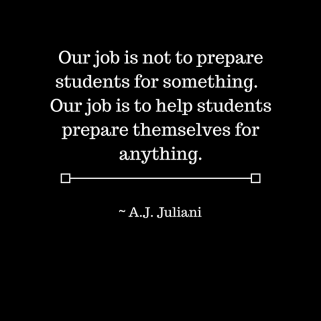
Our job is not to prepare students for something. Our job is to help students prepare themselves for anything.So that brings us to the bigger question: What is school for?  While some of our students may consider a role in manufacturing, the factories of today are way different than the ones of the early to mid 1900s that led to this factory model of education.  Many of our students will not be heading down the path of manufacturing, so that factory model of school definitely doesn’t apply.  If you believe that innovation is going to keep happening (and why wouldn’t it?), then we’re preparing our students for an ever changing world!  That is so different from the traditional model of school as a factory.  In an excellent TED Talk by Seth Godin, he gives 8 examples of things school should be doing:
  1. Homework during the day, lectures at night – flipped learning
  2. Open note and open book all the time – if it’s important enough to memorize, it’s also ok to have to look it up
  3. Access – any course at any time – programs like Kahn or MOOCs can achieve this
  4. Precise focused education – not a one size fits all model
  5. No multiple choice – life isn’t multiple choice
  6. Experiences instead of test scores – learning is focused on the experiences that take place inside (and outside) of our classroom
  7. End of compliance as an outcome – while compliance may be needed at times, it shouldn’t be our end goal
  8. Cooperation instead of isolation – the ability to work with others

I could go into more detail on each of these, but I can’t do any better than what Godin did in his talk, so if you’d like to know more about any of these things, check out that TED Talk here.

So here’s my answer to the question “What is school for?”: I want our students to be equipped to go out into the world and make something that has an impact on their lives and the lives of others.  And I want them to know that if they get stuck, to ask for help and support.  While we might not always have all the answers, hopefully we can help our student to find the answers.

I’m curious to hear your answers – for you, what is school for?  Share your thoughts in the comments below!

Using outdoor spaces

Today I was reading a recent blog post by John Spencer about the ways that nature helps us to be more creative (check it out here).  Personally I love to be out in nature, so the post really caught my attention.  The gist of the post was about the fact that time in nature can lead us to greater levels of creativity.  His 5 ways that nature makes us more creative are listed in bold below, with my own thoughts added:

  1. Nature creates positive disruptions – Life draws us into the natural hustle and bustle of our world. Being in nature helps us get away from technology, current events, and everything else that makes it hard for our brain to stay focused.  That time away from all those distractions allows our brains to think more deeply.
  2. Nature encourages problem-solving – Almost every time I go for a hike, or spend some time in nature, I’m inspired to write a new blog post, or solve a problem, or be creative.
  3. Nature helps us embrace deep work – When do you do your best thinking? There is a lot of research that says that simply being active can lead to deeper thinking.  Simply going for a walk helps us activate our brain in different ways.  According to some research, throw nature into the mix and you multiply that effect.  So what does that mean for you?  Before teaching a particularly important skill, take your class for a walk in the woods outside of school.  Your students brains will be better prepared for deeper thinking when you return.
  4. Nature humbles us while also expanding our worldview – I’m not sure how many of you know this about me, but I was a 10 year 4-H member. I didn’t show animals (we weren’t on the farm), but I did lots of other projects over the years.  One of the projects I did required me to take multiple observations of a natural environment every day over multiple weeks.  I chose a small wooded area with a trail just a little over a mile from my home.  I had to observe at different times in the day, and I began to notice changes in what seemed like an untouched environment.  Some animals were more or less active at certain times of the day, some plants looked different depending on various factors.  The time I have spent in the natural world helps me realize that there are so many things happening in the world around us that we miss when we are in our cars, or on our devices.  Sometimes you really do have to slow down, look around, and smell the flowers in order to be aware of what’s happening in our world, and to realize how little control we have over so much of what’s around us.
  5. Nature can spark innovation – Did you know that Velcro was designed by a Swiss engineer after his dog was covered in burdock burrs after going on a hike? Or that the design of the nose of Japanese high-speed trains was meant to mimic the beak of a kingfisher?  These are just a couple of examples of innovations that came about because of things that people noticed in nature.  Imagine what the future scientists of the world (our students) may be able to develop if they learn to look to nature for ideas and solutions to our problems.

Reading Spencer’s post got me thinking about the natural wonders just waiting to be explored outside of our school.  By walking out the doors of our building, you can access a variety of outdoor environments.  Between the trails in the wooded areas, the stream running through the woods, the untended plain near the baseball fields, or the river, there are so many ways for us to access nature.  And the benefit doesn’t just stop with the kids being out in nature away from their devices.  Something they see while they are with you may inspire creativity and wonder in a way that is totally unexpected.

What have you done with your class in our outdoor areas?  Have you seen increased levels of creativity as a result of the time you have spent outside?  Share your thoughts in the comments below.

Gentle pushback

How do you spend the beginning of the school year?  What types of activities are you using in your classroom?  Keep in mind that the expectations that you set in the first few weeks will carry throughout the year.

So often at the beginning of the year, we spend lots of time on relationship building.  Those of you who know me will know that relationships are a key part to success (see previous posts here, here, and here).  Relationships alone aren’t enough though (I have a bigger post on this topic coming soon).

Part of what got me thinking about this was a series of tweets from Rick Wormeli – I happened to be on Twitter last Saturday evening, and he had a string of tweets on this topic.  He focused on the first week of school – we’re past that already in my school corporation – but I think that his sentiment can carry over to the first month of school.

What things have you tried for the beginning of the year to push your students in intellectual, academic, or creative ways?  What do you think about Wormeli’s thoughts?  Do you have different opinions?  Share your thoughts in the comments below.

Solar eclipse memories

This is my sister and I – probably summer of 1985, just to give a frame of reference!

As we build up to Monday’s solar eclipse, I was thinking back to the only other solar eclipse that I recall seeing.  The date was May 30th, 1984. That May was the beginning of my last summer before I became a “school kid.”  I would be starting kindergarten that fall.  My mom ran an in-home daycare, which was great because that meant I had friends to play with every day.  She had been collecting shoe boxes for a few weeks leading up to the eclipse, and on the day before the eclipse we turned them into pinhole cameras. (One fun fact for all of you who are at RSI – Dave Bradley was one of the kids that was at the daycare on the day of the eclipse).

http://www.mreclipse.com/SEphoto/SEgallery1/image/A1984Mosaic.JPG

While I don’t remember exactly what the sky looked like that day, I remember that there was a lot of excitement about the event.  I also remember that there wasn’t a lot of talk about NASA approved sunglasses (maybe there was and I was too young to know about it).  That day my mom reminded all the kids not to look at the sun, we took out pinhole cameras outside, and we watched the eclipse.  I do remember that the big trees in our backyard were making it hard to see, so Dave and I moved to the backyard behind mine, and we had a much better view.

As many of you know, when I was still a classroom teacher, my favorite subject to teach was science, and my favorite unit was always space science.  I think that my experience with the solar eclipse set me up with curiosity about outer space.  As a kid I loved watching shuttle launches.  I remember crying when the Challenger disaster happened.  I had the chance to go to space camp during my first year as a teacher.  Even today, I can get sucked into a livestream of a SpaceX launch or landing and not be able to turn away.

http://www.history.com/topics/challenger-disaster

I know that there are some who are concerned about safety for our students, but I would hope you seriously consider finding a way to give your students an opportunity to see the eclipse.  My experiences that day have helped lead to the things I am still curious about today, and for our kids it could be such a great provocation to lead into student wonder.  Who knows, a future space scientist, astronaut, or science teacher could be sitting in your classroom!  If you have something cool planned for the solar eclipse, share with us in the comments below!

One key to student success

With it being the beginning of the school year, many of us have been spending countless hours getting ready for our students.  We made sure our classrooms look just right, we made sure to pick the perfect activities for our students to get to know each other (and for us to get to know them).  Before the first day I’m sure you were all just as excited as I was thinking about this school year.

One thing that many of us think about during the summer time is how to help our students to be successful.  For those of us in education, that is something that we all want for our students.  I’ve read many philosophies of education, written by lots of great teachers, and all of them say something about helping our students to be successful.  So what needs to happen in order to help our students be successful?

As I was thinking about this question earlier this week, I found myself drawn back to a book that I read a while back – What Every Middle School Teacher Should Know by Dave Brown and Trudy Knowles.  I know I’ve mentioned this book in previous posts – if you haven’t yet, it’s definitely worth the read!

In order to create cognitive growth for our students, they have to be willing to take risks in their own learning.  They have to be willing to try things that they’ve never done.  They have to be willing to fail from time to time.  Failure leads to growth for all of us!

The problem is, failure is scary.  How many of us have not tried something because we were worried we wouldn’t be able to do it?  During my high school years in Bloomington we would hang out at the Indiana University outdoor pool.  If you’ve never been there, one thing you should know is that there are multiple diving boards, including a platform.  I had a couple of friends who were divers, and they made it look so easy to go off the 3-meter springboard, or any one of the platforms.  I on the other hand, while being a strong swimmer, was scared to death to jump off that top platform.  Multiple trips to the pool, and many times watching others go for it, and I just couldn’t bring myself to do it.  Finally one of my buddies got me to go up the platform with him – “don’t worry, if you don’t want to jump, you can go back down.”  Once I got to the top, he jumped right off.  I was next in line, I turned around and there was a line behind me.  I didn’t want to walk past all of them, so I walked up to the end of the platform, looked over the edge, thought about it for a moment or two, and went for it.  What a rush it was to take that jump!  My fear had held me back and prevented me from a fun experience.

For some of our students, the fear that I felt about jumping off that platform is what they feel about reading aloud, or writing a story.  Maybe a teacher has told them that math isn’t their strong suit, so they don’t want to solve a problem for the class.  We expect our students to come to school for 180 days to do something that feels risky.  How many adults would do something risky every day?  A lot of us might just give up.  For the kids who feel this level of fear about their academics, they may say to themselves “If I’m not good at it, why even try.  I don’t want to embarrass myself.”

These students need our encouragement and support to build enough confidence to take risks.  That comes back to our classroom culture – the expectations we set about how students treat each other, as well as the things we (the adults in the room) say in the classroom.  Kids need to feel safe enough to be able to take risks.  Brown and Knowles share the following list of things students need to feel academic safety:

  • No one laughs at them when they attempt to ask or answer questions
  • Teachers establish realistic academic expectations and outcomes for every student
  • Students’ efforts are recognized, as well as the products of those efforts
  • Teachers eliminate competitive situations that create inequity among students
  • Teachers develop cooperative grouping strategies that encourage students to collaborate in their learning and share their knowledge and expertise with one another
  • Teachers play the role of learning facilitator to encourage student independence
  • Teachers choose alternative instructional strategies to meet each student’s learning style
  • Teachers recognize and appreciate talents other than academic skills

This list is not meant to be the end all be all solution for all our students, but it provides some ideas that we can reflect on in our planning and preparation to make sure that our students will feel safe in our classroom.  They need that safety to take risks, and they have to take risks to grow.

What steps do you plan to take in your classroom to make sure that all of your students feel comfortable to take risks in your classroom?  How can you model your willingness to take risks in your own learning and growth?  Share your thoughts in the comments below.