Throughout much of my teaching career, I used a variety of group projects and activities. I thought that my students would find them more engaging, and that the group work would help build collaboration skills. But let me take you back to a memory of some of those past projects.
Invariably, at least one group would struggle to work together. Despite my best efforts to put students into groups that I thought would support learning, some groups reported that one student wasn’t pulling their weight (missing deadlines, not bringing materials, etc.). Or there would be a group sharing that one student was “taking over” and not incorporating the ideas of the other members. In these situations, I’d go back to our norms and expectations, things would get a bit better, but before long, the problems would reemerge.
The lie that we’re going to address today is the belief that putting students into groups teaches them how to collaborate. I think there is a false belief that grouping kids will lead to learning and collaboration. That’s not what the research tells us.
There is a small nuance that must be addressed: some meta-analyses find that cooperative learning is superior to competitive or individual learning. But cooperative learning is so much more than just putting students into groups. In Setting The Stage for Learning: Equitable, Evidence-Based K-12 Instructional Design and Assessment (found here), Victoria Hobson wrote a chapter on cooperative learning. She points to five key elements of structured cooperative learning highlighted in research by David W. Johnson and Roger T. Johnson (2018).
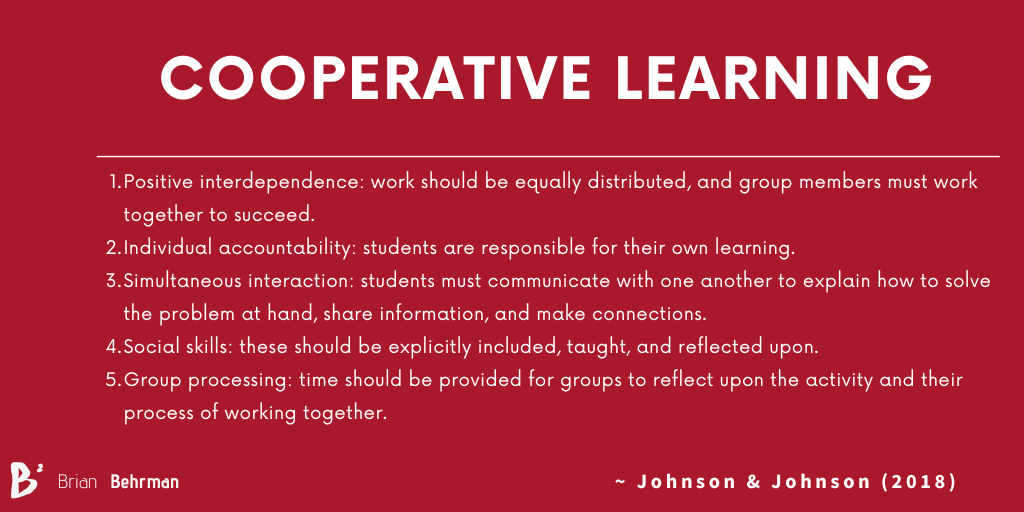
I can assure you, the group work that my students were doing was nowhere near this structured, and to be honest, most group work I see is lacking in at least one if not several of these areas. If we use group work to improve collaboration, we actually have to teach our students to collaborate through modeling, discussion, and feedback. In Hobson’s chapter on cooperative learning, she describes several models that support true cooperative learning. As you plan future group work, keeping these models in mind would benefit your learners.
The truth is that unstructured group work consistently leads to social loafing, unequal participation, and the illusion of learning. Collaboration is a skill that must be taught and scaffolded. We don’t create collaborators just by putting students into groups. In a 1979 study, Latené, Williams, & Harkins defined social loafing as a tendency for people to contribute less in groups than when working alone. They describe it as a social disease that negatively impacts individuals, organizations, and institutions. You can read that research here.
Social loafing has a clear cost to classroom learning. Research by Cait Caffrey (2022) suggests that individuals exert less effort and speak less when working in groups. That would be a sign that the effects go past just productivity and actually impact engagement and learning.
An important aspect of social loafing concerns the size of a group. The bigger the group, the larger the impact. It’s a lot harder to loaf when you are in partner pairs or triads than in groups of five or six. As teachers, it is important to keep in mind when developing our cooperative learning groups.
It is also worth noting that students in both high- and low-performing groups reported experiencing social loafing. Students self-report dividing tasks, completing their portion, and then putting the material together for their group, without any reflection on quality, flow, or whether it meets the project’s criteria. True cooperative learning requires integrating the different parts of the project to ensure the work meets the assignment’s expectations.
Going back to the five key elements of structured cooperative learning, a key point is that social skills must be explicitly taught. For students to be successful in collaboration, they must have explicit instruction in those skills. This means things like role-plays, modeling of behavior, and demonstrations of what not to do will help students better grasp the interactions necessary for true collaboration. Jennifer Gonzalez has a great article on how to build explicit instruction tasks. See the section on interpersonal conflict in this article.
Elizabeth Cohen and Rachel Lotan describe Complex Instruction as an approach to address learners’ varied needs and ensure participation across the group. The research suggests that those who do the most will learn the most, so we need to ensure all students are equally engaged in the task. To support equitable participation, teachers might need to help groups recognize the strengths of a low-participation member. For example, a student who speaks Spanish may not feel comfortable in writing a portion of the report, but they might have the skills to help explain the deeper meaning of the lyrics in a Spanish song that could be used as part of the presentation.
Ultimately, in Complex Instruction, the teacher’s message can be: “No one person has all the skills to be successful, but by combining our skills, each one of us has some of the skills needed.”
Another move that teachers can make to ensure equal participation is to assign students roles within the group. A few potential examples might include leader, recorder, questioner, timekeeper, reporter, fact checker, etc. Depending on the group’s context, different roles might be necessary. I’ve seen the assignment of roles used with great success in book club type group work, and having each student fulfill a different role at each meeting ensures equal participation across the task.
A final fix to keep in mind: Students must have the competencies needed to complete the project. Group work before students have a solid foundation in a topic will invariably lead to social loafing. Students’ perceptions might be, “I can’t do it because I don’t understand the material.” One of the failures I have seen in project work is that the project is the driver of the learning, but without background knowledge, students may struggle to even start the task.
In the past, I’ve discussed the Novice-to-Expert continuum. Students at the novice level of learning cannot be expected to develop meaningful learning of a skill or concept. They must be beyond the novice stage before we set them free to independent or group project work.
Ultimately, a key takeaway here is that social loafing is not an inevitable reaction to group work, it’s a predictable response to poor structure.
Well-designed cooperative learning does work, and there is detailed research on that. For success, we must ensure the 5 elements listed above are in place. When something doesn’t go well in cooperative learning, the problem is almost never entirely the students’ fault, it’s the design.
What are your thoughts? Are there things that you have found key to successful group projects? What are some of your past failures? Share with us in the comments below.