Incremental improvement

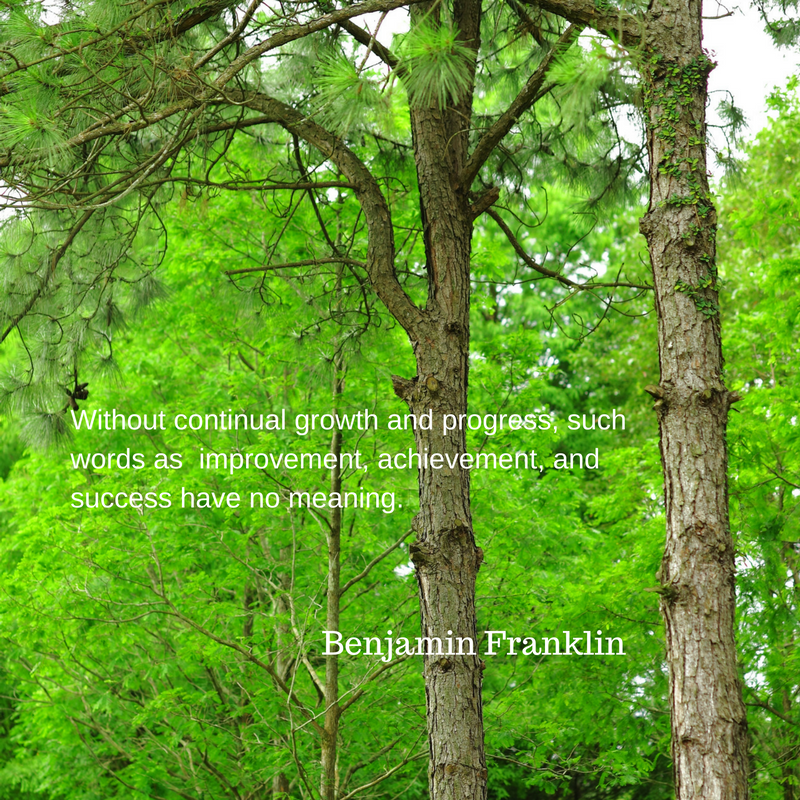
without-continual-growth-and-progress-such-words-as-improvement-achievement-and-success-have-no-meaning

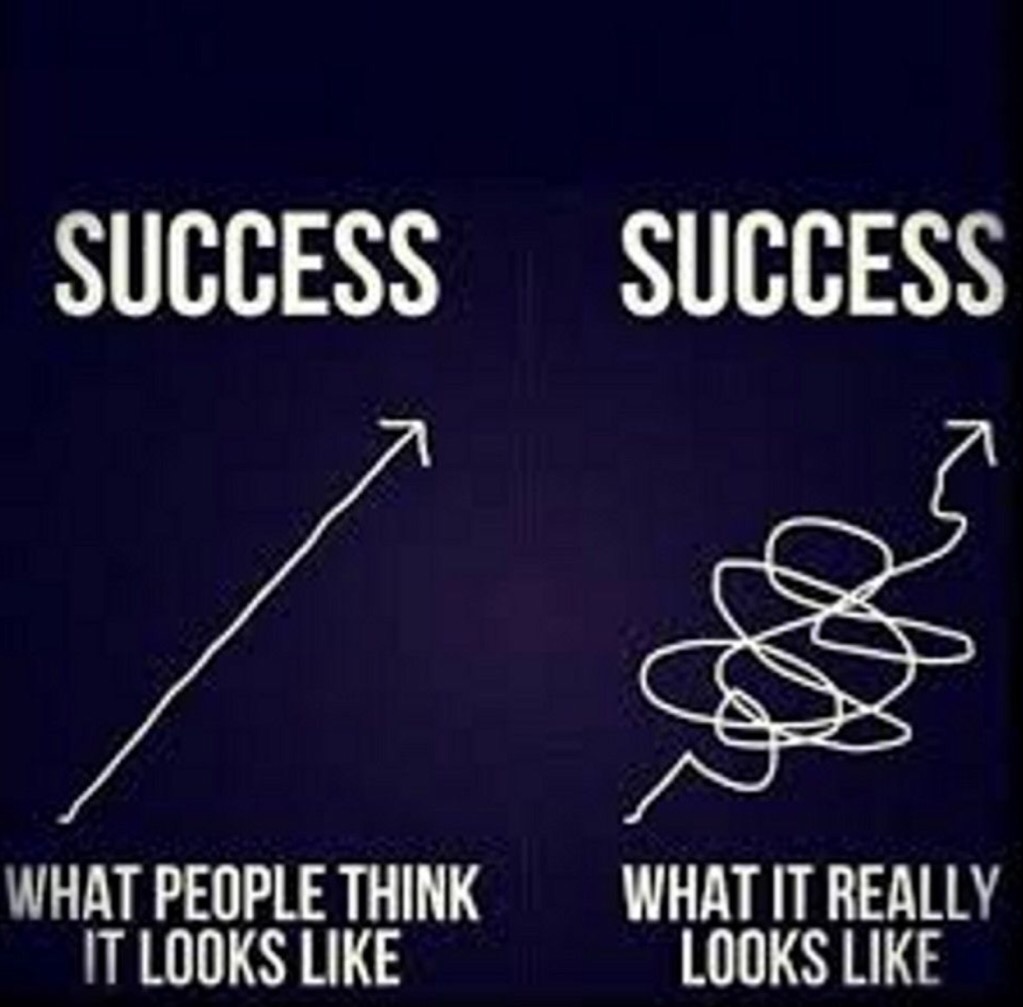
If you were to draw a path to success, what do you think it might look like?  I recently saw this visual, and it made a lot of sense to me:3dd260bf-ecde-4bdd-b88d-ebdcd9bbc539

I think we all would agree that the path to success is not a straight line.  We’ve all had bumps in the road on our own path to where we are.  In the version of success that appears on the right, there are some ups, some downs, and some times in the totally opposite direction of where you want to go. When you understand that this is what the path to success looks like, you also understand the concept of incremental growth.  These are the small steps we take to get closer to our goals.  When we focus on incremental growth, we don’t care as much about the external factors, and instead focus on the things that we can control.  Hopefully you will see the benefit of the rest of this post if you hear questions like this in your classroom:

  • How many points is this worth?
  • Can I earn extra credit?
  • Did you grade the tests yet?

Questions like these are a sign that students care only for an extrinsic motivator – the grade.  The problem with our students having this mindset is that when students are motivated solely by a grade, they will find ways to get the work done and earn the credit, but they will completely miss the educational value of the lesson, and will not retain anything.  The best way to get them past these extrinsic motivators is to shift the mindset of your students.  Work to get them to focus less on the external motivation, and more on the internal motivators.

The first step – make sure that students understand that grades are just another data point, nothing more or less, that tells teachers and parents a little about where students are right now.  When you attach rewards or consequences to a grade, you train the students who do well to expect an external motivator, and you completely miss that kid who might be doing everything in their power just to keep their head above water, and never getting anything for it.  When you talk about report card grades, make sure students know that you are much more concerned with their day to day efforts than you are with their overall grade.

So what are some of the ways that you can give this message to your students?  Check out the points below:

Improving through effective feedback

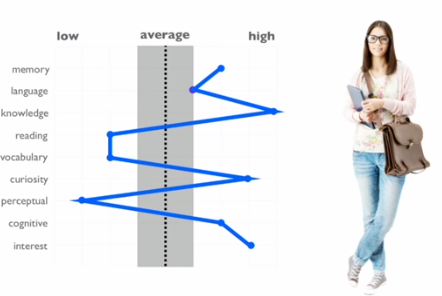
If you want your students to value growth, you have to give them feedback that shows you recognize their growth.  Normally this can’t be shown just in the grade on a paper, but rather through the words you speak to a student.  During work time, be walking around, observing what students are doing, ask questions of them, and sharing your thoughts.  Since we all know that our students have a jagged learning profile (see the last post on “Average” students), we should also be aware that every child is at a different place, with different goals and different needs.  Our feedback should focus on what’s most important to THIS child at THIS time.

One of the other keys to effective feedback – focus on the future, not the past.  Instead of saying “You shouldn’t have done it this way; you should do it this way…” you might want to try saying “Next time, I’d like you to do it this way because…”  Our words totally change the feedback and focus on incremental growth moving forward.

Improving Results

One of the best ways for students to be able to see their improvement is to have a way to reflect on their learning process easily.  A great way to do this is through portfolios.  In this day and age, the portfolio can be totally digital, and easily viewed, shared, and managed.  Apps like SeeSaw, or a blog, can allow students to share their work and create a reflection in writing, audio, or video of what they have learned in their work.

Depending on the task, what you might ask students to include in their portfolio may vary, but some of the things that would probably be valuable to include would be:

  • A title that describes the Big Idea or concept
  • A picture or video of the process or final product from the activity
  • Answers to reflection and synthesis questions that guide each child to successfully demonstrate their understanding of the concept.

The reflection questions should vary depending on the activity and be based on your learning goals, but the idea is to get students to reflect on their learning.  If nothing else, ask them “What did you learn?”  If they can reflect and articulate that, their retention will be that much stronger.

If you feel that students are lacking in their answers to the reflection questions, there is a simple solution.  Follow up their answer with “Tell me more.”  This simple statement gets students to think a bit deeper, and if you model this enough, your students will eventually begin answering your questions in a more complete way without you having to ask.

Critical Peer Feedback

If you are the only person in the classroom who is able to provide feedback, some things might get missed.  We all know there’s only so much time in the day!  The key is to get students to understand that when they are looking at each others work, they are not being judgmental, rather they are looking for specific things that could be improved.  In order to help students understand how to do this, here are some steps you could introduce to them:

  1. Tell your peer that you have an idea of where they might improve. This way they know that you are just trying to help them make their work better.
  2. Start or end with a specific compliment! Let them know what you like and why you like it – when they know you appreciate something they have done, it’s easier to take some critical feedback.
  3. Give your suggestion as a question rather than a statement. Instead of telling your peer what to say, you could ask “have you thought about doing this…” or “I wonder if others might understand it better if you…”

Hopefully you see a couple of ideas here that you could implement in your classroom to help your students move towards an attitude of incremental improvement.  Maybe you noticed that a big key to incremental growth for students is feedback.  Meaningful feedback is the key to incremental growth for all of us!

If you decide to try out any of these strategies in your class, I’d love to hear how it goes!  If you’ve tried anything like this, tell us about it in the comments below.  What worked well?  What were your sticking points?

What is the “average” student? (Part II)

Last week I shared with you a little bit about the idea of averages.  From astronomers in the 16th century, to the work of Quételet in the 1800s, to Lincoln’s efforts to standardize the military during the Civil War, averages have a long history of being used to understand humans both physically and mentally.  During World War II, the research of Gilbert Daniels showed that averages were not a great idea for design of the cockpits of airplanes because no pilot fit the mold of the average man.  As a result, the Air Force banned the use of average for design, and began demanding design to the jagged edges.  This led to adjustable foot pedals, helmet straps, flight suits, and seats (things that seem like a no-brainer today).

airforce-dimensionsThrough the choice to move to flexible design, our Air Force was able to move forward in ways that they were not able to do when design was based on the average.  Now I know that some of you probably read last week’s post and may not have seen an immediate connection to education.  If you recall, in last week’s post I mentioned Todd Rose, a Harvard professor and a high school dropout, who is doing some interesting research in the science of individuality.

During a TEDx Talk titled The Myth of Average (if you have a chance, this is a really good TED Talk with some real implications for the education of all students), Rose talked about the educational repercussions of using average to design learning.  Sometimes our classrooms are like the airplane cockpits at the beginning of World War II.  There aren’t a lot of options for adjustments, and because of that, there are students who struggle.  Here’s the dirty little secret though – it’s not just the kids at the bottom who struggle in school.  When you look at dropout rates, a significant portion of high school and college dropouts aren’t leaving because it’s too hard, they’re leaving because it’s too easy and they aren’t challenged or engaged.

Over the summer I had a video post to the blog titled “An Open Letter to Educators.”  More recently I have been reading the book The Boy Who Played with Fusion, the story of Taylor Wilson, a 22-year-old who built a fusion reactor at the age of 14.  Both talked about a need to embrace new formats of education in an effort to be more individualized and prepare our students for the real world.  The implication I saw was that this individualization isn’t just for the kids that we identify on the low end of the spectrum, or those on the high end of the spectrum, but also for the kids we identify as the “typical” student.

No matter how we might identify our students (typical, below average, above average), our students come to us with jaggedaverage-student learning profiles.  Some are strong in math, but struggle in ELA.  Others have a talent for memorizing facts in social studies or science, but when you try to get them to think deeper, and solve the problems of our scientific world, they just can’t do it.  What if our education system was designed to adapt to the jaggedness of our students instead of expecting our students to adapt to the school setting?

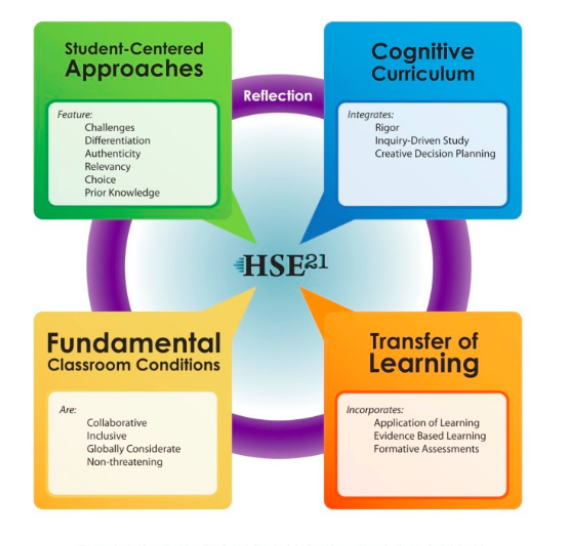
The HSE21 Best Practice Model is a great method to get there.  Through student-centered approaches, transfer of learning, cognitive curriculum, and fundamental classroom conditions, we can develop an environment that accepts students where they are, and helps to move them further.

As you continue to design your classroom conditions for your students, be thinking about their jagged profile of learning.  How are you making the learning environment more flexible?  What are you doing for that science genius who struggles with the reading?  They may be awesome with the hands-on portion of science, but when it comes time to read and learn about theories, they just don’t get there because the textbook is too challenging for them.  Our goal has to be one of constant incremental growth, both for the kids who are struggling in a lot of areas, as well as those who seem to have it all together.  Remember, we’re all jagged!

Technology can help us to get there.  With an iPad, each of your students has the ability to translate text, look up vocabulary, or even have text read aloud to them.  With programs like NEWSELA or Achieve 3000, we are able to have our students read materials that are at the appropriate level for them, be able to understand what they have read, and in turn have an opportunity to grow.

Flexible design in learning is the school equivalent to adjustable seats!  These adaptations will nurture the potential of each individual in your classroom.  And remember, adaptations aren’t just for those on either end of the spectrum.  That kid that you think of as average probably has a jagged profile of learning too, with strengths that we can tap into, and weaknesses that we can target for growth.  The adaptations that we’d make for anyone with a label can work for those without any specific label too – and as the teacher, you are allowed to make the choices of what is best for your students!

What might flexible design in education look like in practice?  Here are a few ideas:

  • Get rid of specific numbers on assignments (3 pages, 5 paragraphs, 4 signposts, etc.) and shift to requiring quality work instead.
  • Allow modifications on assignments.
  • Create a loose structure for projects to allow more student autonomy in what they are creating and how they are making it.
  • De-emphasize standardized test scores or other systems where averages are used to judge students.
  • Let students select the strategies that work best for their own learning (that student who struggles with reading might be able to listen to a podcast or watch a video on YouTube and think just as deeply as that star reader who can learn from the text).
  • Change the pace so that certain students can finish earlier and have enrichment opportunities and others who are behind can have more time to work and not feel like all they are doing is to catch up.

Now, I know some of these ideas sound crazy, or scary, or hard to put into practice.  We can’t change everything at once, but we can move incrementally to try to develop an environment that our students will be able to have more success.  Just like setting goals for students to grow, we have to set goals for our own growth, and then take steps to get there.

But isn’t it worth it?  Who knows, that kid who is struggling in your class right now might be on the path to dropping out, but they may have the potential to be a professor at Harvard – or any one of millions of other successful paths.  They just need to have the opportunity to embrace their individuality!

So what are your thoughts?  What successes have you had when adapting to be better suited to the individuality of your students?  What challenges do you see in this way of thinking?  Let us know in the comments below!

Active learning

the-only-source-of-knowledge-is-experience

The HSE21 Best Practice Model is such a great tool because it reminds us of the fundamental classroom conditions that will help our students be ready for their future.  I was recently reading the book Learn Like a Pirate by Paul Solarz and he spent a lot of time talking about active learning.  In active learning, we see differentiation, authenticity, relevancy, choice, and collaboration – all important pieces of the best practice model.  Think back to your favorite moments when you were in school.  What stands out?  It’s probably an example of active learning.

When I was in elementary school, both of the 6th grade classes in our building collaborated to write, produce, and perform a musical.  I vividly remember working with classmates to write the script, to advertise the show, and to plan the costumes and props for the show.  The skills and strategies that I developed in activities like this were ones that I believe helped set me up for success in middle school, high school, and beyond.  While I remember moments of passive learning when I was in sixth grade (one of my teachers was the queen of having us copy notes from her beloved transparencies), I can’t recall any details that I may have learned in that format of lesson.

So, how can we integrate more active learning into our classrooms?  Here are just a few ideas based on Learn Like a Pirate book:

  • Simulations – What’s a better way to learn about the Boston Tea Party?  Read about it, or take your classroom back to 1773 and have your students simulate the circumstances that led the Sons of Liberty to throw cases of tea into the Boston Harbor?  Or you could integrate some science into your social studies by having your students set up a colony in outer space.  They can experience creating a government for their colony while also learning about the needs for their planet.
  • Debates – The collaboration that goes with a debate can be amazing. If you pick a topic that would have more than 2 sides, you can break your class up into several different groups with different topics, keeping the groups small enough that all play a role, while also large enough that you can put mixed ability students together.  Solarz does alternative energy debates with his students.  He plays the role of President, while his students are the advisors trying to convince him that their energy plan is the best.  While this topic may not resonate with you or your curriculum, there are many other debatable topics that could tie to your standards.
  • Science Fair – This is something that has gone out of style, but why? In a time where we are shifting to STEM classes, and at a period in time when so many of our kids don’t do hands on science projects like previous generations, this seems like a no brainer.  The issue I had with the science fair’s old style was that it was typically done as homework.  The last time I had my students do a science fair, we did everything at school.  Students were asked to bring in poster boards, but I tried to provide most of the other resources they needed (sometimes we had to get creative).  Kids assisted one another on their projects, and were truly excited to share their findings at the end.  I was able to provide feedback, help with data collection, and teach mini-lessons as necessary.  The best part – I knew it was all done by the student on a relevant topic of their own choosing.  A variation on this could be an invention fair, or a coding fair, or anything else you might imagine that lets students be actively involved in inquiry.
  • Project-Based Learning – A trend in education, and one that I was guilty of when I was still in my classroom, is that we teach a unit, and then at the end of the unit students complete a project to show their learning. What PBL asks is that we teach through the project.  Once you have your basic idea planned, students choose their more specific project and dig in.  Throughout the unit, mini-lessons can be taught on content, procedures, or skills that students need to go further in the process.  As a teacher, you are continuously checking in with students, seeing where they are and where they are going next, providing feedback, and deciding if there are topics that you need to build a mini-lesson around.  While we’re giving students choice and freedom, you are allowed to set some parameters up front.  PBL doesn’t mean setting the students free to do whatever they want, there have to be some class norms and expectations in place first.  Think of these expectations as the guardrails to keep your students in the right lane, and heading in the correct direction!  If you’re looking for good PBL resources, the Buck Institute for Education (bie.org) is a great resource!
  • Technology – Sometimes integrating some tech into a passive lesson is just what it takes to up the level into an active learning opportunity. Don’t just use technology for the sake of saying that you’re using technology.  Use technology when it is the best tool for the job.  Remember, HSE21 is not, and has never been, about technology, the iPad, OneDrive, or any of the many apps that are used around school.  However, when we find technology that truly improves or transforms what we’ve been doing, don’t hesitate to add it to your lessons.
  • Reader’s Theater – This is such a great way to work on oral reading fluency.  Students get to practice their part several times with their group.  During that time they can practice pronouncing difficult words, learn to project their voice, add inflection, and enunciate.  Depending on your goals, it could be a single day activity, although students don’t have as many opportunities to practice and they may not be able to create props to go with their performance.  On the other hand, you could do a multi-day activity where students are put into groups and roles one day, have time for rehearsals and planning for the performance (props, costumes, etc.) on a second day, dress rehearsals where you can give feedback on props and costumes that aren’t appropriate or necessary on a third day, and then performance day on the last day.  If you’re really brave, you could record the performances to put on a YouTube page so that parents can see what their kids are up to at school.

This is not intended to be an all-inclusive list of active learning activities, but is meant to give you some ideas of how to create more active learning opportunities for your students.  What am I missing?  Are there active learning examples that you use that I didn’t mention?  Have you tried (or are you thinking about trying) any of the ideas above?  Tell us about your experiences, your thoughts, or your plans in the comments below!

Finding the author’s purpose

AuthorsPurpose

This post is the final post in a three-part series based on my learning from the book Reading Nonfiction as well as recent PD that I attended that was led by Kylene Beers and Bob Probst.  In the first post, “How do we take them further?” I talked about those 3 questions that should guide our thinking when reading nonfiction:

  • What surprised me?
  • What did the author think I already knew?
  • What changed, challenged, or confirmed what I knew?

When we get our students to think about these three questions as they are reading nonfiction, they will notice more, question more, and dig deeper into the text.

In last week’s post, “Defining Nonfiction” I wrote about how we define nonfiction.  I first shared a word cloud based on our own definitions of nonfiction reading:

Nonfiction_definition_wordle

But we then transitioned to a much deeper definition of nonfiction:

Nonfiction is that body of work in which the author purports to tell us about the real world, a real experience, a real person, an idea, or a belief.

To be able to truly dig deeply into a nonfiction text, we must understand the author’s purpose.  In this post I’m going to be sharing with you a couple of the signposts that Beers and Probst recommended as a starting point to really get our students thinking about the author’s purpose.

The first signpost that Beers and Probst shared with us specifically during our PD was the concept of Contrasts and Contradictions.  For those of you who have been using the Notice and Note to teach fiction reading strategies, this one should sound familiar.  In fiction you look for things that the characters do that contrasts or contradicts what you might expect.  In nonfiction we should notice if the author shows us “a difference between what you know and what is happening in the text, or a difference between two or more things in the text.”

Think about it for a second.  If you are reading a news story, and it contradicts something that you have seen in a different story, or something that you believe you already know, that is going to give you pause.  When you stop to think about those differences, you might come to the conclusion that an author is trying to change your opinion – this is a hint of what the author’s purpose might be.  Remember, our students can’t just think of nonfiction as not fake.  Our students have to have that questioning stance so that they can be a bit skeptical of the opinions being shared.

Once we recognize the signpost for contrasts and contradictions, students then need to take it a step further – just noticing the signpost doesn’t get the level of inquiry we want.  Next we need our students to ask themselves a question about that signpost.  I love the chart on page 121 of Reading Nonfiction because it shows anchor questions for different levels of students, or questions that could be asked in the content areas.  The most basic anchor question for this signpost would simply be “What does this make me wonder about?” while a deeper anchor question might be “What is the difference and why does it matter?”

The other signpost that Beers and Probst said was so important in finding the author’s purpose was Extreme or Absolute Language.  This is defined as language that “leaves no doubt about a situation or an event, allows no compromise, or seems to exaggerate or overstate a case.”  Virtually any statement that includes the words all or none would be an example.  It seems this year that you can’t listen to a political speech or read an article about the presidential race that doesn’t include some form of extreme or absolute language.  The extreme language can range from obvious and probably harmless to the subtle and potentially dangerous.  Take the following 3 statements that many of us may have heard at some point:

  • It’s freezing out there!
  • You have to let me go to that party! Everyone is going to be there!
  • Simply stated, we know that Saddam Hussein has weapons of mass destruction.

As you can see, the first statement is probably pretty harmless, the second might give the parent of a teenager pause to think about whether or not it is appropriate for their child to attend the party, but that last one is an example that led to the loss of many lives and history has come to show us it was not accurate.  We need our students to understand that when they encounter language that is extreme or absolute, they need to “be alerted either to the strength of the author’s feelings or to the possibility that the writer is exaggerating and may even be deceiving or misleading the reader.”

Just like with any other signpost, simply noticing it is not enough.  We need to continue to remind our students to stop and think about the anchor question.  Just like with the contrasts and contradictions signpost, the most basic anchor question is “What does this make me wonder about?” while a deeper version could be “Why did the author use this language?”  Again, you can see content specific anchor questions on the chart on page 121.

Between teaching our students about the importance of a questioning stance when reading nonfiction, a true and accurate definition of nonfiction, and at least a couple of the signposts, our students will have the tools they need to be able to read deeply, think deeply, and understand an author’s purpose.  It is so important for our students to develop these skills not only so that they will be successful in school, but also so that they can be productive members of a democratic society.  If we don’t teach our students to have a questioning stance, they will believe whatever they see on the news, no matter whether it is ABC, CBS, NBC, CNN, Fox News, MSNBC, or any of the other multitude of news outlets that are out there.  I love this following quote from page 32 in Reading Nonfiction:

“Far more important than the ability to capture a teacher’s information and thoughts is the ability to acquire information on ones’ own, to test ideas against one another, and to decide for one’s self what notions have merit and which should be rejected or abandoned.”

We need thinkers who can listen to political speeches and read political writings and decide who will best serve their needs.  We need students who can look at the writings of a so-called nonprofit and decipher if a donation will be used in a meaningful way.  Instead of accepting what they are told, our students “need to develop intellectual standards that open them up to new possibilities and challenging ideas and give them the courage and resilience to change their minds when they see persuasive reasons to do so.”

Share with us your thoughts on the importance of nonfiction reading.  Why do you feel understanding nonfiction is important for our students?  What have you noticed about student’s thinking as you push out a questioning stance and the nonfiction strategies?  Let us know about them in the comments below!

Engaging & empowering our students

Last week I shared with you some data on student mental health issues, anxiety, and student engagement.  I closed the post with these three points:

  1. Mental health concerns in our students are rising.
  2. Levels of engagement decline as our students grow older.
  3. Even with increased focus on standards, performance on standardized testing has remained stagnant.

So what can we do?  I’m sure that all of you have noticed these patterns in our own classroom, but knowing the pattern is only part of the task of finding a solution.  In last week’s post I shared the work of two college professors.  Going back to their work, I hope to share a couple ways we might be able to help fight anxiety and lack of engagement.

Peter Gray, the psychology professor from Boston college, feels that the key to learning and growth for our students is free play:

Children today are less free than they have ever been.  And that lack of freedom has exacted a dramatic toll.  My hypothesis is that the generational increases in externality, extrinsic goals, anxiety, and depression are all caused largely by decline, over that same period, in opportunities for free play and the increased time given to schooling.

So as a school, what does play look like?  For one it means we have to be sure to value recess/physical activities during the school day.  There is clear research that one of the benefits of physical activity is increased student engagement.  Think about your classroom on an afternoon where we did not have outdoor recess due to weather.  What are the engagement levels like?

Several recent research studies have looked into increased free play time in the school day, and the results suggest that students with regular recess behave better, are physically healthier and exhibit stronger social and emotional development.

Knowing these facts, does that lead you to think about changing what you do when you return to the classroom on a day when we are unable to go outdoors for recess?  Hopefully you can think about finding a way to squeeze in some free play on those days.  If not free play, then a few short brain break activities to get the kids out of their seat and moving.

And what about the days that students already get their recess?  Does that mean we don’t need to look for other opportunities for play?  Many of our teachers have been doing outdoor activities here at school this week.  I’m sure that they would share that the students are loving the activities they’ve been doing – they are active, engaged, and empowered in this learning environment.  My question though: Do we only save activities like this for the end of the school year?  Or do we try to integrate play into our lessons throughout the year?  How can we make use of our outdoor space, our small and large group instruction rooms, or even just the hallway to get the kids up and playing as they are learning?

Next we have the issue of engagement.  For the purpose of this piece, I am defining engagement in school based on the Schlechty’s Center for Engagement definition:

  • The student sees the activity as personally meaningful.
  • The student’s level of interest is sufficiently high that he/she persists in the face of difficulty.
  • The student finds the task sufficiently challenging that she believes she will accomplish something of worth by doing it.
  • The student’s emphasis is on optimum performance and on “getting it right.”

Is it engagement when we work hard to get students into content that we have selected for them?  You may be able to get their attention, but if it’s based on extrinsic goals (like a grade) the motivation may not last.  So here are some ways you might be able to increase motivation in your classroom:

  1. Students are more motivated academically when they have a positive relationship with their teacher.
  2. Choice is a powerful motivator in most educational contexts.
  3. For complex tasks that require creativity and persistence, extrinsic rewards and consequences actually hamper motivation.
  4. To stay motivated to persist at any task, students must believe they can improve in that task.
  5. Students are motivated to learn things that have relevance to their lives.
HSE21 Best Practice Model

As you spend time thinking about bringing more inquiry into your classroom, as you work to better incorporated the HSE21 Best Practice Model, you will begin to notice increases in your student engagement.  When we provide our students with challenges, with activities that are relevant to their lives, when learning is rigorous and based on inquiry-driven study, when students are able to apply their learning in collaborative ways, when we work to incorporate more of the HSE21 Best Practice Model we will see increases in student engagement.  In fact, if we work towards truly relevant and rigorous study students will not only be engaged, but actually will be empowered to take their learning to levels that we can’t possibly imagine!

As we approach the end of the year, take some time to reflect on things you have tried that have been new.  What activities have led to increased levels of engagement?  What ways have you been able to get a kid truly excited about what they are learning?  Now, think ahead – how can you take the things that have been successful and expand on them for next school year?  Share your thoughts in the comments below.

Anxiety & Engagement

This year at RSI we all read the book The Price of Privilege.  I know from follow up conversations with many of you that we see some of the issues that were described by Dr. Levine.  I don’t want to go through everything that she shared once again, but one of the things that jumps out at me from that book has to do with the level of anxiety in our kids.

Recently I also read a paper written by Jean Twenge, a professor of psychology at San Diego State University.  In the study she looks at the mental health of kids just like those you would find in just about any school in the country.

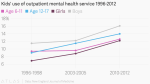
In her paper, Twenge looks at four studies covering 7 million people ranging from teens to young adults in the US.  Among her finding: high school students in the 2010s were twice as likely to see a professional for mental health issues than those in the 1980s; more teens struggled to remember things in 2010-2012 compared to the earlier period; and 73% more reported trouble sleeping compared to their peers in the 1980s.  These so-called “somatic” or “of-the-body” symptoms strongly predict depression (for more on this study, click here)

In fact, the growth in mental health support in the form of services or medication in the 6-18 age group is somewhat shocking:

https://www.theatlas.com/charts/Vko2VfNpe

I think the writing of Peter Gray, a psychologist and professor at Boston College, sums it up this way:

We would like to think of history as progress, but if progress is measured in the mental health and happiness of our young people, then we have been going backward at least since the early 1950s. (to see the whole article, click here)

I know that mental health is something that we have been talking a lot about in our community and our school.  In further reading of the research from both articles, there are differing opinions of the why, but you may notice some similarities.

Twenge has seen a noticeable shift away from internal, or intrinsic goals, which one can control, toward extrinsic ones, which are set by the world and are increasingly unforgiving.  On the other hand, Gray believes kids aren’t learning critical life-coping skills because they never get to play anymore.

We have all had the students who had to have the right clothes, the right phone, the right video game in order to feel as though they could fit in.  We have also seen students who cannot, without adult mediation, play a game at recess that doesn’t end in a fight.

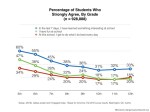
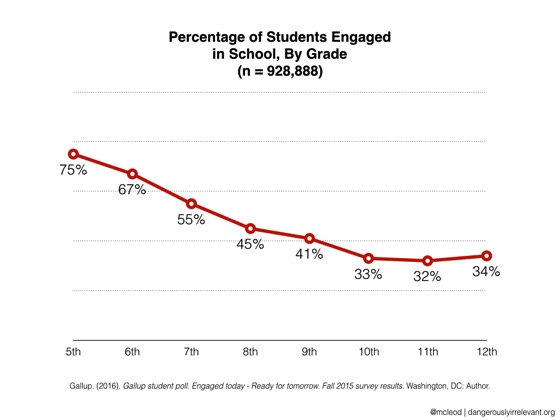
The increase in anxiety and mental health support for our students is one concerning piece, but let’s add to that another issue.  As students grow older, the general trend for all students is towards a lower level of engagement.  In a recent post on the blog Dangerously Irrelevant by Scott Mcleod, the following data from the annual Gallup poll of middle and high school students was shared:

http://dangerouslyirrelevant.org/wp-content/uploads/2016/03/2015-Gallup-Student-Poll-1.jpg
http://dangerouslyirrelevant.org/wp-content/uploads/2016/03/2015-Gallup-Student-Poll-2.jpg

I’m going to let those charts sink in for a bit, and leave you here with 3 thoughts.  Next week we’ll come back to this topic:

  1. Mental health concerns in our students are rising.
  2. Levels of engagement decline as our students grow older.
  3. Even with increased focus on standards, performance on standardized testing has remained stagnant.

What have you noticed in your classroom?  Is there a connection between anxiety and engagement?  What strategies have you tried to help students feel less anxious or more engaged in your classroom?  Share your thoughts in the comments below.