Cognitive load

How many times have you been in a conversation with a colleague, and they started giving you suggestions?  Each one sounds great, you think they could work in your room, but then you walk away from the conversation and nothing has stuck.  All those great ideas went in your ears, passed through your brain, and then disappeared into the ether.  No amount of thought can bring them back, and you feel embarrassed to go back to the colleague because you think that they might be offended that you didn’t remember the first time.

Created by Marshall Vandruff

For all of us, there’s this idea called cognitive load.  Cognitive load refers to the total amount of mental effort being used in the working memory.  When you were talking with that colleague and they were sharing more and more ideas with you, it was causing your brain more and more of a cognitive load.  In that moment, your brain is kind of like a cup – it can only hold so much new information before it begins to overflow.

Now, if each of us struggles cognitively to hold on to multiple ideas in a short conversation, how does this translate to our students?  In a lot of the research on cognitive load in children, there is a clear difference between adult and child knowledge.  Because of the differences in knowledge, children have to make a greater effort to simply process what is coming in, which means that their cognitive load will be exceeded more quickly.

I know that there were times as a teacher when I might have a student ask me a question.  As I was answering the question, I might give more detail than was entirely necessary in order for students to better understand.  Then, a few minutes later the student would ask the same question.  At the time, it was frustrating – “Come on, I just told you that!” but I now understand that by giving the extra details, I was causing too heavy of a cognitive load on my students.

So, what does that mean for us?  As we talk with students – whether we are giving them feedback on classwork, discussing their behavior, or making suggestions, we need to keep it short and to the point.  In a recent post from Matt Miller, he suggested using the sandwich technique:


  • A compliment (positive feedback)
  • A change they could make
  • Another compliment (more positive feedback)

Is it possible that we could suggest 17 corrections?  Sure!  But if we make all 17 at one time, the student will be overwhelmed, and none will get done.  Pick your main point, your main concern, and focus on that.  Once the student has shown that they understand your initial change, then maybe attack one of the other 17 things.

Meaningful feedback to students is one of the best ways to increase learning outcomes for our students.  Give that feedback in the moment – while you’re walking around and peaking over shoulders, and keep it to the point.  Students will learn and grow.

What are some of the strategies you use to give feedback to your students?  Share with us in the comments below.  If you’re looking for a few new ways to give quick feedback to your students, check out this awesome post from Matt Miller:

10 strategies for lightning-quick feedback students can REALLY use

When should we try something new?

How many of you are like me, you see something cool that someone else is doing and you think “I want to try that!”  You may be hearing about a cool activity that a colleague is doing, or it might be seeing something on one of your social media accounts that you think would be great for your classroom.

Sometimes, once we are “into” the school year, it can be tempting to see a cool idea and think “I’ll look at that in the summer.”  Maybe you even go so far as to save the idea as a bookmark, or send yourself an email to keep in a folder in your inbox.  I know that happens to me.  Then what happens?  If you’re anything like me, you might actually go back to that folder or bookmark, but all the context is gone, and you don’t remember why you were so excited about the idea.  Or even worse, you might forget to ever go back to the bookmark or folder!  Please tell me that I am not alone in this!

Earlier in the spring semester, I was participating in a massive open online course led by the author of The Innovator’s MindsetGeorge Couros.  I’ve mentioned it in the blog before.  Couros is all about innovation in education – he defines innovation as things that are new AND better for learning.  During one of the activities for the course, there was a conversation between Couros and a couple of his guest hosts.  The question came up – “When is it best to try things that are new?”  While many of us would feel the temptation to wait until our next group of students so that we can set up expectations and “get it right,” Couros and others encouraged a different mindset.  Think about your current students.  How excited are they when you switch things up?  Something as simple as a new seating arrangement can be the biggest deal to your class.  If a new seating arrangement has such an impact, how might a new and exciting teaching method go?  How much might that accelerate the learning in your classroom?

As an added bonus, you have the benefit of trying something new with a group of kids that you actually know.  Does this activity seem to motivate that kid that you’re always trying to pull along?  Maybe you have a winner of an idea that you want to continue to play with and tweak.  On the other hand, if your kids don’t seem that into it, you know that the idea might not be the best, and you can quickly shift gears back to something that you know will probably work better.

At this point in the year, with so many things going on, and the general stress that goes with the approach of the end of the year, it can be comforting to say “I’m just going to keep doing what I’m doing.”  But here’s the thing, as our student’s attention begins to wain – they see the sunshine and recognize the warm weather, they start thinking about their spring/summer activities that are getting started – it can be difficult to maintain that high level of engagement in the best of situations.  Some of us, without thinking about it, react to that by lowering the cognitive load of our students.  We think that slightly lower expectations may lead to higher engagement.  So, how’s that working for you?

I know that these were choices that I sometimes made when I was in the classroom.  An extra video clip instead of a more challenging activity.  Maybe a simplified version of an activity so that my students could just get through it.  I think back to those choices, and wonder how many of my students I may have short changed in the last few weeks of school.

Keep pushing yourself to look for the new and better activities.  Instead of lowering expectations for students to keep them engaged, throw in a new and exciting activity to amp up the learning in your classroom and hopefully lead to higher engagement for all your students!

What cool new things are you thinking about trying as the end of the year approaches?  What hesitations do you have for trying something new at this time of the year?  Share your thoughts in the comments below.

What’s your why?

The vast majority of the people reading this blog are in the educational realm.  Whether you are a teacher, a counselor, an administrator, or you work in a school in some other way, something called you here.  Take just a moment to think about it, what was it that brought you to this point?

For me, when I think about what brought me into education, there are a few moments in my lifetime that stand out.  I remember my fifth-grade teacher, Mrs. Gromer.  With her, the Maya Angelou quote to the right comes to mind.  There aren’t very many specific things I remember happening in her classroom, but I remember that I always felt welcome, and valued, and important.  I felt that if I wasn’t there, someone missed me, and some value was lost from the class.  While I had great teachers before her, and great teachers after, nobody ever made me feel as important in the classroom setting as Mrs. Gromer.

In high school, one of my stand out teachers was Señora Cease – she was my Spanish teacher for all three years that I took the class.  While I may not be fluent in Spanish today, I learned some valuable study skills that I don’t believe I would have learned anywhere else.  Learning a language came hard to me, and while some friends were valuable parts of my studying, her efforts and ideas in class gave me skills that translated to so many other areas.

Then I think about Professor Katz.  Easily the most entertaining professor that existed – I’ll put money on it.  He was a history professor at IU.  I had the luck of knowing him when I was young, which meant that when I walked into his class, I became an easy target of his.  In a lecture hall full of 400 students, he would find me no matter where I sat and ask my opinion.  While I am a fairly confident person now, I’m sure that term didn’t always describe me. On the first day of class he asked me a question, to which I responded in a noncommittal way.  His response “Are you asking me?  I was asking you.”  Professor Katz helped teach me to be confident in all that I do.  While many of the small groups were led by instructional assistants, I had the privilege of being in the group that Professor Katz led himself.  You had to know your stuff – there was no hiding from him.  In addition to confidence, Professor Katz taught me about preparation.

All of these pieces of my history in education are part of what I brought to my classroom.  I wanted to bring the warmth that Mrs. Gromer had – I wanted my students to know that they were valued and important in my classroom.  I would work to provide scaffolding to support students who were struggling, just as Señora Cease had done for me.  And I would challenge my students at times – push their thinking when I thought they were just giving me surface level knowledge – just as Professor Katz pushed me.

I’m sure there are other things that come from my history that led me to the role that I’m in now, but now, I have an even more important why.  I look at each of my kids.  They have such unique personalities.

Lainey is the quiet rule follower.  Last year she actually received a reminder from her teacher – just one – and she cried about it as soon as she walked in the house.  We still can’t talk about it for fear of another evening full of tears.  She’s also very intentional, to the point of perfection on some things, which causes her to work slowly and sometimes not complete her in class work or feel as though she is falling behind her peers.

On the other hand, there’s Brody.  He’s not in school yet, but he’s been going to preschool.  Brody’s curiosity is almost indescribable.  He’s constantly asking questions – Why? Why do they call it baseball?  What does that word mean?  Sometimes it’s almost exhausting to answer all the questions he has.  To go with that, he loves to play rough – there are a couple of times I thought he was going to take me out by the knees, and even though he’s grown up with a sister, and almost all the kids in the neighborhood around us are girls, he finds ways to get them to play rough as well.  I expect Brody to be a kid who will probably rush through things.  While on spring break last week, he was always asking what we were doing next, so excited to get on to that, that sometimes it seemed that he couldn’t enjoy what we were doing in the moment.

And I know that both Lainey and Brody will have challenges as they grow older.  School can be a difficult place for kids.  Lainey will have times that her perfection will cause her to fall behind others, while Brody will be so concerned about getting on to the next thing, that he’ll probably hand in a paper half completed with several mistakes.

I have hopes and dreams for these two.  I want the best for them.  And I know that if that is the way that I feel, then the parents who trust each of us with their children have similar types of hopes and dreams.  The faces that sit in our classrooms each day are their everything, and they want the best for their kids as well.

So while Mrs. Gromer, Señora Cease, and Professor Katz may be the past why that pushed me into education, and led me to be the teacher that I became, they aren’t the why that will push me moving forward.  The past isn’t going to push me to strive to go further.  The past isn’t what’s going to help me continue to learn and grow as an educator.  Instead, I rely on my kids to be the catalyst for that growth.  And each of the 1,000 kids who walk into our building each day becomes the fuel that keeps that learning and growth going.

So…  What’s your why?

Share your thoughts in the comments below.  I’d love to hear what it is that drives you to do what you do.  Education isn’t easy, and we all need that why to push us!

#IMMOOC #IMMOOCB3: Engage or empower

Engagement.  We all say that this is what we’re striving for when our students are in the classroom.  We want our students to be engaged in whatever’s happening in our classroom.  Normally that means getting your students excited about whatever it is that your class is studying.

But as we think about what it takes for any of us to learn something new, being engaged in the activities doesn’t guarantee learning.  I can guarantee that in the next few days I will be engaged in hours of watching NCAA Basketball.  The likelihood of any kind of deep learning happening in that time is not very high.

Bill Ferriter – @plugusin

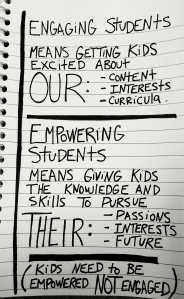
To get students to that deeper understanding, the learning needs to be meaningful.  Bill Ferriter (@plugusin) says “Kids need to be empowered NOT engaged.”  So how do we get there?  Ferriter goes on to say that “Empowering students means giving kids the knowledge and skills to pursue their: Passions, Interests, Future.”

One of the things I believe in education is that we have great power to help our kids be excited about learning.  The more student choice and voice we give, the more authentic and relevant approaches we take, the more we shift our students from engagement to empowerment.

#IMMOOC #IMMOOCB2: School vs. Learning

The graphic above was created by @sylviaduckworth in response to a blog post by @gcouros about the differences between a traditional school setting, and comparing it to what we know best about how people learn.  It makes me think of the TED Talk by Ken Robinson on Changing Education Paradigms (check out this version).

Couros looks at the differences from the graphic above in his post School vs. Learning where he looks at the traditional school model compared to the way that research shows that people and students learn.  Think about the ways you learn best.  Do the descriptions on the left or right of the graphic above fit with your experiences of learning?  The next question – what do the classrooms that you are in most look more like?

Engagement is great, but engagement alone is not learning.  My kids can be engaged with YouTube for hours if I let them.  Does this mean they’re learning?  If we want learning to happen for our students, we need ask “what can I do less of?”

Reflect on what school looks like for you.  If what you reflect on makes you uncomfortable or gives you pause, think about where you can implement change to make learning new and better for your students.

Successful adaptation

I’m not sure how many of you have read the book The Innovator’s Mindset by George Couros.  It’s a book that I have referenced in the past, and today I happened to be on his blog and came across a great post that I want to share.  Below you’ll find a link to his short post titled “Successful Adaptation.”  Click the link to check it out, and then come back here for some closing thoughts:

Successful Adaptation – by George Couros

How many of those contradictions are things that you’ve heard, or maybe even said, before?  I feel our steps with the HSE21 Best Practice Model have helped us to attack many of the contradictions, however I still see some of those contradictions within our building.

I know Couros shared his own remix of those contradictions written as questions, but I have a few more questions for us to think about:

What have you created in the past week?  Month?  Year?  Have you shared any of those things with your students?  How could our own efforts at creation model that expectation for our students?

What are some areas that you would be willing to give up the expectation of students asking for permission? (assuming they are acting responsibly)  How would this promote greater empowerment for our students?

What are the things that you have let go of this year in order to show more of a growth mindset?  What are the policies within our classroom or our building that get in the way of the growth mindset?

I want to say again, I am not asking you to change for change’s sake, rather I am asking you to think about how you might change in order to make your classroom a better learning environment for our students.  With that, I want to leave you with one of my favorite quotes from Couros:

learner-centred

If you feel up to it, share your response to one (or more) of these questions, or one of the questions from the original quote by Couros in the comments below.

Civil discourse

It’s a fact that we cannot control what happens every moment of our student’s lives.  We can’t prevent poor choices in the hallway, unkind statements in the lunchroom, or hurtful words on the bus.  However, we can try to right the ship in our own classrooms.

As a member of our building’s diversity team, this message came through loud and clear during a presentation at our most recent Diversity Coaches Meeting.  During this meeting, we spent an hour with Janet Chandler discussing the concept of Civil Discourse.  During the most recent presidential election cycle we saw endless attacks from various candidates, and many were not living up to the decorum that we might hope for from our elected officials.  The facts are that this type of climate has been in existence for a much longer period of time than just the past couple of years.

“A supporter of Thomas Jefferson once called John Adams “a hideously hermaphroditical character.”  Former Treasury secretary Alexander Hamilton called Vice President Aaron Burr “bankrupt by redemption except by the plunder of his country,” an attack so heinous that the men dueled, and Hamilton died.

Go through the nation’s history, and the noise and heat in public political discourse have always been there, rising with the cycles of economic distress, immigration and cultural upheaval.” – Ann Gerhart (The Washington Post, In Today’s Viral World, Who Keeps a Civil Tounge?, October 11, 2009).

Although uncivil discourse has been a part of our history, with today’s world of 24-hour news, social media, and technology, the noise of the less than civil statements seems to be nonstop.  So what are we to do when that spills over into our classroom?  Here are some tips that I took away from our conversation last week, as well as a link to a great resource from Teaching Tolerance (the link will be at the bottom of this post).  These tips are in no particular order, but hopefully will provide you with some ideas about how to handle discussions that may be a little difficult within your classroom.

If not us, who?

maslows-hierarchy-of-needsIt would be easy to say that these conversations on civil discourse are not our responsibility, but the fact is, there are uncivil things being said in our school building.  We simply cannot have the attitude of “it’s not my problem.”  When we become aware of issues, we have a responsibility to step in.  I can’t recall, nor can I find, where I first heard this, but the quote “we’ve got to take care of the Maslow stuff before you can ever hope to get to the Blooms stuff” comes to mind.  Our students can’t learn without their basic needs being met!

Set the example, not just the expectations!

It’s easy to talk about expectations.  We can say again and again what we expect.  But if, even once, we slip up, some of our students may follow our lead on this.  In a civil discussion we use titles: Mister, Misses, or Miss; President; Senator; Representative, etc.  If we refer to people without those terms, we diminish their role.  Just looking at my Facebook feed in the past couple of weeks, there have been a lot of people who aren’t using titles.  I’ve had people tell me that they won’t use certain titles because of a lack of respect in a person.  Isn’t that part of the issue here?  If you then read through Facebook comments on political posts, you see less than civil statements being made.  When you use a title, you add a level of civility and respect.  By modeling civility in your classroom discussions, you will help your students understand what that looks and sounds like.  Remember – kids act in a way they they see the adults in their lives behaving.  Modeling civil discourse will help lead to more civil conversations in the hallways.

Facts vs. Alternative Facts

I’ve referred to social media a couple of times, and I’m going to do so once again.  No matter your political beliefs, your party affiliation, etc., I think that any of us who have been on Facebook can agree that there are some outrageous statements being made.  The phrase fake news and alternative facts has become something of a joke.  Earlier this school year I posted a blog titled “Finding the author’s purpose” (if you want to go back to it, click here: http://wp.me/p6BRrr-6J).  In this post, I reminded you of the definition of nonfiction that Beers & Probst used in their book Reading Nonfiction:

“Nonfiction is that body of work in which the author purports to tell us about the real world, a real experience, a real person, an idea, or a belief.” (emphasis added)

In that post, I went on to encourage you to teach our students to have a questioning stance when reading nonfiction.  Every author has a purpose in what they have written – sometimes that purpose is not simply to inform.  Facts can be twisted and manipulated to support either side of the political spectrum, and social media is one of the most likely places to see this play out.  More often than not, the articles with the most extreme language seem to be coming from sites that are extremely liberal or conservative, or from sites you’ve never heard of before.

One important piece of a civil discussion is that it has to be based in fact (I could probably do a full post on the definition of the word fact…).  If you are having a civil discussion and someone shares a “fact” that is truly extreme, or is something that is not agreed on by most in the class, it’s time to talk about the idea of triangulating sources – can we find that fact from more than one source?  Do most people agree on this fact?  These conversations are so important because as Beers & Probst remind us that there is a greater purpose to teaching our kids the nonfiction signposts:

“Far more important than the ability to capture a teacher’s information and thoughts is the ability to acquire information on ones’ own, to test ideas against one another, and to decide for one’s self what notions have merit and which should be rejected or abandoned.”

If you read through the Teaching Tolerance link at the bottom, you’ll find a whole section on the three parts of an argument.  Here’s a quick breakdown:

  1. Assertion – The simple statement that is the basis or main point of the argument.
  2. Reasoning – This is the because part of an argument.
  3. Evidence – This is where you truly back your argument.  This may include statements from experts, statistics, data, or other research that supports you assertion and reasoning.

If you’re trying to have a civil conversation, encourage your students to include all three of these parts of an argument.  If you’d like more info on this, it can be found in Teaching Tolerance link below.

Respect

Probably the most important reason to work with our students on the concept of civil discourse is simply the idea of respect.  We are all entitled to our opinions, and we are all allowed to disagree with one another, but we have to make sure that these conversations are happening respectfully.  Our students need help to learn that it’s okay to agree to disagree.  Again, we can’t control what happens everywhere for our students, but we can do our best to make things right once they come in to our classrooms.

What experiences have you had in working with your students on civil discourse?  What has worked well?  What hasn’t?  Does the idea of having conversations like this in the classroom simply freak you out?  Share your thoughts in the comments below.  We can all learn from one another!

http://www.tolerance.org/publication/civil-discourse-classroom

The impact of words

watchsuccessChances are that you have seen the quote to the left before – it’s hanging in our building outside the gym.  According to the poster by our gym, the quote is attributed to Frank Outlaw.  As I was researching the quote, I found it attributed to several people including Lao Tzu and Mathatma Gandhi, among others.

For the past couple of years we have been on a path of shifting assessment practices in an effort to focus more on the learning process, rather than the outcome or finished product.

Combined with that, I know that many of us have given thought into the idea of mindsets.  Many of you have talked with your students about having a growth mindset as compared to a fixed mindset.

Recently I was reading an article in Education Week by Starr Sackstein (@mssackstein on Twitter).  Sackstein is a high school English teacher and teacher coach in New York.  She is also the author of the book Hacking Assessment – part of the Hack Learning Series.  I have not read the book myself, but have listened to Sackstein talk about her shift in grading practices, as well as follow her on Twitter where she an active proponent of making a deliberate shift in assessment practices to focus on the learning our students accomplish as opposed to the grades they earn.

In the article I was reading, she shared her beliefs that the language we use matters as much as, if not more than, the practices we employ.  She goes on to say “What we say and how we say it has a big impact on how students and other stakeholders respond to our choices.”  Take a look at this chart from her book:

grades-vs-assessment

If, as educators, we use the terms on the left side with our students, or their parents, what are we saying we value?  I may be going out on a limb here, but to me the terms on the left are focused on the product.  They are a fixed mindset concept that doesn’t allow room for growth.  In addition, it says to students that they don’t need to learn anything from their mistakes.  These terms symbolize an ending to the learning, and each time we use those terms in our classroom, we are telling our students that we are more concerned with the product.

I know from conversations that many of you have already shifted your thinking about assessment, and are truly focused on the process.  Using those terms that appear on the right side of this chart will truly show our students and their parents what we value.  Assessing students where they are, providing feedback, and encouraging students to try again will help students to understand that you value their learning, not their grade.  It will help students see their challenges as a way to grow and move towards proficiency.

Think about the language you use in the classroom with your students.  How can you shift the words that you use in the classroom to show that you truly value student growth?  Share your thoughts in the comments below.

The Apple Teacher Program

How many of you like to play games?  Maybe you like board games or card games that you can play with your family and friends.  Maybe you like to play video games on the PlayStation or Xbox.  Or maybe you are more into games that you can play on your iPad or phone.  One thing that has become a trend in a lot of the digital games is the idea of earning badges to symbolize advancement in the game.  People love to compete for those badges.  Some teachers have even integrated this gamification into the learning process.  Today I want to share with you something that Apple has developed that can allow all of us as educators to collect our own badges, and maybe learn some new things in the process.

A couple of days ago I saw a post on Twitter from an educator that I follow saying that he had just earned a new badge in the Apple Teacher Program.  I didn’t know much about the program, but a quick Google search took me to Apple’s site with more information about the program (click here if you want to check out the site!).

Reading over the short pieces of information on that site, I learned that through this program you could learn how to use built-in apps to “enhance creativity and productivity” in the classroom.  As you complete lessons, you can take a quiz, and if you pass the quiz you earn a badge.

I decided to sign up so that I could learn more about the program.  Once I was signed up (almost instantaneous – you sign up with your Apple ID, and then you receive an email with the link to sign in to the Apple Teacher Learning Center), I was able to find links to learning resources for teachers, inspiration for new things to try out, and links to earn badges that are based on the iPad or the Mac.  Since we are 1:1 with the iPad, that is where I went first, and without having to participate in any lessons I was able to pass quizzes to earn a couple of the badges.

There are options to earn general badges for the iPad, to learn about productivity, and to learn ways to integrate creativity with the iPad.  There are also badges for specific apps like Pages, Keynote, Numbers, iMovie, and GarageBand.  When you select a badge you want to earn, you have the option to go to a Starter Guide with tons of information about apps – I just skimmed through looking for things that were new to me.  What I also found interesting about the started guide is that it instructed you on how to play with the app in order to learn to use it better.  We all know that we learn better by doing!  In addition to the starter guide, there are links to online help for the app, or even options to sign up for a live workshop at the Apple Store.  Once you feel like you understand the app, you can take a quiz and earn a badge.

In addition to the original options for badges, once you complete all the badges you earn an official Apple Teacher logo, as well as access to additional learning resources and badges.  I wanted to share this with you because I found it interesting.

Have any of you ventured into the Apple Teacher Program in the past?  There seem to be tons of great (and free) resources that could be used in the classroom.  Share with us if you decide to sign up, and then let us know as you add badges to your collection!

Reflections from Tuesday

I hope that all of you were able to take something positive away from Tuesday’s PD: HSE21 Inquiry in Action.  I know that whenever I attend a PD such as that, I feel overwhelmed.  There are so many great ideas, and sometimes some things that just don’t seem to fit for me right now.  Trying to figure out what to do with the information overload can be a bit daunting.

One of the things that I have definitely learned throughout my years of PD – if there was something good, I better try it soon.  I can’t tell you how many times I’ve seen something good at a conference, but I’ve found an excuse to not implement it right away (I don’t have time, I’m not sure my students are ready, etc.).  When I put those awesome ideas off, they end up getting lost in the black hole of professional learning – that’s where all great ideas that we never try go.

So… With that in mind, here’s some simple advice.  Think about the questions that the presenters were asked to frame their sessions around:

  • What can you do to transform your classroom tomorrow?
  • What can you do to transform your classroom next week?
  • What can you do to transform your classroom in the long term?

When you get a chance to reflect on your learning from Tuesday, try to find the nuggets that you might want to use to answer those questions.  What is the thing that you can try tomorrow (or on Monday if you’re reading this the day it posts)?  Commit to it and give it a shot.  If you know you can’t do it tomorrow, set your own goal of when you want to try that new thing.  Put it on your calendar, share with a colleague, or do something to hold yourself accountable.

Next, set one or two long term goals based on something you learned on Tuesday.  Maybe take your idea and collaborate with a colleague, or use the ideas you learned to plan a new unit for your class.

Remember that reflection is one of the most important pieces of the learning process.  Tuesday was nonstop without much time for contemplation between sessions.  Make sure you take a little time while everything is still fresh in your mind to look back on any notes you took, or ideas that you came up with.

As you reflect, share with us one takeaway from your sessions on Tuesday.  What is the one thing you plan to try?  Or tell us what you have already tried.  We’d love to hear about your learning, and your excitement from the day.  Share with us in the comments below.