
 Last summer, I read the book The Innovators by Walter Isaacson. As a brief description, the book was about the work of the many different people who played a role in the development of the computer and internet. For most of us, when we think of innovation, we think of people like Franklin, Edison, Bell, Morse, Jobs, or Gates, but in the case of the digital revolution, most of the work was not the creation of any one person. Instead it was the work of many who connected, collaborated, and iterated. Someone like Steve Jobs is seen as the creator of the iPhone, but really he took several technologies that already existed and combined them into a form factor that connected with a market.
 This past spring, I read the book Creativity, Inc. by Ed Catmull. Catmull is the co-founder of Pixar Animation Studios, and wrote a book about the steps that they take in order to build a highly functioning, creative environment that is able to churn out movies that people love (think Toy Story, Monsters, Inc. Finding Nemo, and more). One of my big takeaways from this book is that the amazing work that occurs at Pixar happens because of 2 things: teamwork; and a willingness to accept feedback from those around you, whether positive or negative, and understand that it’s being shared in the hopes of creating something better.
Now, as many of you know, this blog is geared toward education. You may be wondering what the creation of the digital revolution or the work that occurs at Pixar have to do with what happens in our schools on a daily basis. I’m hoping to make that connection here today!
The connection that I can make between The Innovators and Creativity, Inc. has to do with the collaborative networks that existed between the creators. As an educator, each of you is a creator EVERY DAY. You create the experiences that happen in your classroom. You decide on what the room looks like, you decide if the lights are on or off, you decide if there is music or not, you decide how the desks are arranged when kids walk in. Each of these little decisions plays a role on the learning environment, and those are just the decisions you make BEFORE the students walk in. Think about all the decisions you make during the lesson! None of you are ever allowed to tell me that you “aren’t creative” because you create EVERY SINGLE DAY!!!
Think for a moment about your existence as an educator. You work close to several other amazing teachers every day, but there’s one thing I know about teaching because sometimes I did it when I was still in my classroom: it’s easy to shut the door, do your own thing, and not worry about what’s happening around you. Education is one of the careers where we often live in silos – our classrooms, our content area, our team, our grade level, or our campus.
But there’s one thing that books like The Innovators and Creativity, Inc. hopefully remind us: innovation doesn’t happen inside of a vacuum, it happens with collaboration, teamwork, and connections. With all the amazing educators and schools, we still at times fail to create those critical connections for collaboration that lead to real innovation in education.
This is why I see such value in what happens during our Professional Learning Community (PLC) time. It’s an opportunity for you to come together with your colleagues, to analyze the data your seeing, to talk about what’s working in classrooms, and then to be able to test out whether or not that works in your own room. It’s a chance for you as a team to take risks, to walk out on a ledge as a team, and try something new because as a team you feel it will benefit the students in your room. We all know there’s safety in numbers! We need to see PLC time not as something that’s done to us, but as a form of self and team-directed professional development with regular opportunities to collaborate and communicate.
But if we want to create the amazing innovative environments that our students need in order to learn and grow, we have to be ready and willing to connect on an even grander scale. If you are looking for other ways to learn and grow, there are lots of informal options out there. Things like Twitter chats, EdCamps, and blogs are free and easy way to seek out like-minded educators who are doing amazing things in their classroom. Or there are more formal ways to learn about innovation in the classroom. I recently learned of the Deeper Learning Network (click here to check out their website) that shares tons of resources for innovative ideas in you classroom. Some of the things you can find information about include: Project-Based Learning, Blended Learning, Inquiry-Based Learning, Authentic Assessment, and so much more!
Now, some of you may be wondering why we need to change. Well, the reality is that thanks to the work of the innovative people that are discussed in Isaacson’s book, many of our students are used to on demand learning, are used to making choices in what they want to learn, and how they learn. The digital revolution has changed the game for learners, which means we have to find ways to change the game as teachers to meet their needs. I think we all would agree that our students today are different than the students that were in our schools just 5 years ago. They are digital natives, and many know how to find what they want to know when they want to know it.
If we as educators don’t adapt to the new style of learning, our learners are going to leave us behind. If they don’t see the relevance of what they are doing, if they don’t get choice and voice in their learning, they will not engage. I continue to believe that the HSE21 Best Practice Model is our North Star that gets us to the learning environments that will work for our students. And the best way for each of us to learn and grow towards those best practices is through meaningful collaboration. As one of my favorite professors at IU repeated almost every day “Learning is social” and we are all learners too!

Continue to seek out ways to collaborate. Take a moment to be vulnerable and ask a PLC team member to come observe one of your lessons to give you feedback. If someone asks you for feedback, be willing to give it. We ask our students to be vulnerable and a little uncomfortable every day because that’s where the learning and growth takes place. Why can’t we expect the same of ourselves?
What are some of the things you do to continue to grow? Is there a preferred method for learning from others that works best for you? Share your thoughts in the comments below!

 For the next thirty minutes, while I mowed the rest of the lawn, Lainey and Brody were in heaven with that childhood joy that goes with running through a sprinkler. I may have even let myself get sprayed because I was jealous of the obvious fun they were having.

 Both of these books are available on Amazon, although you can probably find them at any bookstore!


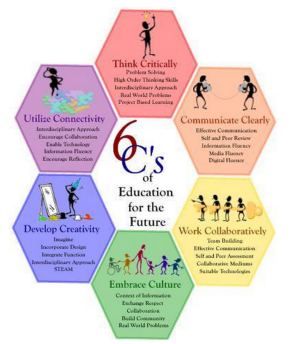 But here’s the thing, if I just accept that creativity isn’t my thing, then I feel like I’m doing a disservice to the students whose life I impact. In previous posts, I have shared the graphic to the right. One of the keys to developing kids who are ready for their unknown future is developing creativity, and if we just throw our hands up and say “But I’m not that creative, so I can’t teach others to be creative” then we are not helping them be ready for whatever their future may hold.
 After reading Miller’s book, I was led to Teach Like a Pirate by Dave Burgess. Burgess spends a huge chunk of time in this book talking about creative ways to hook our students into our lessons. He believes that creativity is something that can be developed in anyone through practice and effort. I have to say that I agree with him on this one – we can help develop creativity in others by giving them the time, space, and opportunity to use their creative ideas in their learning!

 The View from 518