Reflection & Growth

Follow effective action with quiet reflection. From the quiet reflection will come even more effective action.

At the end of every school year, one of my favorite things to do is to take some time to reflect on the year – what worked well?  What didn’t work so well?  What are the things I want to improve upon?  And conversely, what are the things I want to just forget ever happened?

As you are wrapping up your year, keep in mind that moments of reflection can be one of the most powerful pieces of the learning puzzle.  After you have finished cleaning your classroom, preparing for summer break, finishing student grades, and the multitude of other things that the end of the year will bring, take a little quiet time by yourself to just reflect.

You might choose to look back at your lesson plans from the year, you might look at samples of student work that you hung onto, or you might have another method that works for you to remind yourself of all that happened in your room during the last 180 student days.  Whatever method you choose, ask yourself some questions:

  • What are the things that happened this year that were awesome, and you can’t imagine not doing again?  How will you make sure not to forget by next year?
  • What are the things that you were excited about that maybe your students didn’t enjoy as much as you thought they would?  What could you add to get the students more excited about that topic? (If you’re looking for some ideas to hook your students into a lesson, check out Teach Like a Pirate by Dave Burgess – tons of great hooks that can build interest, excitement, and engagement)
  • What did you feel was the single most effective thing you did in your classroom this year?  What ideas can you take from that activity to make other activities more effective?

As you reflect, also take some time to think about things you wish to learn more about.  Make a list of those things that you wish to learn more about.  Write it down so you don’t forget.  If you’re anything like me, the first few days of summer break will be just that, a break.  At some point, you’ll get the itch to think a little more about the things that will help you grow as an educator.  At that time, go back to your list and use some of your free time to grow as an educator!

Many of us also love to have an accountability partner so that we don’t get to the end of the summer and feel like we didn’t accomplish any of the things we wanted to do.  Share the things that you are interested in with your colleagues at the beginning of summer – your teammate, your PLC, others with similar interests – and then reach out to them from time to time.  Share what you are learning, a great book you’re reading, a blog post you loved, or something else that fits with your topic.  For those of us on Twitter – use the hashtag #RSISummerLearning (clicking the link will take you directly to a search of that hashtag on Twitter) to share what you’re up to.  Even if you don’t post to Twitter, you can go to that search anytime to see what others may have shared.  The more we all share, the more we all can learn from one another!  Next August we’ll all be able to bring that learning back to school to support our students and do even more amazing things!

Most of all, enjoy your summer time!  I know that I’m looking forward to my summer for some relaxation, a Cubs game or two, time with family and friends, and time to do some of the things that I never seem to have time for during the school year.  Have a great summer!

Engaging & empowering our students

Last week I shared with you some data on student mental health issues, anxiety, and student engagement.  I closed the post with these three points:

  1. Mental health concerns in our students are rising.
  2. Levels of engagement decline as our students grow older.
  3. Even with increased focus on standards, performance on standardized testing has remained stagnant.

So what can we do?  I’m sure that all of you have noticed these patterns in our own classroom, but knowing the pattern is only part of the task of finding a solution.  In last week’s post I shared the work of two college professors.  Going back to their work, I hope to share a couple ways we might be able to help fight anxiety and lack of engagement.

Peter Gray, the psychology professor from Boston college, feels that the key to learning and growth for our students is free play:

Children today are less free than they have ever been.  And that lack of freedom has exacted a dramatic toll.  My hypothesis is that the generational increases in externality, extrinsic goals, anxiety, and depression are all caused largely by decline, over that same period, in opportunities for free play and the increased time given to schooling.

So as a school, what does play look like?  For one it means we have to be sure to value recess/physical activities during the school day.  There is clear research that one of the benefits of physical activity is increased student engagement.  Think about your classroom on an afternoon where we did not have outdoor recess due to weather.  What are the engagement levels like?

Several recent research studies have looked into increased free play time in the school day, and the results suggest that students with regular recess behave better, are physically healthier and exhibit stronger social and emotional development.

Knowing these facts, does that lead you to think about changing what you do when you return to the classroom on a day when we are unable to go outdoors for recess?  Hopefully you can think about finding a way to squeeze in some free play on those days.  If not free play, then a few short brain break activities to get the kids out of their seat and moving.

And what about the days that students already get their recess?  Does that mean we don’t need to look for other opportunities for play?  Many of our teachers have been doing outdoor activities here at school this week.  I’m sure that they would share that the students are loving the activities they’ve been doing – they are active, engaged, and empowered in this learning environment.  My question though: Do we only save activities like this for the end of the school year?  Or do we try to integrate play into our lessons throughout the year?  How can we make use of our outdoor space, our small and large group instruction rooms, or even just the hallway to get the kids up and playing as they are learning?

Next we have the issue of engagement.  For the purpose of this piece, I am defining engagement in school based on the Schlechty’s Center for Engagement definition:

  • The student sees the activity as personally meaningful.
  • The student’s level of interest is sufficiently high that he/she persists in the face of difficulty.
  • The student finds the task sufficiently challenging that she believes she will accomplish something of worth by doing it.
  • The student’s emphasis is on optimum performance and on “getting it right.”

Is it engagement when we work hard to get students into content that we have selected for them?  You may be able to get their attention, but if it’s based on extrinsic goals (like a grade) the motivation may not last.  So here are some ways you might be able to increase motivation in your classroom:

  1. Students are more motivated academically when they have a positive relationship with their teacher.
  2. Choice is a powerful motivator in most educational contexts.
  3. For complex tasks that require creativity and persistence, extrinsic rewards and consequences actually hamper motivation.
  4. To stay motivated to persist at any task, students must believe they can improve in that task.
  5. Students are motivated to learn things that have relevance to their lives.
HSE21 Best Practice Model

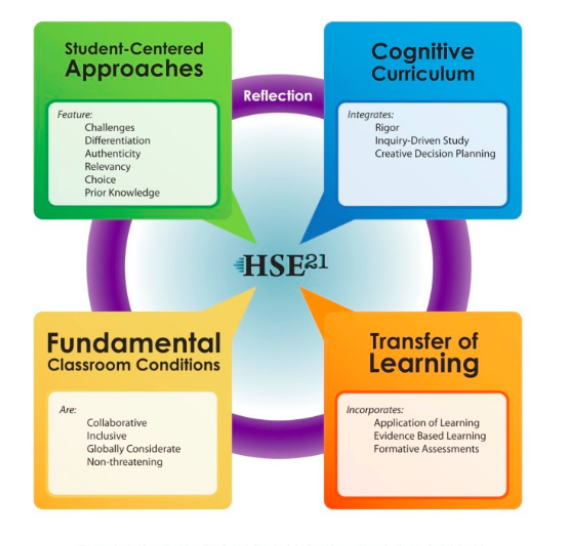
As you spend time thinking about bringing more inquiry into your classroom, as you work to better incorporated the HSE21 Best Practice Model, you will begin to notice increases in your student engagement.  When we provide our students with challenges, with activities that are relevant to their lives, when learning is rigorous and based on inquiry-driven study, when students are able to apply their learning in collaborative ways, when we work to incorporate more of the HSE21 Best Practice Model we will see increases in student engagement.  In fact, if we work towards truly relevant and rigorous study students will not only be engaged, but actually will be empowered to take their learning to levels that we can’t possibly imagine!

As we approach the end of the year, take some time to reflect on things you have tried that have been new.  What activities have led to increased levels of engagement?  What ways have you been able to get a kid truly excited about what they are learning?  Now, think ahead – how can you take the things that have been successful and expand on them for next school year?  Share your thoughts in the comments below.

Moonshot Thinking

We choose to go to the moon. We choose to go to the moon in this decade and do the other things, not because they are easy, but because they are hard, because that goal will serve to organize and measure the best of our energies and skills, because that challenge is one that we are willing to accept, one we are unwilling to postpone, and one which we intend to win, and the others, too. ~John F. Kennedy

Anxiety & Engagement

This year at RSI we all read the book The Price of Privilege.  I know from follow up conversations with many of you that we see some of the issues that were described by Dr. Levine.  I don’t want to go through everything that she shared once again, but one of the things that jumps out at me from that book has to do with the level of anxiety in our kids.

Recently I also read a paper written by Jean Twenge, a professor of psychology at San Diego State University.  In the study she looks at the mental health of kids just like those you would find in just about any school in the country.

In her paper, Twenge looks at four studies covering 7 million people ranging from teens to young adults in the US.  Among her finding: high school students in the 2010s were twice as likely to see a professional for mental health issues than those in the 1980s; more teens struggled to remember things in 2010-2012 compared to the earlier period; and 73% more reported trouble sleeping compared to their peers in the 1980s.  These so-called “somatic” or “of-the-body” symptoms strongly predict depression (for more on this study, click here)

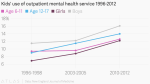
In fact, the growth in mental health support in the form of services or medication in the 6-18 age group is somewhat shocking:

https://www.theatlas.com/charts/Vko2VfNpe

I think the writing of Peter Gray, a psychologist and professor at Boston College, sums it up this way:

We would like to think of history as progress, but if progress is measured in the mental health and happiness of our young people, then we have been going backward at least since the early 1950s. (to see the whole article, click here)

I know that mental health is something that we have been talking a lot about in our community and our school.  In further reading of the research from both articles, there are differing opinions of the why, but you may notice some similarities.

Twenge has seen a noticeable shift away from internal, or intrinsic goals, which one can control, toward extrinsic ones, which are set by the world and are increasingly unforgiving.  On the other hand, Gray believes kids aren’t learning critical life-coping skills because they never get to play anymore.

We have all had the students who had to have the right clothes, the right phone, the right video game in order to feel as though they could fit in.  We have also seen students who cannot, without adult mediation, play a game at recess that doesn’t end in a fight.

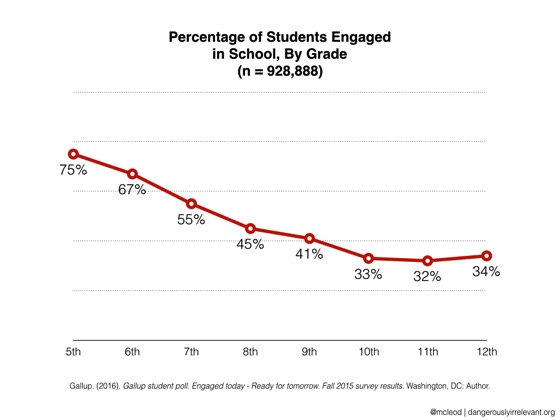
The increase in anxiety and mental health support for our students is one concerning piece, but let’s add to that another issue.  As students grow older, the general trend for all students is towards a lower level of engagement.  In a recent post on the blog Dangerously Irrelevant by Scott Mcleod, the following data from the annual Gallup poll of middle and high school students was shared:

http://dangerouslyirrelevant.org/wp-content/uploads/2016/03/2015-Gallup-Student-Poll-1.jpg
http://dangerouslyirrelevant.org/wp-content/uploads/2016/03/2015-Gallup-Student-Poll-2.jpg

I’m going to let those charts sink in for a bit, and leave you here with 3 thoughts.  Next week we’ll come back to this topic:

  1. Mental health concerns in our students are rising.
  2. Levels of engagement decline as our students grow older.
  3. Even with increased focus on standards, performance on standardized testing has remained stagnant.

What have you noticed in your classroom?  Is there a connection between anxiety and engagement?  What strategies have you tried to help students feel less anxious or more engaged in your classroom?  Share your thoughts in the comments below.

5 Paragraph Essays & Newspaper Articles vs. Blog Posts & Copywriting

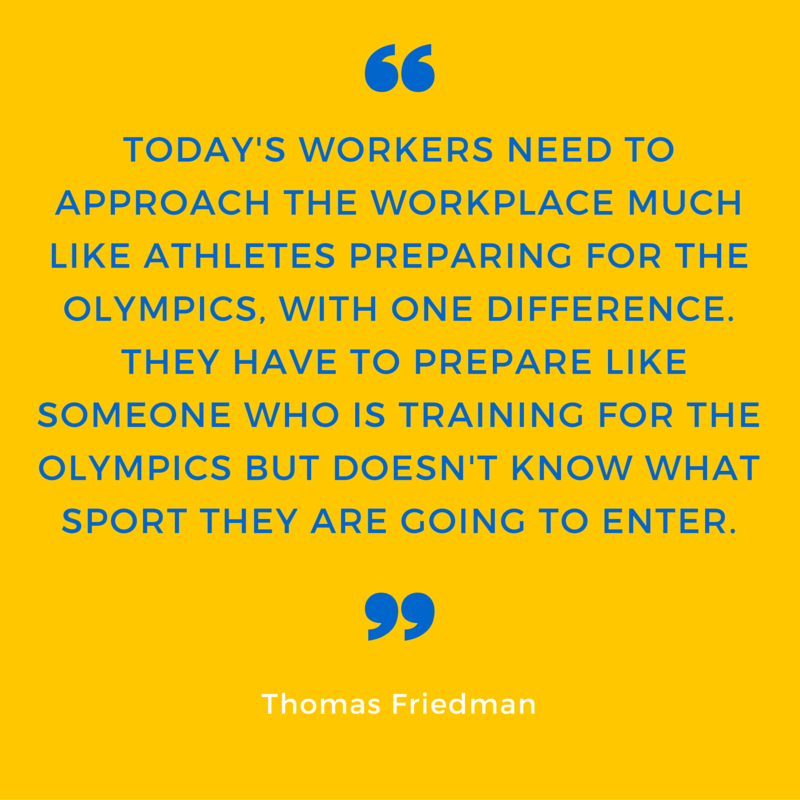
If I were to ask you to write a mission statement as a teacher, what would you write?  If it could only be one sentence, what are the things that would be most important for you to share in your beliefs about our students?  For most of us, I think somewhere in there we’d say something about preparing our students for the future.  That means we have to think about what the future may hold.  I know I’ve shared the quote below, but remember what Thomas Friedman says about today’s workers:

Daily Quotes (2)

While we may not know exactly what the future may hold, we know that there are some things that our students probably will not be doing much of in the future.  Stop and think for a minute – when was the last time you wrote a five paragraph essay?  ELA teacher please don’t hate me for saying this, but really, when was the last time you needed that skill?  I say all of this knowing that when I last taught ELA, we always had at least one research paper that was submitted in the five paragraph format.  Now, I agree that there are aspects of a five paragraph essay that are essential – being concise in our argument, having a clear structure for our writing, etc., but are there other formats of writing that could allow us to teach these same skills and at the same time be innovative?

What about another one of those writing activities that appears in many classrooms (including mine in the past) – the newspaper article.  Now, I will say that I have a subscription to the Indy Star, and while I can’t say that I ever read it cover to cover, and that there are some days that I don’t get to it at all, I do love having the option to sit down and read the paper.  However, the statistics on print media are noticeable.  I did a quick google search and found the charts below.  There’s less money coming into print media in the form of ad revenue, and the number of workers employed in newspaper publishing has been in pretty steady decline.

Now, I may be ruffling a few feathers here – and by no means am I saying that I think our students should never write a five paragraph essay or a newspaper article, but given the probable lack of a need for those skills in their future, what might be more valuable ways for our students to spend their time?  Two things that come to mind – blog posts and copy writing.

More and more, newspapers are trying to reach readers in formats other than print media.  I see IndyStar writers pop up in my Twitter feed sharing copy trying to get people to click the links and go the their site.  I see news articles online that are formatted more like a blog than a newspaper.  Two ways to help our students be able to reach the greater world would involve writing blog posts (like what you’re looking at right now), and learning a little about copywriting (the art and science of writing words used on web pages, ads, promotional materials, etc., that sells your product of service and convinces prospective customers to take action).  Now, I know that our students aren’t trying to sell things, but the skills of writing good copy will help our students be better overall writers.

HSE21 Best Practice Model

Throughout the year you have heard us talk about the HSE21 best practice model.  You’ve also seen examples of the “Less of this, more of this” charts.  Again, I’m not saying we should throw out the five-paragraph essay or the newspaper article.  But we also need to think with an eye towards the future.  What types of writing will be the most valuable for our students when they leave school and move on to a career?

Think about it, a student in your class could write a blog post on something they have been learning about.  Other students (or teachers, parents, family members, or maybe even experts in a given field of study) would be able to read and respond in the comments to their thinking.  Students would be able to share their blog site with their friends and family members.  Parents wouldn’t have to ask the dreaded “What did you do at school today?” because they could have looked at the most recent blog post and say “I saw in the most recent post to the blog that you are learning about …, tell me more about that.”

It’s also been proven through study after study that ELA scores are impacted most by reading and writing across the curriculum (teaching reading and writing skills should not only be the job of the ELA teacher).  What a valuable expression of learning it would be for our students to write a blog post about their experiences in math, art, science, or gym (or any other subject!!!).  And another great thing about blog posts – they don’t have to be just words.  WordPress (and most other blog sites out there) will allow pictures, video, and audio, and if I really wanted to, I could create an entire post from my WordPress app on my cell phone or my iPad.

What are your thoughts on student created blogs?  Can you see a way that you could enrich the learning of the students in your class through writing about it?  What about copywriting?  Curious how it could fit into the writing activities you are already doing?  Wanna talk more about this?  Share your thought below.  We can find a structure to make it work in your classroom!

The Crossroads of Creation and Consumption

What’s the last thing that you “consumed”?  Maybe it’s a new series on Netflix, or a great book, or maybe you listened to a playlist of songs you love.  All of those could be examples of consumption.  Our students are experts at consumption!  Playing a game while listening to music, and with something on the TV.  I know that often in our classrooms we are seeking to help our students to create something for the world.  In your ELA class you might expect them to create a presentation to go with their persuasive research paper.  In science it could be creating an experiment that shows some of the scientific properties that you have been studying.  In math you might ask them to create a model of some of the geometric shapes you have been learning about.  This list could go on.

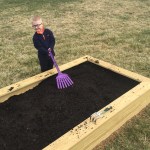
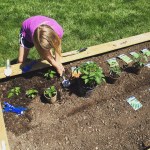
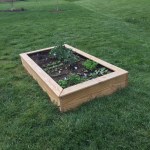
Oftentimes we think of consumption as fairly low level thinking, while creating is higher level thinking.  But I want to challenge that a bit today with certain types of consumption.  Recently my family decided that we wanted to have a vegetable garden in our back yard, but didn’t know exactly what that might entail.  I consumed information from websites and blog posts to think about where we should put it, and how we would create it.  After looking at a variety of options, we decided that we were going to do a raised bed in the back yard.

Next we had to come up with a design.  Again, I consumed resources.  I jumped on Pinterest and looked at pictures of examples of raised bed gardens.  Did we want to use stone or lumber?  Once we decided on wood, then it was a question of what kind.  My searches on Pinterest took me to various websites that talked about the advantage of cedar compared to redwood compared to treated lumber.  The options (and the opinions) seemed endless.  Eventually we decided to go with treated lumber.  Check out the pictures below documenting some of our process!

I guess what I’m getting at is that all of us have to consume from time to time, and so do our students.  Part of 21st Century Learning requires consumption, but I think we would all agree that there is a difference in consumption of a series on Netflix or a book that we are reading for enjoyment as compared to the type of consumption that we do when we want to learn about a new teaching strategy or a project that we want to do at home.  That’s where we come in – through guiding our students in how to consume information, we can help make sure that consumption is for the purpose of learning and creation.

What strategies have been successful to guide your students to meaningful consumption?  What things have you consumed that have led to additional learning?  As lifelong learners, it’s important to verbalize what we are still learning about!  That’s part of what I am documenting in these weekly posts, my own learning!  Share with us in the comments below things that you have taken in that have led you to create something – for your students, your classroom, your family, or just for you.  Or share with us some of the things you students have created!

If you find the idea of creation and consumption interesting and would like to dig a little bit deeper, check out the Ted Talk by Larry Lessig titled Laws that choke creativity.  It might lead you to think about consumption a little bit differently!

All means all

Einstein genius

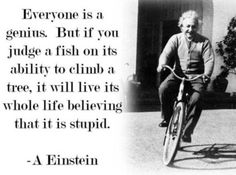
How many times when talking with others in our school do you hear the phrase “We have to get them ready for ____”?  You can fill in the blank with all kinds of different phrases – things like 6th grade, junior high, ISTEP, or any one of the other things we are trying to get our students prepared for.  It is a valid thing to think about because we do have to prepare our students for the future.  However…

This is how some of the students in HSE are starting their experiences in our kindergarten classrooms.

How often do you hear the words “We have to be ready for the students that are coming to us.”?  In most schools, the environment of the school is set up for one specific developmental stage.  I know through conversations with many of you that we have at least a cursory understanding of the fact that our 10, 11, and 12 year old students fall all over the developmental spectrum.  It’s one of the things I love about working with 5th and 6th grade students, but it can also be one of the greatest challenges.  While not being intentional, sometimes schools set up a system that expect all students to fit within a certain box, and when they don’t fit, it creates struggles for students, teachers, and parents.  So the question begs to be asked, is our system set up to meet our students wherever they are in terms of developmental needs?

Think about this for a moment: Should we be worried about whether the kids are ready for the school, or should we be worried about whether the school is ready for the kids?

Next week’s post will share with you my recent experiences visiting a few elementary classrooms.  I am sharing these not to say that we need to try to mirror their methods or strategies, but to help us understand the types of classrooms our students will be coming to us from.  One of the things that I feel sometimes happens in education is that teachers of older grades sometimes “look down upon” the teachers of younger grades.  I think there can be great value in learning from the ways that teachers in grades below us meet the developmental needs of their students.

As we move forward, let’s work towards building our expectations for our students based on where they are when they get to us.  We can still strive to move them to where they need to be, but we need to be open to the fact that some of our students do not fit in the box that we have created for them.   Some of those outliers may need us to provide extra support, while others may just need us to get out of the way and let them learn.

What strategies and methods do you use to meet the needs of the student who walks into your classroom on a daily basis?  Are there methods that seem to help your students who are less mature than the rest of your class?  Or, on the other end of the spectrum, what do you do with the students that are much more mature than the others in your classroom?  Share your thoughts in the comments below!
 

Don’t deny the technology – permanently…

As most of you know, HSE21 has been a multi-year project in which administrators, teachers, parents, and students have been looking at how best to create a 21st century learning experience for our students.  Through the program the Best Practice Model was developed, and in time the decision was made to transition to a 1:1 environment as a way to enhance the Best Practice Model.  These decisions were made as a result of the changing world around us.  As teachers we have all seen more of our students, and possibly more of our own lives, occurring in a digital world.

HSE21 Best Practice Model

For most of us, if we see that a child is engaged in a particular activity, we find ways to try to encourage that skill.  If your child is coloring on the wall, you may initially be upset, but you may also be tempted to put up a chalkboard, or get an easel that they can use to encourage that skill.  Who knows, that kid that started out painting on the wall may turn into the next Picasso or Van Gogh.  In your classroom that may mean allowing students to choose what product would best represent their learning.

Now think of our students.  The second they walk out of the building they are bombarded with digital options.  Smart-phones, tablets, computers, apps, websites, and more are competing for their attention.  If we don’t notice that and innovate towards that, we will lose some of our students.  The way I see it, more and more, technology is a right for our students in their learning.  Are there moments when it may not fit, or they may not use it?  Yes!  But it’s also important that we all recognize that devices and digital tools are becoming interconnected with our lives and with education.

FriedmanI have had many conversations with teachers who fear that we aren’t “preparing students for the real world.”  How can we accurately predict what that world will look like for our students?  I struggle to predict what next week might look like, let alone predicting what the world will be like in 10 years when our students either have entered, or are entering the workforce.  One thing I feel confident in telling you: they will need to know is how to use technology in appropriate and responsible ways.  If our only solution for poor decisions with technology is to try to permanently take technology away from our students, we are doing them a disservice.  Remember, our kids are 10, 11, and 12 year olds, and they are going to make mistakes, but going to the nuclear option of “you can’t use this anymore” doesn’t teach a child anything.  However, taking the device away for a period of time, and then having a conversation about the repercussions of their actions creates a learning opportunity for a child.

Sometimes drastic measures need to be taken to maintain the kind of classroom experiences that our students need – things like a temporary ban on technology – but we have to go back to the fundamentals.  To be relevant for our student we must use the best tools at our disposal.  By avoiding the technology permanently we are missing out on amazing teachable moments.

Thinking about your classroom, where are successes that you have had that would not have been possible without technology?  Have there been times that taking the technology out of a lesson has led to better engagement and learning?  Share with us some of your opinions!

How can you motivate your students? (Part 2)

Last week I shared a TED Talk by Daniel Pink.  If you haven’t watched it yet, take a little time to watch it.  You can scroll down to the post below, and then come back to here.

Sometimes the things that we believe will motivate us actually hold back creativity.

How many times have you tried to incentivize your students?  You let them all know that “if you do this, then you’ll get this…”  Whatever you offer is something that you just know that your students will love, and yet they don’t fulfill your expectation, or you get a negative response.  What I love about Pink’s talk is that he realizes that since rewards and punishments often don’t work, he shares some ideas that do work.  What his research shows is that appealing to deeper motivations like autonomy, mastery, and purpose are the key.  Here’s how he defines each:

  • Autonomy: “the urge to direct our own lives.”
  • Mastery: the desire to get better and better at something that matters.”
  • Purpose: “the yearning to do what we do in the service of something larger than ourselves.”

So, how do we take these ideas and use them to help motivate our students?

Control leads to compliance;autonomy leads to engagement.Autonomy: When I was in high school, I took science all 4 years.  Biology was probably my least favorite, and Physics was the best.  The difference was not so much the subject matter, but rather the way that we learned.  My biology classroom had 30 desks with attached chairs.  It was difficult to manipulate the space, and we were always told at the end of the class to be sure that our desks were lined up correctly (she had permanent marker outlines on the tile floor for the location of every piece of furniture in the room).  On the other hand, my physics classroom was in a giant lab setting.  There were lab tables at the back, and desks arranged in groups at the front.  We didn’t have assigned seats, and could sit where we wanted every day.  I didn’t always sit in the same place, my choice depended on what we were doing.

The more choice we provide our students, the more engaged they will be (think about the HSE21 Best Practice Model – there is a whole section on Student Choice).  Look for any way you can to allow your students to have autonomy in their learning and they will be much more motivated to learn!  If you keep the goal of learning the focus, there are hundreds, if not thousands of digital tools that allow our students to reach our main objectives.  It may take a little longer to grade if everyone’s project is different, but where in the real world is every member of a team expected to produce an identical product?

The process... The journey...
The process… The journey…

Mastery: Historically it was the role of the teacher or educator to be the master of all information in the classroom – think back to an earlier post on Gatekeepers and Travel Guides – but anymore our students may be masters of some of the technology that we have them using, while we are still learning.  It can be uncomfortable to admit that students know more about something than we do, but in this day and age, anyone can be a master of anything.

Allow your students to be the masters sometimes.  If there is someone who figured a new idea out with a tech tool, allow them to share with the class.  We as teachers can become the learners right along with our students.  What if we allowed that student to present during a staff meeting?  Think of how empowering that would be from the student’s perspective!

It's all about the purpose!
It’s all about the purpose!

Purpose: If students feel that the only reason they have to learn your material is to pass a test, that does not help the student feel like they are contributing to “something larger than themselves.”  What if their learning was part of a service project to help others?  Or what if their project solved a problem here at our school, or in our city?  Have your students find how what they are learning can connect to a local need, and they will see purpose in what they learn.

Another way to think about motivation is through the Six C’s of Engagement (Choice, Collaboration, Connection, Challenge, Communication, and Commotion).  If you want to see more, click here.  If you want your students to truly be motivated, use some of the strategies here to move beyond consequences and punishments, and move to a realm of true motivation!

What are some of your most successful motivation strategies?  Share below so that we can all have more ideas!

Share with your community

Every time that I moved to a new subject area, I relied on the teachers around me who had already been in the subject to help me figure out where to get started.  There are some of you in this building that I borrowed (or maybe stole) to the benefit of my students.  More important than taking in is the willingness to share out.  With Office 365 and Blackboard, I know that many of you are already sharing within the building, however as you build connections with the world beyond these 4 walls, you can share them out with others.

Sharing KnowledgeIn Ditch that Textbook, Matt Miller says “The one thing that teachers can do to make this unprecedented collaborative community more powerful is to share.”  Some of you may have your doubts about this – you may think you don’t have anything to share, you don’t know how to best share, and most of all you don’t have time.  I would suggest picking a way that works for you – Twitter is easy to start using and make quick connections through the use of hashtags.  We all have different perspectives based on our own experiences, and any of us can talk about our experiences, content, success, failure, etc.  As for time, start small – a short blog post once a week about your classroom successes, and a Twitter account to follow a few educators that you can check for 5 minutes a day.  Instead of taking the time to come up with an excuse, you could find a way to share.

share-buttonThe two easiest way to share:

  • Pass your best ideas around with colleagues – each time you come up with something new, share it with your PLC, your teammates, or the whole school. If you gain something at a conference, pass it on.  Inspiration is infectious!
  • Start a blog – basically a blog is like an online journal. You can post your ideas, and others can read and comment on them.  I love WordPress.com, and set my blog up in about 5 minutes.  Write about what you know.  The time you take writing causes you to reflect on what you are doing

Nye SharingHow have you benefitted from the things others have shared with you?  What have you shared in the past that others have benefitted from?  Share in the comments below!