
I’ve recently been reading a book called The Innovators by Walter Isaacson. If you don’t know anything about Isaacson, he’s written biographies about Ben Franklin, Henry Kissinger, Albert Einstein, and Leonardo Da Vinci, but several of his other books are more about groups of people who have played a role in some way – one book, titled American Sketches, is about some of the great leaders and creative thinkers of our society.
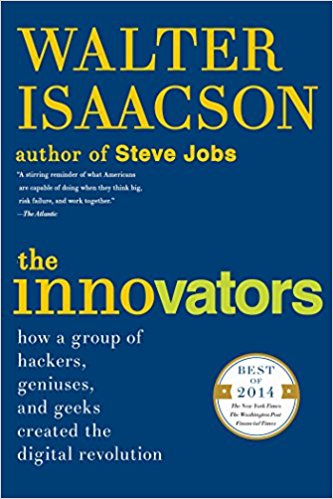 The Innovators has the subtitle “How a group of hackers, geniuses, and geeks created the digital revolution.” This book caught my attention for a couple of reasons – first, I’ve always been something of an early adopter of technology. I love to check out new and exciting innovations. A second reason that this caught my attention is that I’m always curious about how people made the leaps to take us from the earliest computers (devices that took up entire rooms in the basement of college buildings or at military bases), to the technology that I can hold in my hand every time I pick up my iPhone.
Innovation is something that we often think of in terms of those big leaps. When I was in sixth grade, my elementary school was renovated, and one of the classrooms was converted into a computer lab. The first time we walked into the computer lab as a class, we saw a room with about 30 IBM computers. The only thing that I remember being able to do on those computers was a keyboarding program that began the process of teaching me to type. For me, this felt like a HUGE innovation. Little did I know how much more our students would be able to do in the future.
The chapter that I am reading right now is all about software, and one of the big names in the development of computer software was Bill Gates. Early in the chapter is a quote from him about what an innovator is:
An innovator is probably a fanatic, somebody who loves what they do, works day and night, may ignore normal things to some degree and therefore can be viewed as a bit unbalanced.
Reading about Gates, and many of the others who appear in the book, I can see how this definition certainly applies to innovators. Here’s the thing though – I think there are times that you could substitute the word teachers for innovators and that definition would still work (I know my friends think I’m a little unbalanced to spend so much of my time with 10, 11, and 12 year olds!). We are all something of a fanatic about what we do – we’re fanatics for our kids. We love them, we want to help them learn and grow, and we want them to be successful. I know that our efforts to get there make us all feel a little unbalanced at times.
One of the things that I have taken away from the book The Innovators is that the transition to the digital revolution was NOT made up of several giant leaps. Instead, the innovations that have led to the amazing technology that I am able to carry in my pocket has happened because of little steps layered on top of one another. And more often than not, those innovations were not made by any one person. People such as Ada Lovelace, Alan Turing, Robert Noyce, Grace Hopper, Bill Gates, Steve Jobs, and Larry Page (along with so many others) all played important roles in the digital revolution, but the steps of each of these people built on the ideas of others.
We as teachers need to remember that as fanatics, it may not always be easy to get our students to learn and grow as quickly as we want them to. They may not be immediately successful, but if we continue to innovate in our teaching, if we continue to try to reach kids in new and exciting ways, we are going to be able to reach more of them. We also need to remember the value in teamwork for our students to learn. Just as so many of the innovators mentioned above found success by building on the ideas of others, you may find success with a student through strategies others share with you. Whether it be a teammate, your PLC team, someone down the hall, or any one of the multitude of other people in the building, there are others who might have an idea that helps you get that kid to move forward.
What are some of the things that you are fanatical about? Have you ever tried something new that seemed to be the key to reaching that kid? Share you experiences in the comments below!
 So that brings us to the bigger question: What is school for? While some of our students may consider a role in manufacturing, the factories of today are way different than the ones of the early to mid 1900s that led to this factory model of education. Many of our students will not be heading down the path of manufacturing, so that factory model of school definitely doesn’t apply. If you believe that innovation is going to keep happening (and why wouldn’t it?), then we’re preparing our students for an ever changing world! That is so different from the traditional model of school as a factory. In an excellent TED Talk by Seth Godin, he gives 8 examples of things school should be doing:





 So, what does that mean for us? As we talk with students – whether we are giving them feedback on classwork, discussing their behavior, or making suggestions, we need to keep it short and to the point. In a recent post from Matt Miller, he suggested using the sandwich technique:
 Earlier in the spring semester, I was participating in a massive open online course led by the author of The Innovator’s Mindset –
  For me, when I think about what brought me into education, there are a few moments in my lifetime that stand out. I remember my fifth-grade teacher, Mrs. Gromer. With her, the Maya Angelou quote to the right comes to mind. There aren’t very many specific things I remember happening in her classroom, but I remember that I always felt welcome, and valued, and important. I felt that if I wasn’t there, someone missed me, and some value was lost from the class. While I had great teachers before her, and great teachers after, nobody ever made me feel as important in the classroom setting as Mrs. Gromer.
 I have hopes and dreams for these two. I want the best for them. And I know that if that is the way that I feel, then the parents who trust each of us with their children have similar types of hopes and dreams. The faces that sit in our classrooms each day are their everything, and they want the best for their kids as well.
 Knowing how strengths can motivate all of us reminds me to be on the lookout for strengths as I am walking the halls. I am challenging myself to look for the strengths or everyone, and recognize those strengths! I challenge you to do the same.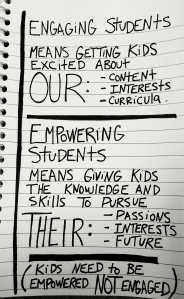
 The View from 518
