Active learning

the-only-source-of-knowledge-is-experience

The HSE21 Best Practice Model is such a great tool because it reminds us of the fundamental classroom conditions that will help our students be ready for their future.  I was recently reading the book Learn Like a Pirate by Paul Solarz and he spent a lot of time talking about active learning.  In active learning, we see differentiation, authenticity, relevancy, choice, and collaboration – all important pieces of the best practice model.  Think back to your favorite moments when you were in school.  What stands out?  It’s probably an example of active learning.

When I was in elementary school, both of the 6th grade classes in our building collaborated to write, produce, and perform a musical.  I vividly remember working with classmates to write the script, to advertise the show, and to plan the costumes and props for the show.  The skills and strategies that I developed in activities like this were ones that I believe helped set me up for success in middle school, high school, and beyond.  While I remember moments of passive learning when I was in sixth grade (one of my teachers was the queen of having us copy notes from her beloved transparencies), I can’t recall any details that I may have learned in that format of lesson.

So, how can we integrate more active learning into our classrooms?  Here are just a few ideas based on Learn Like a Pirate book:

  • Simulations – What’s a better way to learn about the Boston Tea Party?  Read about it, or take your classroom back to 1773 and have your students simulate the circumstances that led the Sons of Liberty to throw cases of tea into the Boston Harbor?  Or you could integrate some science into your social studies by having your students set up a colony in outer space.  They can experience creating a government for their colony while also learning about the needs for their planet.
  • Debates – The collaboration that goes with a debate can be amazing. If you pick a topic that would have more than 2 sides, you can break your class up into several different groups with different topics, keeping the groups small enough that all play a role, while also large enough that you can put mixed ability students together.  Solarz does alternative energy debates with his students.  He plays the role of President, while his students are the advisors trying to convince him that their energy plan is the best.  While this topic may not resonate with you or your curriculum, there are many other debatable topics that could tie to your standards.
  • Science Fair – This is something that has gone out of style, but why? In a time where we are shifting to STEM classes, and at a period in time when so many of our kids don’t do hands on science projects like previous generations, this seems like a no brainer.  The issue I had with the science fair’s old style was that it was typically done as homework.  The last time I had my students do a science fair, we did everything at school.  Students were asked to bring in poster boards, but I tried to provide most of the other resources they needed (sometimes we had to get creative).  Kids assisted one another on their projects, and were truly excited to share their findings at the end.  I was able to provide feedback, help with data collection, and teach mini-lessons as necessary.  The best part – I knew it was all done by the student on a relevant topic of their own choosing.  A variation on this could be an invention fair, or a coding fair, or anything else you might imagine that lets students be actively involved in inquiry.
  • Project-Based Learning – A trend in education, and one that I was guilty of when I was still in my classroom, is that we teach a unit, and then at the end of the unit students complete a project to show their learning. What PBL asks is that we teach through the project.  Once you have your basic idea planned, students choose their more specific project and dig in.  Throughout the unit, mini-lessons can be taught on content, procedures, or skills that students need to go further in the process.  As a teacher, you are continuously checking in with students, seeing where they are and where they are going next, providing feedback, and deciding if there are topics that you need to build a mini-lesson around.  While we’re giving students choice and freedom, you are allowed to set some parameters up front.  PBL doesn’t mean setting the students free to do whatever they want, there have to be some class norms and expectations in place first.  Think of these expectations as the guardrails to keep your students in the right lane, and heading in the correct direction!  If you’re looking for good PBL resources, the Buck Institute for Education (bie.org) is a great resource!
  • Technology – Sometimes integrating some tech into a passive lesson is just what it takes to up the level into an active learning opportunity. Don’t just use technology for the sake of saying that you’re using technology.  Use technology when it is the best tool for the job.  Remember, HSE21 is not, and has never been, about technology, the iPad, OneDrive, or any of the many apps that are used around school.  However, when we find technology that truly improves or transforms what we’ve been doing, don’t hesitate to add it to your lessons.
  • Reader’s Theater – This is such a great way to work on oral reading fluency.  Students get to practice their part several times with their group.  During that time they can practice pronouncing difficult words, learn to project their voice, add inflection, and enunciate.  Depending on your goals, it could be a single day activity, although students don’t have as many opportunities to practice and they may not be able to create props to go with their performance.  On the other hand, you could do a multi-day activity where students are put into groups and roles one day, have time for rehearsals and planning for the performance (props, costumes, etc.) on a second day, dress rehearsals where you can give feedback on props and costumes that aren’t appropriate or necessary on a third day, and then performance day on the last day.  If you’re really brave, you could record the performances to put on a YouTube page so that parents can see what their kids are up to at school.

This is not intended to be an all-inclusive list of active learning activities, but is meant to give you some ideas of how to create more active learning opportunities for your students.  What am I missing?  Are there active learning examples that you use that I didn’t mention?  Have you tried (or are you thinking about trying) any of the ideas above?  Tell us about your experiences, your thoughts, or your plans in the comments below!

Finding the author’s purpose

AuthorsPurpose

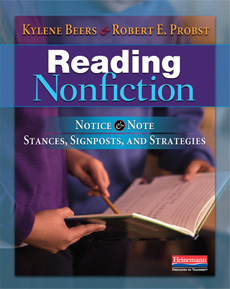
This post is the final post in a three-part series based on my learning from the book Reading Nonfiction as well as recent PD that I attended that was led by Kylene Beers and Bob Probst.  In the first post, “How do we take them further?” I talked about those 3 questions that should guide our thinking when reading nonfiction:

  • What surprised me?
  • What did the author think I already knew?
  • What changed, challenged, or confirmed what I knew?

When we get our students to think about these three questions as they are reading nonfiction, they will notice more, question more, and dig deeper into the text.

In last week’s post, “Defining Nonfiction” I wrote about how we define nonfiction.  I first shared a word cloud based on our own definitions of nonfiction reading:

Nonfiction_definition_wordle

But we then transitioned to a much deeper definition of nonfiction:

Nonfiction is that body of work in which the author purports to tell us about the real world, a real experience, a real person, an idea, or a belief.

To be able to truly dig deeply into a nonfiction text, we must understand the author’s purpose.  In this post I’m going to be sharing with you a couple of the signposts that Beers and Probst recommended as a starting point to really get our students thinking about the author’s purpose.

The first signpost that Beers and Probst shared with us specifically during our PD was the concept of Contrasts and Contradictions.  For those of you who have been using the Notice and Note to teach fiction reading strategies, this one should sound familiar.  In fiction you look for things that the characters do that contrasts or contradicts what you might expect.  In nonfiction we should notice if the author shows us “a difference between what you know and what is happening in the text, or a difference between two or more things in the text.”

Think about it for a second.  If you are reading a news story, and it contradicts something that you have seen in a different story, or something that you believe you already know, that is going to give you pause.  When you stop to think about those differences, you might come to the conclusion that an author is trying to change your opinion – this is a hint of what the author’s purpose might be.  Remember, our students can’t just think of nonfiction as not fake.  Our students have to have that questioning stance so that they can be a bit skeptical of the opinions being shared.

Once we recognize the signpost for contrasts and contradictions, students then need to take it a step further – just noticing the signpost doesn’t get the level of inquiry we want.  Next we need our students to ask themselves a question about that signpost.  I love the chart on page 121 of Reading Nonfiction because it shows anchor questions for different levels of students, or questions that could be asked in the content areas.  The most basic anchor question for this signpost would simply be “What does this make me wonder about?” while a deeper anchor question might be “What is the difference and why does it matter?”

The other signpost that Beers and Probst said was so important in finding the author’s purpose was Extreme or Absolute Language.  This is defined as language that “leaves no doubt about a situation or an event, allows no compromise, or seems to exaggerate or overstate a case.”  Virtually any statement that includes the words all or none would be an example.  It seems this year that you can’t listen to a political speech or read an article about the presidential race that doesn’t include some form of extreme or absolute language.  The extreme language can range from obvious and probably harmless to the subtle and potentially dangerous.  Take the following 3 statements that many of us may have heard at some point:

  • It’s freezing out there!
  • You have to let me go to that party! Everyone is going to be there!
  • Simply stated, we know that Saddam Hussein has weapons of mass destruction.

As you can see, the first statement is probably pretty harmless, the second might give the parent of a teenager pause to think about whether or not it is appropriate for their child to attend the party, but that last one is an example that led to the loss of many lives and history has come to show us it was not accurate.  We need our students to understand that when they encounter language that is extreme or absolute, they need to “be alerted either to the strength of the author’s feelings or to the possibility that the writer is exaggerating and may even be deceiving or misleading the reader.”

Just like with any other signpost, simply noticing it is not enough.  We need to continue to remind our students to stop and think about the anchor question.  Just like with the contrasts and contradictions signpost, the most basic anchor question is “What does this make me wonder about?” while a deeper version could be “Why did the author use this language?”  Again, you can see content specific anchor questions on the chart on page 121.

Between teaching our students about the importance of a questioning stance when reading nonfiction, a true and accurate definition of nonfiction, and at least a couple of the signposts, our students will have the tools they need to be able to read deeply, think deeply, and understand an author’s purpose.  It is so important for our students to develop these skills not only so that they will be successful in school, but also so that they can be productive members of a democratic society.  If we don’t teach our students to have a questioning stance, they will believe whatever they see on the news, no matter whether it is ABC, CBS, NBC, CNN, Fox News, MSNBC, or any of the other multitude of news outlets that are out there.  I love this following quote from page 32 in Reading Nonfiction:

“Far more important than the ability to capture a teacher’s information and thoughts is the ability to acquire information on ones’ own, to test ideas against one another, and to decide for one’s self what notions have merit and which should be rejected or abandoned.”

We need thinkers who can listen to political speeches and read political writings and decide who will best serve their needs.  We need students who can look at the writings of a so-called nonprofit and decipher if a donation will be used in a meaningful way.  Instead of accepting what they are told, our students “need to develop intellectual standards that open them up to new possibilities and challenging ideas and give them the courage and resilience to change their minds when they see persuasive reasons to do so.”

Share with us your thoughts on the importance of nonfiction reading.  Why do you feel understanding nonfiction is important for our students?  What have you noticed about student’s thinking as you push out a questioning stance and the nonfiction strategies?  Let us know about them in the comments below!

How do we take them further?

Reading NonfictionOn Monday I was able to attend a PD session that was led by Kylene Beers and Bob Probst, and one of the things they said early in our day struck a chord with me:

“Some teachers don’t realize that if they just stay out of the way, the kids who do well will keep doing well.  How do we take them further?”

This is such a challenge in our district.  Most of our classes are filled with compliant students who generally do what we ask them to do, they show gains in the normal way, and then they move on to the next grade.  But is that what we want for our students?  Show gains in the normal way?  Don’t we want them to gain spectacularly in the time we have them?  For most of these students, they will hit a wall sometime.  It might be a high school AP class, it might not be until college, and there may be some who can get by until they are out in the “real world” in their job/career.  But eventually their act of going through the motions won’t be enough because they won’t be able to truly think deeply and problem solve.

I think we can all agree that nonfiction reading skills are important.  But research shows us that strong nonfiction reading skills are one of the highest indicators of success.  Unless you’re a literary critic, a novelist, or a teacher (I know, we’re teachers), you probably only read fiction as an escape, but you read nonfiction every day.  That means our kids need the tools to be able to dig deep in the text, think through the text, and figure it out.

And here’s one of the amazing things – if you teach the kids the tools, and you give them the time to read a text, think deeply about it, and talk with each other, they will start asking themselves the same questions (or possibly even better questions) than the ones you would be asking.  During the PD, Probst said “Our goal should be to get our students to be able to have deep conversations about their reading without needing our help.”  Don’t you love the idea of students walking out of the building at the end of the day so tired because of all the deep thinking they have been doing, and you walk out with a smile on your face?  Our students should be doing the hard work, not us.

Too often as teachers we spend our time filling in the blanks for our students, and that is hard work!  We give them the background knowledge, we ask the questions, and then what do we get back?  Low level answers without much deep thinking.  When you ask the question, that leads our students to believe that there is one answer, and if they’re lucky they can find it in the back of the book – that’s how school works, and we all know our students can play school.  But if students were to ask those same questions, on their own, the conversations will be so much deeper.

Sound good?  I think so, but where do we start?  Beers and Probst suggested that the initial starting point would be with their 3 main questions:

  1. What surprised me?
  2. What did the author think I already knew?
  3. What changed, challenged, or confirmed what I knew?

As your students are reading, have them code what they read (this means you need something that they can write on, some post its, or a digital format that they can annotate).  Beers recommended using an exclamation point for question 1, a question mark for question 2, and the letter c for question 3.  Then, after they have read, have them talk in small groups about their thinking.

Next week I plan to go a little deeper with some more of the information that Beers and Probst shared on Monday, but as you get your year rolling, start with the 3 questions.  These 3 simple questions will make the reading more personal and relevant.  It will push thinking and learning to a much deeper level! (If you want to see a great video of where these questions can push students, scan the QR code on page 88 of your copy of Reading Nonfiction – it’s a 3 minute video clip of 6th graders in a 1:1 classroom).

If you haven’t yet read the book Reading Nonfiction by Beers and Probst, I can’t recommend it highly enough.  There is so much there to take your reading instruction to a greater level, and this instruction can take place in ALL classrooms.  We all use nonfiction reading skills in our lives, no matter what subject we teach, to help ourselves increase our knowledge and understanding.  Let’s help our students develop the skills to be more successful nonfiction readers.

Share your thoughts in the comments below.  Have you used the 3 questions in your nonfiction instruction?  What changed for your students?  What things were great?  What struggles did you have?  As a community of teachers, we are also a community of learners, and we can learn most from one another!

Teaching Conflict Management

Last year when we surveyed teachers on the topics they would like to look into as part of the Professional Development for the 2016-2017 school year, some of you chose to “write-in” a topic that you would like to learn more about.  One of the write-ins was:

“Problem solving social situations, especially with friends, recess, lunchtime, specials, etc.”

Learn Like a PirateWhile there are ways that we could probably take that idea and turn it into a PD Topic, I thought that I would give some tools that you might be able to use in the classroom the first time that you see a situation of conflict develop – my goal here is to provide you with a right now strategy.  I can’t claim this idea – the majority of this post is based on ideas from the book Learn Like a Pirate by Paul Salarz (@PaulSalarz).  Mr. Solarz is a fifth grade teacher in the Chicago area and runs a student-led classroom.  There are so many tips in the book to help guide students to collaborate, be empowered, and take leadership in their own learning.  I highly recommend it!!!  The following ideas come from the Teaching Strategies for Dealing with Conflict section on page 56.

In a classroom where you are integrating student voice and student choice and allowing opportunities for students to collaborate there will invariably be some type of disagreement.  We’ve all seen it happen – Tommy and Jeff partner up.  Everyone (including them) knows this is a bad idea.  One strategy would be to break them up before they even have a chance to start working.  However, in a collaborative community, everyone needs to learn how to work with everyone.  Not only will it help your classroom run more smoothly, it’s an important lifelong skill!

We all know what happens next…  If you allow them to work, before long there’s a disagreement.  Our reaction can make or break this situation.  Instead of saying that this is what you knew would happen, and separate them, what if you gave them the tools to find a solution on their own?  What an awesome opportunity to turn this situation into a teachable moment – not just for Tommy and Jeff, but for the whole class.  Here’s what you could do:

  1. Get the entire class’s attention – “Give me five!”, hands up, or whatever strategy you use in your classroom.
  2. With a sincere smile on your face, look at Tommy and Jeff and thank them for having a little bit of trouble because it gives you the opportunity to teach everyone how simple it can be to get through conflicts.
  3. Ask the boys to describe what happened, then teach the whole class the following strategies (you might even consider making an anchor chart for this skill to post in the room – or even better, have the students make the anchor chart!):

Lets settle thisRock-Paper-Scissors: Do you know how many arguments my friends and I have avoided with a simple game of rock-paper-scissors?  When your students can’t decide who gets what job, or what color the background should be on a poster, a single round of rock-paper-scissors can be just the perfect way to find a solution!

Compromise: Take a portion of each person’s idea and combine them together.  (“I want to watch the video clip first.” “But I think we need to plan our poster design.” “Why don’t we plan our poster design right after we watch the video!?”).  Hopefully they can find a solution that makes them both happy!

Choose Kind: Sometimes the best solution to conflict is just to do what the other person wants because it’s also a good idea!  As the quote from Dr. Wayne Dwyer goes: “When given a choice between being right and being kind, choose kind.”  Winning an argument while also hurting a classmate does not help the class win.  This summer I began using the phrase Choose Kind with my children (7 and 4 years old). It’s amazing to see how often they have been choosing kind to solve their disagreements.

The earlier you can teach these strategies to your class, the sooner they can begin to implement them.  Once students understand the process, these steps can be used even when you aren’t there – the lunch room, hallways, recess, etc.  If you don’t run into a conflict after a few days, then you might want to role play a scenario.  The sooner these strategies are introduced, the better!

As with any other strategy, we have to be ready to reinforce the use.  You can’t just introduce it once and then assume they all know it and will be successful.  Every time you notice a conflict, make sure students know you are aware (proximity, a concerned smile, etc.), but don’t just jump in and solve the problem.  Give them a little time to see if they will come to a resolution on their own.  For this strategy to truly be effective, the students have to come to use it on their own.

After you witness students come to a resolution, let them know how proud you are of how they handled it, and see if they would be willing to share their experience with the class.  If they are, have them act it out so the whole class can learn from the situation.  If students don’t want to share, that’s ok too!  They may be shy or embarrassed by what happened.

If students can’t get past the conflict on their own, then you might have to gently remind them of the conflict-management strategies to help them move on (this is where that anchor chart could be really handy!).  It’s also ok if another student steps in to help with finding a solution.  What a sign of good collaboration!

Continue the conversation in the comments below.  Could these strategies work in your room?  What else have you done that’s been successful?  Conflict can be such a distraction and sticking point that we can all use some good new ideas!

What our students see

Today I was walking the around our school thinking about the fact that in less than 2 weeks the halls will be full of almost a thousand 5th and 6th grade students.  Many of the classrooms that I walk past are still in various stages of preparation for all of those students.  Thinking about those students got me excited!  But as I walked through the halls today, I tried to look around with a different perspective.  Instead of walking around with the eyes of an adult, an educator, or an administrator, I tried to look around and see what our students might notice.  What do the things that are posted on the walls say to the 10, 11, and 12 year old students who will be walking these halls?

Many times as educators, we put things up in the hallway or our classroom because we like them.  We might intend to share something of ourselves with a student, we might intend to be funny, or we might intend to set up expectations that we have for our class and our students.  Unfortunately, our students can’t read our mind and know our intentions.  Sometimes your students may see that sign that you think is setting expectations, and instead see it as harsh, judgmental, or possibly even confrontational.  Think about what you have hanging up both outside and inside your classroom. How will it make your students feel when they walk into the room?  Are they going to feel welcome, or are they going to feel intimidated?  Does your room encourage them to be a part of the learning process, or does your room discourage their participation?

From The Thinker Builder: http://www.thethinkerbuilder.com/

I saw a recent post on the blog The Thinker Builder that had a pretty cool idea (at least I thought so).  Instead of covering his bulletin boards with amazing decorations to set up a classroom, the author begins his year with a blank bulletin board and puts a reserved sign on it (I have a screenshot of the sign to the right).  If you’d like to see his post, or be able to download the sign, check out this post – “Reserved” Signs: A Bulletin Board Stress Reliever.  What does a sign like this say to the students and parents that walk into your room?  To me, it shows that you value the thoughts and opinions of the students who will be in your classroom.

Remember, your students will notice what you have posted on the walls both inside and outside of your classroom before you have said one word to them.  Based on what they notice, they are going to form opinions about you.  They will create expectations about what this school year is going to be like.  They will also decide whether they feel that the classroom is a place that they are safe to express themselves and become part of the learning community.

One of my takeaways from the book Mindset by Carol Dweck was that a person’s environment can play a role in what mindset they take.  Posters that use terms that make us think in a fixed way, or make us think that we don’t have any choice or control will generally lead us to behave in a manner that shows a fixed mindset.  On the other hand, things we display that show phrases that encourage a growth mindset will lead us to behave in a manner that shows a growth mindset.

Kids Deserve ItThis year, as you are preparing your classroom, take a few moments to take stock of what kids will see in the hallway outside of your room, as well as when they walk into your room.  Do the words on those posters have a positive connotation, or are they negative?  Are they giving your students an idea of what they will be doing, or of what they will not be allowed to do?  We only get one chance to make a first impression!  Make sure that the impression that you make sets the students up for their best possible year!

Continue the conversation in the comments below.  What are some things you are planning to do to help your students feel welcome in your classroom?  How will they know that they are a valued member of the learning community?  Let me know your thoughts in the comments below!


An Open Letter to Educators

Earlier this summer I finished reading the book The Innovators Mindset by George Couros (@gcouros).  One of the things that I loved about the book was his use of his website and blog as a way of linking to important information that tied to the chapter you had just completed.  On his website you find a page dedicated to each chapter of the book.  It has a brief overview as well as links to additional reading (typically blog posts or new articles), as well as video resources.  One of the links led me to the video below titled “An Open Letter to Educators.”  Take a moment to watch the video:

A few thoughts after watching:

  • If a strong education is the key to success, what does that education look like in this day and age?
  • Does the current institution of education get our students prepared for a successful future?
  • How has “free” information changed your life?  How might it continue to change the lives of your students?

If, as Dan Brown says “education isn’t about teaching facts, it’s about stoking creativity and new ideas” and one of your primary goals should be to “empower students to change the world for the better” then I wonder what our classrooms need to look like?  What are we getting right?  What aren’t we getting quite right yet?

For me, I see collaboration, student choice and student voice, authentic and meaningful learning, inquiry based activities, and opportunities for our students to apply their learning beyond the classroom as keys to help meet these needs for our students.

InnovatorsMindsetWhat do you see as the keys to success for your students?  How is your classroom currently meeting the needs of your students?  In what ways is your classroom still falling short on meeting those needs of your students?  Share your thoughts in the comments below!  If you’re looking for ideas and inspiration, I highly recommend The Innovators Mindset as a way to help you find opportunities for innovation!


I don’t have time for that!

I don’t have time for that!

It’s a refrain that seems to come up quite often in education.  You might have just left a professional development talking with a colleague and you feel excited to try something that you learned only to hear “I don’t have time for that” in response.  Or maybe you shared an article with a friend that you have used to help in your classroom, and the only response you get is “I don’t have time for that.”

Or even worse, maybe you’re the one saying “I don’t have time for that” to your colleague, administrator, or friend.  My immediate response, knowing that we work primarily in a learning environment, is “You don’t have time to learn?”  Would you allow your students to say that?  Would that be an acceptable response in your classroom?

I would challenge you to shift your mindset.  Reading a recent post from the blog Principal of Change, George Couros makes a suggestion of what we can say instead of saying “I don’t have time for that.”

  1. How will my students benefit from this practice?
  2. I am not seeing the relevance of this for teaching and learning…could you give me specifics of how this would impact my practice?
  3. How would you suggest incorporating what you are suggesting into my position?
  4. What has been the biggest benefit for your own practice?
  5. If I was to do this, what would it replace that I am doing now?

Time

How many times have we all tried things, thinking that they wouldn’t be valuable, or we wouldn’t like them, only to realize a few days (or weeks, or months) into the new thing that we couldn’t imagine not doing things this way?

So what can we learn from those moments?  My hope is that we would come to the realization that it is important to be open to learning and trying new things.  Just because you feel as though you “don’t have the time” you can’t just dismiss something out of hand.  Take the moment to ask the questions above.  If the answers are satisfactory, then that should show that you need to make the time to learn a little more, to try it out, and hopefully create a better learning environment for our students.

Remember that we are the ultimate models of learning for our students.  If we never try something new, if we never exit our comfort zone, if we never do things differently than the way we’ve done something in the past, then we are saying to our students that it’s ok for them to be the same way.

What are some things you tried, not knowing quite how they would work out, only to be pleasantly surprised by how great it really was?  Let us know in the comments below!

Engaging & empowering our students

Last week I shared with you some data on student mental health issues, anxiety, and student engagement.  I closed the post with these three points:

  1. Mental health concerns in our students are rising.
  2. Levels of engagement decline as our students grow older.
  3. Even with increased focus on standards, performance on standardized testing has remained stagnant.

So what can we do?  I’m sure that all of you have noticed these patterns in our own classroom, but knowing the pattern is only part of the task of finding a solution.  In last week’s post I shared the work of two college professors.  Going back to their work, I hope to share a couple ways we might be able to help fight anxiety and lack of engagement.

Peter Gray, the psychology professor from Boston college, feels that the key to learning and growth for our students is free play:

Children today are less free than they have ever been.  And that lack of freedom has exacted a dramatic toll.  My hypothesis is that the generational increases in externality, extrinsic goals, anxiety, and depression are all caused largely by decline, over that same period, in opportunities for free play and the increased time given to schooling.

So as a school, what does play look like?  For one it means we have to be sure to value recess/physical activities during the school day.  There is clear research that one of the benefits of physical activity is increased student engagement.  Think about your classroom on an afternoon where we did not have outdoor recess due to weather.  What are the engagement levels like?

Several recent research studies have looked into increased free play time in the school day, and the results suggest that students with regular recess behave better, are physically healthier and exhibit stronger social and emotional development.

Knowing these facts, does that lead you to think about changing what you do when you return to the classroom on a day when we are unable to go outdoors for recess?  Hopefully you can think about finding a way to squeeze in some free play on those days.  If not free play, then a few short brain break activities to get the kids out of their seat and moving.

And what about the days that students already get their recess?  Does that mean we don’t need to look for other opportunities for play?  Many of our teachers have been doing outdoor activities here at school this week.  I’m sure that they would share that the students are loving the activities they’ve been doing – they are active, engaged, and empowered in this learning environment.  My question though: Do we only save activities like this for the end of the school year?  Or do we try to integrate play into our lessons throughout the year?  How can we make use of our outdoor space, our small and large group instruction rooms, or even just the hallway to get the kids up and playing as they are learning?

Next we have the issue of engagement.  For the purpose of this piece, I am defining engagement in school based on the Schlechty’s Center for Engagement definition:

  • The student sees the activity as personally meaningful.
  • The student’s level of interest is sufficiently high that he/she persists in the face of difficulty.
  • The student finds the task sufficiently challenging that she believes she will accomplish something of worth by doing it.
  • The student’s emphasis is on optimum performance and on “getting it right.”

Is it engagement when we work hard to get students into content that we have selected for them?  You may be able to get their attention, but if it’s based on extrinsic goals (like a grade) the motivation may not last.  So here are some ways you might be able to increase motivation in your classroom:

  1. Students are more motivated academically when they have a positive relationship with their teacher.
  2. Choice is a powerful motivator in most educational contexts.
  3. For complex tasks that require creativity and persistence, extrinsic rewards and consequences actually hamper motivation.
  4. To stay motivated to persist at any task, students must believe they can improve in that task.
  5. Students are motivated to learn things that have relevance to their lives.
HSE21 Best Practice Model

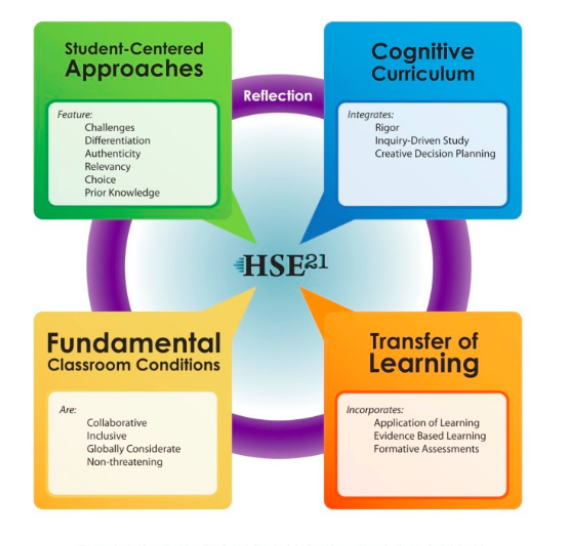
As you spend time thinking about bringing more inquiry into your classroom, as you work to better incorporated the HSE21 Best Practice Model, you will begin to notice increases in your student engagement.  When we provide our students with challenges, with activities that are relevant to their lives, when learning is rigorous and based on inquiry-driven study, when students are able to apply their learning in collaborative ways, when we work to incorporate more of the HSE21 Best Practice Model we will see increases in student engagement.  In fact, if we work towards truly relevant and rigorous study students will not only be engaged, but actually will be empowered to take their learning to levels that we can’t possibly imagine!

As we approach the end of the year, take some time to reflect on things you have tried that have been new.  What activities have led to increased levels of engagement?  What ways have you been able to get a kid truly excited about what they are learning?  Now, think ahead – how can you take the things that have been successful and expand on them for next school year?  Share your thoughts in the comments below.

Moonshot Thinking

We choose to go to the moon. We choose to go to the moon in this decade and do the other things, not because they are easy, but because they are hard, because that goal will serve to organize and measure the best of our energies and skills, because that challenge is one that we are willing to accept, one we are unwilling to postpone, and one which we intend to win, and the others, too. ~John F. Kennedy

Anxiety & Engagement

This year at RSI we all read the book The Price of Privilege.  I know from follow up conversations with many of you that we see some of the issues that were described by Dr. Levine.  I don’t want to go through everything that she shared once again, but one of the things that jumps out at me from that book has to do with the level of anxiety in our kids.

Recently I also read a paper written by Jean Twenge, a professor of psychology at San Diego State University.  In the study she looks at the mental health of kids just like those you would find in just about any school in the country.

In her paper, Twenge looks at four studies covering 7 million people ranging from teens to young adults in the US.  Among her finding: high school students in the 2010s were twice as likely to see a professional for mental health issues than those in the 1980s; more teens struggled to remember things in 2010-2012 compared to the earlier period; and 73% more reported trouble sleeping compared to their peers in the 1980s.  These so-called “somatic” or “of-the-body” symptoms strongly predict depression (for more on this study, click here)

In fact, the growth in mental health support in the form of services or medication in the 6-18 age group is somewhat shocking:

https://www.theatlas.com/charts/Vko2VfNpe

I think the writing of Peter Gray, a psychologist and professor at Boston College, sums it up this way:

We would like to think of history as progress, but if progress is measured in the mental health and happiness of our young people, then we have been going backward at least since the early 1950s. (to see the whole article, click here)

I know that mental health is something that we have been talking a lot about in our community and our school.  In further reading of the research from both articles, there are differing opinions of the why, but you may notice some similarities.

Twenge has seen a noticeable shift away from internal, or intrinsic goals, which one can control, toward extrinsic ones, which are set by the world and are increasingly unforgiving.  On the other hand, Gray believes kids aren’t learning critical life-coping skills because they never get to play anymore.

We have all had the students who had to have the right clothes, the right phone, the right video game in order to feel as though they could fit in.  We have also seen students who cannot, without adult mediation, play a game at recess that doesn’t end in a fight.

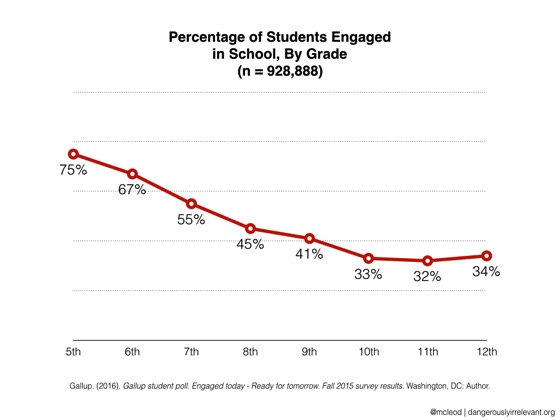
The increase in anxiety and mental health support for our students is one concerning piece, but let’s add to that another issue.  As students grow older, the general trend for all students is towards a lower level of engagement.  In a recent post on the blog Dangerously Irrelevant by Scott Mcleod, the following data from the annual Gallup poll of middle and high school students was shared:

http://dangerouslyirrelevant.org/wp-content/uploads/2016/03/2015-Gallup-Student-Poll-1.jpg
http://dangerouslyirrelevant.org/wp-content/uploads/2016/03/2015-Gallup-Student-Poll-2.jpg

I’m going to let those charts sink in for a bit, and leave you here with 3 thoughts.  Next week we’ll come back to this topic:

  1. Mental health concerns in our students are rising.
  2. Levels of engagement decline as our students grow older.
  3. Even with increased focus on standards, performance on standardized testing has remained stagnant.

What have you noticed in your classroom?  Is there a connection between anxiety and engagement?  What strategies have you tried to help students feel less anxious or more engaged in your classroom?  Share your thoughts in the comments below.