
Goals. It’s the beginning of the school year, so I’m sure we’ve all got them. As you think about the goals for your year, how do you feel about them? This summer I read the book Run Like a Pirate by Adam Welcome. Adam has been a teacher, vice principal, principal, and director of innovation and technology. He also travels all over the country to speak with schools and districts.
The gist of the book Run Like a Pirate is his experiences during 2017. Now, you may wonder why that year. In 2017, Adam set a goal to run one marathon a month for every month of the year. Personally, I like to think of myself as a runner. Those of you that follow me on Twitter may see me post my run stats, pictures from my run, or something on Twitter about those early morning miles that I get in. I’ve run multiple half marathons and have contemplated stepping up to the full marathon. But the idea of running even a half-marathon a month seems completely overwhelming to me, let alone doubling those miles each month!
When you have set goals for yourself in the past, how often do you set a goal that you think “I’ve totally got this, no problem!” and then you do crush that goal? It makes you feel good to know that you’ve met the goal. After meeting that goal you probably set another one.
But here’s a thought. Goals are meant to stretch us. They’re meant to bring us to the growing edge. They should give you that feeling in the pit of your stomach that says “uh-oh” because you aren’t quite sure if you can do it.
It’s important to set goals with this ‘uh-oh’ mindset because the difficulty of meeting the goal is where the payoff comes from. If you set a goal that you can reach easily, that you can possibly reach without having to put in some extra work, you aren’t growing. It feels good to meet a goal, but what’s our point in goal setting? Is it to be able to say that we accomplished our goals exactly as we set them? Or is it about being able to look back on the process of trying to meet the goal and reflect on the struggle you went through and the growth that happened?
When I made the decision to run a half-marathon, that was a huge jump for me. Prior to registering, I had never run anything longer than a 5K. Suddenly I was committed to run a race that was TEN MILES longer than my previous long. So, I did research. I talked to the people at my shoe store to help pick out a good pair of shoes. I looked at multiple training plans for a beginner running a half-marathon. I read up on training methods – should I run hills? Do interval training? Mix in some rest days (because that’s important too)? Then I read up on nutrition. If I was going to be running early morning miles, what should I have for breakfast? How long before the run? What should I have after I got home? What about gels or chews or some other energy-based snack while I was running? And what about hydration? Do I carry a water bottle? Over time I figured out a strategy that worked well for me, but it took lots of trial and error, and I still haven’t met my goal time that I set for my last half-marathon.
As you can see, setting a goal that pushes you to a place you aren’t quite sure you can go forces you to learn a ton! Ultimately, I was able to finish that first half-marathon in a time of just over 2 hours. And then, a couple days later I signed up for my next half-marathon with the goal of breaking the 2-hour mark. As of the writing of this, I have successfully run 7 half-marathons, six of them in a time of less than 2 hours, but still, I haven’t met that goal of 1:45.
With the beginning of this school year, think about the goals you have set for yourself. Are you at the point of thinking “I’m going to crush this” or are you feeling a bit more of that “uh-oh” in the pit of your stomach. I’d like to challenge you that most likely you’re going to learn more when trying to accomplish an “uh-oh” kind of goal. You might not hit your goal exactly as you set it, but that’s ok! You will definitely learn more than if you set a goal that you can achieve easily. Make sure you have a little bit of that uh-oh feeling when you set your next goal!

What are some of the goals you have set for yourself? Share your plans with us in the comments below! A goal has a lot more meaning when we make it public!

 I’ve always loved this quote from Maya Angelou. Over the past several years, there’s been a lot of opportunities for learning about better ways to interact with our students. In the summer of 2017, several of us had the chance to learn from Jim Sporleder about the idea of Trauma-Informed Care based on the work he did in his school in Washington. Many of us walked away with new ideas about how we work with kids. Others of us may have seen the movie “Paper Tigers” documenting his work with trauma-informed schools. Last year, several teachers read the book Lost at School by Ross W. Greene, and it gave us more to think about. Last semester several of our teachers attended a training on Restorative Practices at the Peace Learning Center. We are currently working on a plan to be able to provide this training to all of our teachers. At the beginning of this school year, we did a training on de-escalation techniques. For the past 2 years, I have worked as a member of our district wide Trauma-Informed Team, where we have talked about ways to expand this knowledge. All of this learning has taught us new strategies for how to handle difficult situations with kids.


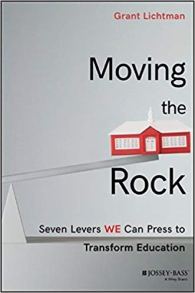 Grant Lichtman, the author of Moving the Rock: Seven Levers WE Can Press to Transform Education, has often used the metaphor of the North Star to talk about the idea of having a shared vision of where we want to get to in terms of great learning. If we don’t agree on where we are going, we have random movement, in random directions, and we end up nowhere! Think about the North Star, no matter where you stand, we can all find it, we can all point to it, we can all figure out our route to get there. In that same way, when we have a shared vision of learning, and we understand that no two educators are moving towards it from the same place, we all have to set a course of our own.
 The opening of the conference included a guest speaker that I was super excited to see – Buzz Aldrin! It was cool to hear Aldrin talk about his experiences, as well as his hopes for continued space exploration. Aldrin is a huge supporter of getting a human being to Mars. Not to mention, there’s something pretty awesome about being in the same room as someone who actually walked on the moon.

 I wanted to briefly touch on my final two sessions, which were on similar topics. One was about an intermediate school in Ellettsville that implemented a school-wide genius hour program. At this school, every other Friday, the entire school basically shuts down for the last hour of the day. Students then work on their genius hour projects. These projects are ungraded, student-led, and lead to a STEAM Night Showcase where students share their findings from their genius hour project. The teachers, administrators, counselors, custodians, and other adults in the building are all able to serve as advisors for students who choose projects on a topic that they have an interest or understanding in. The school has even partnered with outside professionals who can come in and help be mentors for topics students are interested in. Being located near Crane Naval Surface Warfare Center and Cook Inc. opens up the possibility of some great partnerships for this school.
 The final session of the day that I attended was put on by the innovation director and principal from New Palestine Intermediate. This year they created a new day in their related arts rotation called Innovation Hour. Other schools might call this learning clubs, or choice activity time. To create the clubs, staff members signed up with something they were passionate about. Examples include gardening, drones, coding, woodworking, etc. Students then sign up for their top three choices. Once assigned to an Innovation Hour, then they meet every 4th day from 8:30 to 9:20, and all the students are able to participate in the club they are assigned to. So far, everyone has been able to get one of their top 3 choices.
 Today’s post will focus primarily on the principles of restorative practices as shared by Kristina Hulvershorn of the Peace Learning Center in Indianapolis, Indiana. But before we get into the principles, let’s talk about why we should be looking at restorative practices as a piece of our plan for handling behavior and conflict.
 Restorative language (the use of affective language) – To the right you’ll see a screen shot of a document with sentence starters for affective statements (I’ve also included a link to the document at the bottom of this post). If you share this with your students, post it in your room, and begin using statements like these, the kids will too!
 In his conversation with Goins, Kohn challenges us that there is no way to measure or quantify true learning. The moment we try to put a numerical or letter-based score onto a learning task, we take away much of the motivation that students have to learn, and instead we create a system that trains our students for compliance. The things that can be easily measured in an assessment are not the things that truly matter. The example that Kohn used here was that on an assessment of a writing task, we may spend more time and effort in measuring the number of times that a student used punctuation correctly, however we don’t spend nearly as much time on whether the student expressed meaningful ideas in their writing. If we are developing learners in our world, what’s more important? I think most would agree that the ideas are the most important part, but ideas are hard to quantify, so we struggle to factor that into our assessments. As Kohn puts it “More focus on data in teaching means that we teach the trivial stuff more than the important stuff.”
 The View from 518