Childhood trauma

Last weekend I was listening to the most recent episode of the TED Radio Hour, a radio show that is based on a common theme, and then embeds portions of TED Talks, as well as interviews with the people who gave those talks around that central theme.  The episode I was listening was titled “Hardwired” (click here if you’d like to listen to the episode), which was looking at how human behavior is based on both our genetics, as well as our experiences in life.

One of the speakers who is included in this episode is Nadine Burke Harris, a pediatrician in San Francisco.  After listening to her portion of the radio show, I had to watch her full TED Talk.  In her talk “How childhood trauma affects health across a lifetime” she talks about the unbelievable impact that trauma can have on childhood brains, as well as the long term health impacts of those who have lived through trauma.

Many of us are tempted to say “that doesn’t happen here.”  I challenged you to watch the TED Talk and think a little more critically about what Harris has to say about trauma.  This does happen here.  There are students who walk into our school every day who have faced adversity that has an impact on their brain development.  Next week, I’ll follow up with a little more of my thoughts on trauma in kids, but I hope you will find the time to watch this excellent TED Talk.

5 questions

Inquiry

Student voice, student choice, relevancy, collaboration, intellectual risk-taking.  All these phrases should sound familiar as they come from the HSE21 Best Practice Model.  While these are all things that we strive for, sometimes we might wonder how we help our students understand that this is what we’re going for.

I recently saw an article from the Harvard Business Review about questions that businesses should ask their employees.  Based on a 2016 study by Deloitte, people feel loyalty to companies that support their own career and life ambitions.  Wouldn’t it be fair to say that our students are likely to feel the same way (more interested in learning when they feel that the learning is valuable to them)?

With that, imagine the empowerment our students would feel if we not only ask these questions, but actually use their answers to guide the learning that’s taking place in our classrooms!  Here are the questions:

  1. What are you good at doing? What school activities take less effort? What do you do first because you know it will be easy? What things do others notice as strengths for you? These questions will help students to identify their strengths and find possibilities to grow those strengths.
  2. What do you enjoy? What are the things at school that you most look forward to? What things give you extra energy when you know they were coming up? If you could design your own school day with no restrictions, what would you spend your time learning? These questions help students find, or remember, what they love about school.
  3. What feels most useful? What about school makes you feel most proud? What do you do that is critical to the success of others? What are your highest priorities for your life, and how does school fit in? These questions will highlight the inherent value of certain activities.
  4. What creates a sense of forward momentum? What are you learning that you’ll use in the future? What do you envision for your future? How’s your work today getting you closer to what you want for yourself? This line of questioning will help students think about how the things they are doing now will help them achieve their goals.
  5. How do you relate to others? What kind of work partnerships are best for you? How does your work at school enhance your connections with others outside of school? This will help our students see the value in meaningful relationships.

Helping our students to identify their purpose for learning will help them feel more connected in the classroom, and to see the value that comes from their learning.

Gentle pushback

How do you spend the beginning of the school year?  What types of activities are you using in your classroom?  Keep in mind that the expectations that you set in the first few weeks will carry throughout the year.

So often at the beginning of the year, we spend lots of time on relationship building.  Those of you who know me will know that relationships are a key part to success (see previous posts here, here, and here).  Relationships alone aren’t enough though (I have a bigger post on this topic coming soon).

Part of what got me thinking about this was a series of tweets from Rick Wormeli – I happened to be on Twitter last Saturday evening, and he had a string of tweets on this topic.  He focused on the first week of school – we’re past that already in my school corporation – but I think that his sentiment can carry over to the first month of school.

What things have you tried for the beginning of the year to push your students in intellectual, academic, or creative ways?  What do you think about Wormeli’s thoughts?  Do you have different opinions?  Share your thoughts in the comments below.

One key to student success

With it being the beginning of the school year, many of us have been spending countless hours getting ready for our students.  We made sure our classrooms look just right, we made sure to pick the perfect activities for our students to get to know each other (and for us to get to know them).  Before the first day I’m sure you were all just as excited as I was thinking about this school year.

One thing that many of us think about during the summer time is how to help our students to be successful.  For those of us in education, that is something that we all want for our students.  I’ve read many philosophies of education, written by lots of great teachers, and all of them say something about helping our students to be successful.  So what needs to happen in order to help our students be successful?

As I was thinking about this question earlier this week, I found myself drawn back to a book that I read a while back – What Every Middle School Teacher Should Know by Dave Brown and Trudy Knowles.  I know I’ve mentioned this book in previous posts – if you haven’t yet, it’s definitely worth the read!

In order to create cognitive growth for our students, they have to be willing to take risks in their own learning.  They have to be willing to try things that they’ve never done.  They have to be willing to fail from time to time.  Failure leads to growth for all of us!

The problem is, failure is scary.  How many of us have not tried something because we were worried we wouldn’t be able to do it?  During my high school years in Bloomington we would hang out at the Indiana University outdoor pool.  If you’ve never been there, one thing you should know is that there are multiple diving boards, including a platform.  I had a couple of friends who were divers, and they made it look so easy to go off the 3-meter springboard, or any one of the platforms.  I on the other hand, while being a strong swimmer, was scared to death to jump off that top platform.  Multiple trips to the pool, and many times watching others go for it, and I just couldn’t bring myself to do it.  Finally one of my buddies got me to go up the platform with him – “don’t worry, if you don’t want to jump, you can go back down.”  Once I got to the top, he jumped right off.  I was next in line, I turned around and there was a line behind me.  I didn’t want to walk past all of them, so I walked up to the end of the platform, looked over the edge, thought about it for a moment or two, and went for it.  What a rush it was to take that jump!  My fear had held me back and prevented me from a fun experience.

For some of our students, the fear that I felt about jumping off that platform is what they feel about reading aloud, or writing a story.  Maybe a teacher has told them that math isn’t their strong suit, so they don’t want to solve a problem for the class.  We expect our students to come to school for 180 days to do something that feels risky.  How many adults would do something risky every day?  A lot of us might just give up.  For the kids who feel this level of fear about their academics, they may say to themselves “If I’m not good at it, why even try.  I don’t want to embarrass myself.”

These students need our encouragement and support to build enough confidence to take risks.  That comes back to our classroom culture – the expectations we set about how students treat each other, as well as the things we (the adults in the room) say in the classroom.  Kids need to feel safe enough to be able to take risks.  Brown and Knowles share the following list of things students need to feel academic safety:

  • No one laughs at them when they attempt to ask or answer questions
  • Teachers establish realistic academic expectations and outcomes for every student
  • Students’ efforts are recognized, as well as the products of those efforts
  • Teachers eliminate competitive situations that create inequity among students
  • Teachers develop cooperative grouping strategies that encourage students to collaborate in their learning and share their knowledge and expertise with one another
  • Teachers play the role of learning facilitator to encourage student independence
  • Teachers choose alternative instructional strategies to meet each student’s learning style
  • Teachers recognize and appreciate talents other than academic skills

This list is not meant to be the end all be all solution for all our students, but it provides some ideas that we can reflect on in our planning and preparation to make sure that our students will feel safe in our classroom.  They need that safety to take risks, and they have to take risks to grow.

What steps do you plan to take in your classroom to make sure that all of your students feel comfortable to take risks in your classroom?  How can you model your willingness to take risks in your own learning and growth?  Share your thoughts in the comments below.

What did you do this summer?

It’s that time of year – my summer break has ended and I am back in the office preparing for a new school year and the new group of Hawks that will be coming into our building.  As I’ve been at school, I’ve been running into a lot of people that I haven’t seen much during the summer.  Invariably one of us ends up asking “What did you do this summer?”  It’s exciting to get to hear about the awesome things that my friends have been doing, or to share the fun things that I did with my family.

In all my years as an educator, there is one other thing that I have done consistently every summer – it’s been an opportunity to learn.  I always have a stack of professional reading that I want to complete (currently there are 12 books in that stack).  At the beginning of the summer, I grabbed a couple of books from the stack that I really wanted to read, and they came home for the summer.  When someone asks about what I did during the summer, this isn’t something that I always think to share in those conversations, but I think there’s great value in sharing our learning.

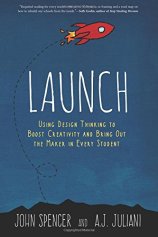
The first book in that stack was one that I had started reading prior to the end of the school year.  Launch: Using Design Thinking to Boost Creativity and Bring Out the Maker in Every Student by John Spencer and A.J. Juliani was so intriguing that I ended up putting together a PD session to share at Launching Inquiry.  Design Thinking is all about creating the conditions to allow students to use their curiosity to find things that they can make and share with a real audience.  Innovative activities like this will empower our students to find problems in their own world, and then seek out meaningful solutions – we can help to give them the tools.

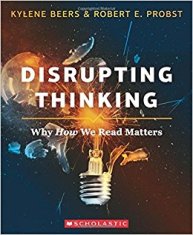
My second book this summer was Disrupting Thinking: Why How We Read Matters by Kylene Beers & Robert E. Probst.  In this book, the authors lay out a framework (called Book, Head, Heart) to help us all understand that there are multiple types of thinking going on when they are reading.  While it is important that kids know what’s happening inside of the book (able to summarize, notice what the author is doing, and understand the theme of the book) Beers & Probst also point out how important it is to recognize what you’re thinking about in your head, and how the book makes you feel.  Each piece is an important part of the interaction that takes place between a reader and the text.

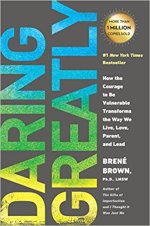
The third professional book, and one that I haven’t yet finished, is Daring Greatly by Brene’ Brown.  In this book, Brown pushes us to understand that vulnerability, or the willingness to put ourselves out there, is part of what brings meaning to our lives.  Without being vulnerable, and willing to dare to do great things, we risk not really living.  It’s scary to make ourselves vulnerable, but only through going out on that ledge can you accomplish great things.

I look forward to continuing my learning – it truly never stops.  As you think about what you did this summer, I’m curious – what did you learn about?  As educators, we’re all committed to being lifelong learners.  Sharing with others, including our students, is a great way to further our own learning.  Share below anything that you learned this summer!

When should we try something new?

How many of you are like me, you see something cool that someone else is doing and you think “I want to try that!”  You may be hearing about a cool activity that a colleague is doing, or it might be seeing something on one of your social media accounts that you think would be great for your classroom.

Sometimes, once we are “into” the school year, it can be tempting to see a cool idea and think “I’ll look at that in the summer.”  Maybe you even go so far as to save the idea as a bookmark, or send yourself an email to keep in a folder in your inbox.  I know that happens to me.  Then what happens?  If you’re anything like me, you might actually go back to that folder or bookmark, but all the context is gone, and you don’t remember why you were so excited about the idea.  Or even worse, you might forget to ever go back to the bookmark or folder!  Please tell me that I am not alone in this!

Earlier in the spring semester, I was participating in a massive open online course led by the author of The Innovator’s MindsetGeorge Couros.  I’ve mentioned it in the blog before.  Couros is all about innovation in education – he defines innovation as things that are new AND better for learning.  During one of the activities for the course, there was a conversation between Couros and a couple of his guest hosts.  The question came up – “When is it best to try things that are new?”  While many of us would feel the temptation to wait until our next group of students so that we can set up expectations and “get it right,” Couros and others encouraged a different mindset.  Think about your current students.  How excited are they when you switch things up?  Something as simple as a new seating arrangement can be the biggest deal to your class.  If a new seating arrangement has such an impact, how might a new and exciting teaching method go?  How much might that accelerate the learning in your classroom?

As an added bonus, you have the benefit of trying something new with a group of kids that you actually know.  Does this activity seem to motivate that kid that you’re always trying to pull along?  Maybe you have a winner of an idea that you want to continue to play with and tweak.  On the other hand, if your kids don’t seem that into it, you know that the idea might not be the best, and you can quickly shift gears back to something that you know will probably work better.

At this point in the year, with so many things going on, and the general stress that goes with the approach of the end of the year, it can be comforting to say “I’m just going to keep doing what I’m doing.”  But here’s the thing, as our student’s attention begins to wain – they see the sunshine and recognize the warm weather, they start thinking about their spring/summer activities that are getting started – it can be difficult to maintain that high level of engagement in the best of situations.  Some of us, without thinking about it, react to that by lowering the cognitive load of our students.  We think that slightly lower expectations may lead to higher engagement.  So, how’s that working for you?

I know that these were choices that I sometimes made when I was in the classroom.  An extra video clip instead of a more challenging activity.  Maybe a simplified version of an activity so that my students could just get through it.  I think back to those choices, and wonder how many of my students I may have short changed in the last few weeks of school.

Keep pushing yourself to look for the new and better activities.  Instead of lowering expectations for students to keep them engaged, throw in a new and exciting activity to amp up the learning in your classroom and hopefully lead to higher engagement for all your students!

What cool new things are you thinking about trying as the end of the year approaches?  What hesitations do you have for trying something new at this time of the year?  Share your thoughts in the comments below.

What’s your why?

The vast majority of the people reading this blog are in the educational realm.  Whether you are a teacher, a counselor, an administrator, or you work in a school in some other way, something called you here.  Take just a moment to think about it, what was it that brought you to this point?

For me, when I think about what brought me into education, there are a few moments in my lifetime that stand out.  I remember my fifth-grade teacher, Mrs. Gromer.  With her, the Maya Angelou quote to the right comes to mind.  There aren’t very many specific things I remember happening in her classroom, but I remember that I always felt welcome, and valued, and important.  I felt that if I wasn’t there, someone missed me, and some value was lost from the class.  While I had great teachers before her, and great teachers after, nobody ever made me feel as important in the classroom setting as Mrs. Gromer.

In high school, one of my stand out teachers was Señora Cease – she was my Spanish teacher for all three years that I took the class.  While I may not be fluent in Spanish today, I learned some valuable study skills that I don’t believe I would have learned anywhere else.  Learning a language came hard to me, and while some friends were valuable parts of my studying, her efforts and ideas in class gave me skills that translated to so many other areas.

Then I think about Professor Katz.  Easily the most entertaining professor that existed – I’ll put money on it.  He was a history professor at IU.  I had the luck of knowing him when I was young, which meant that when I walked into his class, I became an easy target of his.  In a lecture hall full of 400 students, he would find me no matter where I sat and ask my opinion.  While I am a fairly confident person now, I’m sure that term didn’t always describe me. On the first day of class he asked me a question, to which I responded in a noncommittal way.  His response “Are you asking me?  I was asking you.”  Professor Katz helped teach me to be confident in all that I do.  While many of the small groups were led by instructional assistants, I had the privilege of being in the group that Professor Katz led himself.  You had to know your stuff – there was no hiding from him.  In addition to confidence, Professor Katz taught me about preparation.

All of these pieces of my history in education are part of what I brought to my classroom.  I wanted to bring the warmth that Mrs. Gromer had – I wanted my students to know that they were valued and important in my classroom.  I would work to provide scaffolding to support students who were struggling, just as Señora Cease had done for me.  And I would challenge my students at times – push their thinking when I thought they were just giving me surface level knowledge – just as Professor Katz pushed me.

I’m sure there are other things that come from my history that led me to the role that I’m in now, but now, I have an even more important why.  I look at each of my kids.  They have such unique personalities.

Lainey is the quiet rule follower.  Last year she actually received a reminder from her teacher – just one – and she cried about it as soon as she walked in the house.  We still can’t talk about it for fear of another evening full of tears.  She’s also very intentional, to the point of perfection on some things, which causes her to work slowly and sometimes not complete her in class work or feel as though she is falling behind her peers.

On the other hand, there’s Brody.  He’s not in school yet, but he’s been going to preschool.  Brody’s curiosity is almost indescribable.  He’s constantly asking questions – Why? Why do they call it baseball?  What does that word mean?  Sometimes it’s almost exhausting to answer all the questions he has.  To go with that, he loves to play rough – there are a couple of times I thought he was going to take me out by the knees, and even though he’s grown up with a sister, and almost all the kids in the neighborhood around us are girls, he finds ways to get them to play rough as well.  I expect Brody to be a kid who will probably rush through things.  While on spring break last week, he was always asking what we were doing next, so excited to get on to that, that sometimes it seemed that he couldn’t enjoy what we were doing in the moment.

And I know that both Lainey and Brody will have challenges as they grow older.  School can be a difficult place for kids.  Lainey will have times that her perfection will cause her to fall behind others, while Brody will be so concerned about getting on to the next thing, that he’ll probably hand in a paper half completed with several mistakes.

I have hopes and dreams for these two.  I want the best for them.  And I know that if that is the way that I feel, then the parents who trust each of us with their children have similar types of hopes and dreams.  The faces that sit in our classrooms each day are their everything, and they want the best for their kids as well.

So while Mrs. Gromer, Señora Cease, and Professor Katz may be the past why that pushed me into education, and led me to be the teacher that I became, they aren’t the why that will push me moving forward.  The past isn’t going to push me to strive to go further.  The past isn’t what’s going to help me continue to learn and grow as an educator.  Instead, I rely on my kids to be the catalyst for that growth.  And each of the 1,000 kids who walk into our building each day becomes the fuel that keeps that learning and growth going.

So…  What’s your why?

Share your thoughts in the comments below.  I’d love to hear what it is that drives you to do what you do.  Education isn’t easy, and we all need that why to push us!

Building on our strengths

When you get up in the morning, what are you excited about?  For most of us, the thing that gets us going in the morning is also the thing that drives us throughout the day.  It’s also typically something that we feel confident about, that we think we do well, and we enjoy doing.  Most importantly, that thing is also something we would identify as a strength.

I feel that often in education, we get drawn into thinking about weaknesses.  As a teacher, we have to identify weaknesses in our students in order to find ways to support their growth.  As an administrator, evaluations often include identifying weaknesses of the staff in our building, and planning to lead to future growth.  We get caught in a cycle of looking for the weaknesses around us.  If our strengths are the things that motivate us, isn’t it safe to assume that our learners would be motivated by their strengths?

A few years ago, as an ongoing activity throughout our unit on Ancient Rome, I provided students with a list of possible ways they could articulate learning.  These choices involved aspects of Roman society and culture.  I was amazed by the projects that students were able to create based on their strengths.  I had students designing roman outfits based on research because they were interested in style and design.  I had a student write a children’s picture book about the Roman Empire because they felt they were good writers and illustrators.  And probably my favorite, I had a student, Patrick, who had struggled all year long but designed and built a scale model of a Roman Aqueduct that was SPECTACULAR (it’s still in my office today) because he liked to build things.  While we were doing in class activities for learning, students were also researching for these projects.  They were able to select a project that fit their strength, and the results were amazing.  Having students present something that they had learned that also fit with their strengths was such a rewarding experience for me, and I’m sure led to a greater transfer of learning for each of them.  I would guarantee that none of them would be able to answer any of the questions we had on a summative exam, however I would also bet they could tell you about what they created for that project.

Knowing how strengths can motivate all of us reminds me to be on the lookout for strengths as I am walking the halls.  I am challenging myself to look for the strengths or everyone, and recognize those strengths!  I challenge you to do the same.

Be thinking about the data that you collect on students.  Don’t just look for patterns in terms of weaknesses.  Also look at the data that supports their strengths.  Give them the opportunity to build upon those strengths.  Most of our students will choose a career path based on their interests and passions.  Wouldn’t school be a better place if we gave our students the opportunity to accentuate their strengths?  I’m not saying we ignore areas where a student needs to grow, but I can tell you that all the time that my sophomore English teacher had me spend diagraming sentences is not what has led me to be a good writer, a good reader, or any of the other skills I have developed.  All it did was make me hate sophomore year English (sorry English teachers!).

Take a few moments in the coming days to seek out the positives in the students that are in your classroom.  Identify the things you see, and share it with your students.  See how they react to some strength-based feedback.

#IMMOOC #IMMOOCB1: A culture of yes!

So we say we want innovation in our schools, in our classrooms.  Many of us feel that this is the best way to get our students past the point of engagement, and moving to the level of empowerment.  But there is one little word that can kill that process – no.

In the past couple of years, we have had many opportunities to interview potential teachers.  Every time we bring an interview team together, we all agree that we are looking for people who are “go-getters” – people who will do whatever it takes to make the learning experiences for their students new and exciting.  They have helped to bring exciting new learning opportunities into our school.  At the same time, many of the teachers in our building continue to learn and evolve – trying new formats of teaching, new activities, new technologies.  This innovation continues to spread, and is so exciting to watch!

If you know much about improvisational comedy, you know that during a scene the key is to not say no.  The mindset has to be to have an attitude of “yes, and…”  This is what we’re seeking for innovation.  When there are new and exciting ideas that will make learning better for students, I strive to say “yes, and…”

My hope is that this culture of yes will allow us all to continue to learn and grow.  Ultimately, our growth will allow us to make learning more innovative for every student!  Isn’t that the goal?

#IMMOOC Week 1: The Power of Ice Cream

This week is the beginning of The Innovator’s Mindset Massive Open Online Course.  For the next five weeks, I look forward to the opportunity to reread a great book and interact with educators during the weekly YouTube Live sessions as well as the Twitter chats!  I love this format of PD, and look forward to creating new connections and growing my Personal Learning Network!  If this sounds like something you would be interested in, you can still sign up here: IMMOOC

curiousAs I was reading the introduction to The Innovator’s Mindset this week, there was one line that really stood out to me: “if students leave school less curious than when they started, we have failed them.”  Given the meaningfulness of that line, I was so glad that became a major topic during the YouTube Live event on Monday evening.  During this session, AJ Juliani talked about a self-audit based on 4 questions, and I felt that these questions could really help us think about what we do in the classroom that might encourage students to “play” school and take away some of their self-agency and curiosity.

  • What do I allow for in my classroom/school?
  • What do I make time for in my classroom/school?
  • What do I support in my classroom/school?
  • What do I praise, assess, look for in my classroom/school?

What intrigued me the most about these questions is that students who play school well get there not because of their own desires.  Instead they get there due to the things that the adults in their lives (both educators and family members) value.  Watch kids of any age, and you will see curiosity – whether it’s on the playground, with their friends, or while playing a video game, our students our naturally curious.  But for many, when we put them into a classroom and ask them what makes them curious, the response is “I don’t know.”  If this is happening in your class, then your students are probably well trained to play school.

If we want our students to create, we have to model creativity (or at least a willingness to try).  If we want our students to be problem finders and solvers, that spark has to be modeled through our actions.  All of us have our interests and desires.  A lot of us keep those interests and desires separate from what is happening in our classrooms.  If we want to ignite the fire of curiosity in our students, we need to show them that their interests matter.

Recently in our school building, a student noticed that our cafeteria never served ice cream at lunch.  She knew from talking with friends at other intermediate schools that ours was the only one in the school district that did not ever serve ice cream as part of the school lunch.  Instead of just complaining about it, or even accepting that’s just the way it is, she went into action.  She did research.  She got friends and classmates involved.  She met with our school’s cafeteria manager to understand why we didn’t serve ice cream.  She met with our district facilities manager to learn about options to make ice cream a possibility at our school.  She got the student council on board to do a fundraiser.  All of this started last year with the question of why.

The Creamsicle may not be the fanciest of all ice cream treats, but it was a huge step forward in a school that had not served ice cream at lunch ever before! The Creamsicle may not be the fanciest of all ice cream treats, but it was a huge step forward in a school that had not served ice cream at lunch ever before!

Last Friday at lunch, our school served ice cream for the first time.

I would argue that the learning that happened for this student, and her classmates who were part of this work, was some of the most meaningful learning in the past year.  All of this happened because the adults around this student saw the curiosity and the drive that this student had – for ice cream – and they let her run with it.

What are the ice cream moments that are happening in your classroom?  In your school?  How are you helping to ignite that curiosity?  What are the ice cream moments for you?  Are you modeling that curiosity with your students?  As the leaders of our classrooms and schools, we have the ability to choose a course for our students that inspires them, or we can choose a course that creates students who “play” school well.  Which course do you choose?

I’d love to hear your thoughts in the comments below.  Keep the conversation about innovation in learning going here, or hit me up on Twitter @brian_behrman.