A walk in the woods

One of the things that I love about our school is the wonderful outdoor areas that we have on our property. From the simplicity of the outdoor amphitheater that could be an awesome place to take your class to change up the learning environment, to the trails, river, and prairie area we have just a short walk from the doors of our building. Last Friday, I had the opportunity to attend Ditch that Conference at Turkey Run State Park with several of the teachers in our building. This conference was put on by Matt Miller, the author of Ditch that Textbook and co-author of Ditch that Homework. One of the ongoing themes of the conference was “An Analog Conference in a Digital World.” This is the first conference I have ever attended that actually told us in advance not to bring digital devices. I left my computer and iPad at home, and took along my journal (little did I know that I wouldn’t even need mine, because when we checked in we got an awesome Ditch That Textbook journal!).

Ditch Journal
This is the front cover of the cool journal that every attendee who was at the conference received!


There were so many awesome things that I could share with you, but I just wanted to talk about one idea in particular. During one of the sessions, Jed Dearybury took us on a walk on the “Art”side! At the very beginning of the session, Jed had us all pick a leaf from along the trail. We were told that while we were walking, we should be thinking about a story involving the leaf. The reality is that you could have kids pick anything that you want (or you could even allow them to pick whatever they wanted to carry with them). Jed shared that if he was doing this activity, he would encourage students to jot down as many details as they could while they were walking – things they saw, things they heard, etc. Then, when they return to class, students would write a story about their leaf. They would use as many of the details they wrote down to include in their story.

There are some variations you could do with this activity as well:

  • Working on persuasion? Have the student’s object be trying to convince you of something.
  • Social studies? Tell students they need to set the story in the context of the unit you are currently studying.
  • Science? Have the story tie into the biome that students have been studying.
  • Math? Can we figure out a way to find the area of the leaf we picked? What about the volume of a walnut on the ground?
  • Collaboration? Have two students partner up and create a shared story involving both the objects they selected.

These are just a couple of ideas I came up with in just a few minutes of brainstorming. With as many smart and talented people as we have in this building, there could be a multitude of others that never yet crossed my mind!

In our 50 minutes together, Jed shared 2 other awesome ideas that could easily be integrated into activities for any classroom. Want to know about them? Ask me and I’ll share – I don’t want this post to get too long!

I walked away from this short session wanting to encourage you, once again, to find as many ways as you can think of to get your kids outside of the concrete box that is the typical classroom. So many of our kids don’t get the opportunity to spend much time in nature – seeing what happens in the woods, listening to the sounds of nature, and learning from those experiences. Make use of our beautiful campus and great outdoor spaces!

Do you have any ideas for variations on the leaf activity above? Share your thoughts in the comments below!

Childhood trauma – part 2

Last week I encouraged you to watch the TED Talk by Nadine Burke Harris titled “How childhood trauma affects health across a lifetime.”  If you missed it and still would like to watch it, click here.  Even if you didn’t watch the talk, hopefully there will be information in today’s post that will help you understand: 1) the impact of trauma on children; 2) that childhood trauma can affect any community; and 3) a few ways to be able to impact the lives of students and their families to improve outcomes.

Childhood trauma: it affects brain development, the immune system, hormonal systems, and the way our DNA is read and transcribed. It leads to increased risk of heart disease and lung cancer, and can cause a 20-year difference in life expectancy.  Even with all these factors, many doctors are not prepared to be able to identify childhood trauma, and even fewer have the tools necessary to treat these issues.

Trauma

Many physicians, especially those that work in public health, are trained to try to identify root causes of an illness.  When 50 people from the same neighborhood begin exhibiting the same symptoms, doctors are not only going to treat the patients, they are also going to look at what’s going on in that neighborhood.

Dr. Harris began to notice a pattern in many of her patients that she couldn’t initially put her finger on.  She was having kids referred to her for ADHD, but she could not make that diagnosis.  As she got to know more of these patients, the pattern that she found in many was that they had experienced some form of severe trauma.

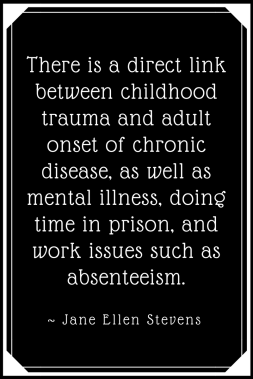
There is a direct link between childhood trauma and adult onset of chronic disease, as well as mental illness, doing time in prison, and work issues, such as absenteeism.Eventually, Dr. Harris learned from a colleague of a study called the Adverse Childhood Experiences Study (ACEs Study).  This ongoing study is a collaboration of Kaiser Permanente and the Centers for Disease Control and Prevention.  I believe that every educator needs to be aware of the ACEs Study.  The study shows a correlation between ACEs that occurred prior to reaching the age of 18 and many health and social problems as an adult.  Here are some basic stats from the ACEs Study:

  • 17,300 adults were part of the original study
  • 70% were Caucasian
  • 70% were college educated
  • All participants have/had livable wages and health insurance
  • All were middle class or affluent

While there were many forms of trauma that the participants in the study had been through, the study identified the top 10 ACEs.  They are:

  1. Sexual Abuse
  2. Physical Abuse
  3. Emotional Abuse
  4. Physical Neglect
  5. Emotional Neglect
  6. Loss of a Parent
  7. Witnessing Family Violence
  8. Incarceration of a Family Member
  9. Having a Mentally Ill, Depressed, or Suicidal Family Member
  10. Living with a Drug Addicted or Alcoholic Family Member

ACEs scores are determined by 1 point per each of the ACEs listed above.  A couple things to be aware of about ACE scores: first, they are extremely common.  67% of the population had at least one ACE, and 12.6% had 4 or more ACEs.  Second, the higher the ACEs score, the worse the potential health outcomes.

ACEs can also have an impact on student success.  In one Washington State University study, students who had at least 3 ACEs were 3 times likelier to experience academic failure.  They are 5 times likelier to have attendance issues.  And they are 6 times as likely to exhibit behavioral problems.

Sunset chaserWhy does this happen?  For the normally developed brain, when it encounters a stressful situation the adrenal gland kicks in and releases adrenaline and cortisol, which gets the body ready for fight, flight, or freeze.  For a child living in trauma, those adrenal glands are constantly being triggered, which causes their brain to have bottom up control, and prevents the upper part of the brain (those that control reasoning, self-control, learning, and understanding), from being able to take control.  And what are the triggers for our trauma students?  You may never know.  It could be walking into their home, it could be a loud voice, it could be a simple as a facial expression.  These triggers are so frequent that the trauma brain is constantly in fight, flight, or freeze mode.

One of the things that we all know is that being an educator can be a very emotional task.  You become connected to your students, you want the best of them, and no matter how hard we try, there are times that they become frustrated.  These frustrations may manifest themselves in many different ways.  We have to be able to help our students to calm their brains and return to top-down control.  Punishments and logic will not work for a dysregulated student.  Instead, our students need relationships, connections, and acceptance.  When we are able to stay calm when our students are not, we may be able to help get our students back to calm.  Remember, when a student is struggling, it is not about us, and we can’t take it personally.

Your presence is the most precious gift you can give another human being.In their book The Trauma-Informed School, Jim Sporleder and Heather T. Forbes identified a few strategies that we can all use to interact with students (and I would suggest that these strategies work for all kids, not just those who have been through trauma).  Here’s a few of them:
  • Respond instead of react – ask yourself “am I responding to this student as a person or am I reacting to his behavior?”
  • Give emotional space – allow the student to be upset, and be there to support the student when they are once again regulated.
  • Ask the right questions – What’s driving the behavior? What can I do to improve my relationship with this student?
  • Statements that show support – What do you need from me right now that takes care of you and allows me to continue teaching?
  • Choose your battles – sometimes it’s best to just get your class going on something, then quietly approach the student to check in.
  • Keep yourself regulated – drop your personal mirror and seek the cause to the problem that is happening in front of you.

No two situations are going to be identical.  No two kids are going to react in the same way.  What works today might not work tomorrow, but simply being aware of what’s going on in the brains of our students, and some possible strategies for when a student becomes dysregulated will help all of us to be able to better meet the needs of our kids.

What strategies have been successful for you?  Are there things that you have done in the past with kids that aren’t included here?  Share your thoughts in the comments below so that we can all spread our knowledge.

What is school for?

Put yourself back in one of your childhood classrooms – at the beginning of the day what was it that your teacher always said?  If it’s anything like my childhood experience, it was something like “Good morning class.” Then what would happen?  The whole class would respond “Good morning…”  And what happened if you weren’t loud enough, or respectful enough?

I think we all have lived that situation – and I may even have been guilty of fulfilling the teacher role (as recently as the first day of school… THIS YEAR!!!).  But here’s the question, what are we teaching with that call and response open to the day?  It’s mostly about teaching obedience.  Traditionally, the common school was built to prepare children to become the factory workers of the future.  Implicitly, and sometimes explicitly, schools taught students to be obedient, to hold a little back, to do the work assigned and nothing more.

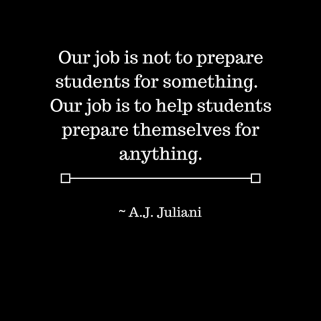
Our job is not to prepare students for something. Our job is to help students prepare themselves for anything.So that brings us to the bigger question: What is school for?  While some of our students may consider a role in manufacturing, the factories of today are way different than the ones of the early to mid 1900s that led to this factory model of education.  Many of our students will not be heading down the path of manufacturing, so that factory model of school definitely doesn’t apply.  If you believe that innovation is going to keep happening (and why wouldn’t it?), then we’re preparing our students for an ever changing world!  That is so different from the traditional model of school as a factory.  In an excellent TED Talk by Seth Godin, he gives 8 examples of things school should be doing:

  1. Homework during the day, lectures at night – flipped learning
  2. Open note and open book all the time – if it’s important enough to memorize, it’s also ok to have to look it up
  3. Access – any course at any time – programs like Kahn or MOOCs can achieve this
  4. Precise focused education – not a one size fits all model
  5. No multiple choice – life isn’t multiple choice
  6. Experiences instead of test scores – learning is focused on the experiences that take place inside (and outside) of our classroom
  7. End of compliance as an outcome – while compliance may be needed at times, it shouldn’t be our end goal
  8. Cooperation instead of isolation – the ability to work with others

I could go into more detail on each of these, but I can’t do any better than what Godin did in his talk, so if you’d like to know more about any of these things, check out that TED Talk here.

So here’s my answer to the question “What is school for?”: I want our students to be equipped to go out into the world and make something that has an impact on their lives and the lives of others.  And I want them to know that if they get stuck, to ask for help and support.  While we might not always have all the answers, hopefully we can help our student to find the answers.

I’m curious to hear your answers – for you, what is school for?  Share your thoughts in the comments below!

Childhood trauma

Last weekend I was listening to the most recent episode of the TED Radio Hour, a radio show that is based on a common theme, and then embeds portions of TED Talks, as well as interviews with the people who gave those talks around that central theme.  The episode I was listening was titled “Hardwired” (click here if you’d like to listen to the episode), which was looking at how human behavior is based on both our genetics, as well as our experiences in life.

One of the speakers who is included in this episode is Nadine Burke Harris, a pediatrician in San Francisco.  After listening to her portion of the radio show, I had to watch her full TED Talk.  In her talk “How childhood trauma affects health across a lifetime” she talks about the unbelievable impact that trauma can have on childhood brains, as well as the long term health impacts of those who have lived through trauma.

Many of us are tempted to say “that doesn’t happen here.”  I challenged you to watch the TED Talk and think a little more critically about what Harris has to say about trauma.  This does happen here.  There are students who walk into our school every day who have faced adversity that has an impact on their brain development.  Next week, I’ll follow up with a little more of my thoughts on trauma in kids, but I hope you will find the time to watch this excellent TED Talk.

5 questions

Inquiry

Student voice, student choice, relevancy, collaboration, intellectual risk-taking.  All these phrases should sound familiar as they come from the HSE21 Best Practice Model.  While these are all things that we strive for, sometimes we might wonder how we help our students understand that this is what we’re going for.

I recently saw an article from the Harvard Business Review about questions that businesses should ask their employees.  Based on a 2016 study by Deloitte, people feel loyalty to companies that support their own career and life ambitions.  Wouldn’t it be fair to say that our students are likely to feel the same way (more interested in learning when they feel that the learning is valuable to them)?

With that, imagine the empowerment our students would feel if we not only ask these questions, but actually use their answers to guide the learning that’s taking place in our classrooms!  Here are the questions:

  1. What are you good at doing? What school activities take less effort? What do you do first because you know it will be easy? What things do others notice as strengths for you? These questions will help students to identify their strengths and find possibilities to grow those strengths.
  2. What do you enjoy? What are the things at school that you most look forward to? What things give you extra energy when you know they were coming up? If you could design your own school day with no restrictions, what would you spend your time learning? These questions help students find, or remember, what they love about school.
  3. What feels most useful? What about school makes you feel most proud? What do you do that is critical to the success of others? What are your highest priorities for your life, and how does school fit in? These questions will highlight the inherent value of certain activities.
  4. What creates a sense of forward momentum? What are you learning that you’ll use in the future? What do you envision for your future? How’s your work today getting you closer to what you want for yourself? This line of questioning will help students think about how the things they are doing now will help them achieve their goals.
  5. How do you relate to others? What kind of work partnerships are best for you? How does your work at school enhance your connections with others outside of school? This will help our students see the value in meaningful relationships.

Helping our students to identify their purpose for learning will help them feel more connected in the classroom, and to see the value that comes from their learning.

Using outdoor spaces

Today I was reading a recent blog post by John Spencer about the ways that nature helps us to be more creative (check it out here).  Personally I love to be out in nature, so the post really caught my attention.  The gist of the post was about the fact that time in nature can lead us to greater levels of creativity.  His 5 ways that nature makes us more creative are listed in bold below, with my own thoughts added:

  1. Nature creates positive disruptions – Life draws us into the natural hustle and bustle of our world. Being in nature helps us get away from technology, current events, and everything else that makes it hard for our brain to stay focused.  That time away from all those distractions allows our brains to think more deeply.
  2. Nature encourages problem-solving – Almost every time I go for a hike, or spend some time in nature, I’m inspired to write a new blog post, or solve a problem, or be creative.
  3. Nature helps us embrace deep work – When do you do your best thinking? There is a lot of research that says that simply being active can lead to deeper thinking.  Simply going for a walk helps us activate our brain in different ways.  According to some research, throw nature into the mix and you multiply that effect.  So what does that mean for you?  Before teaching a particularly important skill, take your class for a walk in the woods outside of school.  Your students brains will be better prepared for deeper thinking when you return.
  4. Nature humbles us while also expanding our worldview – I’m not sure how many of you know this about me, but I was a 10 year 4-H member. I didn’t show animals (we weren’t on the farm), but I did lots of other projects over the years.  One of the projects I did required me to take multiple observations of a natural environment every day over multiple weeks.  I chose a small wooded area with a trail just a little over a mile from my home.  I had to observe at different times in the day, and I began to notice changes in what seemed like an untouched environment.  Some animals were more or less active at certain times of the day, some plants looked different depending on various factors.  The time I have spent in the natural world helps me realize that there are so many things happening in the world around us that we miss when we are in our cars, or on our devices.  Sometimes you really do have to slow down, look around, and smell the flowers in order to be aware of what’s happening in our world, and to realize how little control we have over so much of what’s around us.
  5. Nature can spark innovation – Did you know that Velcro was designed by a Swiss engineer after his dog was covered in burdock burrs after going on a hike? Or that the design of the nose of Japanese high-speed trains was meant to mimic the beak of a kingfisher?  These are just a couple of examples of innovations that came about because of things that people noticed in nature.  Imagine what the future scientists of the world (our students) may be able to develop if they learn to look to nature for ideas and solutions to our problems.

Reading Spencer’s post got me thinking about the natural wonders just waiting to be explored outside of our school.  By walking out the doors of our building, you can access a variety of outdoor environments.  Between the trails in the wooded areas, the stream running through the woods, the untended plain near the baseball fields, or the river, there are so many ways for us to access nature.  And the benefit doesn’t just stop with the kids being out in nature away from their devices.  Something they see while they are with you may inspire creativity and wonder in a way that is totally unexpected.

What have you done with your class in our outdoor areas?  Have you seen increased levels of creativity as a result of the time you have spent outside?  Share your thoughts in the comments below.

Gentle pushback

How do you spend the beginning of the school year?  What types of activities are you using in your classroom?  Keep in mind that the expectations that you set in the first few weeks will carry throughout the year.

So often at the beginning of the year, we spend lots of time on relationship building.  Those of you who know me will know that relationships are a key part to success (see previous posts here, here, and here).  Relationships alone aren’t enough though (I have a bigger post on this topic coming soon).

Part of what got me thinking about this was a series of tweets from Rick Wormeli – I happened to be on Twitter last Saturday evening, and he had a string of tweets on this topic.  He focused on the first week of school – we’re past that already in my school corporation – but I think that his sentiment can carry over to the first month of school.

What things have you tried for the beginning of the year to push your students in intellectual, academic, or creative ways?  What do you think about Wormeli’s thoughts?  Do you have different opinions?  Share your thoughts in the comments below.

Solar eclipse memories

This is my sister and I – probably summer of 1985, just to give a frame of reference!

As we build up to Monday’s solar eclipse, I was thinking back to the only other solar eclipse that I recall seeing.  The date was May 30th, 1984. That May was the beginning of my last summer before I became a “school kid.”  I would be starting kindergarten that fall.  My mom ran an in-home daycare, which was great because that meant I had friends to play with every day.  She had been collecting shoe boxes for a few weeks leading up to the eclipse, and on the day before the eclipse we turned them into pinhole cameras. (One fun fact for all of you who are at RSI – Dave Bradley was one of the kids that was at the daycare on the day of the eclipse).

http://www.mreclipse.com/SEphoto/SEgallery1/image/A1984Mosaic.JPG

While I don’t remember exactly what the sky looked like that day, I remember that there was a lot of excitement about the event.  I also remember that there wasn’t a lot of talk about NASA approved sunglasses (maybe there was and I was too young to know about it).  That day my mom reminded all the kids not to look at the sun, we took out pinhole cameras outside, and we watched the eclipse.  I do remember that the big trees in our backyard were making it hard to see, so Dave and I moved to the backyard behind mine, and we had a much better view.

As many of you know, when I was still a classroom teacher, my favorite subject to teach was science, and my favorite unit was always space science.  I think that my experience with the solar eclipse set me up with curiosity about outer space.  As a kid I loved watching shuttle launches.  I remember crying when the Challenger disaster happened.  I had the chance to go to space camp during my first year as a teacher.  Even today, I can get sucked into a livestream of a SpaceX launch or landing and not be able to turn away.

http://www.history.com/topics/challenger-disaster

I know that there are some who are concerned about safety for our students, but I would hope you seriously consider finding a way to give your students an opportunity to see the eclipse.  My experiences that day have helped lead to the things I am still curious about today, and for our kids it could be such a great provocation to lead into student wonder.  Who knows, a future space scientist, astronaut, or science teacher could be sitting in your classroom!  If you have something cool planned for the solar eclipse, share with us in the comments below!

We can all be better

Nobody’s perfect.  There’s a reason why Steph Curry does shooting practice daily.  There’s a reason why Navy Seals drill with their team on a regular basis.  There’s a reason why the best authors have a daily writing routine.

What they all have in common is that they understand that the best way to get better is through practice combined with reflection.  This practice will help them learn, it will help them grow, and it helps them get better at their craft.

PLCs are one of the ways that teachers can get better.  We look at our student data, reflect on our practices, and identify strategies that can help us to be better than we already are.

Everyone at the top understands that to become the best, or remain the best, you have to be willing to work for it.  Bring the mindset that we can all be better every opportunity you get, and we will all learn and grow together!

One key to student success

With it being the beginning of the school year, many of us have been spending countless hours getting ready for our students.  We made sure our classrooms look just right, we made sure to pick the perfect activities for our students to get to know each other (and for us to get to know them).  Before the first day I’m sure you were all just as excited as I was thinking about this school year.

One thing that many of us think about during the summer time is how to help our students to be successful.  For those of us in education, that is something that we all want for our students.  I’ve read many philosophies of education, written by lots of great teachers, and all of them say something about helping our students to be successful.  So what needs to happen in order to help our students be successful?

As I was thinking about this question earlier this week, I found myself drawn back to a book that I read a while back – What Every Middle School Teacher Should Know by Dave Brown and Trudy Knowles.  I know I’ve mentioned this book in previous posts – if you haven’t yet, it’s definitely worth the read!

In order to create cognitive growth for our students, they have to be willing to take risks in their own learning.  They have to be willing to try things that they’ve never done.  They have to be willing to fail from time to time.  Failure leads to growth for all of us!

The problem is, failure is scary.  How many of us have not tried something because we were worried we wouldn’t be able to do it?  During my high school years in Bloomington we would hang out at the Indiana University outdoor pool.  If you’ve never been there, one thing you should know is that there are multiple diving boards, including a platform.  I had a couple of friends who were divers, and they made it look so easy to go off the 3-meter springboard, or any one of the platforms.  I on the other hand, while being a strong swimmer, was scared to death to jump off that top platform.  Multiple trips to the pool, and many times watching others go for it, and I just couldn’t bring myself to do it.  Finally one of my buddies got me to go up the platform with him – “don’t worry, if you don’t want to jump, you can go back down.”  Once I got to the top, he jumped right off.  I was next in line, I turned around and there was a line behind me.  I didn’t want to walk past all of them, so I walked up to the end of the platform, looked over the edge, thought about it for a moment or two, and went for it.  What a rush it was to take that jump!  My fear had held me back and prevented me from a fun experience.

For some of our students, the fear that I felt about jumping off that platform is what they feel about reading aloud, or writing a story.  Maybe a teacher has told them that math isn’t their strong suit, so they don’t want to solve a problem for the class.  We expect our students to come to school for 180 days to do something that feels risky.  How many adults would do something risky every day?  A lot of us might just give up.  For the kids who feel this level of fear about their academics, they may say to themselves “If I’m not good at it, why even try.  I don’t want to embarrass myself.”

These students need our encouragement and support to build enough confidence to take risks.  That comes back to our classroom culture – the expectations we set about how students treat each other, as well as the things we (the adults in the room) say in the classroom.  Kids need to feel safe enough to be able to take risks.  Brown and Knowles share the following list of things students need to feel academic safety:

  • No one laughs at them when they attempt to ask or answer questions
  • Teachers establish realistic academic expectations and outcomes for every student
  • Students’ efforts are recognized, as well as the products of those efforts
  • Teachers eliminate competitive situations that create inequity among students
  • Teachers develop cooperative grouping strategies that encourage students to collaborate in their learning and share their knowledge and expertise with one another
  • Teachers play the role of learning facilitator to encourage student independence
  • Teachers choose alternative instructional strategies to meet each student’s learning style
  • Teachers recognize and appreciate talents other than academic skills

This list is not meant to be the end all be all solution for all our students, but it provides some ideas that we can reflect on in our planning and preparation to make sure that our students will feel safe in our classroom.  They need that safety to take risks, and they have to take risks to grow.

What steps do you plan to take in your classroom to make sure that all of your students feel comfortable to take risks in your classroom?  How can you model your willingness to take risks in your own learning and growth?  Share your thoughts in the comments below.