The bear trap analogy

Today I was sitting with a student who had a rough start to the day.  He had gotten himself into some trouble because of a poor choice he made in class.  We were talking about what happened, and instead of talking about the incident today, the student started sharing with me about an argument he had with his dad yesterday.  It was almost lunch time and this student’s frustration was not with anything that happened today.  It was an eye opener to me – here’s a kid who had been in our building for almost 3 hours.  He was angry about something that happened yesterday, but he hadn’t had a chance to process those feelings with anyone.

As we started talking about what happened over the weekend and how it related to his incident in class, this student came up with a brilliant analogy.  He shared a story about a picnic, and I’m going to try to recreate it here:

Imagine going on a picnic, you have your lunch set up, and then you realize that you left something you needed in the car.  You walk back to the car to get what you need, and when you return there’s a bear eating your picnic lunch.

So maybe the next time you go on a picnic, you set a bear trap to keep the bear away, but while you’re busy watching for the bear, a bird sneaks up, and tries to takes some of the food, but the bear trap chomps down on the bird.

Somet
Sometimes the bear isn’t really here at school.

The student shared with me that in this analogy, the picnic lunch represents the student’s peace of mind.  The bear represents the true thing that the student was truly upset about, for this student it was the anger about yesterday’s argument.  The bear trap represents the student’s anger – for this kiddo it’s set and ready to go off at any time.  The bird can represent that thing that happens here at school that sets off an angry student – it could be another student, it could be something a teacher says, it could be the bus driver, etc.

More often than not, the students who walk in with their bear trap set are not actually on edge because of things that are going on here at school.  Even though this student “went off” here at school, his bear wasn’t in this building.  Instead a bird managed to set him off.

None of us are able to read our students minds, so we can’t always know who it is that is walking around with anger bottled up inside, however we all know who it is in our class that often seems to be the one who does lose their temper.  These are the students that we need to be aware of at all times.  Make it a point to check in with your students who might be that bear trap just waiting to go off.  It seems like more often than not, these students who reach their breaking point do so right before or after a break – sometimes even just the break of a weekend.  It also seems that for most of these students, once they have a chance to talk, a chance to process, they are much more likely to hold it together for the rest of the day (or sometimes even longer).

If you have a student like this in your homeroom, seek them out, check in, build relationships, let them know that you care, and make sure that they know you are there for them.  If you aren’t able to connect with that kiddo, maybe there’s someone else who can – a teammate, another teacher, a counselor, or someone in the office.  We want these kiddos to feel like they have a trusted adult and a connection here at school.  If you find a student who seems to be ready to lose it, talk with them.  See if you can figure out what’s wrong, if they don’t want to talk to you, see if they would like to talk with that other trusted adult.  Keep looking for ways to support the struggling student.  Through these steps, you might be able to help protect the birds who happen to be in the wrong place at the wrong time.

Have you ever had one of those moments with a student?  They are really upset about something beyond our control, but they reach their breaking point in your room.  What has worked well?  What hasn’t worked so well?  Share your experiences in the comments below.

Civil discourse

It’s a fact that we cannot control what happens every moment of our student’s lives.  We can’t prevent poor choices in the hallway, unkind statements in the lunchroom, or hurtful words on the bus.  However, we can try to right the ship in our own classrooms.

As a member of our building’s diversity team, this message came through loud and clear during a presentation at our most recent Diversity Coaches Meeting.  During this meeting, we spent an hour with Janet Chandler discussing the concept of Civil Discourse.  During the most recent presidential election cycle we saw endless attacks from various candidates, and many were not living up to the decorum that we might hope for from our elected officials.  The facts are that this type of climate has been in existence for a much longer period of time than just the past couple of years.

“A supporter of Thomas Jefferson once called John Adams “a hideously hermaphroditical character.”  Former Treasury secretary Alexander Hamilton called Vice President Aaron Burr “bankrupt by redemption except by the plunder of his country,” an attack so heinous that the men dueled, and Hamilton died.

Go through the nation’s history, and the noise and heat in public political discourse have always been there, rising with the cycles of economic distress, immigration and cultural upheaval.” – Ann Gerhart (The Washington Post, In Today’s Viral World, Who Keeps a Civil Tounge?, October 11, 2009).

Although uncivil discourse has been a part of our history, with today’s world of 24-hour news, social media, and technology, the noise of the less than civil statements seems to be nonstop.  So what are we to do when that spills over into our classroom?  Here are some tips that I took away from our conversation last week, as well as a link to a great resource from Teaching Tolerance (the link will be at the bottom of this post).  These tips are in no particular order, but hopefully will provide you with some ideas about how to handle discussions that may be a little difficult within your classroom.

If not us, who?

maslows-hierarchy-of-needsIt would be easy to say that these conversations on civil discourse are not our responsibility, but the fact is, there are uncivil things being said in our school building.  We simply cannot have the attitude of “it’s not my problem.”  When we become aware of issues, we have a responsibility to step in.  I can’t recall, nor can I find, where I first heard this, but the quote “we’ve got to take care of the Maslow stuff before you can ever hope to get to the Blooms stuff” comes to mind.  Our students can’t learn without their basic needs being met!

Set the example, not just the expectations!

It’s easy to talk about expectations.  We can say again and again what we expect.  But if, even once, we slip up, some of our students may follow our lead on this.  In a civil discussion we use titles: Mister, Misses, or Miss; President; Senator; Representative, etc.  If we refer to people without those terms, we diminish their role.  Just looking at my Facebook feed in the past couple of weeks, there have been a lot of people who aren’t using titles.  I’ve had people tell me that they won’t use certain titles because of a lack of respect in a person.  Isn’t that part of the issue here?  If you then read through Facebook comments on political posts, you see less than civil statements being made.  When you use a title, you add a level of civility and respect.  By modeling civility in your classroom discussions, you will help your students understand what that looks and sounds like.  Remember – kids act in a way they they see the adults in their lives behaving.  Modeling civil discourse will help lead to more civil conversations in the hallways.

Facts vs. Alternative Facts

I’ve referred to social media a couple of times, and I’m going to do so once again.  No matter your political beliefs, your party affiliation, etc., I think that any of us who have been on Facebook can agree that there are some outrageous statements being made.  The phrase fake news and alternative facts has become something of a joke.  Earlier this school year I posted a blog titled “Finding the author’s purpose” (if you want to go back to it, click here: http://wp.me/p6BRrr-6J).  In this post, I reminded you of the definition of nonfiction that Beers & Probst used in their book Reading Nonfiction:

“Nonfiction is that body of work in which the author purports to tell us about the real world, a real experience, a real person, an idea, or a belief.” (emphasis added)

In that post, I went on to encourage you to teach our students to have a questioning stance when reading nonfiction.  Every author has a purpose in what they have written – sometimes that purpose is not simply to inform.  Facts can be twisted and manipulated to support either side of the political spectrum, and social media is one of the most likely places to see this play out.  More often than not, the articles with the most extreme language seem to be coming from sites that are extremely liberal or conservative, or from sites you’ve never heard of before.

One important piece of a civil discussion is that it has to be based in fact (I could probably do a full post on the definition of the word fact…).  If you are having a civil discussion and someone shares a “fact” that is truly extreme, or is something that is not agreed on by most in the class, it’s time to talk about the idea of triangulating sources – can we find that fact from more than one source?  Do most people agree on this fact?  These conversations are so important because as Beers & Probst remind us that there is a greater purpose to teaching our kids the nonfiction signposts:

“Far more important than the ability to capture a teacher’s information and thoughts is the ability to acquire information on ones’ own, to test ideas against one another, and to decide for one’s self what notions have merit and which should be rejected or abandoned.”

If you read through the Teaching Tolerance link at the bottom, you’ll find a whole section on the three parts of an argument.  Here’s a quick breakdown:

  1. Assertion – The simple statement that is the basis or main point of the argument.
  2. Reasoning – This is the because part of an argument.
  3. Evidence – This is where you truly back your argument.  This may include statements from experts, statistics, data, or other research that supports you assertion and reasoning.

If you’re trying to have a civil conversation, encourage your students to include all three of these parts of an argument.  If you’d like more info on this, it can be found in Teaching Tolerance link below.

Respect

Probably the most important reason to work with our students on the concept of civil discourse is simply the idea of respect.  We are all entitled to our opinions, and we are all allowed to disagree with one another, but we have to make sure that these conversations are happening respectfully.  Our students need help to learn that it’s okay to agree to disagree.  Again, we can’t control what happens everywhere for our students, but we can do our best to make things right once they come in to our classrooms.

What experiences have you had in working with your students on civil discourse?  What has worked well?  What hasn’t?  Does the idea of having conversations like this in the classroom simply freak you out?  Share your thoughts in the comments below.  We can all learn from one another!

http://www.tolerance.org/publication/civil-discourse-classroom

This class just can’t handle it…

When I was in high school, I remember taking a physics class – I believe it was my sophomore year.  At my high school, physics classes were taught in the wing that had once been the area for “shop” classes.  My physics classroom was this huge open space.  One side had a large garage door that once allowed cars to come into the building for students to be able to learn how to work on them. By the time I was in high school, the “shop” classes had been shifted to the Hoosier Hills Career Center across town, and the shop classrooms had been converted for other uses.  On any given day, I would walk into this classroom, and around the outside of the class I would see various experiments in process.  There were large lab tables – at one point there were lasers on every table that were being used to make holograms.  Another time there were these air rails that were angled and allowed people to measure velocity and acceleration based on the time it took an object to travel across the rail.  In one corner, there was Newton’s Cradle built out of cable and bowling balls and hanging from the rafters high up in the room.  I could go on…largest-newtons-cradle2-500x334

As a sophomore, I would walk in and see these awesome experiments that would pique my curiosity.  I made it a point to arrive to physics class as early as possible to check out these things.  I remember wondering how you could use a laser to create a hologram, or just how the timing controllers worked on the air rails.  But then, the bell would ring, I would make my way over to my desk in the middle of the room in front of the chalk board, have a seat, and take out my textbook.  You see, as a sophomore, I was in the basic physics class.  Those experiments were not set up for our class, but were there for the AP Physics class that also met in the same classroom.  Now, I don’t want to imply that we never got to do experiments in my physics class that year, but it was nothing on the level of what the AP class was doing.

Thinking back to my experience as a sophomore in high school in my physics class, I know that some of those experiments probably were things that I did not yet have the true theoretical understanding to be able to carry out and understand, but that doesn’t take away how bummed I was to see cool things set up in my classroom and feel as though I could not participate.  The reality is though, there were probably variations on many of those experiments that would have tied to the standards that my basic physics class was expected to cover.  There were probably ways my teacher could have provided scaffolding and support to allow the students in my basic physics class to participate in those cool experiments.  Would we have gone as deep with the experiments?  No, but we would have had that hands-on experience that was sometimes lacking from my physics curriculum that year.

This memory comes to me when I occasionally hear teachers say things like “My regular class just isn’t ready for this.”  Or “this group is my resource group, so they may not be able to do that activity.”  (I’ll admit – I may have made statements like this when I was a classroom teacher).  That fear that students aren’t ready or aren’t capable can hold us back from such cool learning opportunities for our students.  If you’re worried about kids not being ready, you should know that there are some second-grade classes in this district that have been doing some of the same experiments that I have seen happening this year in some of our sixth-grade classrooms.  I’m sure there were adaptations to make the learning accessible for a second grader, but if a second grade student can successfully carry out activities that our sixth grade students are doing, isn’t it worth finding ways to adapt our activities so that all our fifth and sixth grade students can do them?

Whether we’re talking about a socrative seminar, a hands-on experience, an experiment, or a project, we need to makes sure that all our students have the opportunity to learn in exciting ways.  Think critically about how you might be able to adapt your class so that no matter what level your students are at, they have the opportunity to be challenged.  How could you scaffold and support those students that some might say just aren’t ready?  If you’re struggling to find ways to integrate some of these higher-level experiences into your classroom, find someone to collaborate with – it could be with a teammate, a teacher down the hall, a teacher in another grade level, a TDS, one of our resource teachers, or maybe it’s one of our related arts teachers.  We have lots of great people working in this building, and through working together, we can make sure that all our students are able to participate in amazing learning opportunities!

Also, just so that you aren’t too worried about my long-term well-being, I apparently liked that basic physics class enough to go on and take the AP Physics class the next year.  I was able to participate in all those cool experiments that I was so curious about as a sophomore.  I learned how to create a hologram of a die using a laser, I got to do those experiments with the air rails while learning about acceleration and velocity.  I also remember AP Physics as the most difficult class that I took that year, but at the same time it was the most interesting and rewarding because of the hands-on experiences that we had throughout the year.

The cool stuff, the fun stuff, those are the things that get students excited about learning.  Those are the things that students will talk to you about when they run into you in the future.  Those are the activities that stick with them as they get older, that they can go back to and recall what they learned while they were in your classroom.

Do you have memories similar to mine?  How did it make you feel to not be able to do some of the “cool” things that your teachers did with other classes?  Have you ever talked to your students who don’t get to do some of those things because they “just aren’t ready?”  Share your thoughts in the comments below.

We can all be a mentor

In last week’s post I shared with you a bit about the concept that language matters.  The words we use in our classroom have such a way of showing our students what we value.  But words can matter in so many more ways.  Who knows what words you might say in your classroom, in the hallway, in the lunchroom, or at recess that might resonate with a student for the rest of their life.

ted-logoI’ve shared with you before that I love the NPR Show titled TED Radio Hour.  It’s great as a podcast because I can download it to my phone and listen whenever I have a chance.  If you have never heard of the TED Radio Hour, each episode has a common theme, and portions of various talks are shared that fit into that theme.  The host, Guy Raz, also inserts portions of interviews with the speaker.  I was listening to the most recent episode, titled “A Hero’s Journey,” while I was on a run.  One of the Talks resonated with me as an educator and a mentor, so I wanted to share the story with you here.

This portion of the show is from a TED Talk by Jarrett Krosoczka, a children’s author.  He went through a difficult childhood, being adopted by his grandparents when he was 3, having a mother who would come in and out of his life, and a father that he did not meet until he was 17.  He had a couple of mentors who made major impacts in his life, and some were through such simple acts.  When you have a chance, listen to this section of the episode.

Follow the first link below to listen to the story.  I have also included a link to the full episode (the second link), if you’d like to hear more about the topic of “A Hero’s Journey.”  On the TED Radio Hour page, you can also find links to the full TED Talk of each person featured on the show.  Enjoy!

How Can Mentors Turn An Uncertain Journey Into A Heroic One?

Here’s the full episode:

http://www.npr.org/programs/ted-radio-hour/458496650/the-heros-journey?showDate=2017-01-06

How do you use words to be a mentor to your students?  Are there kids that you’ve seen make a major change just by the words that we use to help motivate them?  Share your experiences in the comments below!

The impact of words

watchsuccessChances are that you have seen the quote to the left before – it’s hanging in our building outside the gym.  According to the poster by our gym, the quote is attributed to Frank Outlaw.  As I was researching the quote, I found it attributed to several people including Lao Tzu and Mathatma Gandhi, among others.

For the past couple of years we have been on a path of shifting assessment practices in an effort to focus more on the learning process, rather than the outcome or finished product.

Combined with that, I know that many of us have given thought into the idea of mindsets.  Many of you have talked with your students about having a growth mindset as compared to a fixed mindset.

Recently I was reading an article in Education Week by Starr Sackstein (@mssackstein on Twitter).  Sackstein is a high school English teacher and teacher coach in New York.  She is also the author of the book Hacking Assessment – part of the Hack Learning Series.  I have not read the book myself, but have listened to Sackstein talk about her shift in grading practices, as well as follow her on Twitter where she an active proponent of making a deliberate shift in assessment practices to focus on the learning our students accomplish as opposed to the grades they earn.

In the article I was reading, she shared her beliefs that the language we use matters as much as, if not more than, the practices we employ.  She goes on to say “What we say and how we say it has a big impact on how students and other stakeholders respond to our choices.”  Take a look at this chart from her book:

grades-vs-assessment

If, as educators, we use the terms on the left side with our students, or their parents, what are we saying we value?  I may be going out on a limb here, but to me the terms on the left are focused on the product.  They are a fixed mindset concept that doesn’t allow room for growth.  In addition, it says to students that they don’t need to learn anything from their mistakes.  These terms symbolize an ending to the learning, and each time we use those terms in our classroom, we are telling our students that we are more concerned with the product.

I know from conversations that many of you have already shifted your thinking about assessment, and are truly focused on the process.  Using those terms that appear on the right side of this chart will truly show our students and their parents what we value.  Assessing students where they are, providing feedback, and encouraging students to try again will help students to understand that you value their learning, not their grade.  It will help students see their challenges as a way to grow and move towards proficiency.

Think about the language you use in the classroom with your students.  How can you shift the words that you use in the classroom to show that you truly value student growth?  Share your thoughts in the comments below.

The Apple Teacher Program

How many of you like to play games?  Maybe you like board games or card games that you can play with your family and friends.  Maybe you like to play video games on the PlayStation or Xbox.  Or maybe you are more into games that you can play on your iPad or phone.  One thing that has become a trend in a lot of the digital games is the idea of earning badges to symbolize advancement in the game.  People love to compete for those badges.  Some teachers have even integrated this gamification into the learning process.  Today I want to share with you something that Apple has developed that can allow all of us as educators to collect our own badges, and maybe learn some new things in the process.

A couple of days ago I saw a post on Twitter from an educator that I follow saying that he had just earned a new badge in the Apple Teacher Program.  I didn’t know much about the program, but a quick Google search took me to Apple’s site with more information about the program (click here if you want to check out the site!).

Reading over the short pieces of information on that site, I learned that through this program you could learn how to use built-in apps to “enhance creativity and productivity” in the classroom.  As you complete lessons, you can take a quiz, and if you pass the quiz you earn a badge.

I decided to sign up so that I could learn more about the program.  Once I was signed up (almost instantaneous – you sign up with your Apple ID, and then you receive an email with the link to sign in to the Apple Teacher Learning Center), I was able to find links to learning resources for teachers, inspiration for new things to try out, and links to earn badges that are based on the iPad or the Mac.  Since we are 1:1 with the iPad, that is where I went first, and without having to participate in any lessons I was able to pass quizzes to earn a couple of the badges.

There are options to earn general badges for the iPad, to learn about productivity, and to learn ways to integrate creativity with the iPad.  There are also badges for specific apps like Pages, Keynote, Numbers, iMovie, and GarageBand.  When you select a badge you want to earn, you have the option to go to a Starter Guide with tons of information about apps – I just skimmed through looking for things that were new to me.  What I also found interesting about the started guide is that it instructed you on how to play with the app in order to learn to use it better.  We all know that we learn better by doing!  In addition to the starter guide, there are links to online help for the app, or even options to sign up for a live workshop at the Apple Store.  Once you feel like you understand the app, you can take a quiz and earn a badge.

In addition to the original options for badges, once you complete all the badges you earn an official Apple Teacher logo, as well as access to additional learning resources and badges.  I wanted to share this with you because I found it interesting.

Have any of you ventured into the Apple Teacher Program in the past?  There seem to be tons of great (and free) resources that could be used in the classroom.  Share with us if you decide to sign up, and then let us know as you add badges to your collection!

Best Practices and Innovation

ny-times-best-sellerHave you ever noticed that the majority of the marketing you see, whether it be related to a movie, a book, a car, or music, is focused on the newest stuff?  If you go into Barnes & Noble in the coming weeks, the first thing you are sure to see is the newest releases from popular authors.  But then if you look at the best-selling list, you may notice that not always do those newest books show up.
I was recently reading a post to Seth Godin’s blog – simply named “Seth’s blog” – titled Understanding the backlist (for everything, including books).  For those of you who haven’t heard of Seth Godin, he is an author who writes on many different topics.  He’s probably best known for his writing on marketing, leadership, and change.  In the post he was talking about the difference between backlist and frontlist items.  Backlist items are those things that a company has been making for a long time, while frontlist items are the things that are brand new.  A great example of a backlist item would be a Dr. Seuss book – people don’t buy those books because they’re new, they buy those books because it’s what everyone buys.  On the other hand, frontlist items are the hot new thing that we don’t really know how long they’ll be around.

Earlier I asked if you had noticed that marketers focus on the newest stuff, but think about where consumers spend their money.  If you decide to pick a book as a present for someone, what are you more likely to choose?  A new book that you know nothing about, or that classic that you’ve read several times and love?  Book publishers make 90% of their profit from books that they published more than six months ago, but they put just 2% of their effort into promoting and selling those books.

In education, there are a lot of things that would be considered backlist items.  My first copy of the book Best Practice by Zemelman, Daniels, and Hyde is copyrighted in 1998, and it is a second edition, with the first edition coming out in 1993.  Many of the strategies that are defined as “new standards” are things that I recall happening in my elementary and secondary education in the 80s and 90s.  The book has been updated a couple more times, and is currently on its fourth edition, however if you compare editions, you’ll notice that the key ideas haven’t really changed.  I think we all can agree that in education there are backlist items that have been around for a long time and we use them to help our students learn.

At the same time, there are frontlist items that come along in education.  It might be the shiny new learning tool, some new curriculum idea, or a new app that works wonders.  Some of us are early adopters and try out all the new things to see what works in the classroom, while the more cynical of us might say “I’m just going to hold out and see if this is just going to go away.”

Companies are really good at watching the frontlist items, seeing how they perform, and if things look right, they will make it a core product.  I remember when the first smartphones (think Blackberry) came out, and I thought I would never need/want one.  Then the iPhone came out and it suddenly seemed like something that I had to have.  Currently I’m on my 4th smartphone, starting with a Droid, and then moving to the iPhone.  Frontlist items can become a backlist product with time.

Today's Students are Wired Differently - Matt Miller
Today’s Students are Wired Differently – Matt Miller

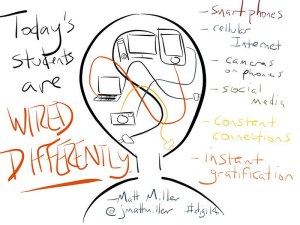
In education, not all of us need to be the early adopters or early innovators, but when we find a tool that has shown student success, it’s hard to justify not giving it a try.  I know that there are some among us who don’t see themselves as innovators, but keep in mind that as the youth we serve interact with the world in new and changing ways, that will affect how they learn.  There are some of those best practices that guys like Zemelman shared over 20 years ago that will continue to be valuable for our students, but some of those innovations will serve our students just as well, if not better.

What are some of the things that you have tried that are new that you couldn’t do without?  I know we have some early adopters out there, and the ideas you share could serve as a resource to the rest of us.  Share your thoughts and successes in the comments below!

Self-Assessment

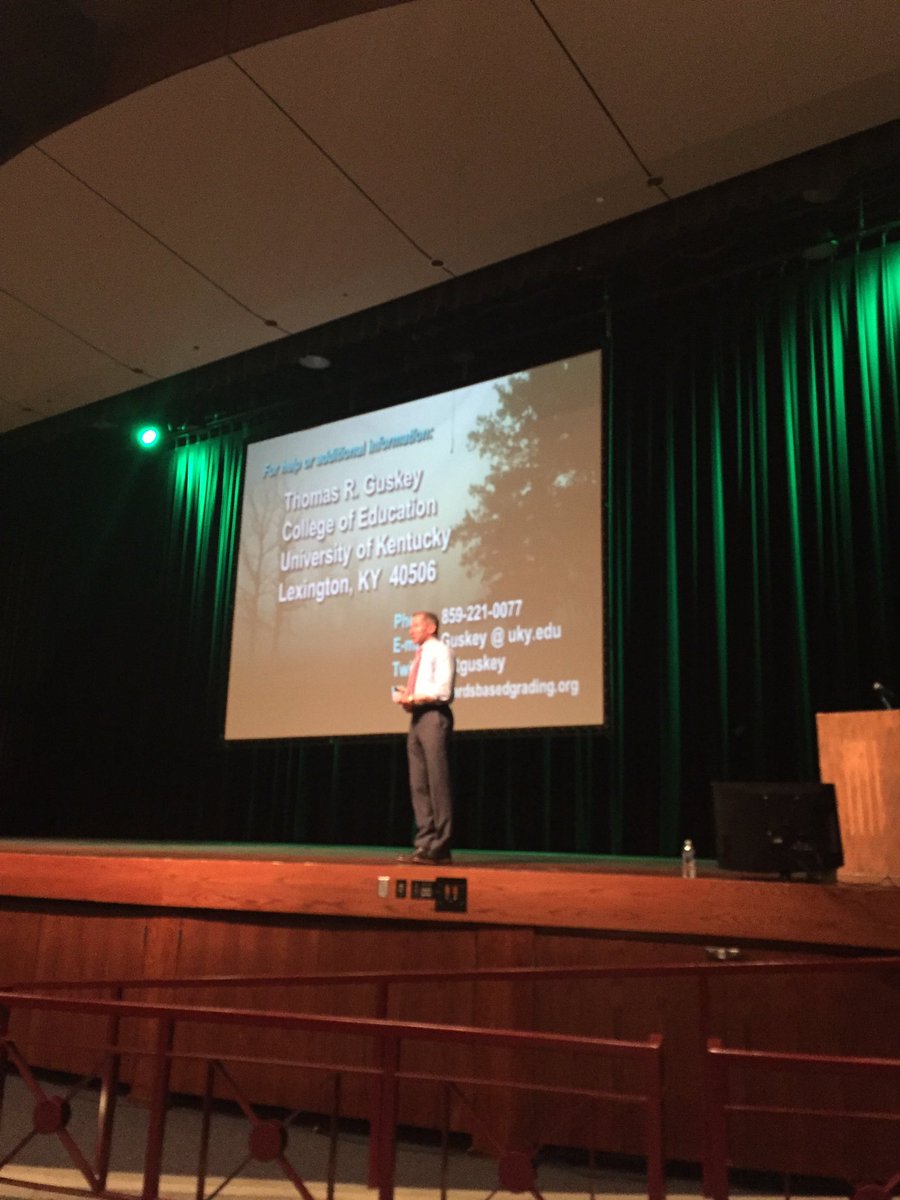
In the most recent post of the blog Teaching and Learning in HSE, Phil included a link to a short (under 2 minutes) video clip from Tom Guskey.  I’ll include the link below if you didn’t watch the clip yet.

guskeyThere were a couple of quotes that were intriguing to me.  At the very beginning, Guskey states “Every time an assessment is given…that is an opportunity to learn.”  However, he’s not talking only about an opportunity for the students to learn.  He’s also talking about the assessment as an opportunity for us to learn.  One of the best ways to assess the job that we are doing is on the consistent performance of our students.  Don’t just look at standardized scores like the ISTEP or NWEA, look at anything that you treat as an assessment, whether formative or summative, as something that is also assessing you.

I loved the strategy that he suggests of keeping a tally of the problems that students have missed.  He shares that “If every kid missed a question, that is not a kid learning problem.  That is a teacher problem.”

If you are using good planning methods, with backwards planning of your units of study, and you start with the end in mind, and you get to that end and the kids missed something that you feel you taught, take a moment to reflect on how you taught that skill.  The easy out is to say “the kids didn’t get it”.  The much harder reflection for any of us to make is to say “maybe I didn’t do a great job of teaching this”.  When that is the reflection we make, it allows us to use the assessment as a way to improve our own teaching.

hl-podcast-cover-large-1024x1024As I watched this clip from Guskey, the comments about self-assessment made me think of a recent episode of the Hack Learning Podcast titled How One Simple Tool Helps Uncover Your Biases (you can follow this link to go to a page where you can listen to this episode).  Hack Learning is a podcast that was created by Mark Barnes, a classroom teacher, author, and publisher of the Hack Learning Series.  While the topic in this podcast is a different form of self-assessment, I feel it is worth sharing.

As you know, we all have biases.  If you have never taken an implicit bias test, google it and give it a shot – you might be shocked by the results.  Our biases can creep into our conversations in the classroom with students.  What we have to remember though is that those biases can have an impact on the learning that happens in your classroom.

hacking-engagementIn this episode of Hack Learning, Barnes shares a portion of the book Hacking Engagement by Jim Sturtevant.  In the book Sturtevant shares a story from early in his teaching career where, as a world history teacher, he professed his position on what might be considered a controversial subject.  He felt that the majority of the class was on board with him, there were some head nods, and they agreed.  After the lesson, one student came up and said “You should be careful about promoting your views so passionately.  I don’t agree with you, and I’m not alone.”

Sturtevant’s initial reaction was that it was no big deal – this is the opinion of one student.  Who cares?  But as he reflected further, he came to the realization that by sharing his controversial beliefs, he was erecting barriers between himself and students.  As he goes on to say in the text “Why in the world would I want to alienate certain kids who may not agree with me on an issue.”

Think about your own interactions with peers, in person or on social media.  When someone expresses a bias that you don’t agree with, what do you do?  You might choose to avoid that person, you might end your friendship, or you might choose to block the person on social media (this is something that I definitely saw happening on Facebook during the most recent election cycle – I saw several friends share that they had blocked or unfriended everyone who’s beliefs opposed their own).  Our students will do the same things if we express our own biases, especially if they do not view things the same way as us.  We might even end up alienating the families of those students as well.

So, what can we do to help us identify our biases and avoid building those barriers between ourselves and our students?  What Sturtevant did was to create a Teacher Disposition Assessment (TDA).  As a world history teacher, there were several aspects of his curriculum that could be seen as controversial.  He identified those things that had the greatest potential to be controversial, and then created a statement from it.  Here is an example of one question on his TDA:

“Muslims should be restricted from entering the United States”

  1. Sturtevant strongly agrees
  2. Sturtevant somewhat agrees
  3. Sturtevant somewhat disagrees
  4. Sturtevant strongly disagrees
  5. Sturtevant’s opinions on this issue are unclear

Every statement included the same five options as a response.  He then took the statements and created a SurveyMonkey to be able to allow students to respond anonymously to the TDA.  As he says “It’s fine to be provocative; such statements will engage your audience.”  Sturtevant uses the TDA as an exit ticket at the end of the semester, but he feels that it could be used at any time of the year.

Sturtevant suggests debriefing after you receive the responses.  You can share the results with your class and ask students what it says about you and their perceptions of you.  He has even gone so far as to create an anonymous Google Form where students can give advice a feedback on times that biases pop up in the classroom.  Finally, Sturtevant asks his students to monitor their own actions moving forward.  He has found that completing the TDA has led students to think about their own actions and behaviors, and has led to some amazing in class conversations.

Talk about a strong self-assessment.  Asking your students to assess your biases based on statements and action in your class – that takes some guts.  But think about what that says to your students.  You are telling them that you are aware of the fact that you might have some biases, and based on your results, it may even lead you to make adjustments to your own statements and actions.  You are also showing them that you want to prevent the barriers that we might accidentally create when we let our biases creep into our teaching.  It’s important to remember that we all have biases, and those biases can impact teaching and learning.

I’m curious if there are any out there who have had issues with biases creating barriers.  Maybe it happened when you were a student and a teacher or professor said something that didn’t sit well with you.  Or maybe you realized later that something you had said or done had created a barrier between you and one of your own students.  If you’re willing, share your experience in the comments below.

Media Literacy

Last week I encouraged all of you to take a moment to reflect on the sessions that you attended and really think about what you learned from the perspective of the following three questions:

  • What can you do to transform your classroom tomorrow?
  • What can you do to transform your classroom next week?
  • What can you do to transform your classroom in the long term?

I’ve loved the conversations I have had with several of you about the new things that you are trying, or are planning to try.

As I reflect on the sessions I attended, one of them stands out more than any of the others.  That was the morning session by Katie Muhtaris called “Wide Awake Minds.”  Her focus in this session was on media literacy and why media matters.

Think for a moment about the amount of time that you spend on a screen – your computer, phone, iPad, TV, etc.  According to information that was shared in this session, tweens ages 8-12 are on their device about 6 hours a day, and that study did not include time spent on devices directly related to school.

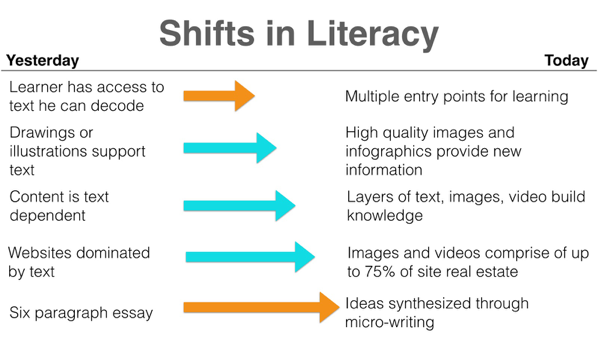
Now think about your consumption of media.  Any digital news source you go to now, whether it be CNN, BBC, Fox News, Facebook, or ESPN, what is the first thing you notice?  Probably the pictures.  What are our students’ favorite things to do on shifts-in-literacytheir devices?  Think Instagram and Snapchat – two social media services that are image and video based.  In the “Wide Awake Minds” session, Muhtaris shared that media literacy is redefining what it means to read.  How do we bring that into our classroom? When talking about media literacy, Muhtaris shared the following questions as entry points for discussions on media literacy:

  • What do you see?
  • What does it make you think?
  • What evidence do you have?

Muhtaris also shared some great resources that we can use to bring media literacy into our classrooms.  Here are a few of my favorites:

  • What’s Going On In This Picture – This source from the New York Times shares an interesting or intriguing picture on Monday morning without captions or descriptions. Come back on Thursday afternoons for additional information about the picture.
  • The Kids Should See This – This cool blog posts interesting videos curated by a mom and her 5 & 8 year olds. The tag line on the site is “not-made-for-kids, but perfect for them.”  The videos can spark interesting conversations and discussions.
  • History in Pictures – This twitter feed shares great historical pictures and can lead to great conversations.
  • National Geographic Photo of the Day – Awesome daily nature and society pictures from all over the world.
  • Daily Infographic – The group that runs this site just looks for interesting infographics on the web – one caveat… Make sure you preview any infographics you’re going to use and read every word!  While most are school appropriate, some might not be!
  • Wordless News – This site’s illustrator chooses a single news story each weekday, sketches something to go with it, and then publishes the picture. You can first discuss the picture, then click the link to see the article that goes with it.

In addition to simple media literacy, images and video can inspire inquiry.  Simply showing an interesting picture or video (like those you might find on the sites above) and asking some questions can lead to inquiry.  Here are some potential questions that you could use to get the process rolling:

  • What questions do you have?
  • What does this image make you wonder?
  • What more would you like to know?
  • What else does this remind you of?
  • Where can we look to find answers?

Have you tried anything to introduce your students to media literacy?  Have you ever tried using images as a jumping off point for inquiry?  Share your experiences in the comments below!

Reflections from Tuesday

I hope that all of you were able to take something positive away from Tuesday’s PD: HSE21 Inquiry in Action.  I know that whenever I attend a PD such as that, I feel overwhelmed.  There are so many great ideas, and sometimes some things that just don’t seem to fit for me right now.  Trying to figure out what to do with the information overload can be a bit daunting.

One of the things that I have definitely learned throughout my years of PD – if there was something good, I better try it soon.  I can’t tell you how many times I’ve seen something good at a conference, but I’ve found an excuse to not implement it right away (I don’t have time, I’m not sure my students are ready, etc.).  When I put those awesome ideas off, they end up getting lost in the black hole of professional learning – that’s where all great ideas that we never try go.

So… With that in mind, here’s some simple advice.  Think about the questions that the presenters were asked to frame their sessions around:

  • What can you do to transform your classroom tomorrow?
  • What can you do to transform your classroom next week?
  • What can you do to transform your classroom in the long term?

When you get a chance to reflect on your learning from Tuesday, try to find the nuggets that you might want to use to answer those questions.  What is the thing that you can try tomorrow (or on Monday if you’re reading this the day it posts)?  Commit to it and give it a shot.  If you know you can’t do it tomorrow, set your own goal of when you want to try that new thing.  Put it on your calendar, share with a colleague, or do something to hold yourself accountable.

Next, set one or two long term goals based on something you learned on Tuesday.  Maybe take your idea and collaborate with a colleague, or use the ideas you learned to plan a new unit for your class.

Remember that reflection is one of the most important pieces of the learning process.  Tuesday was nonstop without much time for contemplation between sessions.  Make sure you take a little time while everything is still fresh in your mind to look back on any notes you took, or ideas that you came up with.

As you reflect, share with us one takeaway from your sessions on Tuesday.  What is the one thing you plan to try?  Or tell us what you have already tried.  We’d love to hear about your learning, and your excitement from the day.  Share with us in the comments below.