The Apple Teacher Program

How many of you like to play games?  Maybe you like board games or card games that you can play with your family and friends.  Maybe you like to play video games on the PlayStation or Xbox.  Or maybe you are more into games that you can play on your iPad or phone.  One thing that has become a trend in a lot of the digital games is the idea of earning badges to symbolize advancement in the game.  People love to compete for those badges.  Some teachers have even integrated this gamification into the learning process.  Today I want to share with you something that Apple has developed that can allow all of us as educators to collect our own badges, and maybe learn some new things in the process.

A couple of days ago I saw a post on Twitter from an educator that I follow saying that he had just earned a new badge in the Apple Teacher Program.  I didn’t know much about the program, but a quick Google search took me to Apple’s site with more information about the program (click here if you want to check out the site!).

Reading over the short pieces of information on that site, I learned that through this program you could learn how to use built-in apps to “enhance creativity and productivity” in the classroom.  As you complete lessons, you can take a quiz, and if you pass the quiz you earn a badge.

I decided to sign up so that I could learn more about the program.  Once I was signed up (almost instantaneous – you sign up with your Apple ID, and then you receive an email with the link to sign in to the Apple Teacher Learning Center), I was able to find links to learning resources for teachers, inspiration for new things to try out, and links to earn badges that are based on the iPad or the Mac.  Since we are 1:1 with the iPad, that is where I went first, and without having to participate in any lessons I was able to pass quizzes to earn a couple of the badges.

There are options to earn general badges for the iPad, to learn about productivity, and to learn ways to integrate creativity with the iPad.  There are also badges for specific apps like Pages, Keynote, Numbers, iMovie, and GarageBand.  When you select a badge you want to earn, you have the option to go to a Starter Guide with tons of information about apps – I just skimmed through looking for things that were new to me.  What I also found interesting about the started guide is that it instructed you on how to play with the app in order to learn to use it better.  We all know that we learn better by doing!  In addition to the starter guide, there are links to online help for the app, or even options to sign up for a live workshop at the Apple Store.  Once you feel like you understand the app, you can take a quiz and earn a badge.

In addition to the original options for badges, once you complete all the badges you earn an official Apple Teacher logo, as well as access to additional learning resources and badges.  I wanted to share this with you because I found it interesting.

Have any of you ventured into the Apple Teacher Program in the past?  There seem to be tons of great (and free) resources that could be used in the classroom.  Share with us if you decide to sign up, and then let us know as you add badges to your collection!

Best Practices and Innovation

ny-times-best-sellerHave you ever noticed that the majority of the marketing you see, whether it be related to a movie, a book, a car, or music, is focused on the newest stuff?  If you go into Barnes & Noble in the coming weeks, the first thing you are sure to see is the newest releases from popular authors.  But then if you look at the best-selling list, you may notice that not always do those newest books show up.

I was recently reading a post to Seth Godin’s blog – simply named “Seth’s blog” – titled Understanding the backlist (for everything, including books).  For those of you who haven’t heard of Seth Godin, he is an author who writes on many different topics.  He’s probably best known for his writing on marketing, leadership, and change.  In the post he was talking about the difference between backlist and frontlist items.  Backlist items are those things that a company has been making for a long time, while frontlist items are the things that are brand new.  A great example of a backlist item would be a Dr. Seuss book – people don’t buy those books because they’re new, they buy those books because it’s what everyone buys.  On the other hand, frontlist items are the hot new thing that we don’t really know how long they’ll be around.

Earlier I asked if you had noticed that marketers focus on the newest stuff, but think about where consumers spend their money.  If you decide to pick a book as a present for someone, what are you more likely to choose?  A new book that you know nothing about, or that classic that you’ve read several times and love?  Book publishers make 90% of their profit from books that they published more than six months ago, but they put just 2% of their effort into promoting and selling those books.

In education, there are a lot of things that would be considered backlist items.  My first copy of the book Best Practice by Zemelman, Daniels, and Hyde is copyrighted in 1998, and it is a second edition, with the first edition coming out in 1993.  Many of the strategies that are defined as “new standards” are things that I recall happening in my elementary and secondary education in the 80s and 90s.  The book has been updated a couple more times, and is currently on its fourth edition, however if you compare editions, you’ll notice that the key ideas haven’t really changed.  I think we all can agree that in education there are backlist items that have been around for a long time and we use them to help our students learn.

At the same time, there are frontlist items that come along in education.  It might be the shiny new learning tool, some new curriculum idea, or a new app that works wonders.  Some of us are early adopters and try out all the new things to see what works in the classroom, while the more cynical of us might say “I’m just going to hold out and see if this is just going to go away.”

Companies are really good at watching the frontlist items, seeing how they perform, and if things look right, they will make it a core product.  I remember when the first smartphones (think Blackberry) came out, and I thought I would never need/want one.  Then the iPhone came out and it suddenly seemed like something that I had to have.  Currently I’m on my 4th smartphone, starting with a Droid, and then moving to the iPhone.  Frontlist items can become a backlist product with time.

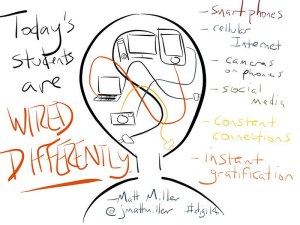
Today's Students are Wired Differently - Matt Miller
Today’s Students are Wired Differently – Matt Miller

In education, not all of us need to be the early adopters or early innovators, but when we find a tool that has shown student success, it’s hard to justify not giving it a try.  I know that there are some among us who don’t see themselves as innovators, but keep in mind that as the youth we serve interact with the world in new and changing ways, that will affect how they learn.  There are some of those best practices that guys like Zemelman shared over 20 years ago that will continue to be valuable for our students, but some of those innovations will serve our students just as well, if not better.

What are some of the things that you have tried that are new that you couldn’t do without?  I know we have some early adopters out there, and the ideas you share could serve as a resource to the rest of us.  Share your thoughts and successes in the comments below!

Self-Assessment

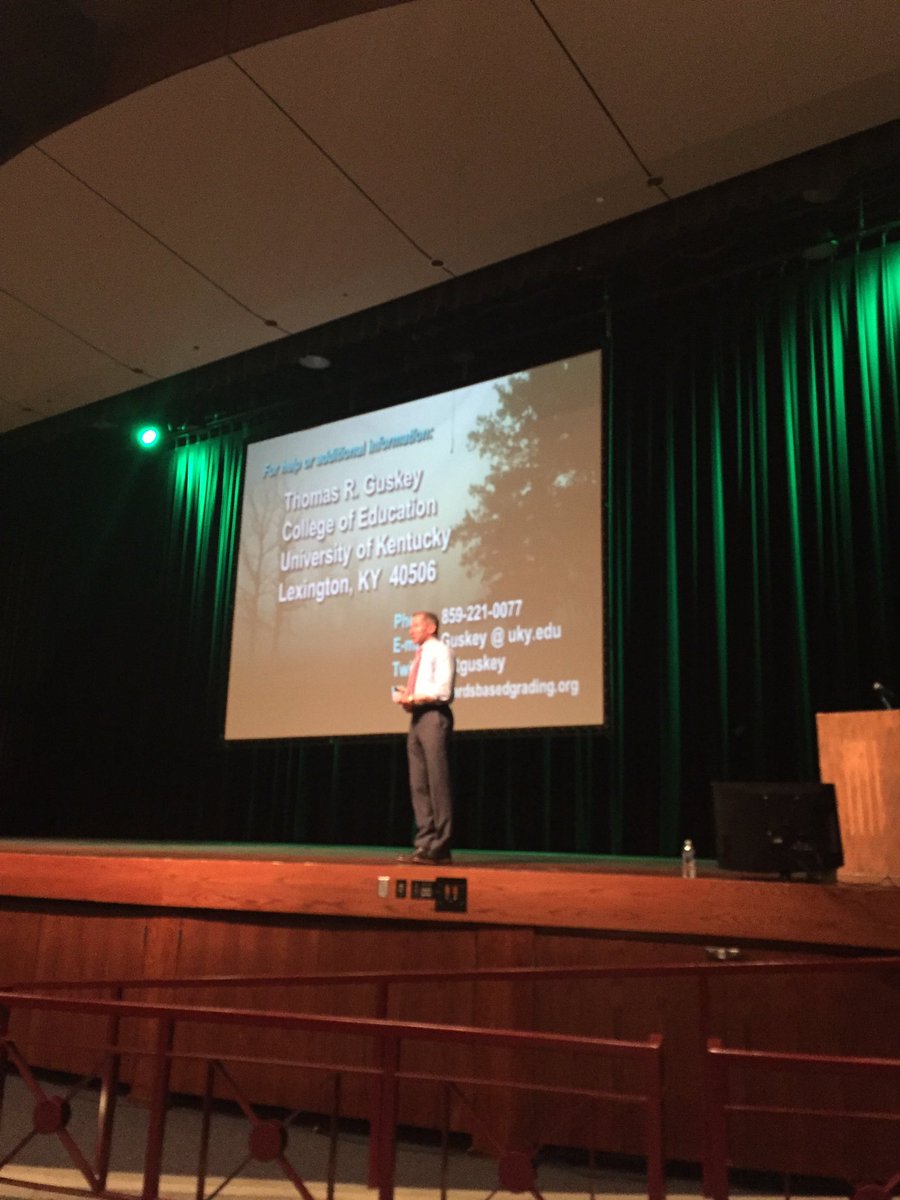
In the most recent post of the blog Teaching and Learning in HSE, Phil included a link to a short (under 2 minutes) video clip from Tom Guskey.  I’ll include the link below if you didn’t watch the clip yet.

guskeyThere were a couple of quotes that were intriguing to me.  At the very beginning, Guskey states “Every time an assessment is given…that is an opportunity to learn.”  However, he’s not talking only about an opportunity for the students to learn.  He’s also talking about the assessment as an opportunity for us to learn.  One of the best ways to assess the job that we are doing is on the consistent performance of our students.  Don’t just look at standardized scores like the ISTEP or NWEA, look at anything that you treat as an assessment, whether formative or summative, as something that is also assessing you.

I loved the strategy that he suggests of keeping a tally of the problems that students have missed.  He shares that “If every kid missed a question, that is not a kid learning problem.  That is a teacher problem.”

If you are using good planning methods, with backwards planning of your units of study, and you start with the end in mind, and you get to that end and the kids missed something that you feel you taught, take a moment to reflect on how you taught that skill.  The easy out is to say “the kids didn’t get it”.  The much harder reflection for any of us to make is to say “maybe I didn’t do a great job of teaching this”.  When that is the reflection we make, it allows us to use the assessment as a way to improve our own teaching.

hl-podcast-cover-large-1024x1024As I watched this clip from Guskey, the comments about self-assessment made me think of a recent episode of the Hack Learning Podcast titled How One Simple Tool Helps Uncover Your Biases (you can follow this link to go to a page where you can listen to this episode).  Hack Learning is a podcast that was created by Mark Barnes, a classroom teacher, author, and publisher of the Hack Learning Series.  While the topic in this podcast is a different form of self-assessment, I feel it is worth sharing.

As you know, we all have biases.  If you have never taken an implicit bias test, google it and give it a shot – you might be shocked by the results.  Our biases can creep into our conversations in the classroom with students.  What we have to remember though is that those biases can have an impact on the learning that happens in your classroom.

hacking-engagementIn this episode of Hack Learning, Barnes shares a portion of the book Hacking Engagement by Jim Sturtevant.  In the book Sturtevant shares a story from early in his teaching career where, as a world history teacher, he professed his position on what might be considered a controversial subject.  He felt that the majority of the class was on board with him, there were some head nods, and they agreed.  After the lesson, one student came up and said “You should be careful about promoting your views so passionately.  I don’t agree with you, and I’m not alone.”

Sturtevant’s initial reaction was that it was no big deal – this is the opinion of one student.  Who cares?  But as he reflected further, he came to the realization that by sharing his controversial beliefs, he was erecting barriers between himself and students.  As he goes on to say in the text “Why in the world would I want to alienate certain kids who may not agree with me on an issue.”

Think about your own interactions with peers, in person or on social media.  When someone expresses a bias that you don’t agree with, what do you do?  You might choose to avoid that person, you might end your friendship, or you might choose to block the person on social media (this is something that I definitely saw happening on Facebook during the most recent election cycle – I saw several friends share that they had blocked or unfriended everyone who’s beliefs opposed their own).  Our students will do the same things if we express our own biases, especially if they do not view things the same way as us.  We might even end up alienating the families of those students as well.

So, what can we do to help us identify our biases and avoid building those barriers between ourselves and our students?  What Sturtevant did was to create a Teacher Disposition Assessment (TDA).  As a world history teacher, there were several aspects of his curriculum that could be seen as controversial.  He identified those things that had the greatest potential to be controversial, and then created a statement from it.  Here is an example of one question on his TDA:

“Muslims should be restricted from entering the United States”

  1. Sturtevant strongly agrees
  2. Sturtevant somewhat agrees
  3. Sturtevant somewhat disagrees
  4. Sturtevant strongly disagrees
  5. Sturtevant’s opinions on this issue are unclear

Every statement included the same five options as a response.  He then took the statements and created a SurveyMonkey to be able to allow students to respond anonymously to the TDA.  As he says “It’s fine to be provocative; such statements will engage your audience.”  Sturtevant uses the TDA as an exit ticket at the end of the semester, but he feels that it could be used at any time of the year.

Sturtevant suggests debriefing after you receive the responses.  You can share the results with your class and ask students what it says about you and their perceptions of you.  He has even gone so far as to create an anonymous Google Form where students can give advice a feedback on times that biases pop up in the classroom.  Finally, Sturtevant asks his students to monitor their own actions moving forward.  He has found that completing the TDA has led students to think about their own actions and behaviors, and has led to some amazing in class conversations.

Talk about a strong self-assessment.  Asking your students to assess your biases based on statements and action in your class – that takes some guts.  But think about what that says to your students.  You are telling them that you are aware of the fact that you might have some biases, and based on your results, it may even lead you to make adjustments to your own statements and actions.  You are also showing them that you want to prevent the barriers that we might accidentally create when we let our biases creep into our teaching.  It’s important to remember that we all have biases, and those biases can impact teaching and learning.

I’m curious if there are any out there who have had issues with biases creating barriers.  Maybe it happened when you were a student and a teacher or professor said something that didn’t sit well with you.  Or maybe you realized later that something you had said or done had created a barrier between you and one of your own students.  If you’re willing, share your experience in the comments below.

Media Literacy

Last week I encouraged all of you to take a moment to reflect on the sessions that you attended and really think about what you learned from the perspective of the following three questions:

  • What can you do to transform your classroom tomorrow?
  • What can you do to transform your classroom next week?
  • What can you do to transform your classroom in the long term?

I’ve loved the conversations I have had with several of you about the new things that you are trying, or are planning to try.

As I reflect on the sessions I attended, one of them stands out more than any of the others.  That was the morning session by Katie Muhtaris called “Wide Awake Minds.”  Her focus in this session was on media literacy and why media matters.

Think for a moment about the amount of time that you spend on a screen – your computer, phone, iPad, TV, etc.  According to information that was shared in this session, tweens ages 8-12 are on their device about 6 hours a day, and that study did not include time spent on devices directly related to school.

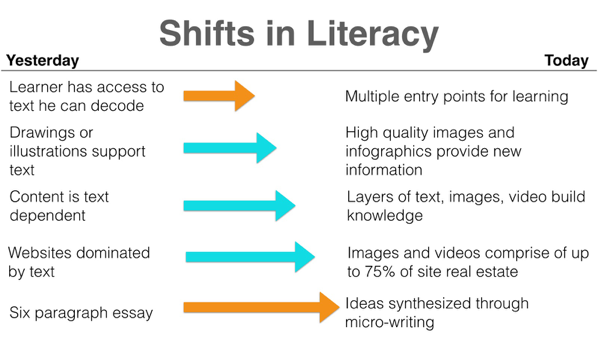
Now think about your consumption of media.  Any digital news source you go to now, whether it be CNN, BBC, Fox News, Facebook, or ESPN, what is the first thing you notice?  Probably the pictures.  What are our students’ favorite things to do on shifts-in-literacytheir devices?  Think Instagram and Snapchat – two social media services that are image and video based.  In the “Wide Awake Minds” session, Muhtaris shared that media literacy is redefining what it means to read.  How do we bring that into our classroom? When talking about media literacy, Muhtaris shared the following questions as entry points for discussions on media literacy:

  • What do you see?
  • What does it make you think?
  • What evidence do you have?

Muhtaris also shared some great resources that we can use to bring media literacy into our classrooms.  Here are a few of my favorites:

  • What’s Going On In This Picture – This source from the New York Times shares an interesting or intriguing picture on Monday morning without captions or descriptions. Come back on Thursday afternoons for additional information about the picture.
  • The Kids Should See This – This cool blog posts interesting videos curated by a mom and her 5 & 8 year olds. The tag line on the site is “not-made-for-kids, but perfect for them.”  The videos can spark interesting conversations and discussions.
  • History in Pictures – This twitter feed shares great historical pictures and can lead to great conversations.
  • National Geographic Photo of the Day – Awesome daily nature and society pictures from all over the world.
  • Daily Infographic – The group that runs this site just looks for interesting infographics on the web – one caveat… Make sure you preview any infographics you’re going to use and read every word!  While most are school appropriate, some might not be!
  • Wordless News – This site’s illustrator chooses a single news story each weekday, sketches something to go with it, and then publishes the picture. You can first discuss the picture, then click the link to see the article that goes with it.

In addition to simple media literacy, images and video can inspire inquiry.  Simply showing an interesting picture or video (like those you might find on the sites above) and asking some questions can lead to inquiry.  Here are some potential questions that you could use to get the process rolling:

  • What questions do you have?
  • What does this image make you wonder?
  • What more would you like to know?
  • What else does this remind you of?
  • Where can we look to find answers?

Have you tried anything to introduce your students to media literacy?  Have you ever tried using images as a jumping off point for inquiry?  Share your experiences in the comments below!

Reflections from Tuesday

I hope that all of you were able to take something positive away from Tuesday’s PD: HSE21 Inquiry in Action.  I know that whenever I attend a PD such as that, I feel overwhelmed.  There are so many great ideas, and sometimes some things that just don’t seem to fit for me right now.  Trying to figure out what to do with the information overload can be a bit daunting.

One of the things that I have definitely learned throughout my years of PD – if there was something good, I better try it soon.  I can’t tell you how many times I’ve seen something good at a conference, but I’ve found an excuse to not implement it right away (I don’t have time, I’m not sure my students are ready, etc.).  When I put those awesome ideas off, they end up getting lost in the black hole of professional learning – that’s where all great ideas that we never try go.

So… With that in mind, here’s some simple advice.  Think about the questions that the presenters were asked to frame their sessions around:

  • What can you do to transform your classroom tomorrow?
  • What can you do to transform your classroom next week?
  • What can you do to transform your classroom in the long term?

When you get a chance to reflect on your learning from Tuesday, try to find the nuggets that you might want to use to answer those questions.  What is the thing that you can try tomorrow (or on Monday if you’re reading this the day it posts)?  Commit to it and give it a shot.  If you know you can’t do it tomorrow, set your own goal of when you want to try that new thing.  Put it on your calendar, share with a colleague, or do something to hold yourself accountable.

Next, set one or two long term goals based on something you learned on Tuesday.  Maybe take your idea and collaborate with a colleague, or use the ideas you learned to plan a new unit for your class.

Remember that reflection is one of the most important pieces of the learning process.  Tuesday was nonstop without much time for contemplation between sessions.  Make sure you take a little time while everything is still fresh in your mind to look back on any notes you took, or ideas that you came up with.

As you reflect, share with us one takeaway from your sessions on Tuesday.  What is the one thing you plan to try?  Or tell us what you have already tried.  We’d love to hear about your learning, and your excitement from the day.  Share with us in the comments below.

Freedom to explore

So this week, I’m going to simply recommend a piece from NPR Ed that I recently listened to titled Freedom to Explore.  If you’ve never checked out the NPR Ed website, there’s tons of interesting information there.  Some of the pieces are articles that are freely available, while other pieces are audio that you can play over your computer, or listen to on your smartphone.

This piece fits with our thinking in the HSE21 model so well!  Listen to how 2 schools (admittedly very different than our school) are moving towards a more progressive version of learning.  Maybe there will be some ideas here that you can bring into your own classroom!  To listen to this piece, click on the link below, then click the listen button on the page.  You can listen from your computer, or on a smart phone.  Enjoy!  After you’ve listened, feel free to share your thoughts in the comments below.

Freedom to Explore

Seeing past the behavior

Looking back on your life as a student, how many of you would be able to describe yourself as a good student, a well behaved student, or maybe even a perfect student?  I know it might be hard to imagine, but I don’t know that I would be able to use any of those phrases to describe my schooling career.  I definitely wasn’t a bad student, but I wasn’t a perfect student either.  Some classes I did well in, while others I struggled with.

As I was writing my last post on responses to student behavior, most of the strategies were for those more serious issues and serious behaviors.  But not always do we have behavior that we would call serious, and not always is the behavior a function of some type of trauma – more likely it’s those slightly annoying (maybe even seriously annoying!) things that kids do in the classroom.  When I think back on the classes where my behavior wasn’t so great, I don’t know that any of the strategies I talked about in my last post would have been any help for my teacher.

A lot of times, the behaviors we're dealing with are a lot more like Calvin's...
A lot of times, the behaviors we’re dealing with are a lot more like Calvin’s…

I can tell you that the classes where my behavior was poor, there was a pattern.  The pattern that I have come to realize over the years is that normally when I was in a class that was hard for me academically, I would often choose to goof around.  I’m sorry to my freshman English teacher, and my sophomore biology teacher, but the truth was, I didn’t do well in those classes.  I struggled to understand what I needed to do to be successful, and as a result, I chose to goof around.  In that freshman English class, I had several friends and I never would have wanted to appear like I didn’t get it in front of them.  So what did I do instead?  I goofed off.  I’m not going to list the things that I may or may not have been responsible for here, but if you’re dying to know, just ask me.

My behavior, and in turn my relationship with my teacher, was a direct function of how well I understood what was going on in class.  When I wasn’t getting something, my behavior went downhill.  It was a lot easier to appear as the jokester than to be the dumb kid who didn’t get it.  And I’m sure that my teachers who saw that sort of behavior didn’t think too highly of me.

We’ve all had situations where a student seems to struggle behaviorally in one teacher’s class and does well in another.  Now that many of you are teaching blocks of classes (STEM or Humanities) you may have begun to notice patterns with some of your students where their behavior is different within the same block.  As you notice patterns where a student’s behavior is different between your classroom and a teammate’s classroom, or even within your block, take a moment to reflect on what might be the root cause of the behavior.  Is the student struggling in one subject, and not in the other?  Sometimes those struggles bring about the behavior that you see.

I don’t know that I have the solution to these issues, but wanted you to be aware (as a formerly less than perfect student) where the behavior sometimes comes from.  Maybe just the awareness will lead us to be able to make a difference for a student in our classroom.

What ideas do you guys have?  Have you run into situations like these?  Have you found any ways to support those struggling students, and in turn change the behavior?  Does this make you think of any of your current students?  Share your thoughts in the comments below.

How do we respond to student behaviors?

In last week’s post we discussed the role of trauma in student behaviors we see.  Each one of us can think of one or two students who manage to get under our skin and push our buttons.  What we have to remember is that for some of these students, they are acting out due to something that we cannot control – they have been through some type of trauma in their life.  It leads to behaviors we don’t understand, and that makes it difficult for us to respond in the appropriate way.  The goal of this post is to think carefully about how we respond to those students so that we are intervening in a way that offers support.

Imagine for a moment that you were to look up from your computer right now, and see this:

Imagine this bear walked into the room you’re in right now. What would you do?

What would you do?  How would you react?

For our students who have been impacted by trauma, every adult that they meet is a bear like the one you see above.  That includes their teachers!  For these students, they are constantly watching for the dangerous bear.  They may not be able to interpret an innocent or neutral look, action, or touch from their teacher or others at school as being benign.  The brains of our traumatized youth lose the ability to understand the difference between safety and danger, and will falsely signal danger and hostility EVERYWHERE.  As a result, these students behave in ways that are not considered appropriate in the normal school environment.  They lack the language skills to be able to describe how they feel, so they act out in ways that we might describe as reactive, impulsive, aggressive, withdrawn, or defiant.  These challenging behaviors have become coping skills that help them survive in abusive or neglectful situations.  Remember from last week’s post, children who have dealt with trauma are living with their focus on the survival portion of the brain (fight, flight, or fright).  Since all of life is about survival for these students, they generalize the behavior to all other environments – even school where we think they should feel safe.

So when students are acting out, especially students that we believe (or possibly even know) have lived through one of the traumas addressed last week, we need to shift our perspective in how we react.  Oftentimes we see this behavior as willfully acting out or disrupting class, or consciously refusing to engage with learning.  Instead, we need to see that:

  1. These responses are based on personal experiences
  2. Students are seeking to meet their needs
  3. They have difficulty regulating emotions
  4. They lack some of the important skills to be successful in school
  5. They believe that adults cannot be trusted

troubled-childrenWe need to put into place supports and other interventions to address these issues.  Instead of seeing the behavior and asking (or even thinking) “What’s wrong with you?” we need to shift our mindset to “What happened and how can I help?”  In order to be sensitive to trauma, we must recognize the prevalence and impact of trauma in our students’ lives and create a framework that provides support, is sensitive to the unique needs of students, and is mindful of avoiding re-traumatization.  I’m sure that some of you are looking now for a list of exactly what to do in each situation.  It doesn’t exist.  Each child is different, their needs are different.  You must take the time to offer your support, your help, and let these children know that you truly care for them.  You do this through paraverbals (tone of voice, body language, volume, and cadence of speech).  Deliberately slow your speech, soften your voice, choose a kind tone, and be supportive of the student.  Students who feel supported are more likely to feel safe.

I think we can all agree that when students feel safe, they are more likely to act in ways that are safe, so how can we support that?  First, we need to ask ourselves if the student is fearful, anxious, frustrated, or tense.  Next, our responses to inappropriate behaviors need to be predictable, and our students who struggle need to have an agreed upon safe haven (maybe the resource room, maybe the counselor’s office, maybe with another teacher) where they can go to work through their complex emotions.  Finally, when that student is ready to return to class, we must find an opportunity to rebuild rapport with that student (this step is quite possibly the MOST important in helping students to feel supported).  Continue to let them know you care, and that you are here to help.  Ask them to let you know how you can help.  They may not have an answer today or tomorrow, but eventually they may have an idea that will support them.  We also have to remember – for students to behave appropriately, we must model and teach the behavior we want to see (this is not the same as telling students what we expect).

In order to help students feel connected in schools, we should work hard to build relationships – especially with the students who struggle the most.  Greet each student at the door of your classroom every day.  Be aware of your student’s likes and interests (these can be used as a distraction in times of crisis).  As I’ve said before, know your kids and love them for who they are.

While we can’t protect our students from all the evils of the world, we can be allies, mentors, and role models.  The relationships we build with our students will help them as they grow, recover, and begin to heal from their trauma.

What experiences have you had with students who have been through trauma?  Have you found strategies that seem to be successful?  Let us know what has worked for you in the comments below.


The role of trauma in student behavior

We’ve all been there, you’re in the middle of class, things seem to be going well, and then you notice what one student is doing.  Maybe they have completely shut down, maybe they are talking to a neighbor, or maybe they are acting out in some way that draws the attention of other students from the current activity to the student who is misbehaving.  The natural (and often simplest) reaction is to redirect, sign a behavior card, raise our voice, or maybe even submit an office referral.

In my personal opinion, a lot of the time that acting out behavior stems from something that has absolutely nothing to do with you, your class, or the students in your classroom, but from something that we as teachers have no influence over.

A couple days ago, I was at a PBIS (Positive Behavioral Interventions and Supports) training with several other members of the PBIS team in my school, as well as some of the other PBIS teams in our district.  We spent a portion of time discussing the role that trauma plays in student behavior and learning.  So, as a working definition, here is how we’re going to define trauma for this post:

Trauma refers to extreme or chronic stress that overwhelms a person’s ability to cope and results in feeling vulnerable, helpless, and afraid.  The event(s) that led to trauma may be witnessed or experienced directly.  Trauma often interferes with relationships, self-regulation, and fundamental beliefs about oneself, others, and one’s place in the world.

the-hurt-that-troubled-children-create-is-never-greater-than-the-hurt-they-feelTrauma can occur from lots of different things – there is simple trauma (serious accident, disaster, one-time physical assault); complex/developmental trauma (witness domestic violence, death of a parent / caretaker, ongoing physical or emotional abuse, ongoing neglect, homelessness, living with family members with untreated mental illness or substance abuse, or having a family member deployed in the military); and finally historical / generational trauma.  Children who have been through traumas like those listed above can have various levels of stress, but those who are living with high levels of stress spend much of their life in the fight, flight, or fright mode.  These children respond to the world as a place of constant fear.

All this stress leads to issues with brain functions and development, and make it very difficult for students to focus on learning.  Oftentimes these students fall behind in school; fail to develop healthy relationships with peers; and/or create problems in classrooms and at school because they are unable to trust adults.

So now that we know a little about where this trauma and stress comes from, we need to examine what it may look like in the classroom.  Let’s first look at the development of the brain.  For typical children, who do not have toxic levels of stress in their lives, they are able to spend very little of their time focused on survival, and as a result are able to spend much more of their time devoted to cognition and social-emotional functions.  For the children who have experienced developmental trauma, the majority of the brain’s attention is focused on survival skills (the fight, flight, or fright reactions), which means there is little time or energy to devote to cognition or the social-emotional functions.

When students have experienced trauma, you may notice some of the following traits:

  • Day dreaming
  • Impaired social & emotional function
  • Difficulty retaining information
  • Labeled as learning disabled
  • Can sit in classroom and not learn
  • Less mature problem solving
  • Use violence as a tool
  • Feel the need to control their environment

These traits can lead to various effects on learning, including the ability to: acquire language & communication skills; understand cause and effect; take another’s perspective; attend to classroom instruction; regulate emotions; engage in the curriculum; and utilize executive function (make plans, organize work, follow classroom rules).

So now we’ve talked a bit about what trauma is, what may have caused trauma in our students, and some of the traits that may happen as a result.  Next week we will look at how our responses can play a role in student behavior, especially those who have experienced some form of trauma in their lives.

In the comments below share your thoughts on this topic.  Have you had experiences working with students who have lived through trauma?  What worked?  What didn’t work?

Incremental improvement

without-continual-growth-and-progress-such-words-as-improvement-achievement-and-success-have-no-meaning

If you were to draw a path to success, what do you think it might look like?  I recently saw this visual, and it made a lot of sense to me:3dd260bf-ecde-4bdd-b88d-ebdcd9bbc539

I think we all would agree that the path to success is not a straight line.  We’ve all had bumps in the road on our own path to where we are.  In the version of success that appears on the right, there are some ups, some downs, and some times in the totally opposite direction of where you want to go. When you understand that this is what the path to success looks like, you also understand the concept of incremental growth.  These are the small steps we take to get closer to our goals.  When we focus on incremental growth, we don’t care as much about the external factors, and instead focus on the things that we can control.  Hopefully you will see the benefit of the rest of this post if you hear questions like this in your classroom:

  • How many points is this worth?
  • Can I earn extra credit?
  • Did you grade the tests yet?

Questions like these are a sign that students care only for an extrinsic motivator – the grade.  The problem with our students having this mindset is that when students are motivated solely by a grade, they will find ways to get the work done and earn the credit, but they will completely miss the educational value of the lesson, and will not retain anything.  The best way to get them past these extrinsic motivators is to shift the mindset of your students.  Work to get them to focus less on the external motivation, and more on the internal motivators.

The first step – make sure that students understand that grades are just another data point, nothing more or less, that tells teachers and parents a little about where students are right now.  When you attach rewards or consequences to a grade, you train the students who do well to expect an external motivator, and you completely miss that kid who might be doing everything in their power just to keep their head above water, and never getting anything for it.  When you talk about report card grades, make sure students know that you are much more concerned with their day to day efforts than you are with their overall grade.

So what are some of the ways that you can give this message to your students?  Check out the points below:

Improving through effective feedback

If you want your students to value growth, you have to give them feedback that shows you recognize their growth.  Normally this can’t be shown just in the grade on a paper, but rather through the words you speak to a student.  During work time, be walking around, observing what students are doing, ask questions of them, and sharing your thoughts.  Since we all know that our students have a jagged learning profile (see the last post on “Average” students), we should also be aware that every child is at a different place, with different goals and different needs.  Our feedback should focus on what’s most important to THIS child at THIS time.

One of the other keys to effective feedback – focus on the future, not the past.  Instead of saying “You shouldn’t have done it this way; you should do it this way…” you might want to try saying “Next time, I’d like you to do it this way because…”  Our words totally change the feedback and focus on incremental growth moving forward.

Improving Results

One of the best ways for students to be able to see their improvement is to have a way to reflect on their learning process easily.  A great way to do this is through portfolios.  In this day and age, the portfolio can be totally digital, and easily viewed, shared, and managed.  Apps like SeeSaw, or a blog, can allow students to share their work and create a reflection in writing, audio, or video of what they have learned in their work.

Depending on the task, what you might ask students to include in their portfolio may vary, but some of the things that would probably be valuable to include would be:

  • A title that describes the Big Idea or concept
  • A picture or video of the process or final product from the activity
  • Answers to reflection and synthesis questions that guide each child to successfully demonstrate their understanding of the concept.

The reflection questions should vary depending on the activity and be based on your learning goals, but the idea is to get students to reflect on their learning.  If nothing else, ask them “What did you learn?”  If they can reflect and articulate that, their retention will be that much stronger.

If you feel that students are lacking in their answers to the reflection questions, there is a simple solution.  Follow up their answer with “Tell me more.”  This simple statement gets students to think a bit deeper, and if you model this enough, your students will eventually begin answering your questions in a more complete way without you having to ask.

Critical Peer Feedback

If you are the only person in the classroom who is able to provide feedback, some things might get missed.  We all know there’s only so much time in the day!  The key is to get students to understand that when they are looking at each others work, they are not being judgmental, rather they are looking for specific things that could be improved.  In order to help students understand how to do this, here are some steps you could introduce to them:

  1. Tell your peer that you have an idea of where they might improve. This way they know that you are just trying to help them make their work better.
  2. Start or end with a specific compliment! Let them know what you like and why you like it – when they know you appreciate something they have done, it’s easier to take some critical feedback.
  3. Give your suggestion as a question rather than a statement. Instead of telling your peer what to say, you could ask “have you thought about doing this…” or “I wonder if others might understand it better if you…”

Hopefully you see a couple of ideas here that you could implement in your classroom to help your students move towards an attitude of incremental improvement.  Maybe you noticed that a big key to incremental growth for students is feedback.  Meaningful feedback is the key to incremental growth for all of us!

If you decide to try out any of these strategies in your class, I’d love to hear how it goes!  If you’ve tried anything like this, tell us about it in the comments below.  What worked well?  What were your sticking points?