Defining nonfiction

Think back to when you were in school.  We all learned the difference between fiction and nonfiction, but take a moment to think about how you would define that term for your students.  I specifically remember one of my teachers reminding us that NF stood for nonfiction and not fake.  Last week I asked you to share your own definition of nonfiction in 5 words or less.  Here’s a word cloud I created based on the definitions you all shared:

Nonfiction_definition_wordle

You’ll notice as you look at this that the terms that appeared most in our definitions were informational, factual, facts, and real.

As we all know, when reading a nonfiction text, we cannot always accept everything at 100% factual.  Think of just about any controversial topic.  You can find nonfiction pieces written in support of and against global warming, evolution, or the risks of tobacco use.  Does that mean that both sides of the story are true?  Or are they both lying to us?  Most of the time, it’s much more nuanced than that.

For a variety of reasons, authors may omit information, tell us little white lies, or manipulate their research and data.  The reality is that nonfiction can be so challenging because it forces us to interact with the text in ways that fiction never expect us to do.  As Beers and Probst say, we must understand when reading nonfiction that “the author is not offering the truth, but one vision of the truth.”  Sometimes a nonfiction author will go so far as to explicitly tell us the inference they want us to make.  The author wants us to accept their version as the truth without questioning, but we must think about the purpose the author has for writing.

This brings us to the question, how do we really define nonfiction?  I love the definition that Beers and Probst put forth, and is much deeper than the definition I was given of “not fake”:

Nonfiction is that body of work in which the author purports to tell us about the real world, a real experience, a real person, an idea, or a belief.

To me, the key word here is purports.  Every author has a purpose in their writing, and depending on that purpose they may lead us to conclusions that we wouldn’t generally make if we were in possession of all the facts.  This definition reminds us of the importance of reading with a questioning stance.

By seeking the author’s purpose while we are reading, we will be better able to look at nonfiction and understand why an author made the choices they did.  If you want to see a great example of an article that can be used to look at author’s purpose, take a look at “Vampires Prey on Panama” found on page 261 of Reading Nonfiction.  As you read the article, pay close attention to the words that are used to describe the farmer compared to the words that are used to describe the scientist.  Who’s the antagonist?  Who’s the hero?  Why does the author choose to write in this way?  If our students learn to have that questioning stance as they read nonfiction, they will be better at identifying the author’s purpose.

The nonfiction signposts will also help our students to get the author’s purpose.  During our PD with Beers and Probst last week, they identified 2 signposts in particular that help us better understand the author’s purpose.  I’ll share with you a little about each of those signposts next week.

In the past week it’s been great seeing so many of the teachers in our building working to integrate the 3 main questions that were the basis of my post last week.  So I’m curious, how do you define nonfiction for your students?  I’d also love to hear more about how you have been implementing the questions into subject areas other than reading, or what you’ve noticed about the thinking that your students are doing as a result of these questions.  Share your thoughts in the comments below.

How do we take them further?

Reading NonfictionOn Monday I was able to attend a PD session that was led by Kylene Beers and Bob Probst, and one of the things they said early in our day struck a chord with me:

“Some teachers don’t realize that if they just stay out of the way, the kids who do well will keep doing well.  How do we take them further?”

This is such a challenge in our district.  Most of our classes are filled with compliant students who generally do what we ask them to do, they show gains in the normal way, and then they move on to the next grade.  But is that what we want for our students?  Show gains in the normal way?  Don’t we want them to gain spectacularly in the time we have them?  For most of these students, they will hit a wall sometime.  It might be a high school AP class, it might not be until college, and there may be some who can get by until they are out in the “real world” in their job/career.  But eventually their act of going through the motions won’t be enough because they won’t be able to truly think deeply and problem solve.

I think we can all agree that nonfiction reading skills are important.  But research shows us that strong nonfiction reading skills are one of the highest indicators of success.  Unless you’re a literary critic, a novelist, or a teacher (I know, we’re teachers), you probably only read fiction as an escape, but you read nonfiction every day.  That means our kids need the tools to be able to dig deep in the text, think through the text, and figure it out.

And here’s one of the amazing things – if you teach the kids the tools, and you give them the time to read a text, think deeply about it, and talk with each other, they will start asking themselves the same questions (or possibly even better questions) than the ones you would be asking.  During the PD, Probst said “Our goal should be to get our students to be able to have deep conversations about their reading without needing our help.”  Don’t you love the idea of students walking out of the building at the end of the day so tired because of all the deep thinking they have been doing, and you walk out with a smile on your face?  Our students should be doing the hard work, not us.

Too often as teachers we spend our time filling in the blanks for our students, and that is hard work!  We give them the background knowledge, we ask the questions, and then what do we get back?  Low level answers without much deep thinking.  When you ask the question, that leads our students to believe that there is one answer, and if they’re lucky they can find it in the back of the book – that’s how school works, and we all know our students can play school.  But if students were to ask those same questions, on their own, the conversations will be so much deeper.

Sound good?  I think so, but where do we start?  Beers and Probst suggested that the initial starting point would be with their 3 main questions:

  1. What surprised me?
  2. What did the author think I already knew?
  3. What changed, challenged, or confirmed what I knew?

As your students are reading, have them code what they read (this means you need something that they can write on, some post its, or a digital format that they can annotate).  Beers recommended using an exclamation point for question 1, a question mark for question 2, and the letter c for question 3.  Then, after they have read, have them talk in small groups about their thinking.

Next week I plan to go a little deeper with some more of the information that Beers and Probst shared on Monday, but as you get your year rolling, start with the 3 questions.  These 3 simple questions will make the reading more personal and relevant.  It will push thinking and learning to a much deeper level! (If you want to see a great video of where these questions can push students, scan the QR code on page 88 of your copy of Reading Nonfiction – it’s a 3 minute video clip of 6th graders in a 1:1 classroom).

If you haven’t yet read the book Reading Nonfiction by Beers and Probst, I can’t recommend it highly enough.  There is so much there to take your reading instruction to a greater level, and this instruction can take place in ALL classrooms.  We all use nonfiction reading skills in our lives, no matter what subject we teach, to help ourselves increase our knowledge and understanding.  Let’s help our students develop the skills to be more successful nonfiction readers.

Share your thoughts in the comments below.  Have you used the 3 questions in your nonfiction instruction?  What changed for your students?  What things were great?  What struggles did you have?  As a community of teachers, we are also a community of learners, and we can learn most from one another!

Teaching Conflict Management

Last year when we surveyed teachers on the topics they would like to look into as part of the Professional Development for the 2016-2017 school year, some of you chose to “write-in” a topic that you would like to learn more about.  One of the write-ins was:

“Problem solving social situations, especially with friends, recess, lunchtime, specials, etc.”

Learn Like a PirateWhile there are ways that we could probably take that idea and turn it into a PD Topic, I thought that I would give some tools that you might be able to use in the classroom the first time that you see a situation of conflict develop – my goal here is to provide you with a right now strategy.  I can’t claim this idea – the majority of this post is based on ideas from the book Learn Like a Pirate by Paul Salarz (@PaulSalarz).  Mr. Solarz is a fifth grade teacher in the Chicago area and runs a student-led classroom.  There are so many tips in the book to help guide students to collaborate, be empowered, and take leadership in their own learning.  I highly recommend it!!!  The following ideas come from the Teaching Strategies for Dealing with Conflict section on page 56.

In a classroom where you are integrating student voice and student choice and allowing opportunities for students to collaborate there will invariably be some type of disagreement.  We’ve all seen it happen – Tommy and Jeff partner up.  Everyone (including them) knows this is a bad idea.  One strategy would be to break them up before they even have a chance to start working.  However, in a collaborative community, everyone needs to learn how to work with everyone.  Not only will it help your classroom run more smoothly, it’s an important lifelong skill!

We all know what happens next…  If you allow them to work, before long there’s a disagreement.  Our reaction can make or break this situation.  Instead of saying that this is what you knew would happen, and separate them, what if you gave them the tools to find a solution on their own?  What an awesome opportunity to turn this situation into a teachable moment – not just for Tommy and Jeff, but for the whole class.  Here’s what you could do:

  1. Get the entire class’s attention – “Give me five!”, hands up, or whatever strategy you use in your classroom.
  2. With a sincere smile on your face, look at Tommy and Jeff and thank them for having a little bit of trouble because it gives you the opportunity to teach everyone how simple it can be to get through conflicts.
  3. Ask the boys to describe what happened, then teach the whole class the following strategies (you might even consider making an anchor chart for this skill to post in the room – or even better, have the students make the anchor chart!):

Lets settle thisRock-Paper-Scissors: Do you know how many arguments my friends and I have avoided with a simple game of rock-paper-scissors?  When your students can’t decide who gets what job, or what color the background should be on a poster, a single round of rock-paper-scissors can be just the perfect way to find a solution!

Compromise: Take a portion of each person’s idea and combine them together.  (“I want to watch the video clip first.” “But I think we need to plan our poster design.” “Why don’t we plan our poster design right after we watch the video!?”).  Hopefully they can find a solution that makes them both happy!

Choose Kind: Sometimes the best solution to conflict is just to do what the other person wants because it’s also a good idea!  As the quote from Dr. Wayne Dwyer goes: “When given a choice between being right and being kind, choose kind.”  Winning an argument while also hurting a classmate does not help the class win.  This summer I began using the phrase Choose Kind with my children (7 and 4 years old). It’s amazing to see how often they have been choosing kind to solve their disagreements.

The earlier you can teach these strategies to your class, the sooner they can begin to implement them.  Once students understand the process, these steps can be used even when you aren’t there – the lunch room, hallways, recess, etc.  If you don’t run into a conflict after a few days, then you might want to role play a scenario.  The sooner these strategies are introduced, the better!

As with any other strategy, we have to be ready to reinforce the use.  You can’t just introduce it once and then assume they all know it and will be successful.  Every time you notice a conflict, make sure students know you are aware (proximity, a concerned smile, etc.), but don’t just jump in and solve the problem.  Give them a little time to see if they will come to a resolution on their own.  For this strategy to truly be effective, the students have to come to use it on their own.

After you witness students come to a resolution, let them know how proud you are of how they handled it, and see if they would be willing to share their experience with the class.  If they are, have them act it out so the whole class can learn from the situation.  If students don’t want to share, that’s ok too!  They may be shy or embarrassed by what happened.

If students can’t get past the conflict on their own, then you might have to gently remind them of the conflict-management strategies to help them move on (this is where that anchor chart could be really handy!).  It’s also ok if another student steps in to help with finding a solution.  What a sign of good collaboration!

Continue the conversation in the comments below.  Could these strategies work in your room?  What else have you done that’s been successful?  Conflict can be such a distraction and sticking point that we can all use some good new ideas!

What our students see

Today I was walking the around our school thinking about the fact that in less than 2 weeks the halls will be full of almost a thousand 5th and 6th grade students.  Many of the classrooms that I walk past are still in various stages of preparation for all of those students.  Thinking about those students got me excited!  But as I walked through the halls today, I tried to look around with a different perspective.  Instead of walking around with the eyes of an adult, an educator, or an administrator, I tried to look around and see what our students might notice.  What do the things that are posted on the walls say to the 10, 11, and 12 year old students who will be walking these halls?

Many times as educators, we put things up in the hallway or our classroom because we like them.  We might intend to share something of ourselves with a student, we might intend to be funny, or we might intend to set up expectations that we have for our class and our students.  Unfortunately, our students can’t read our mind and know our intentions.  Sometimes your students may see that sign that you think is setting expectations, and instead see it as harsh, judgmental, or possibly even confrontational.  Think about what you have hanging up both outside and inside your classroom. How will it make your students feel when they walk into the room?  Are they going to feel welcome, or are they going to feel intimidated?  Does your room encourage them to be a part of the learning process, or does your room discourage their participation?

From The Thinker Builder: http://www.thethinkerbuilder.com/

I saw a recent post on the blog The Thinker Builder that had a pretty cool idea (at least I thought so).  Instead of covering his bulletin boards with amazing decorations to set up a classroom, the author begins his year with a blank bulletin board and puts a reserved sign on it (I have a screenshot of the sign to the right).  If you’d like to see his post, or be able to download the sign, check out this post – “Reserved” Signs: A Bulletin Board Stress Reliever.  What does a sign like this say to the students and parents that walk into your room?  To me, it shows that you value the thoughts and opinions of the students who will be in your classroom.

Remember, your students will notice what you have posted on the walls both inside and outside of your classroom before you have said one word to them.  Based on what they notice, they are going to form opinions about you.  They will create expectations about what this school year is going to be like.  They will also decide whether they feel that the classroom is a place that they are safe to express themselves and become part of the learning community.

One of my takeaways from the book Mindset by Carol Dweck was that a person’s environment can play a role in what mindset they take.  Posters that use terms that make us think in a fixed way, or make us think that we don’t have any choice or control will generally lead us to behave in a manner that shows a fixed mindset.  On the other hand, things we display that show phrases that encourage a growth mindset will lead us to behave in a manner that shows a growth mindset.

Kids Deserve ItThis year, as you are preparing your classroom, take a few moments to take stock of what kids will see in the hallway outside of your room, as well as when they walk into your room.  Do the words on those posters have a positive connotation, or are they negative?  Are they giving your students an idea of what they will be doing, or of what they will not be allowed to do?  We only get one chance to make a first impression!  Make sure that the impression that you make sets the students up for their best possible year!
Continue the conversation in the comments below.  What are some things you are planning to do to help your students feel welcome in your classroom?  How will they know that they are a valued member of the learning community?  Let me know your thoughts in the comments below!


What our classrooms need

Summertime is one of my favorite times of the year.  I’m able to spend more time with my family, play with my kids more, and have the freedom to do some of the things that there just isn’t time for during the school year.  With all of that fun, I also make it a point to spend some time learning too.  During the school year I don’t always have the time to read the books that have been piling up on my desk, or delve deeply into new ideas and ways of thinking.  Luckily, the summertime allows just that.

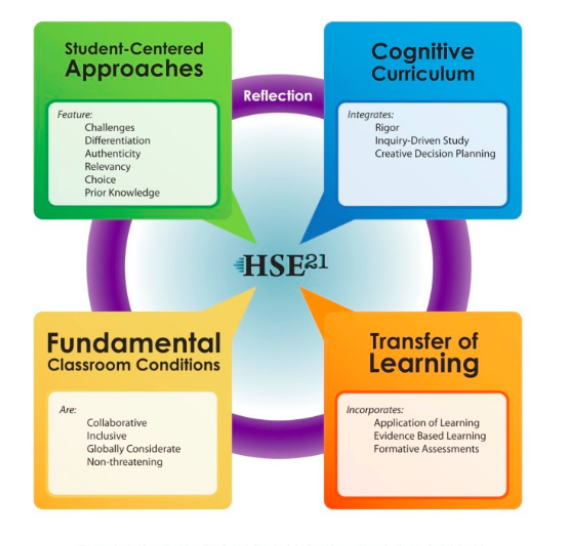
HSE21 Best Practice Model

This summer, in addition to the learning that I did on my own, I was able to participate in a couple of different conferences, and the learning opportunities that were provided to me there continued to reaffirm that we are on the right path.  Throughout the posts that I have made to this blog in the past year, I have constantly referenced the Best Practice Model.  When we look at the HSE21 homepage, we see the following statement to describe learning in HSE:

We must ensure that our students develop a strong academic edge through experiences with rigorous academic content and effective information, communication, and technology skills. Our students’ future education and career choices require critical thinking, creative problem solving, and the ability to work together with others to successfully compete in today’s world. In HSE classrooms, students think deeply and critically about content knowledge and complex issues. Students regularly collaborate and actively investigate real-world problems. Hamilton Southeastern Schools is dedicated to implementing curriculum and learning opportunities that build the skills and abilities necessary for our connected society. When students graduate from HSE Schools, they will be ready for their future and equipped for excellence. (from http://www.hse.k12.in.us/ADM/academics/hse21/)

So…  What does that mean for our classrooms?  Here are some things that I think we all should expect to see in a classroom:

  • Voice – In the summer before my senior year at IU, I took a class, and the mantra of my professor was “Learning is social!” This is just as true today as it ever was.  Our students need the time to co-construct their knowledge.  They need time to share their learning, and to learn from one another.  Empower your students to speak up in your classroom so that they are able to use their voice when they move beyond the classroom.
  • Choice – Students need as much choice as possible. Allow your students times to choose what they learn, how they learn, what they produce as a result of their learning, etc.  How many of you struggled early in your undergrad years, only to do much better as you moved along in college?  Why does this happen to so many?  It’s because as a freshman or sophomore in college, so many of your courses are prerequisite, not something you chose, rather something you are required to take.  What happened as you got into classes that were more directly related to your degree?  If you’re anything like me, you did much better.  These are the things you were interested in and the learning was more relevant for you.  The choices we give students helps make their learning more relevant!
  • Time for Reflection – John Dewey is quoted as having said “We do not learn from experience; we learn from reflecting on experience.” That time for reflection is so important!  We need to be intentional in building that time in for students, and we also need to build it into our own practice!  I know classrooms are busy places, and we are busy people, but a few minutes of reflection allows us to really think about and understand what we have learned.
  • Opportunities for Innovation – When our students are passionate about something, the learning never stops. If our students are playing a video game and get stuck, they aren’t going to give up – they’ll find a way to beat it (maybe a YouTube video, help from a friend, a cheat code, etc.).  How can we create that attitude for learning?  Help students to find the curiosities in your subject matter, or give the students the time to explore their curiosity, and then let them innovate in that space!
  • Critical Thinkers – One of the hallmarks of the educations system has been the idea of compliance – this came about as part of the factory model of education. This factory model and expectation of compliance does not allow our students to be critical thinkers.  Our students need to be taught how to respectfully ask questions and challenge ideas of others for the sake of helping us all move forward. Hemingway once said that “Every man should have a built in automatic crap detector operating inside him.”  Our students need this skill in these days of social media and internet hoaxes.
  • Problem Solvers/Finders – While at a Pure Genius workshop this summer I heard a story of a high school student who saw that families who were part of the Supplemental Nutrition Assistance Program (SNAP) who were often unable to use their benefits to purchase healthy food for their family. The student began working with the Noblesville Farmers Market to find a way to allow families to use their SNAP benefits at the farmers market.  As part of her project, the student created wooden coins that she designed and printed using technology available to her at Noblesville High School.  Now families can take their SNAP card to the farmers market, swipe the card for the amount of benefits that they wish to use, and receive market currency in that amount to be spent on items at the farmers market.  One thing I know about most kids – they recognize things that they feel are not just.  Allow them to identify those problems, and create learning opportunities in the classroom that allow students to find solutions to the problems they see in our world!  Then, help them take that learning outside of the classroom.
  • Self-Assessment – Earlier I talked about the importance of reflection – on the day to day level, that reflection allows us to better understand new information, but on a long term level, that reflection allows us to see our own growth. A portfolio is just one way that students can look back and see their own growth.  Students can see where they were and how far they have come.  It is a valuable skill for all of us to be able to identify our own strengths and weaknesses.  We need to provide students with opportunities to assess themselves.  What might a digital learning portfolio look like for your class?  If you’re struggling to visualize it, let me know and we can try to come up with a plan that would work for your classroom!
  • Connected Learning – When we encourage students to be problem finders, we might run into some issues. What if the problem that students want to solve is something you know nothing about?  You might feel there is no way you can guide them to a solution.  That may be true, but in today’s connected world we can use technology to connect to experts who are able to support your student’s learning.  Though Twitter, Skype, FaceTime, Google Hangouts, and others, our students can create connections that allow them to learn.  Imagine if your students were connected with students at other levels with more background knowledge, or maybe even with people who have gone much further.  Who would you rather learn about space from?  A teacher or an astronaut?  With social media like Twitter, that astronaut is only 140 characters away!  With technology we can teach students how to facilitate their own learning.

In addition to all these factors, there is at least one other factor to success for our students in the future.  Our students need to be good people.  I don’t care how smart you may be, if you are unkind and disrespectful you will never find the same level of success.  In most schools we talk to students about their actions as a choice.  Remind them that it is always important to choose kind (if you follow me on Twitter, you will see the hashtag #choosekind a lot this year!).

What have I missed?  What can you expand upon?  Keep the discussion going in the comments below!  Enjoy your remaining weeks of summer, and be thinking about what you can do to make your classroom the best environment possible for your students!

An Open Letter to Educators

Earlier this summer I finished reading the book The Innovators Mindset by George Couros (@gcouros).  One of the things that I loved about the book was his use of his website and blog as a way of linking to important information that tied to the chapter you had just completed.  On his website you find a page dedicated to each chapter of the book.  It has a brief overview as well as links to additional reading (typically blog posts or new articles), as well as video resources.  One of the links led me to the video below titled “An Open Letter to Educators.”  Take a moment to watch the video:

A few thoughts after watching:

  • If a strong education is the key to success, what does that education look like in this day and age?
  • Does the current institution of education get our students prepared for a successful future?
  • How has “free” information changed your life?  How might it continue to change the lives of your students?

If, as Dan Brown says “education isn’t about teaching facts, it’s about stoking creativity and new ideas” and one of your primary goals should be to “empower students to change the world for the better” then I wonder what our classrooms need to look like?  What are we getting right?  What aren’t we getting quite right yet?

For me, I see collaboration, student choice and student voice, authentic and meaningful learning, inquiry based activities, and opportunities for our students to apply their learning beyond the classroom as keys to help meet these needs for our students.

InnovatorsMindsetWhat do you see as the keys to success for your students?  How is your classroom currently meeting the needs of your students?  In what ways is your classroom still falling short on meeting those needs of your students?  Share your thoughts in the comments below!  If you’re looking for ideas and inspiration, I highly recommend The Innovators Mindset as a way to help you find opportunities for innovation!


I don’t have time for that!

I don’t have time for that!

It’s a refrain that seems to come up quite often in education.  You might have just left a professional development talking with a colleague and you feel excited to try something that you learned only to hear “I don’t have time for that” in response.  Or maybe you shared an article with a friend that you have used to help in your classroom, and the only response you get is “I don’t have time for that.”

Or even worse, maybe you’re the one saying “I don’t have time for that” to your colleague, administrator, or friend.  My immediate response, knowing that we work primarily in a learning environment, is “You don’t have time to learn?”  Would you allow your students to say that?  Would that be an acceptable response in your classroom?

I would challenge you to shift your mindset.  Reading a recent post from the blog Principal of Change, George Couros makes a suggestion of what we can say instead of saying “I don’t have time for that.”

  1. How will my students benefit from this practice?
  2. I am not seeing the relevance of this for teaching and learning…could you give me specifics of how this would impact my practice?
  3. How would you suggest incorporating what you are suggesting into my position?
  4. What has been the biggest benefit for your own practice?
  5. If I was to do this, what would it replace that I am doing now?

Time

How many times have we all tried things, thinking that they wouldn’t be valuable, or we wouldn’t like them, only to realize a few days (or weeks, or months) into the new thing that we couldn’t imagine not doing things this way?

So what can we learn from those moments?  My hope is that we would come to the realization that it is important to be open to learning and trying new things.  Just because you feel as though you “don’t have the time” you can’t just dismiss something out of hand.  Take the moment to ask the questions above.  If the answers are satisfactory, then that should show that you need to make the time to learn a little more, to try it out, and hopefully create a better learning environment for our students.

Remember that we are the ultimate models of learning for our students.  If we never try something new, if we never exit our comfort zone, if we never do things differently than the way we’ve done something in the past, then we are saying to our students that it’s ok for them to be the same way.

What are some things you tried, not knowing quite how they would work out, only to be pleasantly surprised by how great it really was?  Let us know in the comments below!

Defining Innovation

Recently in education there has been a lot of talk about innovation.  The question is, how do we really define that word?  What is innovation in education?  Do we get there by handing our kids a digital device and then stepping back?  Do we get there by taking our old worksheets or workbooks and fill in the blank packets and making them digital?

This electric car dates back to the 1890s at a time when electric vehicles outsold combustion engines at a rate of 10 to 1.

When I think of innovation, I don’t just think of something as new – I think of something that is both new and better.  Electric cars have existed since the 1830s (look it up!), but not until recently with companies like Tesla (or Toyota with the Prius) have electric cars begun to be innovative because not only are they something new, but some would argue that they are better than other options on the market.


Avoid the $1000 Pencil


If we hand our students an iPad and then take our old lessons and make them digital, then that iPad is nothing more than a $399 (or maybe more depending on the model of iPad) pencil.  Are we being innovative by spending that much on something that we were already doing?  Probably not!  In the past, I have talked about the SAMR model.  Substitution and Augmentation are the basic levels of tech integration – to get to the Modification and Redefinition is a high bar to climb.  Look back at a previous post for what it takes to get there.

So to be innovative, we have to shift our mindsets.  Just adding tech does not make you innovative.  Being intentional in our choices about how we use technology is what gets us to the innovative activities that will lead to greater student engagement and growth.  And here’s what’s amazing about that – what’s innovative in one classroom or for one teacher may not be innovative for another.  Innovation is different for all of us because we all are at different places on the spectrum of innovation.

As you think about how you want to grow and innovate as a teacher, take it one activity at a time.  Think about what you could do to make this one thing new and better.  As you innovate one thing, you may get the bug to innovate in another area.  With each step you take you move further along that spectrum.

It’s easy to get stuck in a creative rut and say we don’t have time, but if we don’t try new things, we aren’t modeling for our students what it means to learn and grow.  Sometimes we all have to be a little uncomfortable with where we are or where we’re going.  Think about how often you expect your students to try new things, to be a little uncomfortable, and to be willing to fail.  Sometimes we have to remind ourselves what that feels like by pushing ourselves to go a little further.

What is one activity that you think you can play with this summer to make it new and better for your students in the fall?  How will you make sure that you keep pushing yourself to be innovative?  Add your thoughts in the comments below.

Reflection & Growth

Follow effective action with quiet reflection. From the quiet reflection will come even more effective action.

At the end of every school year, one of my favorite things to do is to take some time to reflect on the year – what worked well?  What didn’t work so well?  What are the things I want to improve upon?  And conversely, what are the things I want to just forget ever happened?

As you are wrapping up your year, keep in mind that moments of reflection can be one of the most powerful pieces of the learning puzzle.  After you have finished cleaning your classroom, preparing for summer break, finishing student grades, and the multitude of other things that the end of the year will bring, take a little quiet time by yourself to just reflect.

You might choose to look back at your lesson plans from the year, you might look at samples of student work that you hung onto, or you might have another method that works for you to remind yourself of all that happened in your room during the last 180 student days.  Whatever method you choose, ask yourself some questions:

  • What are the things that happened this year that were awesome, and you can’t imagine not doing again?  How will you make sure not to forget by next year?
  • What are the things that you were excited about that maybe your students didn’t enjoy as much as you thought they would?  What could you add to get the students more excited about that topic? (If you’re looking for some ideas to hook your students into a lesson, check out Teach Like a Pirate by Dave Burgess – tons of great hooks that can build interest, excitement, and engagement)
  • What did you feel was the single most effective thing you did in your classroom this year?  What ideas can you take from that activity to make other activities more effective?

As you reflect, also take some time to think about things you wish to learn more about.  Make a list of those things that you wish to learn more about.  Write it down so you don’t forget.  If you’re anything like me, the first few days of summer break will be just that, a break.  At some point, you’ll get the itch to think a little more about the things that will help you grow as an educator.  At that time, go back to your list and use some of your free time to grow as an educator!

Many of us also love to have an accountability partner so that we don’t get to the end of the summer and feel like we didn’t accomplish any of the things we wanted to do.  Share the things that you are interested in with your colleagues at the beginning of summer – your teammate, your PLC, others with similar interests – and then reach out to them from time to time.  Share what you are learning, a great book you’re reading, a blog post you loved, or something else that fits with your topic.  For those of us on Twitter – use the hashtag #RSISummerLearning (clicking the link will take you directly to a search of that hashtag on Twitter) to share what you’re up to.  Even if you don’t post to Twitter, you can go to that search anytime to see what others may have shared.  The more we all share, the more we all can learn from one another!  Next August we’ll all be able to bring that learning back to school to support our students and do even more amazing things!

Most of all, enjoy your summer time!  I know that I’m looking forward to my summer for some relaxation, a Cubs game or two, time with family and friends, and time to do some of the things that I never seem to have time for during the school year.  Have a great summer!

Engaging & empowering our students

Last week I shared with you some data on student mental health issues, anxiety, and student engagement.  I closed the post with these three points:

  1. Mental health concerns in our students are rising.
  2. Levels of engagement decline as our students grow older.
  3. Even with increased focus on standards, performance on standardized testing has remained stagnant.

So what can we do?  I’m sure that all of you have noticed these patterns in our own classroom, but knowing the pattern is only part of the task of finding a solution.  In last week’s post I shared the work of two college professors.  Going back to their work, I hope to share a couple ways we might be able to help fight anxiety and lack of engagement.

Peter Gray, the psychology professor from Boston college, feels that the key to learning and growth for our students is free play:

Children today are less free than they have ever been.  And that lack of freedom has exacted a dramatic toll.  My hypothesis is that the generational increases in externality, extrinsic goals, anxiety, and depression are all caused largely by decline, over that same period, in opportunities for free play and the increased time given to schooling.

So as a school, what does play look like?  For one it means we have to be sure to value recess/physical activities during the school day.  There is clear research that one of the benefits of physical activity is increased student engagement.  Think about your classroom on an afternoon where we did not have outdoor recess due to weather.  What are the engagement levels like?

Several recent research studies have looked into increased free play time in the school day, and the results suggest that students with regular recess behave better, are physically healthier and exhibit stronger social and emotional development.

Knowing these facts, does that lead you to think about changing what you do when you return to the classroom on a day when we are unable to go outdoors for recess?  Hopefully you can think about finding a way to squeeze in some free play on those days.  If not free play, then a few short brain break activities to get the kids out of their seat and moving.

And what about the days that students already get their recess?  Does that mean we don’t need to look for other opportunities for play?  Many of our teachers have been doing outdoor activities here at school this week.  I’m sure that they would share that the students are loving the activities they’ve been doing – they are active, engaged, and empowered in this learning environment.  My question though: Do we only save activities like this for the end of the school year?  Or do we try to integrate play into our lessons throughout the year?  How can we make use of our outdoor space, our small and large group instruction rooms, or even just the hallway to get the kids up and playing as they are learning?

Next we have the issue of engagement.  For the purpose of this piece, I am defining engagement in school based on the Schlechty’s Center for Engagement definition:

  • The student sees the activity as personally meaningful.
  • The student’s level of interest is sufficiently high that he/she persists in the face of difficulty.
  • The student finds the task sufficiently challenging that she believes she will accomplish something of worth by doing it.
  • The student’s emphasis is on optimum performance and on “getting it right.”

Is it engagement when we work hard to get students into content that we have selected for them?  You may be able to get their attention, but if it’s based on extrinsic goals (like a grade) the motivation may not last.  So here are some ways you might be able to increase motivation in your classroom:

  1. Students are more motivated academically when they have a positive relationship with their teacher.
  2. Choice is a powerful motivator in most educational contexts.
  3. For complex tasks that require creativity and persistence, extrinsic rewards and consequences actually hamper motivation.
  4. To stay motivated to persist at any task, students must believe they can improve in that task.
  5. Students are motivated to learn things that have relevance to their lives.
HSE21 Best Practice Model

As you spend time thinking about bringing more inquiry into your classroom, as you work to better incorporated the HSE21 Best Practice Model, you will begin to notice increases in your student engagement.  When we provide our students with challenges, with activities that are relevant to their lives, when learning is rigorous and based on inquiry-driven study, when students are able to apply their learning in collaborative ways, when we work to incorporate more of the HSE21 Best Practice Model we will see increases in student engagement.  In fact, if we work towards truly relevant and rigorous study students will not only be engaged, but actually will be empowered to take their learning to levels that we can’t possibly imagine!

As we approach the end of the year, take some time to reflect on things you have tried that have been new.  What activities have led to increased levels of engagement?  What ways have you been able to get a kid truly excited about what they are learning?  Now, think ahead – how can you take the things that have been successful and expand on them for next school year?  Share your thoughts in the comments below.