What’s your why?

The vast majority of the people reading this blog are in the educational realm.  Whether you are a teacher, a counselor, an administrator, or you work in a school in some other way, something called you here.  Take just a moment to think about it, what was it that brought you to this point?

For me, when I think about what brought me into education, there are a few moments in my lifetime that stand out.  I remember my fifth-grade teacher, Mrs. Gromer.  With her, the Maya Angelou quote to the right comes to mind.  There aren’t very many specific things I remember happening in her classroom, but I remember that I always felt welcome, and valued, and important.  I felt that if I wasn’t there, someone missed me, and some value was lost from the class.  While I had great teachers before her, and great teachers after, nobody ever made me feel as important in the classroom setting as Mrs. Gromer.

In high school, one of my stand out teachers was Señora Cease – she was my Spanish teacher for all three years that I took the class.  While I may not be fluent in Spanish today, I learned some valuable study skills that I don’t believe I would have learned anywhere else.  Learning a language came hard to me, and while some friends were valuable parts of my studying, her efforts and ideas in class gave me skills that translated to so many other areas.

Then I think about Professor Katz.  Easily the most entertaining professor that existed – I’ll put money on it.  He was a history professor at IU.  I had the luck of knowing him when I was young, which meant that when I walked into his class, I became an easy target of his.  In a lecture hall full of 400 students, he would find me no matter where I sat and ask my opinion.  While I am a fairly confident person now, I’m sure that term didn’t always describe me. On the first day of class he asked me a question, to which I responded in a noncommittal way.  His response “Are you asking me?  I was asking you.”  Professor Katz helped teach me to be confident in all that I do.  While many of the small groups were led by instructional assistants, I had the privilege of being in the group that Professor Katz led himself.  You had to know your stuff – there was no hiding from him.  In addition to confidence, Professor Katz taught me about preparation.

All of these pieces of my history in education are part of what I brought to my classroom.  I wanted to bring the warmth that Mrs. Gromer had – I wanted my students to know that they were valued and important in my classroom.  I would work to provide scaffolding to support students who were struggling, just as Señora Cease had done for me.  And I would challenge my students at times – push their thinking when I thought they were just giving me surface level knowledge – just as Professor Katz pushed me.

I’m sure there are other things that come from my history that led me to the role that I’m in now, but now, I have an even more important why.  I look at each of my kids.  They have such unique personalities.

Lainey is the quiet rule follower.  Last year she actually received a reminder from her teacher – just one – and she cried about it as soon as she walked in the house.  We still can’t talk about it for fear of another evening full of tears.  She’s also very intentional, to the point of perfection on some things, which causes her to work slowly and sometimes not complete her in class work or feel as though she is falling behind her peers.

On the other hand, there’s Brody.  He’s not in school yet, but he’s been going to preschool.  Brody’s curiosity is almost indescribable.  He’s constantly asking questions – Why? Why do they call it baseball?  What does that word mean?  Sometimes it’s almost exhausting to answer all the questions he has.  To go with that, he loves to play rough – there are a couple of times I thought he was going to take me out by the knees, and even though he’s grown up with a sister, and almost all the kids in the neighborhood around us are girls, he finds ways to get them to play rough as well.  I expect Brody to be a kid who will probably rush through things.  While on spring break last week, he was always asking what we were doing next, so excited to get on to that, that sometimes it seemed that he couldn’t enjoy what we were doing in the moment.

And I know that both Lainey and Brody will have challenges as they grow older.  School can be a difficult place for kids.  Lainey will have times that her perfection will cause her to fall behind others, while Brody will be so concerned about getting on to the next thing, that he’ll probably hand in a paper half completed with several mistakes.

I have hopes and dreams for these two.  I want the best for them.  And I know that if that is the way that I feel, then the parents who trust each of us with their children have similar types of hopes and dreams.  The faces that sit in our classrooms each day are their everything, and they want the best for their kids as well.

So while Mrs. Gromer, Señora Cease, and Professor Katz may be the past why that pushed me into education, and led me to be the teacher that I became, they aren’t the why that will push me moving forward.  The past isn’t going to push me to strive to go further.  The past isn’t what’s going to help me continue to learn and grow as an educator.  Instead, I rely on my kids to be the catalyst for that growth.  And each of the 1,000 kids who walk into our building each day becomes the fuel that keeps that learning and growth going.

So…  What’s your why?

Share your thoughts in the comments below.  I’d love to hear what it is that drives you to do what you do.  Education isn’t easy, and we all need that why to push us!

Building on our strengths

When you get up in the morning, what are you excited about?  For most of us, the thing that gets us going in the morning is also the thing that drives us throughout the day.  It’s also typically something that we feel confident about, that we think we do well, and we enjoy doing.  Most importantly, that thing is also something we would identify as a strength.

I feel that often in education, we get drawn into thinking about weaknesses.  As a teacher, we have to identify weaknesses in our students in order to find ways to support their growth.  As an administrator, evaluations often include identifying weaknesses of the staff in our building, and planning to lead to future growth.  We get caught in a cycle of looking for the weaknesses around us.  If our strengths are the things that motivate us, isn’t it safe to assume that our learners would be motivated by their strengths?

A few years ago, as an ongoing activity throughout our unit on Ancient Rome, I provided students with a list of possible ways they could articulate learning.  These choices involved aspects of Roman society and culture.  I was amazed by the projects that students were able to create based on their strengths.  I had students designing roman outfits based on research because they were interested in style and design.  I had a student write a children’s picture book about the Roman Empire because they felt they were good writers and illustrators.  And probably my favorite, I had a student, Patrick, who had struggled all year long but designed and built a scale model of a Roman Aqueduct that was SPECTACULAR (it’s still in my office today) because he liked to build things.  While we were doing in class activities for learning, students were also researching for these projects.  They were able to select a project that fit their strength, and the results were amazing.  Having students present something that they had learned that also fit with their strengths was such a rewarding experience for me, and I’m sure led to a greater transfer of learning for each of them.  I would guarantee that none of them would be able to answer any of the questions we had on a summative exam, however I would also bet they could tell you about what they created for that project.

Knowing how strengths can motivate all of us reminds me to be on the lookout for strengths as I am walking the halls.  I am challenging myself to look for the strengths or everyone, and recognize those strengths!  I challenge you to do the same.
Be thinking about the data that you collect on students.  Don’t just look for patterns in terms of weaknesses.  Also look at the data that supports their strengths.  Give them the opportunity to build upon those strengths.  Most of our students will choose a career path based on their interests and passions.  Wouldn’t school be a better place if we gave our students the opportunity to accentuate their strengths?  I’m not saying we ignore areas where a student needs to grow, but I can tell you that all the time that my sophomore English teacher had me spend diagraming sentences is not what has led me to be a good writer, a good reader, or any of the other skills I have developed.  All it did was make me hate sophomore year English (sorry English teachers!).

Take a few moments in the coming days to seek out the positives in the students that are in your classroom.  Identify the things you see, and share it with your students.  See how they react to some strength-based feedback.

#IMMOOC #IMMOOCB3: Engage or empower

Engagement.  We all say that this is what we’re striving for when our students are in the classroom.  We want our students to be engaged in whatever’s happening in our classroom.  Normally that means getting your students excited about whatever it is that your class is studying.

But as we think about what it takes for any of us to learn something new, being engaged in the activities doesn’t guarantee learning.  I can guarantee that in the next few days I will be engaged in hours of watching NCAA Basketball.  The likelihood of any kind of deep learning happening in that time is not very high.

Bill Ferriter – @plugusin

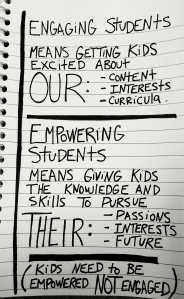
To get students to that deeper understanding, the learning needs to be meaningful.  Bill Ferriter (@plugusin) says “Kids need to be empowered NOT engaged.”  So how do we get there?  Ferriter goes on to say that “Empowering students means giving kids the knowledge and skills to pursue their: Passions, Interests, Future.”

One of the things I believe in education is that we have great power to help our kids be excited about learning.  The more student choice and voice we give, the more authentic and relevant approaches we take, the more we shift our students from engagement to empowerment.

#IMMOOC #IMMOOCB2: School vs. Learning

The graphic above was created by @sylviaduckworth in response to a blog post by @gcouros about the differences between a traditional school setting, and comparing it to what we know best about how people learn.  It makes me think of the TED Talk by Ken Robinson on Changing Education Paradigms (check out this version).

Couros looks at the differences from the graphic above in his post School vs. Learning where he looks at the traditional school model compared to the way that research shows that people and students learn.  Think about the ways you learn best.  Do the descriptions on the left or right of the graphic above fit with your experiences of learning?  The next question – what do the classrooms that you are in most look more like?

Engagement is great, but engagement alone is not learning.  My kids can be engaged with YouTube for hours if I let them.  Does this mean they’re learning?  If we want learning to happen for our students, we need ask “what can I do less of?”

Reflect on what school looks like for you.  If what you reflect on makes you uncomfortable or gives you pause, think about where you can implement change to make learning new and better for your students.

#IMMOOC #IMMOOCB1: A culture of yes!

So we say we want innovation in our schools, in our classrooms.  Many of us feel that this is the best way to get our students past the point of engagement, and moving to the level of empowerment.  But there is one little word that can kill that process – no.

In the past couple of years, we have had many opportunities to interview potential teachers.  Every time we bring an interview team together, we all agree that we are looking for people who are “go-getters” – people who will do whatever it takes to make the learning experiences for their students new and exciting.  They have helped to bring exciting new learning opportunities into our school.  At the same time, many of the teachers in our building continue to learn and evolve – trying new formats of teaching, new activities, new technologies.  This innovation continues to spread, and is so exciting to watch!

If you know much about improvisational comedy, you know that during a scene the key is to not say no.  The mindset has to be to have an attitude of “yes, and…”  This is what we’re seeking for innovation.  When there are new and exciting ideas that will make learning better for students, I strive to say “yes, and…”

My hope is that this culture of yes will allow us all to continue to learn and grow.  Ultimately, our growth will allow us to make learning more innovative for every student!  Isn’t that the goal?

#BookSnaps

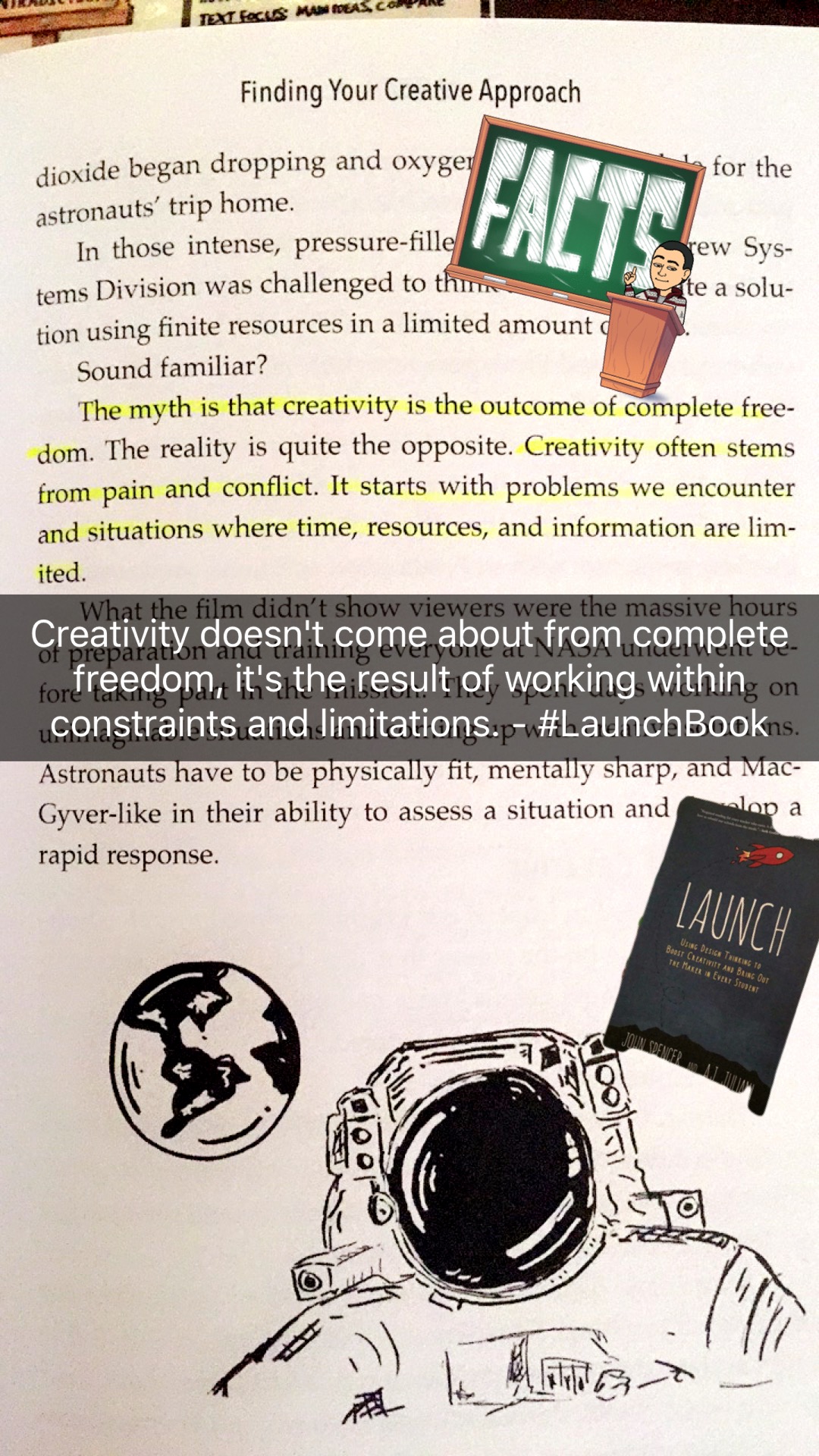
This is a BookSnap I created while reading the second chapter of the book Launch by John Spencer and AJ Juliani

If you are on Twitter and follow any of the same people that I do, you have probably noticed people posting pictures of text, sometimes with highlighting, adding emojis, bitmojis, or text, and then posting it on Twitter with their own comments.  Normally if you look at the comments, you will see the hashtag #BookSnaps linked to it.  Even if you aren’t on Twitter, you can see what people are posting by clicking this link: Twitter #BookSnaps

If you go to Twitter and check this out, you will probably notice that most of the posts here are educators who are sharing their personalized professional reading with their Twitter followers.  If you look closely though, some of what you will find is teachers sharing BookSnaps that students created in their classroom.  It got me started thinking about how some of you might be able to use them in your classroom.  Check out this student created BookSnap that the teacher then added some additional comments to:

This BookSnap was created by a student on SeeSaw and then shared by a teacher.

Most of the ones that you see are using SnapChat in order to create and share.  For those of you that know what technology your students are using, SnapChat is a pretty popular app.  But here’s the thing, there are ways that BookSnaps could be created using other apps that don’t involve the social network aspect of SnapChat.  Any app that allows you to pull in your own pictures and add text, drawings, and emojis could be used in the same way.  The student created example to the left was created using SeeSaw.  Some other examples that come to mind are Skitch, Google Drawings, various PDF annotating apps, and even Instagram.

Think of the potential engagement for your students if you asked them to create their own BookSnaps.  Could you imagine what they would say if you told them to open SnapChat or Instagram in class?  In ELA classes, you could have students create a BookSnap when they run into a Notice and Note signpost.  You could have them create one to identify the climax in the book they’re reading, or create one based on their own writing, identifying specific plot points.

And don’t say “I’m not an ELA teacher, this doesn’t apply.”  I could see real potential for BookSnaps in nonfiction reading as well – identifying the main idea in a science article.  Sharing things that surprised them as they are reading about some historical figure.  Responding to the 3 Big Questions from Reading Nonfiction by Beers and Probst.

I could even see integration into math class – MathSnaps could be a thing (acutally I just checked, and it is a real thing on Twitter)!  You could have a kid snap a picture of the answer to a problem and then add text describing how they came to that answer.  Or there could be ArtSnapsMusicSnaps, or GymSnaps.  The limitations are only bound by the creativity of how to integrate this technology.

As for how to share, again, the options are probably endless.  If you’re already using SeeSaw, that’s an easy option.  Other ideas I’ve seen include Google Slide Decks, a class shared PowerPoint (these options allow everyone can see what BookSnaps other kids have created based on the same reading assignment), or even something as basic as emailing it to you (although a way to share with classmates would make the audience so much more authentic and meaningful).  Once kids have shared them with you, find a way to share beyond the walls of your classroom.  If you’re on Twitter, tweet it out with the #BookSnaps hashtag – others will see it.  You could also put it out on Instagram or Facebook – both have people actively using this hashtag.  If you don’t have social media, you could have students print them out and put on their locker, or create a BookSnaps bulletin board.

If you are still at a loss for how you even create a BookSnap, there are some great resources from Tara Martin.  You can find her on Twitter at @TaraMartinEDU or @BookSnapsREAL.

On Martin’s blog, she’s also created some how to videos that could be useful to see how she puts a BookSnap together.  Check it out here: http://www.tarammartin.com/resources/booksnaps-how-to-videos/

I know I’ve got some creative people in my audience.  If you have an idea for how BookSnaps could be used in the classroom, please share in the comments below.  My ideas above are simply ones that have come to me in the past couple of days.  You might have something that I haven’t thought of – or possibly never would.  Let us know!

If you begin using BookSnaps in the classroom, please share them!  Use the #RSIHawks or #RSIReads hashtag in your post!

Successful adaptation

I’m not sure how many of you have read the book The Innovator’s Mindset by George Couros.  It’s a book that I have referenced in the past, and today I happened to be on his blog and came across a great post that I want to share.  Below you’ll find a link to his short post titled “Successful Adaptation.”  Click the link to check it out, and then come back here for some closing thoughts:

Successful Adaptation – by George Couros

How many of those contradictions are things that you’ve heard, or maybe even said, before?  I feel our steps with the HSE21 Best Practice Model have helped us to attack many of the contradictions, however I still see some of those contradictions within our building.

I know Couros shared his own remix of those contradictions written as questions, but I have a few more questions for us to think about:

What have you created in the past week?  Month?  Year?  Have you shared any of those things with your students?  How could our own efforts at creation model that expectation for our students?

What are some areas that you would be willing to give up the expectation of students asking for permission? (assuming they are acting responsibly)  How would this promote greater empowerment for our students?

What are the things that you have let go of this year in order to show more of a growth mindset?  What are the policies within our classroom or our building that get in the way of the growth mindset?

I want to say again, I am not asking you to change for change’s sake, rather I am asking you to think about how you might change in order to make your classroom a better learning environment for our students.  With that, I want to leave you with one of my favorite quotes from Couros:

learner-centred

If you feel up to it, share your response to one (or more) of these questions, or one of the questions from the original quote by Couros in the comments below.

Media literacy

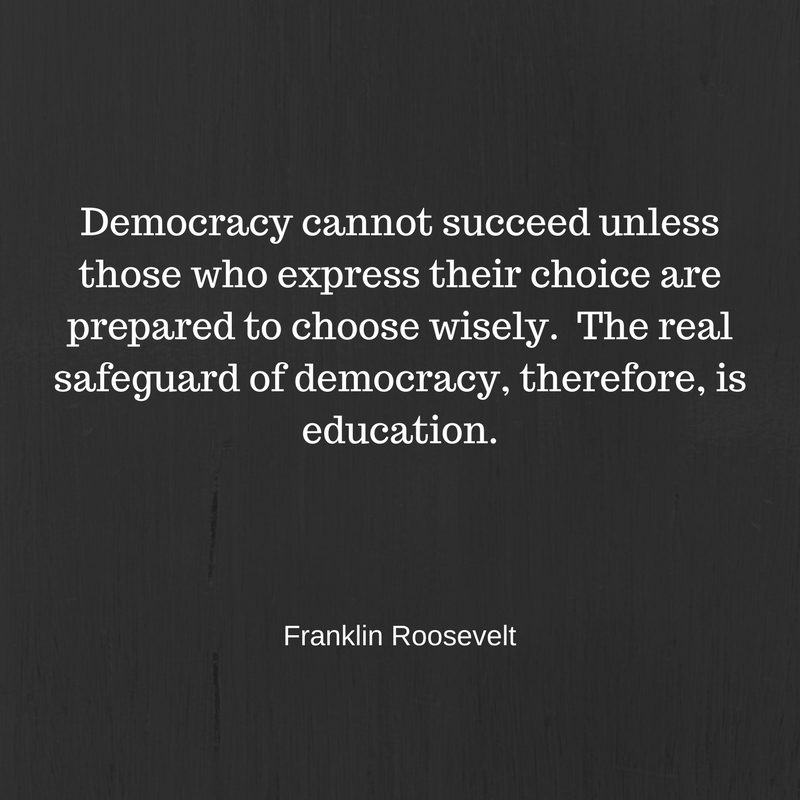
democracy-cannot-succeed-unless-those-whoexpress-their-choice-are-prepared-to-choosewisely-the-real-safeguard-of-democracytherefore-is-educationAccording to the Center for Media Literacy (CML), the most basic definition of media literacy is “the ability to access, analyze, evaluate, and create media in a variety of forms.”  However in today’s world they have expanded that definition a little further and now define Media Literacy as:

“a 21st century approach to education.  It provides a framework to access, analyze, evaluate, create and participate with messages in a variety of forms – from print to video to the Internet.  Media literacy builds an understanding of the role of media in society as well as essential skills of inquiry and self-expression necessary for citizens of a democracy.”

If you aren’t sure why I’d be writing a post on this topic, I have 2 questions for you… 1) What bubble have you been living under? and 2) Might I join you there?  It seems that wherever you look – news, Facebook, Twitter, websites, etc. – you can never seem to get an accurate answer.  One location you might see a story that says something definitely happened, elsewhere they say it might have happened, and in a third place it definitely didn’t happen.  Scrolling through my Facebook and Twitter feeds, the people I am friends with or follow have all kinds of different beliefs.  Within a couple of minutes of scrolling, I often see links to articles or headlines for articles that directly oppose one another.  It’s completely overwhelming!  One good thing to come of it?  I’m finding more time to read books, and I’m spending less time on other forms of reading.

So, if we feel overwhelmed, what in the world are our students thinking?

As I was thinking about this article, I spent some time looking at various resources for media literacy, and there were tons.  One of the resources that I found was on the Center for Media Literacy’s website.  They share that the heart of media literacy is informed by inquiry and share a four-step process:

  1. Access information from a variety of sources.
  2. Analyze and explore how messages are “constructed” whether through social media, print, verbal, visual, or multi-media.
  3. Evaluate media’s explicit and implicit messages against one’s own ethical, moral, and/or democratic principles.
  4. Express or create their own messages using a variety of media tools, digital or not.

So what might a lesson in media literacy look like in one of our classrooms?  As a brief overview, it might be something like this:

  • Choose an interesting, provocative, or possibly even controversial topic that is in the news – or if this seems too far, pick advertisements for similar products.
  • In pairs or teams have students seek out different sources that have shared that story. If this makes you nervous, maybe select the sources in advance and share those sources with the students.  Don’t limit them to print media – use videos, radio, podcast, YouTube, etc.
  • Have students analyze and evaluate their resource – I’ll share more about this process below.
  • Finally, have them use what they have learned to share their own message about the topic.

On the CML website you can download a free resource titled “Literacy for the 21st Century.”  One of the things you will find in this document is a list of Key Questions and Core Concepts.  While the free resource on the CML site will go into a lot more detail, here are those Key Questions and Core Concepts:

Key Questions:

  1. Who created this message?
  2. What creative techniques are used to attract my attention?
  3. How might different people understand this message differently?
  4. What values, lifestyles and points of view are represented in, or omitted from, this message?
  5. Why is this message being sent?

Core Concepts:

  1. All media messages are constructed.
  2. Media messages are constructed using a creative language with its own rules.
  3. Different people experience the same media message differently.
  4. Media have embedded values and points of view.
  5. Most media messages are organized to gain profit and/or power.

medialiteracy-image-11

And why do we need to be thinking about media literacy?  With the current political climate, it can be tempting to bury our heads in the sand in terms of talking about issues with students, however our students need to have the 21st century skills to be successful.  Media literacy is an important part of those skills.  In fact, according to CML, “helping our students to be media literate is an alternative to censoring, boycotting, or blaming ‘the media.’”

Hopefully you also see some connections between this post and our work with Reading Nonfiction by Kylene Beers and Bob Probst.  Teaching that questioning stance will help our students be more media literate as well!

What are your thoughts on this topic?  Have you been thinking about media literacy for your students?  Have you used news articles or topics in your classrooms?  Share your thoughts in the comments below.

The bear trap analogy

Today I was sitting with a student who had a rough start to the day.  He had gotten himself into some trouble because of a poor choice he made in class.  We were talking about what happened, and instead of talking about the incident today, the student started sharing with me about an argument he had with his dad yesterday.  It was almost lunch time and this student’s frustration was not with anything that happened today.  It was an eye opener to me – here’s a kid who had been in our building for almost 3 hours.  He was angry about something that happened yesterday, but he hadn’t had a chance to process those feelings with anyone.

As we started talking about what happened over the weekend and how it related to his incident in class, this student came up with a brilliant analogy.  He shared a story about a picnic, and I’m going to try to recreate it here:

Imagine going on a picnic, you have your lunch set up, and then you realize that you left something you needed in the car.  You walk back to the car to get what you need, and when you return there’s a bear eating your picnic lunch.

So maybe the next time you go on a picnic, you set a bear trap to keep the bear away, but while you’re busy watching for the bear, a bird sneaks up, and tries to takes some of the food, but the bear trap chomps down on the bird.

Somet
Sometimes the bear isn’t really here at school.

The student shared with me that in this analogy, the picnic lunch represents the student’s peace of mind.  The bear represents the true thing that the student was truly upset about, for this student it was the anger about yesterday’s argument.  The bear trap represents the student’s anger – for this kiddo it’s set and ready to go off at any time.  The bird can represent that thing that happens here at school that sets off an angry student – it could be another student, it could be something a teacher says, it could be the bus driver, etc.

More often than not, the students who walk in with their bear trap set are not actually on edge because of things that are going on here at school.  Even though this student “went off” here at school, his bear wasn’t in this building.  Instead a bird managed to set him off.

None of us are able to read our students minds, so we can’t always know who it is that is walking around with anger bottled up inside, however we all know who it is in our class that often seems to be the one who does lose their temper.  These are the students that we need to be aware of at all times.  Make it a point to check in with your students who might be that bear trap just waiting to go off.  It seems like more often than not, these students who reach their breaking point do so right before or after a break – sometimes even just the break of a weekend.  It also seems that for most of these students, once they have a chance to talk, a chance to process, they are much more likely to hold it together for the rest of the day (or sometimes even longer).

If you have a student like this in your homeroom, seek them out, check in, build relationships, let them know that you care, and make sure that they know you are there for them.  If you aren’t able to connect with that kiddo, maybe there’s someone else who can – a teammate, another teacher, a counselor, or someone in the office.  We want these kiddos to feel like they have a trusted adult and a connection here at school.  If you find a student who seems to be ready to lose it, talk with them.  See if you can figure out what’s wrong, if they don’t want to talk to you, see if they would like to talk with that other trusted adult.  Keep looking for ways to support the struggling student.  Through these steps, you might be able to help protect the birds who happen to be in the wrong place at the wrong time.

Have you ever had one of those moments with a student?  They are really upset about something beyond our control, but they reach their breaking point in your room.  What has worked well?  What hasn’t worked so well?  Share your experiences in the comments below.

Civil discourse

It’s a fact that we cannot control what happens every moment of our student’s lives.  We can’t prevent poor choices in the hallway, unkind statements in the lunchroom, or hurtful words on the bus.  However, we can try to right the ship in our own classrooms.

As a member of our building’s diversity team, this message came through loud and clear during a presentation at our most recent Diversity Coaches Meeting.  During this meeting, we spent an hour with Janet Chandler discussing the concept of Civil Discourse.  During the most recent presidential election cycle we saw endless attacks from various candidates, and many were not living up to the decorum that we might hope for from our elected officials.  The facts are that this type of climate has been in existence for a much longer period of time than just the past couple of years.

“A supporter of Thomas Jefferson once called John Adams “a hideously hermaphroditical character.”  Former Treasury secretary Alexander Hamilton called Vice President Aaron Burr “bankrupt by redemption except by the plunder of his country,” an attack so heinous that the men dueled, and Hamilton died.

Go through the nation’s history, and the noise and heat in public political discourse have always been there, rising with the cycles of economic distress, immigration and cultural upheaval.” – Ann Gerhart (The Washington Post, In Today’s Viral World, Who Keeps a Civil Tounge?, October 11, 2009).

Although uncivil discourse has been a part of our history, with today’s world of 24-hour news, social media, and technology, the noise of the less than civil statements seems to be nonstop.  So what are we to do when that spills over into our classroom?  Here are some tips that I took away from our conversation last week, as well as a link to a great resource from Teaching Tolerance (the link will be at the bottom of this post).  These tips are in no particular order, but hopefully will provide you with some ideas about how to handle discussions that may be a little difficult within your classroom.

If not us, who?

maslows-hierarchy-of-needsIt would be easy to say that these conversations on civil discourse are not our responsibility, but the fact is, there are uncivil things being said in our school building.  We simply cannot have the attitude of “it’s not my problem.”  When we become aware of issues, we have a responsibility to step in.  I can’t recall, nor can I find, where I first heard this, but the quote “we’ve got to take care of the Maslow stuff before you can ever hope to get to the Blooms stuff” comes to mind.  Our students can’t learn without their basic needs being met!

Set the example, not just the expectations!

It’s easy to talk about expectations.  We can say again and again what we expect.  But if, even once, we slip up, some of our students may follow our lead on this.  In a civil discussion we use titles: Mister, Misses, or Miss; President; Senator; Representative, etc.  If we refer to people without those terms, we diminish their role.  Just looking at my Facebook feed in the past couple of weeks, there have been a lot of people who aren’t using titles.  I’ve had people tell me that they won’t use certain titles because of a lack of respect in a person.  Isn’t that part of the issue here?  If you then read through Facebook comments on political posts, you see less than civil statements being made.  When you use a title, you add a level of civility and respect.  By modeling civility in your classroom discussions, you will help your students understand what that looks and sounds like.  Remember – kids act in a way they they see the adults in their lives behaving.  Modeling civil discourse will help lead to more civil conversations in the hallways.

Facts vs. Alternative Facts

I’ve referred to social media a couple of times, and I’m going to do so once again.  No matter your political beliefs, your party affiliation, etc., I think that any of us who have been on Facebook can agree that there are some outrageous statements being made.  The phrase fake news and alternative facts has become something of a joke.  Earlier this school year I posted a blog titled “Finding the author’s purpose” (if you want to go back to it, click here: http://wp.me/p6BRrr-6J).  In this post, I reminded you of the definition of nonfiction that Beers & Probst used in their book Reading Nonfiction:

“Nonfiction is that body of work in which the author purports to tell us about the real world, a real experience, a real person, an idea, or a belief.” (emphasis added)

In that post, I went on to encourage you to teach our students to have a questioning stance when reading nonfiction.  Every author has a purpose in what they have written – sometimes that purpose is not simply to inform.  Facts can be twisted and manipulated to support either side of the political spectrum, and social media is one of the most likely places to see this play out.  More often than not, the articles with the most extreme language seem to be coming from sites that are extremely liberal or conservative, or from sites you’ve never heard of before.

One important piece of a civil discussion is that it has to be based in fact (I could probably do a full post on the definition of the word fact…).  If you are having a civil discussion and someone shares a “fact” that is truly extreme, or is something that is not agreed on by most in the class, it’s time to talk about the idea of triangulating sources – can we find that fact from more than one source?  Do most people agree on this fact?  These conversations are so important because as Beers & Probst remind us that there is a greater purpose to teaching our kids the nonfiction signposts:

“Far more important than the ability to capture a teacher’s information and thoughts is the ability to acquire information on ones’ own, to test ideas against one another, and to decide for one’s self what notions have merit and which should be rejected or abandoned.”

If you read through the Teaching Tolerance link at the bottom, you’ll find a whole section on the three parts of an argument.  Here’s a quick breakdown:

  1. Assertion – The simple statement that is the basis or main point of the argument.
  2. Reasoning – This is the because part of an argument.
  3. Evidence – This is where you truly back your argument.  This may include statements from experts, statistics, data, or other research that supports you assertion and reasoning.

If you’re trying to have a civil conversation, encourage your students to include all three of these parts of an argument.  If you’d like more info on this, it can be found in Teaching Tolerance link below.

Respect

Probably the most important reason to work with our students on the concept of civil discourse is simply the idea of respect.  We are all entitled to our opinions, and we are all allowed to disagree with one another, but we have to make sure that these conversations are happening respectfully.  Our students need help to learn that it’s okay to agree to disagree.  Again, we can’t control what happens everywhere for our students, but we can do our best to make things right once they come in to our classrooms.

What experiences have you had in working with your students on civil discourse?  What has worked well?  What hasn’t?  Does the idea of having conversations like this in the classroom simply freak you out?  Share your thoughts in the comments below.  We can all learn from one another!

http://www.tolerance.org/publication/civil-discourse-classroom