Childhood trauma – part 2

Last week I encouraged you to watch the TED Talk by Nadine Burke Harris titled “How childhood trauma affects health across a lifetime.”  If you missed it and still would like to watch it, click here.  Even if you didn’t watch the talk, hopefully there will be information in today’s post that will help you understand: 1) the impact of trauma on children; 2) that childhood trauma can affect any community; and 3) a few ways to be able to impact the lives of students and their families to improve outcomes.

Childhood trauma: it affects brain development, the immune system, hormonal systems, and the way our DNA is read and transcribed. It leads to increased risk of heart disease and lung cancer, and can cause a 20-year difference in life expectancy.  Even with all these factors, many doctors are not prepared to be able to identify childhood trauma, and even fewer have the tools necessary to treat these issues.

Trauma

Many physicians, especially those that work in public health, are trained to try to identify root causes of an illness.  When 50 people from the same neighborhood begin exhibiting the same symptoms, doctors are not only going to treat the patients, they are also going to look at what’s going on in that neighborhood.

Dr. Harris began to notice a pattern in many of her patients that she couldn’t initially put her finger on.  She was having kids referred to her for ADHD, but she could not make that diagnosis.  As she got to know more of these patients, the pattern that she found in many was that they had experienced some form of severe trauma.
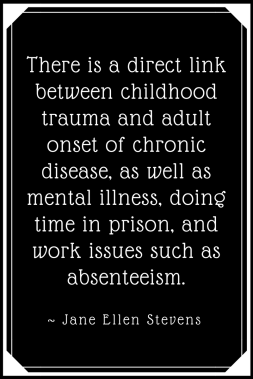
There is a direct link between childhood trauma and adult onset of chronic disease, as well as mental illness, doing time in prison, and work issues, such as absenteeism.Eventually, Dr. Harris learned from a colleague of a study called the Adverse Childhood Experiences Study (ACEs Study).  This ongoing study is a collaboration of Kaiser Permanente and the Centers for Disease Control and Prevention.  I believe that every educator needs to be aware of the ACEs Study.  The study shows a correlation between ACEs that occurred prior to reaching the age of 18 and many health and social problems as an adult.  Here are some basic stats from the ACEs Study:

  • 17,300 adults were part of the original study
  • 70% were Caucasian
  • 70% were college educated
  • All participants have/had livable wages and health insurance
  • All were middle class or affluent

While there were many forms of trauma that the participants in the study had been through, the study identified the top 10 ACEs.  They are:

  1. Sexual Abuse
  2. Physical Abuse
  3. Emotional Abuse
  4. Physical Neglect
  5. Emotional Neglect
  6. Loss of a Parent
  7. Witnessing Family Violence
  8. Incarceration of a Family Member
  9. Having a Mentally Ill, Depressed, or Suicidal Family Member
  10. Living with a Drug Addicted or Alcoholic Family Member

ACEs scores are determined by 1 point per each of the ACEs listed above.  A couple things to be aware of about ACE scores: first, they are extremely common.  67% of the population had at least one ACE, and 12.6% had 4 or more ACEs.  Second, the higher the ACEs score, the worse the potential health outcomes.

ACEs can also have an impact on student success.  In one Washington State University study, students who had at least 3 ACEs were 3 times likelier to experience academic failure.  They are 5 times likelier to have attendance issues.  And they are 6 times as likely to exhibit behavioral problems.

Sunset chaserWhy does this happen?  For the normally developed brain, when it encounters a stressful situation the adrenal gland kicks in and releases adrenaline and cortisol, which gets the body ready for fight, flight, or freeze.  For a child living in trauma, those adrenal glands are constantly being triggered, which causes their brain to have bottom up control, and prevents the upper part of the brain (those that control reasoning, self-control, learning, and understanding), from being able to take control.  And what are the triggers for our trauma students?  You may never know.  It could be walking into their home, it could be a loud voice, it could be a simple as a facial expression.  These triggers are so frequent that the trauma brain is constantly in fight, flight, or freeze mode.

One of the things that we all know is that being an educator can be a very emotional task.  You become connected to your students, you want the best of them, and no matter how hard we try, there are times that they become frustrated.  These frustrations may manifest themselves in many different ways.  We have to be able to help our students to calm their brains and return to top-down control.  Punishments and logic will not work for a dysregulated student.  Instead, our students need relationships, connections, and acceptance.  When we are able to stay calm when our students are not, we may be able to help get our students back to calm.  Remember, when a student is struggling, it is not about us, and we can’t take it personally.

Your presence is the most precious gift you can give another human being.In their book The Trauma-Informed School, Jim Sporleder and Heather T. Forbes identified a few strategies that we can all use to interact with students (and I would suggest that these strategies work for all kids, not just those who have been through trauma).  Here’s a few of them:

  • Respond instead of react – ask yourself “am I responding to this student as a person or am I reacting to his behavior?”
  • Give emotional space – allow the student to be upset, and be there to support the student when they are once again regulated.
  • Ask the right questions – What’s driving the behavior? What can I do to improve my relationship with this student?
  • Statements that show support – What do you need from me right now that takes care of you and allows me to continue teaching?
  • Choose your battles – sometimes it’s best to just get your class going on something, then quietly approach the student to check in.
  • Keep yourself regulated – drop your personal mirror and seek the cause to the problem that is happening in front of you.

No two situations are going to be identical.  No two kids are going to react in the same way.  What works today might not work tomorrow, but simply being aware of what’s going on in the brains of our students, and some possible strategies for when a student becomes dysregulated will help all of us to be able to better meet the needs of our kids.

What strategies have been successful for you?  Are there things that you have done in the past with kids that aren’t included here?  Share your thoughts in the comments below so that we can all spread our knowledge.
What is school for?

Put yourself back in one of your childhood classrooms – at the beginning of the day what was it that your teacher always said?  If it’s anything like my childhood experience, it was something like “Good morning class.” Then what would happen?  The whole class would respond “Good morning…”  And what happened if you weren’t loud enough, or respectful enough?

I think we all have lived that situation – and I may even have been guilty of fulfilling the teacher role (as recently as the first day of school… THIS YEAR!!!).  But here’s the question, what are we teaching with that call and response open to the day?  It’s mostly about teaching obedience.  Traditionally, the common school was built to prepare children to become the factory workers of the future.  Implicitly, and sometimes explicitly, schools taught students to be obedient, to hold a little back, to do the work assigned and nothing more.

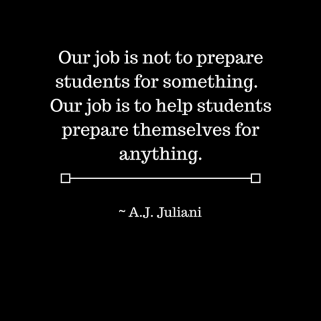
Our job is not to prepare students for something. Our job is to help students prepare themselves for anything.So that brings us to the bigger question: What is school for?  While some of our students may consider a role in manufacturing, the factories of today are way different than the ones of the early to mid 1900s that led to this factory model of education.  Many of our students will not be heading down the path of manufacturing, so that factory model of school definitely doesn’t apply.  If you believe that innovation is going to keep happening (and why wouldn’t it?), then we’re preparing our students for an ever changing world!  That is so different from the traditional model of school as a factory.  In an excellent TED Talk by Seth Godin, he gives 8 examples of things school should be doing:

  1. Homework during the day, lectures at night – flipped learning
  2. Open note and open book all the time – if it’s important enough to memorize, it’s also ok to have to look it up
  3. Access – any course at any time – programs like Kahn or MOOCs can achieve this
  4. Precise focused education – not a one size fits all model
  5. No multiple choice – life isn’t multiple choice
  6. Experiences instead of test scores – learning is focused on the experiences that take place inside (and outside) of our classroom
  7. End of compliance as an outcome – while compliance may be needed at times, it shouldn’t be our end goal
  8. Cooperation instead of isolation – the ability to work with others

I could go into more detail on each of these, but I can’t do any better than what Godin did in his talk, so if you’d like to know more about any of these things, check out that TED Talk here.

So here’s my answer to the question “What is school for?”: I want our students to be equipped to go out into the world and make something that has an impact on their lives and the lives of others.  And I want them to know that if they get stuck, to ask for help and support.  While we might not always have all the answers, hopefully we can help our student to find the answers.

I’m curious to hear your answers – for you, what is school for?  Share your thoughts in the comments below!

Childhood trauma

Last weekend I was listening to the most recent episode of the TED Radio Hour, a radio show that is based on a common theme, and then embeds portions of TED Talks, as well as interviews with the people who gave those talks around that central theme.  The episode I was listening was titled “Hardwired” (click here if you’d like to listen to the episode), which was looking at how human behavior is based on both our genetics, as well as our experiences in life.

One of the speakers who is included in this episode is Nadine Burke Harris, a pediatrician in San Francisco.  After listening to her portion of the radio show, I had to watch her full TED Talk.  In her talk “How childhood trauma affects health across a lifetime” she talks about the unbelievable impact that trauma can have on childhood brains, as well as the long term health impacts of those who have lived through trauma.

Many of us are tempted to say “that doesn’t happen here.”  I challenged you to watch the TED Talk and think a little more critically about what Harris has to say about trauma.  This does happen here.  There are students who walk into our school every day who have faced adversity that has an impact on their brain development.  Next week, I’ll follow up with a little more of my thoughts on trauma in kids, but I hope you will find the time to watch this excellent TED Talk.

5 questions

Inquiry

Student voice, student choice, relevancy, collaboration, intellectual risk-taking.  All these phrases should sound familiar as they come from the HSE21 Best Practice Model.  While these are all things that we strive for, sometimes we might wonder how we help our students understand that this is what we’re going for.

I recently saw an article from the Harvard Business Review about questions that businesses should ask their employees.  Based on a 2016 study by Deloitte, people feel loyalty to companies that support their own career and life ambitions.  Wouldn’t it be fair to say that our students are likely to feel the same way (more interested in learning when they feel that the learning is valuable to them)?

With that, imagine the empowerment our students would feel if we not only ask these questions, but actually use their answers to guide the learning that’s taking place in our classrooms!  Here are the questions:

  1. What are you good at doing? What school activities take less effort? What do you do first because you know it will be easy? What things do others notice as strengths for you? These questions will help students to identify their strengths and find possibilities to grow those strengths.
  2. What do you enjoy? What are the things at school that you most look forward to? What things give you extra energy when you know they were coming up? If you could design your own school day with no restrictions, what would you spend your time learning? These questions help students find, or remember, what they love about school.
  3. What feels most useful? What about school makes you feel most proud? What do you do that is critical to the success of others? What are your highest priorities for your life, and how does school fit in? These questions will highlight the inherent value of certain activities.
  4. What creates a sense of forward momentum? What are you learning that you’ll use in the future? What do you envision for your future? How’s your work today getting you closer to what you want for yourself? This line of questioning will help students think about how the things they are doing now will help them achieve their goals.
  5. How do you relate to others? What kind of work partnerships are best for you? How does your work at school enhance your connections with others outside of school? This will help our students see the value in meaningful relationships.

Helping our students to identify their purpose for learning will help them feel more connected in the classroom, and to see the value that comes from their learning.

Using outdoor spaces

Today I was reading a recent blog post by John Spencer about the ways that nature helps us to be more creative (check it out here).  Personally I love to be out in nature, so the post really caught my attention.  The gist of the post was about the fact that time in nature can lead us to greater levels of creativity.  His 5 ways that nature makes us more creative are listed in bold below, with my own thoughts added:

  1. Nature creates positive disruptions – Life draws us into the natural hustle and bustle of our world. Being in nature helps us get away from technology, current events, and everything else that makes it hard for our brain to stay focused.  That time away from all those distractions allows our brains to think more deeply.
  2. Nature encourages problem-solving – Almost every time I go for a hike, or spend some time in nature, I’m inspired to write a new blog post, or solve a problem, or be creative.
  3. Nature helps us embrace deep work – When do you do your best thinking? There is a lot of research that says that simply being active can lead to deeper thinking.  Simply going for a walk helps us activate our brain in different ways.  According to some research, throw nature into the mix and you multiply that effect.  So what does that mean for you?  Before teaching a particularly important skill, take your class for a walk in the woods outside of school.  Your students brains will be better prepared for deeper thinking when you return.
  4. Nature humbles us while also expanding our worldview – I’m not sure how many of you know this about me, but I was a 10 year 4-H member. I didn’t show animals (we weren’t on the farm), but I did lots of other projects over the years.  One of the projects I did required me to take multiple observations of a natural environment every day over multiple weeks.  I chose a small wooded area with a trail just a little over a mile from my home.  I had to observe at different times in the day, and I began to notice changes in what seemed like an untouched environment.  Some animals were more or less active at certain times of the day, some plants looked different depending on various factors.  The time I have spent in the natural world helps me realize that there are so many things happening in the world around us that we miss when we are in our cars, or on our devices.  Sometimes you really do have to slow down, look around, and smell the flowers in order to be aware of what’s happening in our world, and to realize how little control we have over so much of what’s around us.
  5. Nature can spark innovation – Did you know that Velcro was designed by a Swiss engineer after his dog was covered in burdock burrs after going on a hike? Or that the design of the nose of Japanese high-speed trains was meant to mimic the beak of a kingfisher?  These are just a couple of examples of innovations that came about because of things that people noticed in nature.  Imagine what the future scientists of the world (our students) may be able to develop if they learn to look to nature for ideas and solutions to our problems.

Reading Spencer’s post got me thinking about the natural wonders just waiting to be explored outside of our school.  By walking out the doors of our building, you can access a variety of outdoor environments.  Between the trails in the wooded areas, the stream running through the woods, the untended plain near the baseball fields, or the river, there are so many ways for us to access nature.  And the benefit doesn’t just stop with the kids being out in nature away from their devices.  Something they see while they are with you may inspire creativity and wonder in a way that is totally unexpected.

What have you done with your class in our outdoor areas?  Have you seen increased levels of creativity as a result of the time you have spent outside?  Share your thoughts in the comments below.

Gentle pushback

How do you spend the beginning of the school year?  What types of activities are you using in your classroom?  Keep in mind that the expectations that you set in the first few weeks will carry throughout the year.

So often at the beginning of the year, we spend lots of time on relationship building.  Those of you who know me will know that relationships are a key part to success (see previous posts here, here, and here).  Relationships alone aren’t enough though (I have a bigger post on this topic coming soon).

Part of what got me thinking about this was a series of tweets from Rick Wormeli – I happened to be on Twitter last Saturday evening, and he had a string of tweets on this topic.  He focused on the first week of school – we’re past that already in my school corporation – but I think that his sentiment can carry over to the first month of school.

What things have you tried for the beginning of the year to push your students in intellectual, academic, or creative ways?  What do you think about Wormeli’s thoughts?  Do you have different opinions?  Share your thoughts in the comments below.

We can all be better

Nobody’s perfect.  There’s a reason why Steph Curry does shooting practice daily.  There’s a reason why Navy Seals drill with their team on a regular basis.  There’s a reason why the best authors have a daily writing routine.

What they all have in common is that they understand that the best way to get better is through practice combined with reflection.  This practice will help them learn, it will help them grow, and it helps them get better at their craft.

PLCs are one of the ways that teachers can get better.  We look at our student data, reflect on our practices, and identify strategies that can help us to be better than we already are.

Everyone at the top understands that to become the best, or remain the best, you have to be willing to work for it.  Bring the mindset that we can all be better every opportunity you get, and we will all learn and grow together!

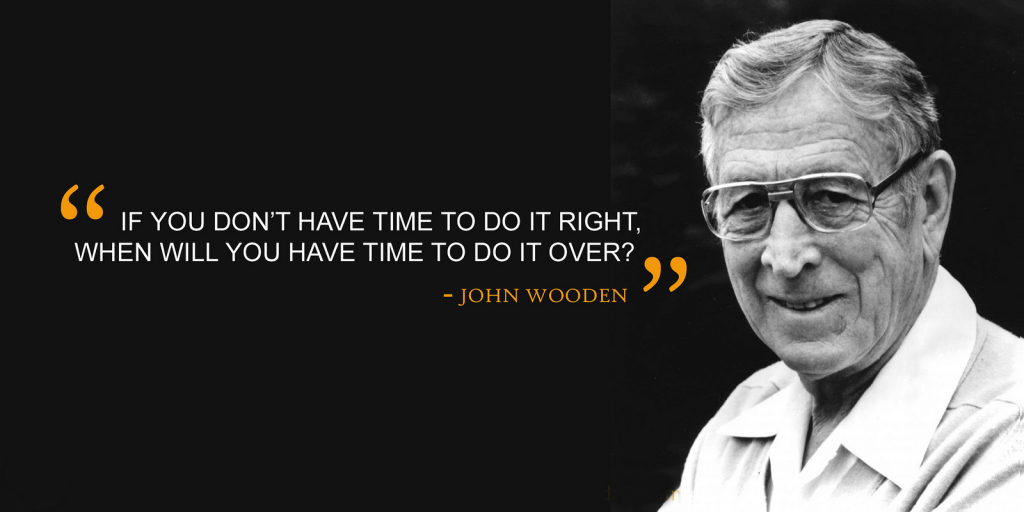
What does John Wooden have to do with teaching?

As many of you know, when I was still teaching, I also coached basketball.  In one of the first seasons I was coaching, I attended a coaching clinic.  I learned a ton that day, but one of the things that has stuck with me even beyond my time as a coach was probably a throw away comment by one of the assistant coaches about John Wooden – one of the greatest college basketball coaches of all time.  During the clinic we were talking about a variation on Coach Wooden’s famous secondary break, and someone mentioned one of Wooden’s books.  I jotted a note to myself, and ordered it from Amazon later.  When it arrived, I expected a book with information about various plays and strategy – after all it is a book on coaching.  What I found however, was that the majority of the book was on coaching philosophies.

To me, this was valuable information as well, I mean the guy is one of the most successful college basketball coaches of all time, coaching his UCLA teams to 10 national championships, including a stretch of 7 consecutive national championships.  During his years as the coach at UCLA, he was able to get some of the best basketball players in the country to come and play for his team.  One of the things that I found most intriguing as I read about Wooden’s coaching was in how he began his season.  He was bringing in some of the best recruits in the country, there were many players who went on to careers playing in the NBA, and yet every season, no matter who was on the team, Wooden would start the first practice in the locker room talking about how players should correctly put on their socks and shoes.  He felt that you had to start at the absolute beginning with everything in order to make sure that the players on his team knew the expectations and procedures that were part of success for UCLA Bruins basketball players.

Every year at the beginning of the school year a new group of students walk into your classroom.  We have to look at each of those kids as our top recruits – we know that they are in the eyes of the parents who trust us to help their children learn and grow while they are here with us.

When Wooden got his top recruits, he could have easily gone straight to the basketball court to start working on offenses and defenses that the team would run throughout the year – I mean these guys all knew how to put on their socks and shoes, they had to have been successful players in high school to end up at UCLA.  But Wooden knew that expectations and procedures were the key to a successful season.  He started with the small things – socks and shoes.  Once they made it to the basketball court, much of their time in the early part of the season were on fundamentals – dribbling, passing, footwork.  Wooden understood that if you had a solid base of expectations, teaching players to play the game the way they needed to in order to be successful would be so much easier.

So, how do you spend your time at the beginning of the school year?  I know that it can be tempting to think that our students, most of whom have been “in school” for 5-6 years, know what is expected.  It can be easy to skip over the base level procedures.  Just like Wooden could have said that his players knew how to put on their socks and shoes, or they knew how to dribble, pass, and move their feet, we could assume that our students know how to line up, how (and when) to sharpen a pencil, how to work in a small group, etc.  But here’s the thing – it’s possible that the way you expect students to do some of these things is different than the way that a past teacher expected things to be done.

I am writing this post in late April, knowing that I’m not going to post it until the beginning of the school year.  In my role I have the privilege of visiting lots of different classrooms, seeing how different people spend their time, and seeing what people value.  One thing that I notice in April is that the teachers who have invested time throughout the year with the basic expectations – like Wooden did with socks and shoes – are currently (in April) having the most success with student behavior.

So, what are the things we need to teach on the most basic level?  Here are just a few ideas that come to mind:

  • Transitions
  • What to bring to class every day
  • Small group time / collaboration time
  • Lunch
  • Recess
  • Restroom expectations

What might you add to your list?  There might be expectations that are specific to your content area, or there might be things that don’t apply for your class structure.  In the last couple of years I was in the classroom, I created a 1 slide power point for each of these situations along with a few that were directly connected to my content area, and I would display them every time that it fit at the beginning of the year.  As the year went on, I would spend less and less time on the review, unless I noticed a pattern of issues.  Then we might review for a few days.  We would also spend some time reviewing each of the expectations after any break from school.  While this did not always solve every single issue, it helped in the long run, and by taking the time to create these slides in advance, it was easy for me to pull one up and display for my students.

As you prepare for your school year, what are the socks and shoes type of procedures that your students need to know about in order to be successful in your classroom?  After creating a list of expectations, think about the method that might work best for you to be able to teach your students those expectations.  It can be easy to assume that our students will know what to do, but they might not.  Maybe you will share your procedures in a power point slide like mine, maybe it’s something more involved like a student created video.  Whatever the plan is, take the time to think about how you can share your expectations with your students so that they truly know what to do.

For your students to be truly successful, they have to have a solid foundation.  What pieces of the foundation do you think you need to work on the most for your students to learn and grow in your class?  Share your ideas in the comments below – maybe your thoughts and ideas will spark an idea for others!

What did you do this summer?

It’s that time of year – my summer break has ended and I am back in the office preparing for a new school year and the new group of Hawks that will be coming into our building.  As I’ve been at school, I’ve been running into a lot of people that I haven’t seen much during the summer.  Invariably one of us ends up asking “What did you do this summer?”  It’s exciting to get to hear about the awesome things that my friends have been doing, or to share the fun things that I did with my family.

In all my years as an educator, there is one other thing that I have done consistently every summer – it’s been an opportunity to learn.  I always have a stack of professional reading that I want to complete (currently there are 12 books in that stack).  At the beginning of the summer, I grabbed a couple of books from the stack that I really wanted to read, and they came home for the summer.  When someone asks about what I did during the summer, this isn’t something that I always think to share in those conversations, but I think there’s great value in sharing our learning.

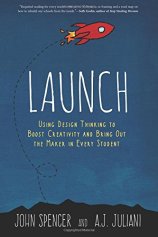
The first book in that stack was one that I had started reading prior to the end of the school year.  Launch: Using Design Thinking to Boost Creativity and Bring Out the Maker in Every Student by John Spencer and A.J. Juliani was so intriguing that I ended up putting together a PD session to share at Launching Inquiry.  Design Thinking is all about creating the conditions to allow students to use their curiosity to find things that they can make and share with a real audience.  Innovative activities like this will empower our students to find problems in their own world, and then seek out meaningful solutions – we can help to give them the tools.

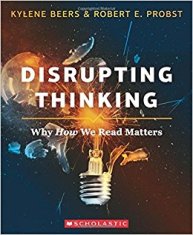
My second book this summer was Disrupting Thinking: Why How We Read Matters by Kylene Beers & Robert E. Probst.  In this book, the authors lay out a framework (called Book, Head, Heart) to help us all understand that there are multiple types of thinking going on when they are reading.  While it is important that kids know what’s happening inside of the book (able to summarize, notice what the author is doing, and understand the theme of the book) Beers & Probst also point out how important it is to recognize what you’re thinking about in your head, and how the book makes you feel.  Each piece is an important part of the interaction that takes place between a reader and the text.

The third professional book, and one that I haven’t yet finished, is Daring Greatly by Brene’ Brown.  In this book, Brown pushes us to understand that vulnerability, or the willingness to put ourselves out there, is part of what brings meaning to our lives.  Without being vulnerable, and willing to dare to do great things, we risk not really living.  It’s scary to make ourselves vulnerable, but only through going out on that ledge can you accomplish great things.

I look forward to continuing my learning – it truly never stops.  As you think about what you did this summer, I’m curious – what did you learn about?  As educators, we’re all committed to being lifelong learners.  Sharing with others, including our students, is a great way to further our own learning.  Share below anything that you learned this summer!

The why

This week was one of the most exciting learning opportunities that I will have all summer.  On Wednesday and Thursday of this week, my home school district held an event called Launching Inquiry.  This 2-day event had a keynote speaker both mornings, and then multiple breakout sessions throughout the day.  Today I’ve been reflecting on my learning from the event, rereading my notes, highlighting things, and thinking about next steps for all of the learning that happened while I was there.  I find myself repeatedly returning to one quote from the event:

This quote came from a breakout session with Will Richardson (@willrich45).  I’ve posted before on a description of my “why” for education (What’s your why?), but after sitting through Richardson’s keynote, and a couple of breakout sessions with him, I find myself re-examining my why.  In my original post, I identified my kids as the primary catalyst for growth, along with each of the students who set foot in my school.

For a fuller context of the quote above, in the breakout session we were talking about new literacies, and the role they may play in self-determined / self-directed learning.  Based on a question from one of the other participants in the breakout session, we began talking about the topics that today’s kids need to know to be able to actively participate in society.  If we let student learning be self-determined, some worry that they will only learn about the things that they are passionate about – so they might only study baseball, or animals, or whatever it might be that draws their attention, and never learn about the things that they aren’t passionate about.  If that’s all they “know” and all they learn, how will they be able to participate in dinner conversations that branch into other topics? (maybe it’s politics, maybe it’s history, etc.)

The issue with this idea of topics that kids “need to know” is that depending on who you talk to and what their background is, that list of things kids need to know is a moving target.  In the session, the example that was brought up was the idea of World War II.  While I consider myself to be a person who is well rounded, and a guy that likes learning about history, I don’t know how much I’d truly be able to offer to a conversation about the intricacies of World War II.  I could share my surface knowledge, but to be able to get into an in-depth conversation, I might need my brain hard wired into Google.

Think about it like this: if you were to put a math teacher, science teacher, English teacher, and history teacher together to create a list of the 3 most important things that all students need to know, odds are it would be impossible for them to come to consensus.  Each would likely put higher value on their own content, and lower value on the content of others.

As I processed this quote, and other aspects of the conference, I wonder if we might be having a hard time seeing the forest through the trees.  The research is solid, kids don’t maintain our “content” for a long period of time.  If you give a kid an end of course assessment in June, and then the exact same kid takes the exact same test in September, you are going to see a significant decline.  The content doesn’t stick – no matter how great a teacher you are, or how great a student you give it to.

So, what are the implications for each of us?  For most of us, when someone asks us what we teach, our answer is our grade level, or our content area.  I’m starting to think that the content area is the individual tree.  But the beauty of the forest is all of the trees together, along with all the other things that are living and growing (or sometimes decomposing) there.  And for me, that forest has to be the concept of learning.  If we know that content doesn’t stick, if we know that kids are probably going to forget a portion of the content that we teach them, then I guess the forest – the thing we need to focus on – isn’t so much what our students learn, but simply that they know how to learn, and have a desire to learn.

In Richardson’s keynote, he used the phrase productive learning.  Seymour Sarason says:

“Productive learning is where the process engenders and reinforces wanting to learn more.  Absent wanting to learn, the learning context is unproductive.”

After processing these thoughts, it’s time to come back to my why.  It’s going to continue to be my kids, and it’s going to continue to be the students that walk into my school building in August, but it’s also going to be about productive learning.  It’s going to be about creating situations where our students want to learn more.

What are your thoughts?  Do you have ideas on how you’re going to help get your kids have the desire to learn?  Share them in the comments below.