
 This summer a group of educators in my school district did a book study of Moving the Rock: Seven Levers WE Can Press to Transform Education by Grant Lichtman. I was not an original member of the book study, but when that group came to an end, they decided they wanted to keep meeting, and that they wanted to grow the group – so, I was invited to become a member. That group is called the Innovation Task Force. Since I felt a bit behind the other members, I decided to read the Moving the Rock. I picked it up and read it in just a couple of days (I could have finished it in a day if I let myself!).
When discussing the first of his seven levers, Lichtman used the phrase the “North Star of Great Learning.” In the book, he suggests that defining that North Star is one of the first ways that we can create the demand for better schools. So, what is our North Star? As a way to help define what that may look like at our school, we spent a portion of our first staff meeting talking about what great learning looks like. We began our meeting with the following image:

We asked each teacher to respond with a single word. We then created a word cloud from the ideas that were shared by our staff. This is what we came up with:

I think that’s a pretty impactful list of words to describe what great learning looks like, and it definitely helps us as a building chart the plan for what deeper learning should look like in our building. It seems that if this is what we believe, it should serve as the foundation of the North Star of Great Learning.
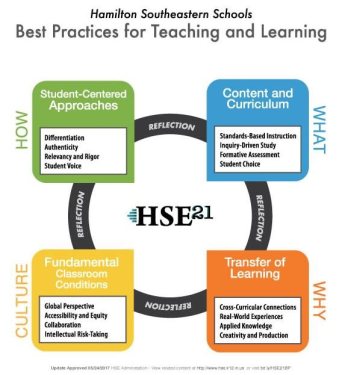 As a district, we also have our Instructional Framework, Called the HSE21 Best Practices for Teaching and Learning (it can be found to the right). As I look at this framework, and compare it to the words that we as a staff selected to define great learning, they seem very well aligned.
I wonder at times though, how often we reflect on what is happening in our classrooms on a daily basis compared to what our beliefs about great learning actually are. Is our practice meeting what we say that we want great learning to look like? I wonder if we were to ask our students about learning in our classrooms what they might say about our daily practices.
I’ve often heard leaders talk about the idea of cognitive dissonance, that idea of being a little bit uncomfortable with what you are doing. Of being ok with others questioning our practice. Of understanding that we are all here to create the best possible learning environment for our students (and sometimes that will not be the easiest path for the adults!). Of understanding that if you are completely comfortable in all you are doing, you probably aren’t growing that much.
During our last meeting as the Innovation Task Force, one of the colleagues in the group shared that instead of thinking about how to prepare our students for when they graduate from high school, maybe a better thing to think about is how do we prepare them for life at 22. When we think about graduating from high school as our end goal for students, we let ourselves off the hook for helping them be ready for what they need to know in those first couple of years AFTER they graduate from high school.
Raise your hand if there were things that you didn’t understand about the world when you graduated high school. I can assure you that my hand is up too! Creating a transformational learning environment will help our students to see that learning is something that can happen anytime and anywhere, not something that is done to them while they are sitting in a classroom.
Just like the mind shift that it takes to transfer our classrooms from the traditional learning environments that most of us grew up in towards transformational learning environments who implement the 4 Cs on a daily basis (Creative Thinking, Collaboration, Creativity, and Communication), we have to shift our thinking about what it is that we are truly preparing students for.
The next chance you get, ask your students about the favorite things that they have done in your classroom so far this year, or ask them to tell you what great learning should look like. Reflect on the things they share with you. Create more learning opportunities like that! Then, share their responses in the comments below. I’d love to hear from our students.


 Let’s contrast that just a bit with human history. I’ve recently been reading Walter Isaacson’s fascinating biography Benjamin Franklin. There were a lot of things that I knew about Franklin, his role as an inventor/scientist, his time as a member of the Continental Congress, and that he’s a writer and printer. I don’t know that I fully realized what a world traveler he was. I also did not quite realize just how curious he was – throughout his life he found wonder in the world around him, and spent time trying to learn more.


 Last summer, I read the book The Innovators by Walter Isaacson. As a brief description, the book was about the work of the many different people who played a role in the development of the computer and internet. For most of us, when we think of innovation, we think of people like Franklin, Edison, Bell, Morse, Jobs, or Gates, but in the case of the digital revolution, most of the work was not the creation of any one person. Instead it was the work of many who connected, collaborated, and iterated. Someone like Steve Jobs is seen as the creator of the iPhone, but really he took several technologies that already existed and combined them into a form factor that connected with a market.
 This past spring, I read the book Creativity, Inc. by Ed Catmull. Catmull is the co-founder of Pixar Animation Studios, and wrote a book about the steps that they take in order to build a highly functioning, creative environment that is able to churn out movies that people love (think Toy Story, Monsters, Inc. Finding Nemo, and more). One of my big takeaways from this book is that the amazing work that occurs at Pixar happens because of 2 things: teamwork; and a willingness to accept feedback from those around you, whether positive or negative, and understand that it’s being shared in the hopes of creating something better.
 For the next thirty minutes, while I mowed the rest of the lawn, Lainey and Brody were in heaven with that childhood joy that goes with running through a sprinkler. I may have even let myself get sprayed because I was jealous of the obvious fun they were having.


 If a student can turn to Google, Siri, Alexa, or whatever smart tool comes out next to find the answer to your question, then maybe we aren’t asking the right questions.
 The students in our school in general are very compliant. Compliant students sometimes struggle with creative tasks because they want specific directions to follow. They may not remember what it feels like to be creative or curious. Years of compliance in the school setting seems to suck creativity and curiosity out of our students. I think that sometimes students lose that ability to be creative and curious because they have grown accustomed to the amount of scaffolding that we provide for learning activities. That scaffolding can begin to feel a bit like a cage, and students forget how to get out.
 The View from 518